
Premio Internacional Periodismo Y Periodismo Migrante*📃
La Información Directa a tu Celular 📲 de HOY *Miércoles 23 de Agosto 2023* *En El Plano Nacional e Internacional*:
*Ahora también ya estamos en la redes y síguenos a través de nuestros siguientes medios:*
– *TikTok*: https://www.tiktok.com/@federicolamontoficial?_t=8edqqgfd4ac&_r=1
*YouTube:* https://www.youtube.com/@FedericoLamontTv
*Instagram:* https://instagram.com/federicolamontoficial?utm_source=qr&igshid=ZDc4ODBmNjlmNQ%3D%3D
*Twitter:* https://twitter.com/federicolamont_?t=1JFGx2rnaadYGDPKxR_jpA&s=09
*Colaboración Especial En:* http://MexicoTodayUSA.com
*The Surprising Striver in the World’s Space Business*
With at least 140 registered space-tech start-ups, India stands to transform the planet’s connection to the final frontier.
When it launched its first rocket in 1963, India was a poor country pursuing the world’s most cutting-edge technology. That projectile, its nose cone wheeled to the launchpad by a bicycle, put a small payload 124 miles above the Earth. India was barely pretending to keep up with the United States and the Soviet Union.
In today’s space race, India has found much surer footing.
In a sleek and spacious rocket hangar an hour south of Hyderabad, a hub to India’s tech start-ups, a crowd of young engineers pored over a tiny, experimental cryogenic thruster engine. The two founders of Skyroot Aerospace, talking between blasts of hissing steam, explained their exhilaration at seeing a rocket of their own design mount India’s first private satellite launch last November. These new thrusters will guide Skyroot’s next one into orbit this year, with a much more valuable payload.
Suddenly India has become home to at least 140 registered space-tech start-ups, comprising a local research field that stands to transform the planet’s connection to the final frontier. It’s one of India’s most sought-after sectors for venture capital investors. The start-ups’ growth has been explosive, leaping from five when the pandemic started. And they see a big market to serve. Pawan Kumar Chandana, 32, Skyroot’s chief executive, anticipates a global need for 30,000 satellites to be launched this decade.
India’s importance as a scientific power is taking center stage. When President Biden hosted Prime Minister Narendra Modi in Washington last month, the White House’s statement said the two leaders “called for enhanced commercial collaboration between the U.S. and Indian private sectors in the entire value chain of the space economy.” Both countries see space as an arena in which India can emerge as a counterweight to their mutual rival: China.
For its first three decades, the Indian Space Research Organization, or ISRO, the local version of NASA, made the country proud: An image of India’s first satellite graced the two-rupee note until 1995. Then for a while India paid less attention to its space ambitions, with young researchers focused on more tangible developments in information technology and pharmaceuticals. Now India is not only the world’s most populous country but also its fastest-growing large economy and a thriving center of innovation.
*Today’s Top News: The First G.O.P. Presidential Debate, and More*
Exclusively from New York Times Audio, our new app.
The New York Times Audio app is home to journalism and storytelling, and provides news, depth and serendipity. If you haven’t already, download it here — available to Times news subscribers on iOS — and sign up for our weekly newsletter.
The Headlines brings you the biggest stories of the day from the Times journalists who are covering them, all in about 10 minutes. Hosted by Annie Correal, the new morning show features three top stories from reporters across the newsroom and around the world, so you always have a sense of what’s happening, even if you only have a few minutes to spare.
*China Tries to Increase Its Clout in Africa Amid Rivalry With the U.S.*
China’s leader, Xi Jinping, pitches his country as a leader of the developing world, rallying support for an alternative to the U.S.-dominated global order.
President Xi Jinping of China, traveling to Africa for the first time in five years, pledged greater cooperation with South Africa to enhance the voice of poor nations. He commended developing countries for “shaking off the yoke of colonialism.”
And on Wednesday, he held talks with the leaders of the BRICS, a club of emerging nations, and called for members to “accelerate” its expansion to serve as a counterweight to the West.
“At present, the Cold War mentality is lingering, and the geopolitical situation is grim,” Mr. Xi said. The grouping, he continued, should “bring more countries into the BRICS family so as to pool our strength, pool our wisdom to make global governance more just and equitable.”
On his four-day visit to South Africa this week, Mr. Xi has sought to cast himself as a leader of the developing world. Mr. Xi kicked off his trip with a state visit and was received with an honor guard, a 21-gun salute and roads lined with cheering crowds waving Chinese flags.
For China, the reception in Pretoria reinforced the message Beijing hopes to send to audiences both at home and abroad — that China’s offer of an alternative to the U.S.-led global order has ample purchase outside the exclusive club of the developed countries. That has grown increasingly important to China. Its support for Russia and its aggressive posture on issues like the status of Taiwan, the self-governed island Beijing claims as its territory, has alienated it from countries in North America, Europe and Asia.
“For Xi, the goal is to try to discredit the West and show that there is an alternative out there,” said Eric Olander, the chief editor of The China-Global South Project website. “He’s trying to tap into this incredible well of grievance and frustration among many Global South countries over what they perceive as this massive duplicity and hypocrisy on the part of rich countries.”
That frustration has been driven in recent years by unfulfilled promises by developed countries to deliver Covid-19 vaccines to poorer countries and the feeling that not enough is being done about soaring food and energy prices.
*Who Can Seize the Spotlight From Trump? What to Watch for in the G.O.P. Debate*
Former President Donald J. Trump won’t be on the stage in Milwaukee, but his rivals still need to make a case to be the alternative.
Eight candidates will appear onstage for the first Republican debate on Wednesday. But much of the focus will be on one person who won’t be there, Donald J. Trump.
The dynamic has left his opponents preparing for an unusual scenario: debating among themselves while the front-runner with a commanding lead is entirely absent.
Still, for Mr. Trump’s rivals, the debate provides the biggest audience of the race to date, and their first chance to not only make an impression but to make the race a true contest.
Senator Mitt Romney, a Republican who ran the presidential debate gantlet twice and is his party’s most prominent elected Trump antagonist, offered this advice: “The key for them is not to focus on each other but the person who’s at the top. You gotta punch up.”
Yet even the most viral moment could quickly be swept away in a wave of Trump-driven news. “In 99 out of 100 futures,” said Newt Gingrich, the former Republican presidential candidate and House speaker, “Donald Trump is the Republican nominee and he doesn’t even breathe heavy.”
But the eight candidates have a shot to present Republican voters with an alternative. How they make their case could make the 2024 primary a contest and not a coronation.
Here are nine things that are likely to define the debate.
How present is Trump, even when he’s absent?
A significant portion of the debate will most likely revolve around Mr. Trump, his criminal indictments, his continued questioning of the 2020 election and his responsibility for the Jan. 6 attack on the Capitol. While the candidates have been asked about those issues frequently, a debate allows for follow-up questions — heightening the possibility of a misstep.
Mr. Trump will still put his mark on the moment. He has announced plans to try to upstage the debate with the release of a recorded online interview with the former Fox News host Tucker Carlson.
*A Saudi Rolex Sold in a U.S. Mall Could Get Bolsonaro Arrested*
Brazil’s former president, Jair Bolsonaro, is the target of multiple criminal investigations. One includes a watch, gifted by the Saudis, sold in a Pennsylvania mall.
It has been a bad 10 months for Jair Bolsonaro.
He lost re-election as Brazil’s president. Thousands of his supporters stormed Brazil’s halls of power. And he was blocked from holding elected office for seven years.
Now things could soon get worse: Across Brazil, both his critics and supporters speculate that the next twist might be his arrest.
Mr. Bolsonaro, 68, has become ensnared in a series of investigations into fraud and election tampering that have already landed some of his closest allies in jail and that, over the past several weeks, appear to be closing in on him.
But one case may pose the biggest threat to the former president in the near term, and it revolves around an alleged scheme that resembles a small-scale mafia scam: Selling embezzled watches at a shopping mall outside Philadelphia.
This month, Brazilian federal police carried out raids as part of an investigation into what it says was a broad conspiracy by Mr. Bolsonaro and several allies to embezzle expensive gifts he received as president from Saudi Arabia and other countries. In one case, authorities accuse Mr. Bolsonaro’s personal aide of selling a diamond Rolex watch and a Patek Philippe watch to a jewelry shop at the Willow Grove Park mall in Pennsylvania last year.
Mr. Bolsonaro ultimately received at least some of the $68,000 from the sale in cash, federal police officials said.
In an interview, Mr. Bolsonaro’s lawyer, Paulo Cunha Bueno, said that whether Mr. Bolsonaro attempted to sell the diplomatic gifts is irrelevant because a government panel had previously ruled that much of the jewelry is Mr. Bolsonaro’s personal property, not the state’s. “It’s his right,” Mr. Bueno said. “It doesn’t matter.”
*It Is No Longer Possible to Escape What We Have Done to Ourselves*
On the drive to our cottage here in June, my wife and I collided with the dense wall of Canadian wildfire smoke. The clear spring air began turning a sickly orange in the Adirondack Mountains, the sun was reduced to a red spot, and by the time we reached Montreal the skyline was barely visible from across the St. Lawrence River. On that day, June 25, Montreal had the worst air quality in the world.
Up at our lake, we soon learned to track the sheets of smoke online as they swept across Canada, down into the United States and even across the Atlantic Ocean. Some days we stayed indoors; like many others, we bought an air purifier.
We were not alone, of course. Millions have suffered this summer from scratchy throats, teary eyes and worse, and thousands have been forced to evacuate homes in endangered areas, especially in the Western provinces, where huge fires are still wreaking havoc. Only last week, wildfires approaching West Kelowna, a city in British Columbia, and Yellowknife, the capital of the Northwest Territories, forced evacuation of homes in both cities, and British Columbia declared a state of emergency.
On Lac Labelle, we were never in direct danger, but the acrid smoke and the unfamiliar drumbeat of crisis from the vast Canadian wilderness hit home. After decades of being told that we humans were knowingly, fundamentally and radically altering the climate of our planet, the eerie orange haze had invaded the zone in which my family had always thought we could take refuge.
This was not another report of melting icecaps, rising oceans, blistering heat or unusual tornadoes somewhere far away; this was a horizon-to-horizon pall over us, rising from infernos across the great Canadian north that had been ignited by record temperatures, record drought and ceaseless lightning storms. Nothing like it had ever happened before — these wildfires began far earlier and spread far faster than usual, and they have burned far more boreal forest than any fire in Canada’s modern history.
*As West Bank Shootings Rise, Israel’s Government Vows to Retaliate*
An apparently unarmed Palestinian man and an Israeli teacher were among the recent victims. Israel’s government has pledged to strike at Palestinian assailants.
Israel’s far-right government pledged on Tuesday to strike at Palestinian assailants, and those sending them to attack, amid what is being described as the bloodiest year in the occupied West Bank since the second Palestinian uprising about two decades ago.
In the last few days in the West Bank, an Israeli father and his adult son were shot at point-blank range as they waited for their car to be washed in a Palestinian town, and an Israeli preschool teacher was killed in a drive-by shooting in front of her 12-year-old daughter. Within that same time frame, an apparently unarmed Palestinian man was seen on video being shot from behind and a 17-year-old Palestinian boy was shot in the head during a military raid.
The government did not elaborate on its response plans, but it has been under increasing criticism for what is seen as a security failure by both its detractors and by leaders of the West Bank Jewish settler movement, who are represented by key partners in the coalition government.
So far this year, about 180 Palestinians have been killed, mostly in clashes with the Israeli military or while carrying out attacks against Israelis. Uninvolved bystanders have also been killed. About 33 Israelis have been killed in Palestinian attacks also this year, more than 20 of them in or near settlements or on roads in the West Bank.
The second intifada, or the Palestinian uprising from 2000 to 2005, left a far greater toll, leaving about 3,000 Palestinians and more than 1,000 Israelis dead and deeply traumatizing both societies.
The most recent Palestinian victim, Uthman Abu Kharaj, 17, was shot in the head early Tuesday, according to the Palestinian health ministry, during an Israeli military incursion in the village of Zababdeh, near Jenin in the northern West Bank.
Describing its operations overnight Tuesday, the Israeli military said in a statement that its forces had apprehended 15 “wanted suspects” in overnight raids across the northern West Bank. In Zababdeh, it said, people hurled explosive devices at its forces, who responded with live fire and hit a person, whom the statement did not identify.
In a video of a separate episode in the West Bank, widely distributed on social networks and in the news media, a Palestinian man identified as Amid al-Ja’oub, 32, an electrician from the town of Beita, near Nablus, was seen on Monday running toward a group of Palestinians, according to B’Tselem, an Israeli human rights organization. The group was trying to help another Palestinian, who had been shot by Israeli forces, according to B’Tselem.
*ATENTAMENTE*
*MAESTRO FEDERICO LA MONT*
Sent from my iPod
Sent from my iPod
*LAS NOTICIAS CON LA MONT* 📰
📃 *Premio Internacional Periodismo Y Periodismo Migrante*📃
La Información Directa a tu Celular 📲 de HOY *Martes 22 de Agosto 2023* *En El Plano Nacional e Internacional*:
*Ahora también ya estamos en la redes y síguenos a través de nuestros siguientes medios:*
– *TikTok*: https://www.tiktok.com/@federicolamontoficial?_t=8edqqgfd4ac&_r=1
*YouTube:* https://www.youtube.com/@FedericoLamontTv
*Instagram:* https://instagram.com/federicolamontoficial?utm_source=qr&igshid=ZDc4ODBmNjlmNQ%3D%3D
*Twitter:* https://twitter.com/federicolamont_?t=1JFGx2rnaadYGDPKxR_jpA&s=09
*Colaboración Especial En:* http://MexicoTodayUSA.com
*Why It’s So Hard for China to Fix Its Real Estate Crisis*
Beijing has often addressed economic troubles by boosting spending on infrastructure and real estate, but now heavy debt loads make that a hard playbook to follow.
China’s stock market was plunging and its currency was teetering. The head of the central bank, fielding questions at a rare news conference, said that China would make it easier to get home mortgages.
It was February 2016 and Zhou Xiaochuan, the central bank’s longtime governor at the time, announced what proved to be the start of an extraordinary blitz of lending by China’s immense banking system.
Minimum down payments for buying apartments were reduced, triggering a surge in construction. Vast sums were also lent to local governments, allowing them to splurge on new roads and rail lines. For China, it was a familiar response to economic trouble. Within months, growth started to pick up and financial markets stabilized.
Today, as China faces another period of deep economic uncertainty, policymakers are drawing on elements of its crisis playbook, but with little sign of the same results. It has become considerably harder for China to borrow and invest its way back to economic strength.
On Friday, China’s top financial regulators summoned the leaders of the country’s leading banks and securities firms and urged them to provide more loans and other financial support for the economy — the latest in a series of similar admonitions.
But demand for more borrowing has wilted in recent months, blunting the effectiveness of looser lending policies by the banks.
The construction and sale of new homes has stalled. More than 50 real estate developers have run out of money and defaulted or stopped payment on bonds. The companies have left behind hundreds of thousands of unfinished apartments that many predominantly middle-class families had already purchased, taking out mortgages to do so.
At the same time, companies are wary of borrowing money for expansion as their sales tumble and the economy faces deflation. Local governments across much of China are deeply indebted and struggling even to pay their civil servants. Years of heavy infrastructure investments, followed by huge amounts of spending for mass testing and quarantines during the pandemic, have left China less willing to employ fiscal firepower to jolt demand.
*BRICS Meeting Attracts Global Interest Not Seen in Years*
The leaders from the five-member group of nations — Brazil, Russia, India, China and South Africa — are discussing expanding the club, which harbors ambitions of becoming a geopolitical alternative to Western-led forums.
The leaders from the five-member group of nations known as BRICS — Brazil, Russia, India, China and South Africa — are beginning a three-day summit in Johannesburg on Tuesday, where they are discussing expanding the club that harbors ambitions of becoming a geopolitical alternative to Western-led forums like the Group of 7.
The latest gathering of leaders has garnered a level of international interest rarely seen since the group was first formed 14 years ago.
A trade war between Beijing and Washington and Russia’s invasion of Ukraine have reinvigorated the debate over whether the bloc will remain a loose trade alliance or become a new international coalition. Dozens of countries have expressed interest in joining, including Argentina, Nigeria, Iran, Belarus, Saudi Arabia and Indonesia. The candidates are as diverse as the BRICS bloc, which represents 40 percent of the world’s population and a quarter of its economy.
China’s leader, Xi Jinping, held a state visit with President Cyril Ramaphosa in Pretoria and was then expected to travel to Johannesburg for the summit. Prime Minister Narendra Modi of India arrived in Johannesburg in the afternoon, the Times of India reported. President Vladimir V. Putin of Russia will appear virtually, to avoid an international arrest warrant for crimes against humanity committed during the war in Ukraine.
Mr. Xi met with Mr. Ramaphosa at the Union Buildings, the seat of the presidency in the administrative capital Pretoria. In the formal visit, Mr. Xi inspected an honor guard and shook hands with a row of cabinet ministers as cannon fire rang out, announcing the official visit. The two leaders held a short news conference afterward, reiterating their longstanding political and economic ties, but took no questions.
In Mr. Putin’s absence, Russia’s foreign minister, Sergey V. Lavrov, was leading the country’s delegation. After shaking hands with a row of officials on this his arrival, Mr. Lavrov joined a group of traditional dancers. After a few unsure steps, he clapped along for a few beats before giving a thumbs up and walking away.
China, the biggest economy in the group, favors expansion to shore up its own influence, while an isolated Russia needs new allies as it digs in for a protracted war in Ukraine. India and Brazil, with strong alliances among industrialized nations, favor a more cautious approach. South Africa, the smallest economy of the group, is pushing to have more African members and has invited more than 30 African leaders to join this year’s meeting.
The diplomatic challenges South Africa has faced over the summit reflects the geopolitical interests BRICS nations must balance — particularly the smaller countries that have to navigate their allegiances to more wealthy and powerful nations.
*Commerce Secretary to Visit China Next Week in Bid to Steady Ties*
The trip by Gina Raimondo, the secretary of commerce, comes at a tense moment for the U.S.-China relationship and the Chinese economy.
Gina Raimondo, the secretary of commerce, will travel to Beijing and Shanghai for a series of meetings next week, becoming the latest Biden official to visit China as the United States seeks to stabilize the relationship between the countries.
Ms. Raimondo will meet with senior Chinese officials and American business leaders between Aug. 27 and Aug. 30, the Department of Commerce said in an announcement Tuesday. The department said that Ms. Raimondo was looking forward to “constructive discussions on issues relating to the U.S.-China commercial relationship, challenges faced by U.S. businesses, and areas for potential cooperation.”
The visit comes during a period of tensions between Washington and Beijing, and amid extreme volatility in the Chinese economy, which is struggling with stalling growth, a real estate crisis and lackluster consumer confidence.
The Biden administration has dispatched a series of officials to China in recent months in an attempt to restore some stability to the bilateral relationship, after the flight of a Chinese surveillance balloon across the United States early this year left ties badly frayed.
Since June, Secretary of State Antony J. Blinken, Treasury Secretary Janet L. Yellen and the presidential climate envoy, John Kerry, have made trips to meet with counterparts in China. The meetings could potentially pave the way for a visit by China’s leader, Xi Jinping, to the United States this fall.
As the cabinet official most responsible for promoting the interests of American businesses abroad, Ms. Raimondo is likely to try to expand some commercial relations, and express concerns about a recent crackdown on firms with foreign ties in China. A Chinese statistics agency announced that it has imposed fines of nearly $1.5 million on the Mintz Group, an American corporate investigations firm that had been raided in March, after finding that the company had engaged in “foreign-related” surveys without official permission.
The meetings are also expected to touch on the technology restrictions that Ms. Raimondo’s department oversees, which have prohibited companies in fields like artificial intelligence and quantum computing from sharing their most advanced technology with China. China has strongly objected to those restrictions.
Last month, U.S. officials said Chinese hackers, likely affiliated with the country’s military or spy services, had obtained Ms. Raimondo’s emails, in a hack that was discovered in June by State Department cybersecurity experts. The hackers had penetrated email accounts belonging to State and Commerce Department officials, the U.S. officials said.
*At Risk of Invasion or Lovely to Visit: Two Views of a Polish Border Area*
Polish authorities have issued dire warnings that the Suwalki Gap, on Poland’s northern border between Russia and Belarus, is under threat. Locals say that is just election-related fear-mongering.
After a day of kayaking last month along Poland’s northeastern border with Belarus, the chief editor of a news portal covering events in a strip of farmland and forest known as the Suwalki Gap watched the news in dismay as the Polish prime minister warned about Russian mercenary fighters advancing on the region from Belarus.
More than three weeks on, there is no sign of the mercenaries from the Wagner paramilitary group moving anywhere, except perhaps back to Russia. And the only real danger that the editor, Wojciech Drazba, sees comes from the “parallel world” of Polish leaders “spewing fear” about the Suwalki Gap as they pose as muscular defenders of Poland’s borders ahead of a critical national election.
“The sun is shining, the scenery is beautiful and absolutely nothing is happening,” Mr. Drazba said last week in Suwalki, the sleepy town that serves as the administrative center of a border area that Polish state television, recycling overwrought foreign media reports, describes as the “most dangerous place on earth.”
A supporter of neighboring Ukraine in its efforts to resist Russian aggression, Poland has taken in millions of Ukrainian refugees and become a vital transit route for Western arms. But its critical role as a linchpin of the West’s military, humanitarian and diplomatic support for Ukraine has coexisted with a government agenda increasingly driven by domestic politics.
With Poland’s nationalist governing party, Law and Justice, facing a tough general election in October, residents of the Suwalki Gap have been bombarded with warnings by the government in Warsaw and the sprawling media apparatus it controls of the imminent danger posed by President Vladimir V. Putin of Russia and his loyal Belarusian ally, President Aleksandr G. Lukashenko.
On a visit to Suwalki this month, Prime Minister Mateusz Morawiecki joined the president of neighboring Lithuania, a fellow NATO member, to pore over military maps of the border region — and denounce Poland’s main opposition leader, Donald Tusk, as being soft on national security and for downplaying the threat posed by Wagner fighters. “These threats are real,” Mr. Morawiecki insisted, adding that the “Wagner group is extremely dangerous” and gearing up for a possible attack.
*Thai Parliament Picks Real Estate Mogul as Next Prime Minister*
Months of political chaos have culminated in the selection of Srettha Thavisin, a businessman seen as amenable to royalists and the military-appointed Senate.
After a three-month delay, Thailand’s Parliament chose the country’s next prime minister on Tuesday, picking a real estate tycoon from a party seen as acceptable to conservative elites. The move ends, for now, a prolonged period of uncertainty that had pushed the country to the cusp of a political crisis.
The selection of Srettha Thavisin capped a dramatic day in Thailand, where, in the morning, Thaksin Shinawatra, the former premier who was ousted in a coup and has been living in exile since 2006, returned for the first time in 15 years. He was quickly taken into custody, as he was sentenced to prison earlier in connection with three corruption and abuse-of-power cases.
Mr. Srettha is a close ally of Mr. Thaksin, and many analysts had said the former leader’s return reflected the degree of confidence that he has in Pheu Thai — the populist party that he founded in 2007 and that Mr. Srettha is part of — to form a government.
Thailand has not named a new prime minister since its general election in May, when Pita Limjaroenrat led his progressive Move Forward Party to victory. Mr. Pita’s party had vowed to weaken a law that criminalizes criticism of the monarchy and shrink the military. After the election, he was functionally blocked from office by allies of both institutions.
Mr. Srettha received 482 combined votes in the House of Representatives and the military-appointed Senate, surpassing the 374 votes he needed to win the premiership.
Now comes the hard part.
Even with the current political deadlock resolved for now, Mr. Srettha, 60, faces the immense challenge of meeting the demands of an electorate that voted for change and is now disillusioned with his party, which once actively campaigned against the military junta but is now working with it. He will have to manage the tensions between the public and the country’s powerful institutions — the military and the royalist establishment — that appear certain to continue for months or years to come.
Move Forward’s push to amend the law penalizing those who criticize the monarchy splintered the initial eight-party coalition, causing its eventual collapse. Pheu Thai said it had to form a new coalition without the Move Forward Party because the latter refused to withdraw its pledge to revise the law.
Supporters of Move Forward have responded angrily to Pheu Thai’s decision to part ways, pouring fake blood on effigies and setting them alight in front of the headquarters of Pheu Thai. Since the first failed vote for Mr. Pita, sporadic protests have broken out in the streets of Bangkok, with supporters denouncing what they say are the establishment’s efforts to erode the will of the people.
Pheu Thai vowed repeatedly to get the military out of politics, but it relied on the military’s support for Mr. Srettha to help get him into office. It included two parties linked with the military leaders of the 2014 coup against Mr. Thaksin’s sister, Yingluck Shinawatra, in its 11-party coalition. On Tuesday, Move Forward’s parliamentarians voted against Mr. Srettha; they had announced earlier that they would do so because Pheu Thai was forming a government with military-linked parties.
Mr. Thaksin’s homecoming underscores a realignment in Thai politics that would have been unthinkable just a decade ago. He was long viewed as a threat to wealthy Thai society, and his influence was considered to be so dangerous that the military launched a coup against him, and later his sister, Ms. Yingluck. His name recalls bitter divisions between the pro-Thaksin “red shirt” protesters from the rural north and the anti-Thaksin “yellow shirt” faction made up of royalists and the urban elite.
*If Republicans Narrow the Field, We Will Beat Trump*
This week, Republican primary candidates for president will have a chance to make their case before a national audience — with or without Donald Trump on the debate stage. To win, they must break free of Mr. Trump’s drama, step out of his shadow, go on offense, attack, and present their case. Then they need to see if they can catch fire this fall — and if they can’t, they need to step aside, because winnowing down the field of candidates is the single best chance to stop Mr. Trump. Too much is at stake for us to have wishful candidacies. While the other Republican candidates are running to save America, Mr. Trump is running to save himself.
Candidates on the debate stage should not be afraid to attack Donald Trump. While it’s true that Mr. Trump has an iron grip on more than 30 percent of the electorate, the other 60 percent or so is open to moving forward with a new nominee. Mr. Trump’s shortcomings hardly need reciting. Tim Scott, Ron DeSantis, and Vivek Ramaswamy — candidates with compelling stories, records and polling — must show voters they are willing to take on Mr. Trump, show a spark, and not just defend him in absentia. Chris Christie, who has done great work exposing Mr. Trump’s weaknesses, must broaden his message and show voters that he is more than the anti-Trump candidate.
If Mr. Trump is the Republican nominee for president in 2024, Republicans will lose up and down the ballot. According to a recent Associated Press-NORC Center for Public Affairs Research poll, nearly two-thirds of Americans say they would likely not support Mr. Trump in 2024 — not even Jimmy Carter had re-election numbers that bleak. Every candidate with an (R) next to their name, from school board to the statehouse, will be left to answer for the electoral albatross at the top of the ticket. Instead of going on offense and offering an alternative to Joe Biden’s failing leadership, Republicans will continue to be consumed with responding to Mr. Trump’s constant grievances and lies, turning off every independent suburban voter in America. And Mr. Trump, ever the narcissist, will spend the entire campaign whining about his legal troubles and bilking his supporters of their retirement savings to pay for his lawyers.
Donald Trump is beatable, and it starts in Iowa and New Hampshire. Ignore the national polls that show he is leading — they are meaningless. It’s a reflection of the national conversation, name ID, and who is top of mind — not where the momentum is headed.
The best indicator of Mr. Trump’s strength is looking to where the voters are paying attention: in states where candidates are campaigning, television ads are running, and there is a wide range of media attention on every candidate.
In Iowa and New Hampshire, the first two states that will vote in the 2024 Republican primaries, Mr. Trump is struggling. In both Iowa and New Hampshire, he is consistently polling in the low 40 percent range. The floor of his support may be high, but his ceiling is low.
In New Hampshire, more than half of Republican primary voters — our party’s most ardent voters — want someone not named Trump. While he regularly polls above 50 percent nationally, and even closer to 60 percent many times, he has not hit over 50 percent in New Hampshire in the last five months, according to Real Clear Politics.
Having won four statewide elections in New Hampshire and earning more votes in 2020 than any candidate in history (outpacing Mr. Trump’s loss by 20 percentage points that year), I know that in New Hampshire, you don’t only win on policy: You win face-to-face, person-to-person. Voters have to look you in the eye and sign off on you as a person before they can sign off on you as a candidate. Prepared remarks behind a podium do not work.
Candidates who have gone on to win the New Hampshire primary, best illustrated by former Senator John McCain, become omnipresent in my state. You must listen first, talk second. Talking at voters in New Hampshire does not work.
This is why Mr. Trump must face a smaller field. It is only then that his path to victory shrinks. Leaders within the Republican Party — governors, senators, donors and media influencers — have an obligation to help narrow the field.
At a minimum, any candidate who does not make the stage for the first two debates must drop out.
Anyone who is polling in the low single digits by Christmas must acknowledge that their efforts have fallen short.
After the results from Iowa come in, it is paramount that the field must shrink, before the New Hampshire primary, to the top three or four.
Candidates who have essentially been running for years, and who have seen little movement in the polls especially in the early states, are particularly in focus. This fall, if their numbers have not improved, tough conversations between donors and their candidates need to happen. Media influencers and leading voices should amplify the Republican message that the longer these candidates stay in the race, the more they are helping Joe Biden — and Kamala Harris — get four more years.
Provided the field shrinks by Iowa and New Hampshire, Mr. Trump loses. He will always have his die-hard base, but the majority is up for grabs. Candidates who seize on the opportunity and present a clear contrast to the former president will earn the votes.
Candidates cannot continue to let the former president dominate the media like he has for the last six months. They need to be more aggressive about seizing the opportunity to boost their national profiles. There has been positive movement from some candidates, but more needs to be done.
It must be said that candidates who stay in this race when they have no viable path should be called out. They are auditioning for a Trump presidency cabinet that will simply never happen. And even if a Trump administration magically materialized, no public humiliation that great is worth the sacrifice.
As governor of the first-in-the-nation primary state, I will do everything I can to help narrow the field. I plan to endorse and campaign for the best alternative to Mr. Trump. As of now, it’s anyone’s for the taking.
For 20 years straight, the winner of the New Hampshire Republican presidential primary has gone on to secure the party’s nomination. Once the voters of Iowa and New Hampshire are presented a clear alternative to Mr. Trump, his path forward darkens, and the Republican Party’s future begins to take shape. The rest of the country needs to see not just that the emperor has no clothes, but that the Republican Party is able to refocus the conversation where it needs to be, on a nominee dedicated to saving America.
*Japan to Release Treated Water From Ruined Nuclear Plant Despite Concerns*
In the face of regional and domestic objections, the country plans to proceed with a discharge at Fukushima that will eventually reach more than a million tons of water.
Japan will begin releasing treated radioactive wastewater from the ruined Fukushima Daiichi nuclear plant into the ocean this week, its government said on Tuesday, setting aside regional and domestic objections as it moves to eventually discharge over a million tons of the water into the sea.
Prime Minister Fumio Kishida made the announcement after a meeting of his cabinet, saying the release would begin on Thursday if weather and ocean conditions allowed.
The International Atomic Energy Agency said in July that the government’s plan met the agency’s safety standards, and it has said that releasing the treated water is not likely to pose a serious health threat to humans.
But some scientists have raised questions about whether the Japanese government and the company that operated the plant, Tokyo Electric Power, have been sufficiently forthcoming about what radioactive material may remain in the holding tanks.
The Chinese government, which has strongly opposed the plan, warned on Tuesday that it would take “all necessary measures” to safeguard the marine environment, food safety and public health. A large segment of the South Korean public also objects to the discharge, as do fishing groups and others in Japan.
Mr. Kishida visited the wrecked nuclear plant on Sunday and met with leaders of the Japanese fishery industry in Tokyo on Monday, vowing to ensure that fishermen can continue to make a living after the release.
Masanobu Sakamoto, head of the National Federation of Fisheries Cooperative Associations, said that while many of his group’s members had come to accept the government’s assurances on the safety of the discharge, it remained opposed because of the potential effects on fishermen’s livelihoods.
Since an earthquake and tsunami triggered a triple meltdown in Fukushima in 2011, the question of what to do with the accumulating tons of water used to cool nuclear fuel rods has been one of the biggest challenges facing both the government and Tokyo Electric.
For Japan, it is as much a political problem as it is an engineering or environmental one. Despite the determination by the international agency that it was safe to release the water, opponents at home and in neighboring countries have questioned both the government and the agency’s motives. When Japan’s cabinet approved the treated-water plan in 2021, it described the controlled ocean release as the best available disposal option.
*ATENTAMENTE*
*MAESTRO FEDERICO LA MONT*
Sent from my iPod
📰 *LAS NOTICIAS CON LA MONT* 📰
📃 *Premio Internacional Periodismo Y Periodismo Migrante*📃
La Información Directa a tu Celular 📲 de HOY *Lunes 7 de Agosto 2023* *En El Plano Nacional e Internacional*:
*Ahora también ya estamos en la redes y síguenos a través de nuestros siguientes medios:*
– *TikTok*: https://www.tiktok.com/@federicolamontoficial?_t=8edqqgfd4ac&_r=1
*YouTube:* https://www.youtube.com/@FedericoLamontTv
*Instagram:* https://www.youtube.com/@FedericoLamontTv
*Twitter:* https://twitter.com/federicolamont_?t=1JFGx2rnaadYGDPKxR_jpA&s=09
*A New Role for Kamala Harris in the 2024 Campaign, and More*
Exclusively from New York Times Audio, our new app.
The Headlines brings you the biggest stories of the day from the Times journalists who are covering them, all in about 10 minutes. Hosted by Annie Correal, the new morning show features three top stories from reporters across the newsroom and around the world, so you always have a sense of what’s happening, even if you only have a few minutes to spare.
*‘It’s Not a Sprint,’ Ukraine’s Marines Insist. ‘It’s a Marathon.’*
Journalists from The Times spent two weeks with troops from brigades trained and supplied by NATO to get their take on how, and where, the counteroffensive is going.
They have NATO equipment and Western training. Some have English-speaking commanders, unusual in the Ukrainian military, and even an American-accented, evangelical chaplain.
“I am never tired, I’m in the Ukrainian marines,” joked Oleksandr, 28, a battalion commander of the 37th Marine Brigade. Sitting down in the shade outside a cottage near the front line, he was determinedly positive. “I think it’s going well.”
Over the past several months, nine Ukrainian brigades, 36,000 troops in all, have received four to six weeks of training in combined arms combat, a synchronized way of fighting that some thought would enable them to spearhead another rout of the Russian military, as in Kharkiv last year.
But some brigades suffered heavy losses in the initial stages of this summer’s counteroffensive, struggling to advance against the formidable Russian defenses. At least one new brigade was so badly debilitated from casualties that it was withdrawn from the battlefield to rebuild.
Most of the fighting has been hidden from the view of the news media since the start of operations in early June. But reporters from The New York Times were permitted to visit several marine brigades — two of them newly formed brigades — that are operating on one part of the southern front to hear from the troops themselves about their role in the counteroffensive.
Ukraine’s new brigades, trained and equipped according to NATO standards, have a different look and feel from many other Ukrainian units. These marines now carry American M4 assault rifles and drive Humvees, which they repainted, changing the desert brown of the vehicles so often seen in Afghanistan and Iraq to a deep green for better cover in Ukraine’s lush countryside.
*Putin’s Forever War*
Vladimir Putin wants to lead Russians into a civilizational conflict with the West far larger than Ukraine. Will they follow him?
Through towering pine forests and untouched meadows, the road to Lake Baikal in southern Siberia winds past cemeteries where bright plastic flowers mark the graves of Russians killed in Ukraine. Far from the Potemkin paradise of Moscow, the war is ever visible.
On the eastern shore of the lake, where white-winged gulls plunge into the steel-blue water, Yulia Rolikova, 35, runs an inn that doubles as a children’s summer camp. She is some 3,500 miles from the front, yet the war reverberates in her family and in her head.
“My ex-husband wanted to go fight — he claimed it was his duty,” she said. “I said, ‘No, you have an 8-year-old daughter, and it’s a much more important duty to be a father to her.’”
“People are dying there in Ukraine for nothing,” she said.
He finally understood and stayed, she told me, with a look that said: Mine is just another ordinary Russian life. That is to say the life of a single mother in a country with one of the highest divorce rates in the world, a nation plunged into an intractable war, fighting a neighboring state that President Vladimir V. Putin deemed a fiction, where tens of millions of Russians, like herself, have ties of family, culture and history.
I spent a month in Russia, a country almost as large as the United States and Canada combined, searching for clues that might explain its nationalist lurch into an unprovoked war and its mood more than 17 months into a conflict conceived as a lightning strike, only to become a lingering nightmare. The war, which has transformed the world as radically as 9/11 did, has now taken 200,000 lives since Feb. 24, 2022, roughly split between the two sides, American diplomats in Moscow estimate.
As I traveled from Siberia to Belgorod on Russia’s western border with Ukraine, across the vertigo-inducing vastness that informs Russian assertiveness, I found a country uncertain of its direction or meaning, torn between the glorious myths that Mr. Putin has cultivated and everyday struggle.
Along the way, I encountered fear and fervid bellicosity, as well as stubborn patience to see out a long war. I found that Homo sovieticus, far from dying out, has lived on in modified form, along with habits of subservience. So with the aid of relentless propaganda on state television, the old Putin playbook — money, mythmaking and menace of murder — has just about held.
*Xi Remade China’s Military to His Liking. Now a Purge Threatens Its Image.*
Xi Jinping, China’s leader, set out to clean up the military a decade ago. But now his crown jewel, the missile force, is under a shadow.
As Xi Jinping has entrenched his hold on power in China, he has likened himself to a physician, eradicating the toxins of corruption and disloyalty that threaten the rule of the Communist Party. And his signature project for over a decade has been bringing to heel the once extravagantly corrupt military leadership.
But recent upheavals at high levels of the People’s Liberation Army forces suggest that Mr. Xi’s cure has not endured. Last week, he abruptly replaced two top generals in the Rocket Force, an unexplained shake-up that suggests suspicions of graft or other misconduct in the sensitive arm of the military that manages conventional and nuclear missiles.
“Obviously, something has gone wrong in the system, which is probably related to discipline and corruption,” said Andrew N.D. Yang, an expert on the Chinese military who was formerly a senior Taiwanese defense official. “It’s like a virus in the system that has come back. It’s a deep-rooted problem, and it has survived in the system.”
A scandal involving the top brass of the armed forces would be a setback for Mr. Xi, who has taken pride in turning the 98 million-strong Communist Party and the Chinese military into unquestioning enforcers of his rule. Days before the generals were ousted, Mr. Xi removed the foreign minister, Qin Gang, another troublesome dismissal for Mr. Xi, who had elevated Mr. Qin as a trusted steward of his policies.
The signs of misconduct are likely to reinforce Mr. Xi’s conviction that China’s officials can be kept from straying only with intense scrutiny and pressure from above. That strategy includes subjecting cadres to constant inspections by party investigators; campaigns to instill loyalty to the Communist Party and to Mr. Xi; and to dismissals and arrests.
In Mr. Xi’s view, “you never get to the point where the danger recedes,” said Joseph Torigian, an assistant professor at American University in Washington who studies elite politics in China. “Even when you have an absolutely dominant leader, that doesn’t mean you don’t have churn in the system.”
When Mr. Xi came to power in 2012, he moved urgently to clean out corruption and lax discipline in the People’s Liberation Army, subduing potential rivals and centralizing power around himself — an overhaul that set an example for how he has transformed China as a whole.
*The Rally-Around-Trump Effect*
Donald Trump is the most-indicted front-running presidential candidate ever.
There is, of course, no other competition for this distinction. The myriad charges, with perhaps another set on the way, have shown no sign of denting Mr. Trump’s appeal among Republicans. Indeed, it’s not that he’s winning despite the indictments; it’s almost as though he’s winning because of the indictments.
The indictment by the Manhattan district attorney, Alvin Bragg, over the Stormy Daniels hush money changed the trajectory of the Republican race. Mr. Trump had already stabilized from the hit he took after the disappointing midterms for Republicans, but the indictment helped boost him nearly 10 points in the national polls, and he’s stayed on that elevated plane ever since.
Before this, the presumption in contemporary politics has been that a serious presidential candidate would have to withdraw if indicted. If the time and resources necessary to fight criminal charges didn’t dissuade him or her, the voters would leave the candidate no other choice.
Why hasn’t this happened to Mr. Trump? His ability to weather, and benefit from, his legal straits is a testament not just to his hold on the party but also to a deep distrust of the criminal justice system among Republicans.
There’s a natural suspicion when one side is indicting a leading politician of the other. Imagine if George W. Bush’s Justice Department had indicted John Kerry in 2003 when he was the presumed front-runner for the Democratic nomination to run against Mr. Bush in 2004. Even if, in this hypothetical, Mr. Kerry had been caught dead to rights on something, Democrats probably wouldn’t have assumed Attorney General John Ashcroft had the best of intentions.
As for Mr. Bragg, he’s a partisan Democrat who boasted about his work investigating and suing Mr. Trump in his election campaign and, sure enough, indicted him on gossamer-thin charges. If the circumstance were reversed and the prosecuting attorney in Jackson County, W.Va. — 74.7 percent for Mr. Trump in 2020 — found a reason to indict President Biden on dubious charges, Democratic voters surely would rally around Mr. Biden in sympathy and outrage.
On top of this, there is the Russia investigation of Mr. Trump, which began and continued for so long largely as a function of the F.B.I.’s incompetence and hostility to him. At the time, he denounced the unfairness of it all, and ultimately, based on any reasonable reading of the record, was vindicated. When he invokes “the Russia hoax” or “Russia, Russia, Russia” to paint other investigations as simply further attempts to get him, Republicans tend to believe it.
The split screen with I.R.S. whistle-blowers testifying that Hunter Biden was given every consideration by the Department of Justice in an investigation that is potentially perilous to President Biden only helps Mr. Trump’s case.
Then there’s the politics of attention. As Mr. Trump showed in 2016, when it comes to media coverage, quantity has a quality all its own. The indictments make everything about him, more so than is the case ordinarily. His motorcades haven’t been covered as extensively since he was president, and his latest Truth Social posts denouncing his mistreatment are being covered as breaking news.
It all contributes to the miniaturization of the rest of the field. Other candidates are given the choice of saying what many Republicans want to hear about how shabbily Mr. Trump is being treated and end up simply echoing his points or condemning his underlying conduct and seeming to pile on with his bitterest and most-hated enemies.
There may be Democrats who still believe they can somehow indict Mr. Trump out of presidential contention, but many Republicans who oppose him have dreaded the indictments as sure to bolster him, and so it has proved.
A figure like Mr. Trump, a colorful populist adored by a political base that loves him, in part, because he is so embattled, is unlikely to be taken down by the very authorities he says are corrupt and arrayed against him.
In the 1930s, impeachment didn’t stop Gov. Huey Long, the scourge of Louisiana’s establishment, who was entertaining and cunning and seemed to care nothing for rules or norms. After escaping impeachment on charges including blasphemy, partying with a stripper (some things never change) and subornation of murder, he went on to become a U.S. senator, popular with his base until his assassination in 1935.
Expulsion from the House and various legal entanglements didn’t stop Representative Adam Clayton Powell Jr. of New York, a larger-than-life civil-rights activist who portrayed himself as the victim whenever faced with potential consequences for various financial and personal transgressions. He won a special election by seven to one after his expulsion and then won handily again.
Mr. Powell had decamped to the Bahamas for more than a year to avoid subpoenas, then finally came back to New York City in 1968 to surrender and accept the terms of his parole, smoking a cigar. The Daily News recounted, “Then uptown he went, grinning broadly. Screaming supporters mobbed him at the Renaissance Ballroom at Seventh Avenue and 138th Street. Women flung themselves deliriously upon him. Daddy’s home! Daddy’s home! ‘Keep the faith,’ he instructed them one by one.”
Mr. Trump engenders a similar reaction among his supporters. It may be that nearly six months from now, in the cold light of day before the Iowa caucuses, Republicans conclude the burden of his potential trials next year in terms of time, expense and political fallout makes him too risky a nominee. In the meantime, almost every Republican who wants to beat him is thinking, “Please, no more indictments.”
*A Senator’s New Wife and Her Old Friends Draw Prosecutors’ Attention*
Unlike her husband, Nadine Menendez has lived a mainly private life. Investigators appear focused on the possibility that she or the senator received undisclosed gifts.
In early 2019, Senator Bob Menendez of New Jersey and his new girlfriend, Nadine Arslanian, were riding high.
He had avoided a federal bribery conviction after his trial ended with a hung jury, and the couple had begun traveling the world.
Mr. Menendez proposed to Ms. Arslanian that October in India with a grand gesture, singing “Never Enough” from “The Greatest Showman” outside the Taj Mahal. They married a year later in a small ceremony in Queens and were showered with gifts from a dozen influential friends, including the head of one of New Jersey’s largest health care systems and a lawyer who would later become the U.S. attorney for the District of New Jersey.
The senator moved into his wife’s modest split-level house in Englewood Cliffs, N.J., and they have since attended two state dinners at the White House, dining with the president of France and the prime minister of India.
*Leprosy May Be Endemic in Central Florida, Scientists Report*
Leprosy, a fearsome scourge of ancient civilizations, may have become a permanent fixture in Florida, according to a new study.
The authors described a 54-year-old man who was diagnosed with the illness but had no known risk factors and had never traveled outside Florida. Other people have similarly become infected without obvious explanation, suggesting that leprosy is now endemic in the state, the researchers said.
Their report appeared in the journal Emerging Infectious Diseases.
Still, there is no rising tide of leprosy in Florida. In the United States, the number of infections plummeted after peaking in 1983 but began a slow rise again about 20 years ago. The number of cases in the United States is fewer than 200 each year, and it is not rising.
“It’s a drop in the bucket, especially when you view it through a global lens,” said Dr. Charles Dunn, a dermatologist and an author of the study.
“Our paper simply highlights that there appears to be this really intriguingly strong geographic predilection for this illness that’s very uncommon,” he added.
The Centers for Disease Control and Prevention “does not believe there is a great concern to the American public,” a spokeswoman said in an email. The number of cases “is very small.”
What Scientists Don’t Know: How some cases are acquired.
Researchers have identified a second type of bacteria that leads to leprosy. Both pathogens are close cousins of the bacteria that cause tuberculosis.
None of these bacterial species can easily be cultured in the lab, leaving many questions unanswered about the disease’s transmission and progression.
New cases of leprosy were often diagnosed in people who had traveled to other parts of the world. But since 2015, more than one-third of the cases in the United States have been locally acquired.
Many new patients report no travel or contact with armadillos that would explain their infection, according to the researchers.
*California Judge Arrested in Connection With Killing of His Wife, Police Say*
The wife of Judge Jeffrey Ferguson of Orange County Superior Court was found fatally shot inside their Anaheim home on Thursday, the police said.
A Southern California judge was arrested on Thursday in connection with the killing of his wife, whom police officers found dead from a gunshot wound inside the couple’s Anaheim home, the authorities said on Friday.
The judge, Jeffrey Ferguson, 72, of the Orange County Superior Court, was booked into the Anaheim Police Department’s detention facility on Thursday and held on $1 million bail, the police said.
He posted bail on Friday and has been released, according to Orange County Sheriff’s Department records.
The police responded around 8 p.m. on Thursday to reports of a shooting at a home in Anaheim, Calif., which is about 25 miles southeast of Los Angeles.
Inside the house, officers found that Judge Ferguson’s wife, Sheryl Ferguson, 65, had been fatally shot, the Anaheim Police Department said in a news release.
It is unclear what led up to the shooting, and the police did not immediately respond to calls for comment on Saturday night.
Photos taken outside the home where Ms. Ferguson was killed showed a beige house flanked by palm trees and bordered by crime scene tape. Another photo shows an official walking near the scene with two firearms in his hands.
*ATENTAMENTE*
*MAESTRO FEDERICO LA MONT*
Sent from my
📰 *LAS NOTICIAS CON LA MONT* 📰
📃 *Premio Internacional Periodismo Y Periodismo Migrante*📃
La Información Directa a tu Celular 📲 de HOY *Martes 8 de Agosto 2023* *En El Plano Nacional e Internacional*:
*Ahora también ya estamos en la redes y síguenos a través de nuestros siguientes medios:*
– *TikTok*: https://www.tiktok.com/@federicolamontoficial?_t=8edqqgfd4ac&_r=1
*YouTube:* https://www.youtube.com/@FedericoLamontTv
*Instagram:* https://instagram.com/federicolamontoficial?utm_source=qr&igshid=ZDc4ODBmNjlmNQ%3D%3D
*Twitter:* https://twitter.com/federicolamont_?t=1JFGx2rnaadYGDPKxR_jpA&s=09
*The Prosecution of Trump May Have Terrible Consequences*
It may be satisfying now to see Special Counsel Jack Smith indict former President Donald Trump for his reprehensible and possibly criminal actions in connection with the 2020 presidential election. But the prosecution, which might be justified, reflects a tragic choice that will compound the harms to the nation from Mr. Trump’s many transgressions.
Mr. Smith’s indictment outlines a factually compelling but far from legally airtight case against Mr. Trump. The case involves novel applications of three criminal laws and raises tricky issues of Mr. Trump’s intent, of his freedom of speech and of the contours of presidential power. If the prosecution fails (especially if the trial concludes after a general election that Mr. Trump loses), it will be a historic disaster.
But even if the prosecution succeeds in convicting Mr. Trump, before or after the election, the costs to the legal and political systems will be large.
There is no getting around the fact that the indictment comes from the Biden administration when Mr. Trump holds a formidable lead in the polls to secure the Republican Party nomination and is running neck and neck with Mr. Biden, the Democratic Party’s probable nominee.
This deeply unfortunate timing looks political and has potent political implications even if it is not driven by partisan motivations. And it is the Biden administration’s responsibility, as its Justice Department reportedly delayed the investigation of Mr. Trump for a year and then rushed to indict him well into G.O.P. primary season. The unseemliness of the prosecution will likely grow if the Biden campaign or its proxies uses it as a weapon against Mr. Trump if he is nominated.
This is all happening against the backdrop of perceived unfairness in the Justice Department’s earlier investigation, originating in the Obama administration, of Mr. Trump’s connections to Russia in the 2016 general election. Anti-Trump texts by the lead F.B.I. investigator, a former F.B.I. director who put Mr. Trump in a bad light through improper disclosure of F.B.I. documents and information, transgressions by F.B.I. and Justice Department officials in securing permission to surveil a Trump associate and more were condemned by the Justice Department’s inspector general even as he found no direct evidence of political bias in the investigation. The discredited Steele Dossier, which played a consequential role in the Russia investigation and especially its public narrative, grew out of opposition research by the Democratic National Committee and the Hillary Clinton campaign.
And then there is the perceived unfairness in the department’s treatment of Mr. Biden’s son Hunter, where the department has once again violated the cardinal principle of avoiding any appearance of untoward behavior in a politically sensitive investigation. Credible whistle-blowers have alleged wrongdoing and bias in the investigation, though the Trump-appointed prosecutor denies it. And the department’s plea arrangement with Hunter came apart, in ways that fanned suspicions of a sweetheart deal, in response to a few simple questions by a federal judge.
These are not whataboutism points. They are the context in which a very large part of the country will fairly judge the legitimacy of the Justice Department’s election fraud prosecution of Mr. Trump. They are the circumstances that for very many will inform whether the prosecution of Mr. Trump is seen as politically biased. This is all before the Trump forces exaggerate and inflame the context and circumstances, and thus amplify their impact.
*Turbulent Waters: How the Black Sea Became a Hot Spot in the War*
The Black Sea, a largely overlooked part of the war in Ukraine, is suddenly a cauldron of military and geopolitical tensions. The region is deeply important to both Moscow, Ukraine and the West.
Russian warships patrol the surface of the Black Sea, launching missiles at Ukrainian towns while creating a de facto blockade, threatening any vessel that might try to breach it.
Skimming the water’s surface, Ukrainian sea drones carry explosives stealthily toward Russian ports and vessels, a growing threat in Kyiv’s arsenal. In the airspace above, NATO and allied surveillance planes and drones fly over international waters, gathering intelligence used to blunt Moscow’s invasion, even as Russia fills the skies with its own aircraft.
Bordered by Ukraine, Russia and three NATO countries, but sometimes overlooked in the war, the Black Sea has become an increasingly dangerous cauldron of military and geopolitical tensions, following Moscow’s decision last month to end a deal ensuring the safe passage of Ukrainian grain.
Removed from the fierce fighting on the front, the Black Sea nevertheless puts Russia and NATO countries in the kind of proximity that does not exist in other theaters of the war, like the defense of Kyiv or the battle for Bakhmut — increasing the risk of confrontation.
“The Black Sea is now a zone of conflict — a war zone as relevant to NATO as western Ukraine,” said Ivo Daalder, a former American ambassador to NATO who runs the Chicago Council on Global Affairs.
After withdrawing from the grain deal, Russia pulverized Ukrainian Black Sea ports to stymie grain shipments key to Ukraine’s economy, and even struck sites on the Danube River a few hundred yards from Romania, a NATO member; the attack escalated fears that the military alliance would get drawn into the conflict.
*An Oil-Rich Ally Tests Its Relationship With the U.S.*
The United Arab Emirates, which has translated its wealth into outsize global influence, is diverging from U.S. foreign policy — particularly when it comes to isolating Russia and limiting ties with China.
The ruler of the United Arab Emirates, Sheikh Mohammed bin Zayed, is a key American ally who counts on the United States to defend his country.
But he has traveled twice to Russia over the past year to meet with President Vladimir V. Putin, and in June, his country was celebrated as the guest of honor at the Russian leader’s flagship investment forum. Later this month, the Emirati and Chinese air forces plan to train together for the first time, a notable shift for an oil-rich Gulf nation that has long relied on American fighter jets, weapons and protection.
These deepening relationships show how a Middle Eastern leader viewed by the U.S. government as an important partner is increasingly striking out on his own path. American officials have had limited success in persuading Sheikh Mohammed to align with U.S. foreign policy — particularly when it comes to limiting Chinese military ties and isolating Russia after the invasion of Ukraine.
Instead, the Emirates has thrived on inflows of Russian money, oil and gold, fueling a feeding frenzy in real estate in the glittering metropolis of Dubai. The growing ties with both American rivals and expanding economies like India are all in preparation for a world that may someday be no longer dominated by the United States.
“What we’re seeing in the international order is not necessarily a multipolar world, but we’re seeing a more fluid world where things are changing,” Anwar Gargash, a diplomatic adviser to Sheikh Mohammed, told The New York Times recently. In a lecture in Arabic last year, he was much blunter, declaring that Western hegemony was “in its final days.”
*In One Word, Biden and Trump Tell Us Exactly Who They Are*
Presidents are forever linked to their most memorable lines or slogans, phrases that become inseparable from their passage through history. Ronald Reagan proclaimed morning in America. Barack Obama promised America hope and change. Donald Trump pledged to make America great again. Our leaders also utter words they might rather take back — say, about lip-reading or the meaning of “is” — but their go-to lines can capture their message, signal their attitude and even betray their worldview.
Joe Biden has long settled on his preferred pitch. “We are living through a battle for the soul of this nation,” he wrote in 2017, after the darkness of Charlottesville. Biden highlighted the battle for that soul again in his 2020 and 2024 campaign announcements and has revisited it in multiple speeches. It is ominous and a bit vague — John Anzalone, Biden’s 2020 pollster, complained during that race that no one knows what “soul of America” means and that the line “doesn’t move the needle.” But it does provide the rationale for Biden’s candidacy and presidency. Under Trump, Biden contends, America was becoming something other than itself.
Yet there is another Biden line — a single word, really — that also stands out, and it comes up whenever this president reflects on that American soul, on what the country is and what it might become. It is still.
“We have to show the world America is still a beacon of light,” Biden wrote in that same post-Charlottesville essay.
“We have to prove democracy still works — that our government still works and we can deliver for our people,” he said in a speech to a joint session of Congress in April 2021.
“We are still an America that believes in honesty and decency and respect for others, patriotism, liberty, justice for all, hope, possibilities,” the president said in a speech in September at Independence Hall in Philadelphia, where he asserted that the foundations of the Republic were under assault by MAGA forces. “We are still, at our core, a democracy.”
There is an insistent quality, almost a stubbornness, to Biden’s “still.” Its implicit assumption is that many Americans may no longer believe in the nation’s professed virtues or trust that they will last much longer, that we must be persuaded of either their value or their endurance. To say that America is a democracy is to issue a statement of belief. To say that we are still a democracy is to engage in an argument, to acknowledge — and push back against — mounting concerns to the contrary.
The contrast between Biden saying America is still a democracy and Trump vowing to make it great again is more than a quirk of speechwriting. What presidents say — especially what they grow comfortable repeating — can reveal their underlying beliefs and basic impulses, shaping their administrations in ways that are concrete, not just rhetorical. Biden’s “still” stresses durability; Trump’s “again” revels in discontinuity. “Still” is about holding on to something good that may be slipping away; “again” is about bringing back something better that was wrested away. Both candidates, now in a dead heat in the 2024 presidential race, look to the nation’s past but through divergent lenses. It’s the difference between America as an ideal worth preserving and an illusion worth summoning.
*Imagine What Another Indictment Could Do for Donald Trump*
Donald Trump is the most-indicted front-running presidential candidate ever.
There is, of course, no competition for this distinction. The myriad charges, with perhaps another set on the way, have shown no sign of denting Mr. Trump’s appeal among Republicans. Indeed, it’s not that he’s winning despite the indictments; it’s almost as though he’s winning because of the indictments.
The indictment by the Manhattan district attorney, Alvin Bragg, over the Stormy Daniels hush money changed the trajectory of the Republican race. Mr. Trump had already stabilized from the hit he took after the disappointing midterms for Republicans, but the indictment helped boost him nearly 10 points in the national polls, and he’s stayed on that elevated plane ever since.
Before this, the presumption in contemporary politics has been that a serious presidential candidate would have to withdraw if indicted. If the time and resources necessary to fight criminal charges didn’t dissuade him or her, the voters would leave the candidate no other choice.
Why hasn’t this happened to Mr. Trump? His ability to weather, and benefit from, his legal straits is a testament not just to his hold on the party but also to a deep distrust of the criminal justice system among Republicans.
There’s a natural suspicion when one side is indicting a leading politician of the other. Imagine if George W. Bush’s Justice Department had indicted John Kerry in 2003 when he was the presumed front-runner for the Democratic nomination to run against Mr. Bush in 2004. Even if, in this hypothetical, Mr. Kerry had been caught dead to rights on something, Democrats probably wouldn’t have assumed Attorney General John Ashcroft had the best of intentions.
As for Mr. Bragg, he’s a partisan Democrat who boasted during his election campaign about his work investigating and suing Mr. Trump and, sure enough, indicted him on gossamer-thin charges. If the circumstance were reversed and the prosecuting attorney in Jackson County, W.Va. — 74.7 percent for Mr. Trump in 2020 — found a reason to indict President Biden on dubious charges, Democratic voters surely would rally around Mr. Biden in sympathy and outrage.
On top of this, there is the Russia investigation of Mr. Trump, which began and continued for so long largely as a function of the F.B.I.’s incompetence and hostility toward him. At the time, he denounced the unfairness of it all, and ultimately, based on any reasonable reading of the record, was vindicated. When he invokes “the Russia hoax” or “Russia, Russia, Russia” to paint other investigations as simply further attempts to get him, Republicans tend to believe it.
The split screen with I.R.S. whistle-blowers testifying that Hunter Biden was given every consideration by the Department of Justice in an investigation that is potentially perilous to President Biden only helps Mr. Trump’s case.
Then there’s the politics of attention. As Mr. Trump showed in 2016, when it comes to media coverage, quantity has a quality all its own. The indictments make everything about him more so than is the case ordinarily. His motorcades haven’t been covered as extensively since he was president, and his latest Truth Social posts denouncing his mistreatment are being covered as breaking news.
It all contributes to the miniaturization of the rest of the field. Other candidates are given the choice of saying what many Republicans want to hear about how shabbily Mr. Trump is being treated and end up simply echoing his points or condemning his underlying conduct and seeming to pile on with his bitterest and most-hated enemies.
There may be Democrats who still believe they can somehow indict Mr. Trump out of presidential contention, but many Republicans who oppose him have dreaded the indictments as sure to bolster him, and so it has proved.
A figure like Mr. Trump, a colorful populist adored by a political base in part because he is so embattled, is unlikely to be taken down by the very authorities he says are corrupt and arrayed against him.
*NACIONAL*
Gobernadora de Edomex protestará el 14 de septiembre, acuerda Jucopo
•Informa el diputado Elías Rescala, presidente de la Junta, que la toma de protesta será en el recinto del Congreso en sesión verpertina.
•Anuncia el diputado Maurilio Hernández que se invitará al presidente Andrés Manuel López Obrador y este martes podría haber respuesta.
Por Mario Ruiz Hernández
TOLUCA, Méx., a 8 de agosto del 2023.- La Junta de Coordinación Política del Congreso mexiquense acordó la propuesta de formato de toma de protesta de la próxima gobernadora constitucional, Delfina Gómez Álvarez, ante el pleno del Poder Legislativo del Estado de México el 14 de septiembre a las cinco de la tarde, con un mensaje posterior en el Teatro Morelos.
Así lo dio a conocer el diputado Elías Rescala Jiménez, presidente de la Jucopo y coordinador del grupo parlamentario del PRI, quien resaltó que la Sesión Solemne de toma de protesta se realizará en el recinto legislativo y mencionó que esperarán las propuestas de reformas que envíe el equipo de la gobernadora electa.
En este sentido, abundó que una vez que las reciba, la Legislatura analizará estas propuestas de forma institucional para coadyuvar con el Ejecutivo estatal en beneficio de las y los mexiquenses.
“Lo que sí queremos decir es que en el PRI siempre hemos sido institucionales y creemos que nosotros podemos coadyuvar a que se haga un mejor gobierno.
“Seremos coadyuvantes del gobierno estatal y daremos impulso a lo que creamos que tiene sentido para beneficio de los mexiquenses”, señaló.
En sus artículos 61 y 75, la Constitución Política estatal establece las facultades del Poder Legislativo para recibir la protesta de la Gobernadora o del Gobernador, así como la obligación de la próxima titular del Ejecutivo estatal de rendir la protesta constitucional ante la Legislatura para ejercer esa función a partir del 16 de septiembre.
Al respecto, el coordinador de los diputados locales de morena, Maurilio Hernández González, confirmó que se girará invitación al presidente Andrés Manuel López Obrador para acudir a la ceremonia solemne.
Dijo que este martes se podría confirmar la asistencia del jefe del Ejecutivo federal y sería la primera ocasión durante el sexenio que acuda a una ceremonia de este tipo.
Destacó que la toma de protesta será en el recinto legislativo, una vez que el 5 de septiembre se realice la primera sesión del Tercer Año de Ejercicio de la 61 Legislatura, “mientras seguimos con los preparativos, estamos en tiempo, en el entendido de que ya en la Junta se ha concertado esta ruta y consecuentemente los grupos parlamentarios lo estarán avalando”, apuntó.
Hoy Japón formaliza su NUEVO SISTEMA EDUCATIVO. Ya el viejo sistema educativo japonés era muy bueno, y este es tan revolucionario que forma a los niños como «Ciudadanos del mundo», no como japoneses. Se está probando en Japón un revolucionario plan piloto llamado «Cambio Valiente» ( Futoji no henko), basado en los programas educativos Erasmus, Grundtvig, Monnet, Ashoka y Comenius. Es un cambio conceptual. Entenderán y aceptarán diferentes culturas y sus horizontes serán globales, no nacionales.El programa de 12 años, está basado en los conceptos:
– Cero materias de relleno.
– Cero tareas.
– Y Solo tiene 5 materias, que son:
1. Aritmética de Negocios.
Las operaciones básicas y uso de calculadoras financieras.
2. Lectura.
Empiezan con el libro que cada niño escoja y terminan leyendo uno por semana.
3. Civismo.
Entendiendo éste, como el respeto total a las leyes, el valor civil, la ética, el respeto a las normas de convivencia y a la tolerancia, el altruismo y el respeto a la ecología y medio ambiente.
4. Computación.
Office, internet, redes sociales y negocios on-line.
5. Idiomas.
4 ó 5 Alfabetos, Culturas, Religiones, entre japonesa, latina, inglesa, alemana, china, árabe; con visitas socializadoras de intercambio a familias de cada país durante el verano.
¿Cuál será la resultante de este programa?
Jóvenes que a los 18 años hablan 4 idiomas, conocen 4 culturas, 4 alfabetos.
– Son expertos en uso de sus computadoras y celulares como herramientas de trabajo.
– Leen 52 libros cada año.
– Respetan la ley, la ecología y la convivencia.
– Manejan la aritmética de negocios y finanzas al dedillo.
¡Contra ellos van a competir nuestros hijos! ¿Y quienes son nuestros hijos?
• Chicos que saben más de los chismes de la farándula de moda, que se saben y conocen los nombres y la vida de los artistas famosos, pero nada de historia, literatura o matemáticas, entre otros…
• Chicos que hablan sólo español más o menos, que tienen pésima ortografía, que odian leer libros, que no saben hacer sumas de quebrados, que son expertos en «copiar» durante los exámenes y burlar las normas a los ojos de padres y educadores.
• Chicos que pasan más tiempo viendo y aprendiendo las estupideces de la Internet, la televisión o partidos e ídolos de «fútbol», que estudiando o leyendo, casi sin comprender lo que leen, y por ello creen que un jugador de fútbol es superior a un científico.
• Chicos que son los llamados homo-videos, ya que no son socializados adecuadamente, sino
que están estupidizados, zombies del iPhone y Android, las tablets, el skate, el facebook, Instagram, los chats; donde sólo hablan de las mismas estupideces que enumeramos antes o con los juegos informáticos, en un claro aislamiento que conocemos como autismo cibernético y que atenta contra la libertad, la educación, contra su autoestima, autonomía, contra el respeto a sus padres o al prójimo, contra el medio ambiente, la solidaridad, la cultura, y promueven un egoísmo alarmante dejando una sociedad ciega
Creo que tenemos mucho trabajo por hacer.
*ATENTAMENTE*
*MAESTRO FEDERICO LA MONT*
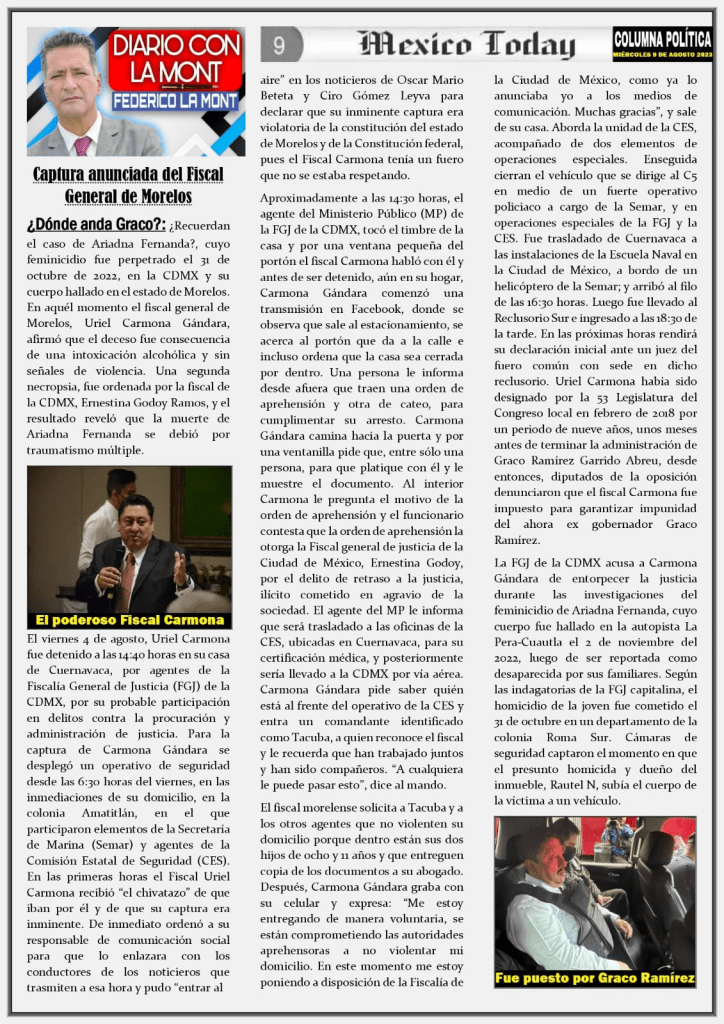
📰 *LAS NOTICIAS CON LA MONT* 📰
📃 *Premio Internacional Periodismo Y Periodismo Migrante*📃
La Información Directa a tu Celular 📲 de HOY *Martes 8 de Agosto 2023* *En El Plano Nacional e Internacional*:
*Ahora también ya estamos en la redes y síguenos a través de nuestros siguientes medios:*
– *TikTok*: https://www.tiktok.com/@federicolamontoficial?_t=8edqqgfd4ac&_r=1
*YouTube:* https://www.youtube.com/@FedericoLamontTv
*Instagram:* https://instagram.com/federicolamontoficial?utm_source=qr&igshid=ZDc4ODBmNjlmNQ%3D%3D
*Twitter:* https://twitter.com/federicolamont_?t=1JFGx2rnaadYGDPKxR_jpA&s=09
*Colaboración Especial En:* http://MexicoTodayUSA.com
*China’s Economy Faces Yet Another Threat: Falling Prices*
A deepening slowdown in the world’s second-biggest economy has now raised fears of deflation, which could be crippling for heavily indebted China.
The United States has spent much of the past 18 months struggling to control inflation. China is experiencing the opposite problem: People and businesses are not spending, pushing the economy to the verge of a pernicious condition called deflation.
Consumer prices in China, after barely rising for the past several months, fell in July for the first time in more than two years, the country’s National Bureau of Statistics announced on Wednesday. For 10 straight months, the wholesale prices generally paid by businesses to factories and other producers have been down from a year earlier. Real estate prices are tumbling.
Those patterns have amplified concerns about deflation, a potentially crippling pattern of broadly falling prices that tend to also depress the net worth of households — as it did in Japan for years — and make it very hard for borrowers to repay their loans.
Deflation is particularly serious in a country with very high debt, like China. Overall debt is now larger in China, compared with national economic output, than in the United States.
The Chinese government has pressured economists inside the country not to mention the possibility of deflation, while publicly denying that deflation poses any risk.
“Generally speaking, there is no deflation in Chinese society and there won’t be in the future,” Fu Linghui, a National Bureau of Statistics official, declared at a news briefing on July 17.
*Biden to Restrict Investments in China, Citing National Security Threats*
The measure to clamp down on investments in certain industries deemed to pose security risks, set to be issued Wednesday, appears likely to open a new front in the U.S.-China economic conflict.
The Biden administration plans on Wednesday to issue new restrictions on American investments in certain advanced industries in China, according to people familiar with the deliberations, a move that supporters have described as necessary to protect national security but that will undoubtedly rankle Beijing.
The measure would be one of the first significant steps the United States has taken amid an economic clash with China to clamp down on outgoing financial flows. It could set the stage for more restrictions on investments between the two countries in the years to come.
The restrictions would bar private equity and venture capital firms from making investments in certain high-tech sectors, like quantum computing, artificial intelligence and advanced semiconductors, the people said, in a bid to stop the transfer of American dollars and expertise to China.
It would also require firms making investments in a broader range of Chinese industries to report that activity, giving the government better visibility into financial exchanges between the United States and China.
The White House declined to comment. But Biden officials have emphasized that outright restrictions on investment would narrowly target a few sectors that could aid the Chinese military or surveillance state as they seek to combat security threats but not disrupt legitimate business with China.
“There is mounting evidence that U.S. capital is being used to advance Chinese military capabilities and that the U.S. lacks a sufficient means of combating this activity,” said Emily Benson, the director of project on trade and technology at the Center for Strategic and International Studies, a Washington think tank.
The Biden administration has recently sought to calm relations with China, dispatching Treasury Secretary Janet L. Yellen and other top officials to talk with Chinese counterparts. In recent speeches, Biden officials have argued that targeted actions taken against China are aimed purely at protecting U.S. national security, not at damaging the Chinese economy.
At the same time, the Biden administration has continued to push to “de-risk” critical supply chains by developing suppliers outside China, and it has steadily ramped up its restrictions on selling certain technologies to China, including semiconductors for advanced computing.
*Previously Secret Memo Laid Out Strategy for Trump to Overturn Biden’s Win*
The House Jan. 6 committee’s investigation did not uncover the memo, whose existence first came to light in last week’s indictment.
A lawyer allied with President Donald J. Trump first laid out a plot to use false slates of electors to subvert the 2020 election in a previously unknown internal campaign memo that prosecutors are portraying as a crucial link in how the Trump team’s efforts evolved into a criminal conspiracy.
The existence of the Dec. 6, 2020, memo came to light in last week’s indictment of Mr. Trump, though its details remained unclear. But a copy obtained by The New York Times shows for the first time that the lawyer, Kenneth Chesebro, acknowledged from the start that he was proposing “a bold, controversial strategy” that the Supreme Court “likely” would reject in the end.
But even if the plan did not ultimately pass legal muster at the highest level, Mr. Chesebro argued that it would achieve two goals. It would focus attention on claims of voter fraud and “buy the Trump campaign more time to win litigation that would deprive Biden of electoral votes and/or add to Trump’s column.”
The memo had been a missing piece in the public record of how Mr. Trump’s allies developed their strategy to overturn Mr. Biden’s victory. In mid-December, the false Trump electors could go through the motions of voting as if they had the authority to do so. Then, on Jan. 6, 2021, Vice President Mike Pence could unilaterally count those slates of votes, rather than the official and certified ones for Joseph R. Biden Jr.
While that basic plan itself was already known, the document, described by prosecutors as the “fraudulent elector memo,” provides new details about how it originated and was discussed behind the scenes. Among those details is Mr. Chesebro’s proposed “messaging” strategy to explain why pro-Trump electors were meeting in states where Mr. Biden was declared the winner. The campaign would present that step as “a routine measure that is necessary to ensure” that the correct electoral slate could be counted by Congress if courts or legislatures later concluded that Mr. Trump had actually won the states.
*After Russian Attack in Ukraine, Broken Glass and Rattled Nerves in Romania*
A drone assault on a Danube River port sent shock waves — both the physical and the psychological kind — into villages just across the water that are in NATO territory.
His thatched-roof shack on the bank of the Danube River just 200 yards from Ukraine has no running water, and getting to it involves waiting for a ferry and a bumpy ride on dirt roads.
Last week, however, the farmyard home of Gheorge Puflea, 71, became a piece of attention-grabbing real estate thanks to its unwanted status as the first property in NATO territory damaged in a Russian attack aimed at Ukraine.
The drone missile assault, carried out before dawn last Wednesday, hit a Ukrainian cargo port across the river, but it was so close that shock waves from the explosions shattered windows in Plauru, a tiny hamlet with just a dozen tumbledown homes on the Romanian side of the Danube.
The sound of the blasts and breaking glass woke Mr. Puflea from his sleep and sent him rushing outside in a panic to see what was going on.
“At first I thought it was a thunderstorm,” he said, recalling how he had taken shelter under a pear tree in his yard and then watched in horror as “what looked like a war movie played out right on my doorstep.”
The night sky crackled with Ukrainian antiaircraft fire and huge fireballs rose from three Ukrainian port buildings blasted by Russian drones. A week earlier Russia had attacked Reni, another Ukrainian port across the Danube from Romania.
The Russian attacks were aimed at severing what has been a shipping lifeline provided to Ukraine by river ports, ever since the collapse last month of a deal that had allowed Ukraine to export its grain through the Black Sea despite a naval blockade by Russia. With Ukraine’s seaports too dangerous for grain-carrying vessels bound for the Middle East and Africa, its ports on the Danube have become the last shipping outlet for millions of tons of grain.
*Ohio Vote Shows Abortion’s Potency to Reshape Elections*
The Dobbs ruling has turned a coalition of liberal, swing and moderate Republican voters into a political force. Even in August in Ohio.
Gov. Mike DeWine of Ohio, a Republican, argued that Tuesday’s vote over how to amend the State Constitution was about protecting the state from a flood of special interest money. Secretary of State Frank LaRose, another Republican, urged voters to protect the “very foundational rules” of their constitution.
But Ohio voters clearly didn’t buy it. About three million of them showed up for a vote dominated by the debate over abortion rights — an issue that was not technically on the ballot, but was the undeniable force that transformed what would have normally been a little-noticed election over an arcane legislative proposal into a national event.
For decades, a majority of Americans supported some form of legalized abortion. But the Supreme Court’s Dobbs decision overturning Roe v. Wade has shifted the political intensity on the issue, reshaping a once mostly-silent coalition of liberal, swing and moderate Republican voters into a political force. It’s a force Democrats are working hard to harness in elections across the country next year, often with ballot measures, and it’s a power Republicans have yet to figure out how to match, or at least manage.
“We’ve taken it on the chin since Dobbs,” said Michael Gonidakis, president of Ohio Right to Life in Columbus, Ohio, who helped organize efforts supporting the proposal on Tuesday. “One of the things we learned was to get out in front and get out ahead and don’t wait because you’ll be run over by the train.”
Officially, Ohio voters were being asked whether to make it harder to amend the State Constitution by raising the threshold to enact a new constitutional amendment from a simple majority to 60 percent and increase the requirements to get such initiatives on the ballot.
In remarks before party activists and in strategy memos, Republican officials acknowledged that the measure was an attempt to make it harder for abortion rights supporters to pass a ballot measure scheduled for November that would add an amendment protecting abortion rights to the State Constitution. Those private comments fueled a firestorm of national media coverage, nearly $20 million in political spending and surprisingly high turnout for an election in the dead of summer.
Nearly twice as many people voted on the Ohio measure than cast ballots in primaries for governor, Senate, House and other marquee statewide races last year.
The power of abortion to mobilize a majority coalition has armed Democrats with a potent new political tool, particularly in crucial battlegrounds like Michigan, Ohio and Arizona where Republican legislatures moved quickly to restrict abortion rights. Already, Democrats are looking ahead to 2024, with activists in around 10 states considering efforts to put abortion protections in state constitutions.
*Covid Didn’t Take a Summer Vacation*
Many people don’t want to think about the virus, but an increase in cases means it’s time for a refresher on how to protect yourself and others.
You’re not imagining it: Covid-19 cases are on the rise again.
Fortunately, since a vast majority of Americans have some sort of immunity, either from vaccination or a prior infection, or both, most people who get infected now will have a mild illness.
And while there are multiple strains circulating (nearly all of them descendants of the Omicron XBB variant), they are unlikely to cause the “wildfire spreading” that occurred with the Delta variant and the first Omicron variant, said Dr. David Boulware, a professor of medicine specializing in infectious diseases at the University of Minnesota Medical School. That includes EG.5, which was recently named a “variant under monitoring” by the World Health Organization and currently accounts for about 17 percent of cases in the United States.
“I’m not sure if it’s a surge, per se, or just uptick,” Dr. Boulware said of the current situation. Either way, he added, it’s a reminder “that, yes, Covid still exists.”
Below is a quick refresher on how to navigate an outbreak in your community or home.
Tracking
Monitoring where and how much the virus is spreading has become significantly more difficult since the Centers for Disease Control and Prevention stopped tracking cases in May, with the end of the federal public health emergency. However, there are still a few metrics to pay attention to — in addition to anecdotal evidence that people around you are getting sick.
The two best metrics to monitor local infection levels are hospitalization rates and wastewater data, which can both be found on the C.D.C. Covid Data Tracker website. For hospitalization rates, go to the map and select your county. For wastewater data, scroll down to the surveillance map and locate your nearest monitoring site.
Because fewer people tend to have severe cases these days, hospitalization data is less representative of how many people are currently infected. But it can still be useful for measuring trends: Nationwide, about 9,000 people were hospitalized for Covid in the past week, a roughly 12 percent increase over the prior week.
Many experts say that wastewater testing is a more accurate metric for identifying how much virus is circulating in a community. More than 1,300 sewage treatment plants across all 50 states currently monitor levels of the virus, which infected people shed in their stools.
“Wastewater is the only data source we have that gives us early warnings of new outbreaks,” said Aparna Keshaviah, the director of wastewater research at Mathematica, a research consultancy firm. “Hospitalizations and deaths are like these contrails of Covid infections; they show you the aftermath of what’s already happened.”
*Why Televising the Trump Trial Is a Bad Idea*
As the indictments against former President Donald Trump multiply, TV and print media commentators as well as members of Congress have called for cameras in the courtroom. They claim that broadcasting the trials will increase the public’s understanding of the charges and the evidence against Mr. Trump and that it is the only way there can be full “transparency.” Even Mr. Trump’s lawyer John Lauro says he “personally” wants the American public to see “what kind of prosecution is going on.”
But the arguments in favor of broadcasting the trials do not give enough weight to the dangers that could pose to trial witnesses and jurors, or the potential to undermine the integrity of the trial processes themselves.
As an assistant United States attorney in the Southern District of New York, I tried a number of Mafia and organized crime cases. It was difficult, if not impossible, to convince ordinary citizens to testify in such cases because they were all fearful of physical retaliation. Even armed with subpoena power, I was reluctant to force people to testify, not only because of the real danger that existed but also because of the impact that fear would have on their testimony before the jury.
The Trump trials are no different. The judge who presided over the E. Jean Carroll civil (not criminal) rape trial, Lewis Kaplan, explicitly recognized the danger to the jury of being harassed and targeted by Trump partisans and ruled that the names of the jurors not be publicly disclosed. “If jurors’ identities [in this case] were disclosed, there would be a strong likelihood of unwanted media attention to the jurors, influence attempts, and/or of harassment or worse of jurors by supporters of Mr. Trump,” Judge Kaplan found on March 23. In reaching that decision, the judge referred to reports of Mr. Trump’s previous “violent rhetoric.”
The concern is the same for witnesses in the Trump criminal prosecutions. If there was any doubt that Judge Kaplan’s reason for protecting the safety of jurors applies equally to trial witnesses, it was obliterated last week when Mr. Trump threatened on social media: “IF YOU GO AFTER ME, I’M COMING AFTER YOU!”
It is one thing to testify in a public courtroom; it is a whole different level of public exposure to testify before the entire world on television. A witness who is named and pictured on television becomes a sitting duck for any Trump partisan intent on seeking retribution.
A major lesson from the O.J. Simpson murder trial, which gripped the nation when it was broadcast starting in 1995, is how the impact of television can undermine a trial when the judge, the lawyers, the defendant and the witnesses play to the viewing audience, as they did then. This turned a grave murder trial, with Mr. Simpson’s guilt or innocence hanging in the balance, into daily entertainment.
Mr. Trump likely wants cameras in the courtrooms precisely for that reason. His successes or failures as a president will likely always be debated, but almost everyone agrees that he excels at creating reality TV. No matter how experienced a judge is in controlling the courtroom, Mr. Trump could, through gestures or well-timed outbursts, try to use the broadcast to sway public opinion and in the process undermine the trial’s solemnity.
*India Is on the Brink*
Indian social media is a brutal place, a window on the everyday hatred and violence that has come to colonize the country in the nine years since Prime Minister Narendra Modi’s government came to power. But the images from the northeastern state of Manipur that began circulating in July were shocking even by those low standards.
A video clip showed two women being sexually assaulted as they were paraded, naked, by a crowd of men who later gang-raped one of them, according to a police complaint. The horrific scene was part of an explosion of ethnic violence since May that has turned the small state into a war zone, killing more than 150 people and displacing tens of thousands.
The state has a long history of ethnic animosities that predate Mr. Modi’s rise. But the fuse for the current unrest in Manipur was lit by the politics of Hindu supremacy, xenophobia and religious polarization championed by his Bharatiya Janata Party.
India is a diverse nation, crisscrossed by religious, ethnic, caste, regional and political fault lines. Since Mr. Modi took office in 2014, his ruling party has torn those asunder with dangerous exclusionary politics intended to charge up the party’s base and advance its goal of remaking India’s secular republic into a majoritarian Hindu state. The repugnant nature of this brand of politics has been clear for some time, but the situation in Manipur shows what’s ahead for India: The world’s most populous country is slowly degenerating into a conflict zone of sectarian violence.
Under Mr. Modi’s government, the state monopoly on violence is being surrendered to extremists and vigilantes. Those targeted by the kind of mob violence that we are seeing in India may conclude that equal rights are no longer guaranteed, that political differences can no longer be peacefully reconciled or fairly mediated and that violence is the only way for them to resist.
The targeting of minorities — particularly Muslims — by right-wing Hindu extremists is now a way of life in many states. Vigilante mobs, who often assemble provocatively in front of mosques, regularly assault Muslims as understaffed and underequipped police fail to intervene. Lynchings and open calls for genocide are common. India now ranks among the top 10 countries at the highest risk of mass killings, according to Early Warning Project, which assesses such risks around the world.
In Manipur, Christians are bearing the brunt as the state’s B.J.P. government stokes the insecurities of the majority ethnic Meitei, who are predominantly Hindu. State leaders have branded the Kuki tribes who populate the hill districts, and who are mostly Christian, as infiltrators from Myanmar, have blamed them for poppy cultivation intended for the drug trade and evicted some of them from their forest habitats. The specific trigger for the current violence was a court ruling in the state in favor of granting the Meitei affirmative action provisions and other benefits that have long been enjoyed by the Kuki and other tribes, which sparked a protest by tribal communities opposed to the ruling. The Manipur government this year also began a citizenship verification drive that infringes on the privacy of Kuki. A similar drive in neighboring Assam state targeting Muslims has already reportedly disenfranchised nearly two million people.
*In One Word, Biden and Trump Tell Us Exactly Who They Are*
Presidents are forever linked to their most memorable lines or slogans, phrases that become inseparable from their passage through history. Ronald Reagan proclaimed morning in America. Barack Obama promised America hope and change. Donald Trump pledged to make America great again. Our leaders also utter words they might rather take back — say, about lip-reading or the meaning of “is” — but their go-to lines can capture their message, signal their attitude and even betray their worldview.
Joe Biden has long settled on his preferred pitch. “We are living through a battle for the soul of this nation,” he wrote in 2017, after the darkness of Charlottesville. Biden highlighted the battle for that soul again in his 2020 and 2024 campaign announcements and has revisited it in multiple speeches. It is ominous and a bit vague — John Anzalone, Biden’s 2020 pollster, complained during that race that no one knows what “soul of America” means and that the line “doesn’t move the needle.” But it does provide the rationale for Biden’s candidacy and presidency. Under Trump, Biden contends, America was becoming something other than itself.
Yet there is another Biden line — a single word, really — that also stands out, and it comes up whenever this president reflects on that American soul, on what the country is and what it might become. It is still.
“We have to show the world America is still a beacon of light,” Biden wrote in that same post-Charlottesville essay.
“We have to prove democracy still works — that our government still works and we can deliver for our people,” he said in a speech to a joint session of Congress in April 2021.
“We are still an America that believes in honesty and decency and respect for others, patriotism, liberty, justice for all, hope, possibilities,” the president said in a speech in September at Independence Hall in Philadelphia, where he asserted that the foundations of the Republic were under assault by MAGA forces. “We are still, at our core, a democracy.”
There is an insistent quality, almost a stubbornness, to Biden’s “still.” Its implicit assumption is that many Americans may no longer believe in the nation’s professed virtues or trust that they will last much longer, that we must be persuaded of either their value or their endurance. To say that America is a democracy is to issue a statement of belief. To say that we are still a democracy is to engage in an argument, to acknowledge — and push back against — mounting concerns to the contrary.
The contrast between Biden saying America is still a democracy and Trump vowing to make it great again is more than a quirk of speechwriting. What presidents say — especially what they grow comfortable repeating — can reveal their underlying beliefs and basic impulses, shaping their administrations in ways that are concrete, not just rhetorical. Biden’s “still” stresses durability; Trump’s “again” revels in discontinuity. “Still” is about holding on to something good that may be slipping away; “again” is about bringing back something better that was wrested away. Both candidates, now in a dead heat in the 2024 presidential race, look to the nation’s past but through divergent lenses. It’s the difference between America as an ideal worth preserving and an illusion worth summoning.
*Amid Signs of a Covid Uptick, Researchers Brace for the ‘New Normal’*
Infections remain very low, despite signs of a slight increase. Now, experts are looking for clues to what living with the coronavirus will be like this winter and beyond.
Echoing patterns in prior years, coronavirus infections are slowly ticking up in parts of the country, the harbinger of a possible fall and winter wave. But the numbers remain low for now, and are unlikely to reach the horrific highs seen in previous winters, experts said in interviews.
Infections have been trending upward for about four weeks now, according to data gathered from wastewater monitoring, test positivity rates and hospitalizations and emergency room visits. Taken together, the figures offer researchers and public health officials the first glimpse of the coronavirus as a post-pandemic, seasonal threat, a permanent fixture of the infectious disease landscape.
Wastewater analyses point to the highest increases in the Northeast and the South, followed by the West and Midwest. After hitting a trough at the end of June, hospitalizations are inching upward again, but fortunately very slowly.
Test positivity has risen to 7.6 percent, a level last seen in November 2021, and that summer, just before the Delta variant swept the nation.
“This is the fourth summer now that we see a wave beginning around July, often starting in the South,” said Caitlin Rivers, an epidemiologist at the Johns Hopkins Center for Health Security.
Nearly all Americans have built up multiple layers of immunity following repeated infections, immunizations or both, so the virus is unlikely to cause the harm this winter that was seen in previous seasons.
Still, for older adults, pregnant women and people with weakened immune systems or certain chronic conditions, the virus may yet pose a serious threat.
The number of deaths is the lowest since the pandemic began, and roughly one-tenth of the levels in January. Most virus fatalities now occur in adults older than 75. But the real toll will be apparent only at the end of the year, after the fall and winter’s respiratory blitz, experts said.
“We are in a very different place, but Covid is still a thing,” said Katelyn Jetelina, a public health expert and author of the widely read newsletter, “Your Local Epidemiologist.”
“I think we do the public a disservice by saying that it’s over and let’s move on, because it is going to be disruptive this winter, and it will cause a number of people to die,” she added. “That’s just not acceptable to the public health world, especially since it’s preventable.”
Researchers have been trying to assess how updated Covid vaccines and emerging variants might change the course of the pandemic. By the most pessimistic estimates, if no vaccine were available and the circulating variant dodged most immune defenses, Covid might lead to about 839,000 hospitalizations and around 87,000 deaths nationwide between September and April.
*ATENTAMENTE*
*MAESTRO FEDERICO LA MONT*
Sent from my iPod
 Mexico Today USA