
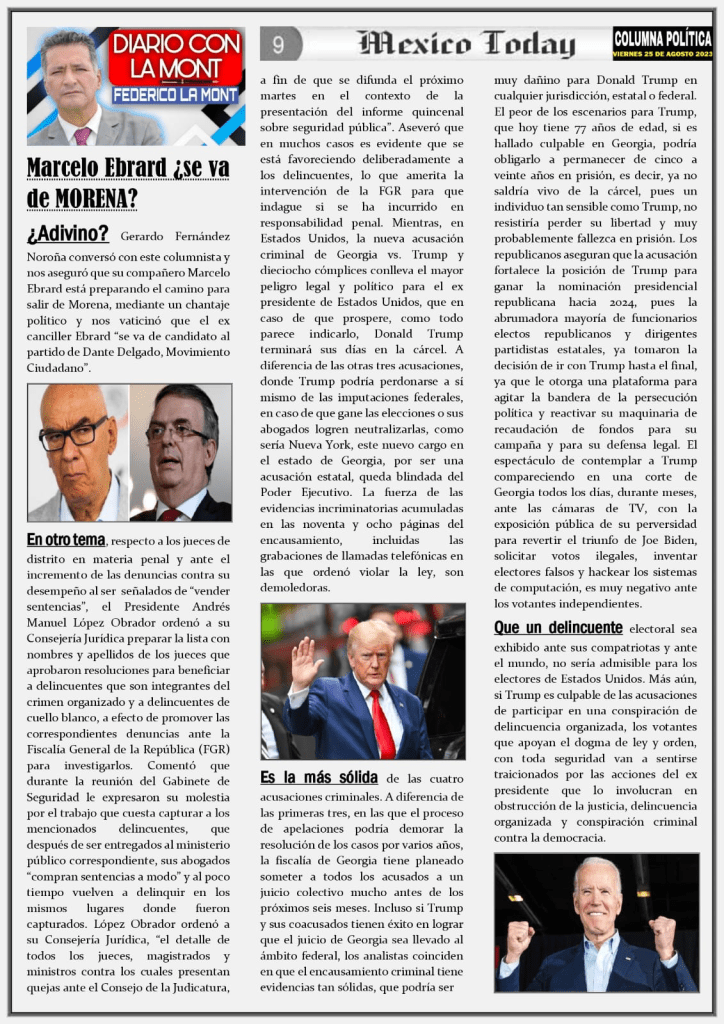
Internacional Periodismo Y Periodismo Migrante*📃
La Información Directa a tu Celular 📲 de HOY *Viernes 25 de Agosto 2023* *En El Plano Nacional e Internacional*:
*Ahora también ya estamos en la redes y síguenos a través de nuestros siguientes medios:*
– *TikTok*: https://www.tiktok.com/@federicolamontoficial?_t=8edqqgfd4ac&_r=1
*YouTube:* https://www.youtube.com/@FedericoLamontTv
*Instagram:* https://instagram.com/federicolamontoficial?utm_source=qr&igshid=ZDc4ODBmNjlmNQ%3D%3D
*Twitter:* https://twitter.com/federicolamont_?t=1JFGx2rnaadYGDPKxR_jpA&s=09
*Colaboración Especial En:* http://MexicoTodayUSA.com
*With Prigozhin’s Death, Putin Projects a Message of Power*
The Kremlin appears to be sending the signal that no degree of effectiveness can protect someone from punishment for disloyalty.
Just as the news broke on Wednesday of the presumed death of the mercenary chief Yevgeny V. Prigozhin, President Vladimir V. Putin of Russia was presiding over a televised World War II anniversary ceremony on a dark stage lit dramatically in red.
He held a moment of silence, flanked by service members in dress uniforms, while a metronome’s beats sounded, like the slow ticking of a clock: Tock. Tock. Tock.
The eerie split screen — the reported fiery demise of the man who launched an armed rebellion in June and the Russian president telegraphing the state’s military might — may have been coincidental. But it underscored the imagery of dominance and power that Mr. Putin, 18 months into his full-scale invasion of Ukraine, appears more determined than ever to project.
Mr. Prigozhin may have been brutally effective, throwing tens of thousands of his fighters into the maw of the battle for Bakhmut in eastern Ukraine, tying up Ukrainian forces in the process and hobbling Kyiv’s ability to stage a counteroffensive. His internet “troll farm” helped the Kremlin interfere in the 2016 American presidential election, while his mercenary empire helped Russia exert influence across Africa and the Middle East.
But with his June rebellion, Mr. Prigozhin threatened something even more sensitive: Mr. Putin’s own hold on power. After the crash of Mr. Prigozhin’s plane on Wednesday, the Kremlin appears to be sending the message that no degree of effectiveness and achievement can protect someone from punishment for violating Mr. Putin’s loyalty.
“Everyone’s afraid,” Konstantin Remchukov, a Moscow newspaper editor with ties to the Kremlin, said of the reaction among the Russian elite to the plane crash Wednesday that Western officials theorize was caused by an explosion on board. “It’s just that everyone sees that anything is possible.”
*Trump Surrenders at Atlanta Jail in Georgia Election Interference Case*
Mr. Trump spent about 20 minutes at the jail, getting fingerprinted and having his mug shot taken for the first time in the four criminal cases he has faced this year.
Former President Donald J. Trump surrendered at the Fulton County jail in Atlanta on Thursday and was booked on 13 felony charges for his efforts to reverse his 2020 election loss in Georgia.
It was an extraordinary scene: a former U.S. president who flew on his own jet to Atlanta and surrendered at a jail compound surrounded by concertina wire and signs that directed visitors to the “prisoner intake” area.
As Mr. Trump’s motorcade of black S.U.V.s drove to the jail through cleared streets, preceded by more than a dozen police motorcycles — a trip captured by news helicopters and broadcast live on national television — two worlds collided in ways never before seen in American political history. The nation’s former commander in chief walked into a notorious jail, one that has been cited in rap lyrics and is the subject of a Department of Justice investigation into unsanitary and unsafe conditions, including allegations that an “incarcerated person died covered in insects and filth.”
The case is the fourth brought against Mr. Trump this year, but Thursday was the first time that he was booked at a jail.
Mr. Trump spent about 20 minutes there, submitting to some of the routines of criminal defendant intake. He was fingerprinted and had his mug shot taken. He was assigned an identification number, P01135809. But the process was faster than for most defendants; minutes after he entered the jail, Mr. Trump’s record appeared in Fulton County’s booking system, which listed him as having “blond or strawberry” hair, a height of 6 feet 3 inches and a weight of 215 pounds — 24 pounds less than the White House doctor reported Mr. Trump weighing in 2018.
His form was filled out in advance by aides, according to someone familiar with the preparations, not by officials at the jail.
Outside, supporters and detractors of Mr. Trump had gathered all day in the swampy Atlanta heat. The news media was kept at bay. The Fulton County Sheriff’s Office barred reporters from accessing the parking lot in front of the jail’s main entrance, a break with tradition.
*Hawaii Wildfires Spur Insurers to Reassess the State’s Risk*
Hawaii has long been a low-risk and profitable market for insurers, but the Maui disaster could change that, and even have a global ripple effect.
Just days after the Maui fires, Roy Wright, the head of an insurance industry-funded research organization, began mobilizing a team.
His team’s job is to analyze exactly how the fires spread once they hit an inhabited area, looking for clues like how burning embers got into buildings that hadn’t yet ignited, and whether things like fences, plants and sheds close to various houses helped the fires spread.
“We focus on the point by which the fire intrudes into the neighborhoods,” said Mr. Wright, the chief executive of the Insurance Institute for Business and Home Safety, which investigates the causes of big insurance losses and proposes ways to reduce them.
Weeks after wildfires killed at least 115 people on Maui, insurance companies are beginning to assess the damage to calculate their payouts. Early estimates for the total cost of the fires are $4 billion to $6 billion, according to a report from Moody’s Risk Management Solutions.
But private insurers, already grappling with the costs of climate-related disasters in California and Florida, are also reassessing a home insurance market they had long considered both predictable and profitable, and whether they should charge residents of Hawaii higher rates.
The occurrence of another unexpected catastrophic event “is going to have an impact globally for the underwriting community,” said Sean Kent, an insurance broker for FirstService Financial.
Hawaii hadn’t been on the minds of insurers. With few natural disasters since Hurricane Iniki in 1992, and thus few payouts, Hawaii has offered the highest return on investment for insurers looking for calm waters. The models that insurance companies use to stay profitable — which make predictions based on past data — seemed to back that up.
*Spin. Pilates. Prigozhin? Presidential Business Follows Biden on Vacation.*
President Biden’s weeklong vacation to Lake Tahoe has been punctuated by crises at home and abroad.
On Thursday, from a sprawling mansion on Lake Tahoe, President Biden spoke with President Volodymyr Zelensky of Ukraine, commemorating the country’s Independence Day and discussing the commencement of training its military fighter pilots.
On Wednesday, by the time Mr. Biden joined his family for a Pilates class, he had signed a disaster declaration to help Alaska recover from historic flooding, gotten word of an active shooter in Pittsburgh, and been briefed on reports that the mercenary leader Yevgeny V. Prigozhin had died in a plane crash in Russia.
And on Monday, he flew to Hawaii to tour a coastal town that had been scorched by deadly wildfires. Mr. Biden met with hundreds of grieving residents on the one-day trip, which included 10 hours of flying and two helicopter rides.
Mr. Biden’s weeklong vacation to Lake Tahoe, where he has been staying at a home owned by Tom Steyer, the billionaire climate investor, has been punctuated by moments of crisis at home and abroad.
It is a dynamic that seems to come with the job: A crisis will almost certainly unfold during any presidential holiday.
The only occasion when Mr. Biden was spotted doing a recreational activity so far was on Wednesday, holding a banana-blueberry smoothie after his workout at PeloDog, a Pilates and cycle studio. He was asked by reporters whether he believed President Vladimir V. Putin of Russia was behind the plane crash. It looked that way, the president said, but he needed to find out more.
“I’ve been working out for the last hour and a half,” he said.
A senior adviser said the president values family time, but there was neither hesitation nor perceived sacrifice in traveling to Maui, which coincided with other brewing natural disasters. And for the most part, the president and his family have retreated to Mr. Steyer’s lake-view home in the gated community of Glenbrook, Nev., the oldest settlement in Lake Tahoe with one of the most expensive ZIP codes in the country. (White House officials said the president was renting the house for “fair market value” but did not disclose details.)
And observers say that Mr. Biden seems to have embraced the reality that has become inevitable for most presidents since Theodore Roosevelt installed a phone at his home in Sagamore Hill, on Long Island, to work during the summers.
“When you’re president, things are constantly coming your way — there’s no respite,” said Tevi Troy, a presidential scholar and former George W. Bush administration official, who wrote the book “Shall We Wake the President? Two Centuries of Disaster Management From the Oval Office.” “So you can say that August is a nice time to take a vacation — go to Tahoe, or Rehoboth or wherever it is you like to — but this just doesn’t leave you.”
President George H.W. Bush was vacationing in Kennebunkport, Maine, in August 1991 amid an attempted Soviet coup; in August 1998, President Bill Clinton announced airstrikes in Afghanistan and Sudan from Martha’s Vineyard.
But the public perception of a president’s relaxing holiday can backfire.
Mr. Biden has come under criticism from Republicans for not saying enough publicly, in their view, about the Maui wildfires before his visit. White House officials said he had signed the major disaster declaration, which would deploy federal relief, within 63 minutes of its arriving at the White House, and had been on the phone and in briefings about the inferno every day during a vacation in Rehoboth Beach, Del., that weekend.
On Thursday, a White House spokeswoman said that Mr. Biden had never heard a reporter’s question about the fires in Maui that he appeared to brush off with a “no comment” on Aug. 13 in Delaware.
*Nikki Haley Is the Best Trump Alternative*
I have a bunch of friends and acquaintances who are Never Trump, maybe-Trump or kind-of-Trump Republicans. They’ve been looking around for the candidate they can support and give their dollars to, somebody who is an antidote to Donald Trump and who can win a general election.
We’ve had endless conversations about who this person might be. Many of these friends and acquaintances went through a Ron DeSantis phase. A few like the No Labels third candidate option. I’ve often found myself talking up Tim Scott with them. If Trump is a moral stain, I would say, Tim Scott is the kind, honest and optimistic remedy.
But Wednesday’s debate persuaded me that the best Trump alternative is not Scott, it’s Nikki Haley. Nothing against Scott, he just didn’t show the specific kind of power and force needed to bring down Trump. Haley showed more than a glimpse of that power.
Wednesday’s debate illustrated the cancer that is eating away at the Republican Party. It’s not just Trumpian immorality. The real disease is narcissistic hucksterism. The real danger is that he’s creating generations of people, like Vivek Ramaswamy, who threaten to dominate the G.O.P. for decades to come.
Ramaswamy has absolutely no reason to be running for president. He said that Trump is the best president of the 21st century. So why is he running against the man he so admires? The answer is: To draw attention to himself. Maybe to be Trump’s vice president or secretary of social media memes.
If Trump emerged from the make-believe world of pro wrestling, Ramaswamy emerges from the make-believe world of social media and the third-rate sectors of the right-wing media sphere. His statements are brisk, in-your-face provocations intended to produce temporary populist dopamine highs. It’s all performative show. Ramaswamy seems as uninterested in actually governing as his idol.
Republicans have been unable to take down Trump because they haven’t been able to rebut and replace the core Trump/Ramaswamy ethos — that politics is essentially a form of entertainment. But time and again, Haley seemed to look at the Trump/Ramaswamy wing and implicitly say: You children need to stop preening and deal with reality. She showed total impatience for the kind of bravado that the fragile male ego manufactures by the boatload.
Haley dismantled Ramaswamy on foreign policy. It was not only her contemptuous put-down: “You have no foreign policy experience and it shows.” She took on the whole America First ethos that sounds good as a one-liner but that doesn’t work when you’re governing a superpower. Gesturing to Ramaswamy, she said, “He wants to hand Ukraine to Russia, he wants to let China eat Taiwan, he wants to go and stop funding Israel. You don’t do that to friends.”
*Trump’s Plan: Skip the Debates, Win Iowa, Avoid Prison*
As the Republican candidates tap dance around the former president, the party proves it’s still stuck on Trump.
The first Republican primary debate of the 2024 election is over. Chris Christie wiggled his fingers. Nikki Haley took Vivek Ramaswamy to the woodshed. Tim Scott was a “nonentity.” And then there was that elephant decidedly not in the room, Donald Trump, who instead spent his evening raving about water pressure to Tucker Carlson.
As the former president is expected to turn himself in at the Fulton County Jail, the Matter of Opinion hosts discuss what we learned from the first G.O.P. debate — and what it means when everyone in the party is still desperate to both be Trump, and be rid of him.
*In a Report From a Distant Border, I Glimpsed Our Brutal Future*
Once in a while, some single thing manages to encapsulate all that feels terrible about our world today. For me, this week, it was a bone-chilling report from Human Rights Watch documenting how Saudi border guards had killed hundreds — perhaps thousands — of Ethiopians seeking to cross from Yemen into Saudi Arabia.
It landed in my inbox on Monday with concussive force. The accounts were so brutal that I struggled to read the 73 pages in one sitting: A 14-year-old girl named Hamdiya described waking up after an attack: “I could feel people sleeping around me. I realized what I thought were people sleeping around me were actually dead bodies.” There were bloodied corpses all around her. Another survivor, a 17-year-old boy, described being forced by Saudi guards to rape two girls after another man who had been asked to do the same was executed for refusing. These are defenseless children, unarmed people fleeing a savage conflict and relentless poverty, hoping for some chance at a life free of violence and want in one of the richest countries in the world.
In these reports from a remote corner of a distant desert, I saw a glimpse of the unrelenting cruelty that is our future.
First, let’s talk about Saudi Arabia. In 2018, its security forces, allegedly at the direction of Crown Prince Mohammed bin Salman, known far and wide by his initials, M.B.S., dismembered a Washington Post journalist and American permanent resident in the Saudi consulate in Istanbul. That was merely the most shocking and public example of Saudi human rights abuses: Courts routinely sentence citizens to decades in prison and even death for the crime of speaking their minds or living their lives as they wish.
Of course, none of this chilled the blossoming friendship between then-President Donald Trump and M.B.S., not to mention the Saudi prince’s warm bromance with Trump’s son-in-law, Jared Kushner, who would later get a $2 billion investment from a Saudi fund M.B.S. controls.
This administration was supposed to be different. During the 2020 campaign, Joe Biden rightly referred to Saudi Arabia as a pariah. In an awkward moment on a swing through the Middle East last summer, he avoided shaking hands with M.B.S. by bumping fists with him instead.
Fast forward a year. Biden is now seeking to broker a historic pact between the Saudis and Israel. The contours of any such deal will be highly contested, and it faces a steep climb in Congress. But such a deal, far from making Saudi Arabia a pariah, would draw it even closer to the United States through defense guarantees.
Our messy, multipolar moment in global politics means that some countries are simply too important to face any kind of lasting opprobrium for their brutality. And so, M.B.S. swans across the global stage like a prima ballerina in a career-making role. He was welcomed with warmth in Paris by Emmanuel Macron in June. He convened dozens of nations to discuss prospects for peace in Ukraine this month. Britain’s government said this month that Prime Minister Rishi Sunak is eager to meet him “at the earliest opportunity” to discuss deepening ties between the two countries.
Meanwhile, the Saudis are making efforts to improve their country’s name recognition and reputation around the world. They have plowed some of their ample profits — buoyed by the high oil prices that Saudi Arabia helped guarantee — into culture and, especially, sports: Hundreds of millions of dollars have been spent on buying up some of the world’s top soccer stars for a nascent Saudi league. And the Saudis have plotted the merger of the vaunted PGA Tour with the much smaller Saudi-backed upstart LIV Golf, effectively taking control of the commanding heights of the favored pastime of the masters of the universe. Human rights organizations refer to these kinds of moves as “sportswashing.”
*Five Debate Moments That Will Shape the Republican Campaign*
There are moments of fireworks at every presidential debate, and then there are moments that last — the moments that shape the public image of candidates, the moments that influence campaign strategy, messaging, fund-raising and staying power. As part of Opinion’s commentary on the winners and losers in Wednesday’s debate, we asked five of our writers — Ross Douthat, David French, Michelle Goldberg, Daniel McCarthy and Michelle Cottle — to pick a video clip and explain why it will help shape the arguments in the Republican primary race or the trajectory of the candidates in the weeks ahead.
Ross Douthat: Of all the varied and vigorous clashes between Mike Pence and Vivek Ramaswamy, the moment when Ramaswamy started talking about despair and doom and declining mental health in America and Pence shot back with the claim that actually there’s nothing wrong with the American people, just with our failed government and leaders, offered an especially pellucid distillation of the big divide between pre-Trump and post-Trump conservatism.
It’s a divide that’s both ideological and generational, pitting the old G.O.P. defaults (which are clearly still Pence’s defaults) of patriotic boosterism against a growing sense on the right that the American exceptionalism conservatives once defended has decayed or dissolved — and that something more radical than a message of small government and stewardship is required to bring it back.
Haley Decimates Ramaswamy’s Isolationism…
David French: When Nikki Haley mustered all her experience and knowledge as America’s former ambassador to the U.N. and all the moral clarity of traditional American resistance to Russian tyranny, she decimated Vivek Ramaswamy’s populist isolationism. She won on style and substance and reminded voters why she was once considered a Republican rising star.
…And Then Hammers Him As Inexperienced
Michelle Goldberg: Nikki Haley’s best moment was when she eviscerated Vivek Ramaswamy for his eagerness to surrender Ukraine to Vladimir Putin: “You have no foreign policy experience and it shows.” Ramaswamy may have thought the Trumpified Republican Party would eat up his trollishly amoral foreign policy, and there’s no doubt that plenty of base voters thrill to his contempt for the liberal Democratic icon Volodymyr Zelensky, but the crowd seemed to be clearly with Haley.
A Revealing Moment About DeSantis
Daniel McCarthy: Ron DeSantis could have gone along with most of the field in automatically supporting more aid for Ukraine. Instead, he joined Vivek Ramaswamy in wondering why Americans should pay more than Europeans for Europe’s security. The foreign policy debate in the G.O.P. is serious and intense, even if debates like this are more intense than serious. Gov. DeSantis and Ramaswamy point toward a new direction for U.S. strategy, not only in Europe but globally, while Nikki Haley and Mike Pence want to continue down the path set by Bill Clinton and George W. Bush after the Cold War.
This was a pivotally clarifying moment, and it will earn DeSantis much obloquy from pundits and think tanks, but perhaps more support from the G.O.P.’s antiglobalist base.
*La megafarmacia: un fracaso anunciado*
Los primeros días de septiembre sabremos quienes serán los abanderados de las dos alianzas para la contienda presidencial en 2024; el tema nos tendrá bastante distraídos como para prestar suficiente atención a la discusión del presupuesto federal para 2024, a iniciar en por esas fechas.
Hay varios rubros a los cuales debiéramos poner mucha atención. Podríamos empezar por ver cuántos recursos solicitará el Ejecutivo para las famosas y costosas megaobras, con tal de inaugurarlas durante el primer semestre del próximo año. Pero sobre todo, fijarse si esas son ya las últimas partidas presupuestales que requerirán.
Hay una última ocurrencia presidencial que creo que le costará un ojo de la cara a los contribuyentes; me refiero a la megafarmacia que se planea ubicar en la Ciudad de México para surtir a todo el país.
Don Andrés Manuel tiene una visión simplista de los proyectos y una confianza mesiánica en su palabra; si se le ocurre una idea, pues la resuelve mentalmente, sin profundizar en los requerimientos y procedimientos para que tenga éxito. Una vez verbalizada su idea, pues sigue la lógica de “hágase la luz y se hizo”.
Yo que más quisiera que su idea funcionara, pero lo veo improbable. Me explico:
Cuando AMLO desbarató el sistema de compras de medicamentos, no cayó en la cuenta de que también hizo trizas el sistema de distribución. Varios de los laboratorios importantes no cuentan con infraestructura de distribución, porque había otras empresas –las concentradoras- encargadas de tal tarea para varios laboratorios. Dichas concentradoras entraban a las licitaciones con una oferta específica de medicamentos, incluyendo la distribución a farmacias de hospitales, centros de salud y hasta los modestos consultorios en zonas poco pobladas.
Desde 2020, este país sufre de desabasto y es fecha que no se soluciona. En las mañaneras, una y otra vez nos dice López Obrador que ya está resuelto el problema, pero la realidad indica otra cosa. También hace tres años, el inquilino de Palacio Nacional tuvo otra epifanía: encomendar la distribución de los medicamentos a la paraestatal Biológicos y Reactivos de México, S.A., BIRMEX.
Como he comentado en otras entregas, BIRMEX estaba dedicada a la producción de vacunas. Y todo pasó: dejó de producir inmunológicos, no armó la infraestructura y la logística de distribución, y se metió en un lío de malos manejos administrativos (ver BIRMEX: entre la ineficiencia y la corrupción, 06/10/22). Vamos, ni el IMSS la pudo contratar por el servicio caro y deficiente que ofrecía.
¿Qué va a pasar con BIRMEX? Vaya usted a saber.
Lo que el presidente nunca consideró es que con el servicio de las concentradoras, las distintas dependencias del sector salud NO requerían de almacenes, ni de flotillas de distribución. Le enlisto algunos requerimientos a calcular en los gastos de operación de la megafarmacia:
1) Renta o compra de un mega local o varios cercanos para las bodegas, personal, mobiliario de almacén y de oficina, sistemas de refrigeración, energía eléctrica y agua, sistema informático y papeleo para controles de entradas y salidas, atención a las unidades de salud, empaque, servicios de vigilancia, seguros contra daños y robos.
2) Camiones, motocicletas, choferes, gasolina, peajes, refacciones, vehículos con refrigeración y seguros.
3) Capacitación de todo el personal, particularmente en logística y manejo de productos delicados.
Y todo esto tiene que funcionar como relojito 24/7.
Como ve, mi estimado don Erasmo, no es enchílame la otra y debe costar un mundanal de dinero. Desde luego, las concentradoras cargaban el costo del servicio al precio final, pero el sector salud se ahorraba muchas preocupaciones como a continuación le describo.
Hay otro problema adicional. Cada centro de salud tiene una suerte de cuadro farmacológico dependiendo de su nivel de especialización; la obligación de las concentradoras era mantener dicho cuadro satisfecho de manera PERMANENTE. Si faltaba algún medicamento, el responsable de farmacia solo tenía que llamar por teléfono a la concentradora y ésta lo debía surtir en cuestión de horas, so pena de multa.
Ninguna concentradora, incluso después de años en el mercado, tuvo la capacidad de cubrir todo el país. Así que cabe la pregunta: ¿de verdad la megafarmacia va a contar con los recursos, procedimientos y logística para llevar, como dice el presidente, cualquier medicamento a cualquier punto de México?
No pretendo ser ave de mal agüero, pero la megafarmacia será un fracaso más en los servicios de salud. Que las ideas del presidente fracasen es lo de menos; lo de más son los enfermos que seguirán colgados de la brocha.
Como ve, diputado González, esto de gobernar no es para iluminados.
*ATENTAMENTE*
*MAESTRO FEDERICO LA MONT*
Sent from my iPod
LAS NOTICIAS CON LA MONT* 📰
📃 *Premio Internacional Periodismo Y Periodismo Migrante*📃
La Información Directa a tu Celular 📲 de HOY *Jueves 24 de Agosto 2023* *En El Plano Nacional e Internacional*:
*Ahora también ya estamos en la redes y síguenos a través de nuestros siguientes medios:*
– *TikTok*: https://www.tiktok.com/@federicolamontoficial?_t=8edqqgfd4ac&_r=1
*YouTube:* https://www.youtube.com/@FedericoLamontTv
*Instagram:* https://instagram.com/federicolamontoficial?utm_source=qr&igshid=ZDc4ODBmNjlmNQ%3D%3D
*Twitter:* https://twitter.com/federicolamont_?t=1JFGx2rnaadYGDPKxR_jpA&s=09
*Colaboración Especial En:* http://MexicoTodayUSA.com
*Ramaswamy Seizes Spotlight as DeSantis Hangs Back: 7 Debate Takeaways*
As Republican presidential candidates traded fire at their first debate, they mostly left their party’s dominant front-runner unscathed.
One thing was clear when former President Donald J. Trump decided to skip the first debate of the 2024 Republican primary race: There would be a vacuum to fill.
But it was not Mr. Trump’s chief rival in the polls, Gov. Ron DeSantis of Florida, who emerged at the epicenter of the first Trump-free showdown on Wednesday, but instead the political newcomer Vivek Ramaswamy, whose unlikely rise has revealed the remarkable degree to which the former president has remade the party.
Mr. DeSantis had stumbled heading into the debate and was widely seen as in need of a stabilizing performance. He sought it by largely avoiding the scrum and sticking closely to the core case he makes on the stump, hoping to gain incremental ground in front of a national audience.
All eight candidates mostly jostled for position among themselves, and few targeted the front-runner who is set to surrender on Thursday after his fourth criminal indictment.
Six months ago, the idea that Mr. Ramaswamy, a 38-year-old entrepreneur, would be standing center stage at a Republican presidential debate would have seemed unimaginable.
And yet there he was, leaning into that fact with a line echoing one used famously by Barack Obama, asking, “Who the heck is this skinny guy with a funny last name?”
That skinny guy quickly became a punching bag for rivals, led by former Vice President Mike Pence, who invoked his experience to say that it wasn’t time for a “rookie” who needed “on-the-job training.” Former Gov. Chris Christie of New Jersey recalled the Obama line, quipping, “I’m afraid we’re dealing with the same type of amateur.”
*Who Won the Debate? Political Observers Weigh In.*
Commentators largely agreed that little seemed to alter the state of a race in which Donald J. Trump appears the runaway favorite.
The first Republican debate on Wednesday night offered political pundits a bit of a thought experiment: If the clear front-runner doesn’t take part, can the debate have a clear winner?
Even as commentators spent the debate and its aftermath arguing over which of the eight underdogs on the debate stage performed best, they largely agreed that little seemed to alter the state of a race in which Donald J. Trump appears the runaway favorite.
Still, some pundits said that Mr. Trump’s absence did offer candidates the chance to differentiate themselves, an opportunity they may not have had if he had participated. And the battle to become Mr. Trump’s top challenger, some said, is more hazy. Here is a sampling of commentary on how the candidates fared.
Ron DeSantis
Gov. Ron DeSantis of Florida in some ways entered Wednesday’s debate with the most to prove and the most to lose. While he has long been viewed as Mr. Trump’s strongest potential challenger, his campaign has stumbled in recent weeks amid fund-raising trouble and staffing changes.
But while Mr. DeSantis may have seemed like the apparent leader among this group of hopefuls, political pundits noted that he largely evaded the serious criticism or attacks that rivals usually level at would-be front-runners.
Rich Lowry, the editor of National Review, said during the debate that he expected Mr. DeSantis to “deal with constant incoming” attacks. By the end, Mr. Lowry said that Mr. DeSantis had “helped himself” by sticking to his message — and took “no incoming fire.”
Other observers noted Mr. DeSantis’s ability to stay in comfortable territory, trumpeting his conservative track record in Florida as proof that he could steer the Republican Party to success.
Mary Katharine Ham, a journalist and conservative commentator, called Mr. DeSantis’s strategy “effective.”
*The BRICS Group Announces New Members, Expanding Its Reach*
Argentina, Egypt, Ethiopia, Iran, the U.A.E. and Saudi Arabia have been invited to join the club of emerging nations, strengthening its role as a geopolitical alternative to Western-led forums.
The five-nation BRICS club of emerging economies that came together to tilt the international order away from the West announced plans Thursday to expand its membership, feeding concerns about a growing global divide.
The BRICS group, which encompasses Brazil, Russia, India, China and South Africa, represents a quarter of the world’s economy and has increasingly sought to act as a counterweight to the dominance of Western-led forums like the Group of 7 and the World Bank.
At its summit in Johannesburg, the group announced that Argentina, Egypt, Ethiopia, Iran, the United Arab Emirates and Saudi Arabia had been invited to join, and that their membership would begin in January.
The BRICS group has said that it wants to bring diversity to the world’s power structure amid increasing polarization. That polarization has been deepened by Russia’s invasion of Ukraine and strained relations on economic and security issues between the United States and China. Smaller countries caught between the world’s wealthier nations have faced pressure to pick sides or, in some cases, occupy a middle ground in an effort to get the best deal from the competing nations
The inclusion of Tehran — which has antagonistic relations with China’s chief rival, the United States — suggests that Chinese and Russian pressure had succeeded over the qualms of members like India, Brazil and South Africa, which maintain friendly ties with the West.
“Iran, obviously, is a complicated choice,” said Cobus van Staden, a researcher with the China Global South Project. “I can imagine that some of the other members worry that it might increase geopolitical tensions with Western powers, which I think it kind of inevitably would.”
The expansion, more broadly, gives the group more financial heft and bolsters the bid by China’s leader, Xi Jinping, to demonstrate that Beijing has growing diplomatic support for its agenda despite having alienated many countries in the developing world over his support for Russia.
*How Multiple Warnings About a Killer Nurse Went Unheeded*
Since the trial of Lucy Letby, a nurse who murdered babies in her care, experts have warned of a culture of hostility toward whistle-blowers in Britain’s National Health Service.
It was June 2016, and almost a year had passed since Stephen Brearey, the lead doctor at a neonatal unit in northwest England, first became concerned about a spate of troubling and unexpected deaths on his ward.
Five babies had died, and at least six others had experienced unusual complications. The neonatal ward at the Countess of Chester Hospital cared for premature and vulnerable babies, but the number of deaths was far above average for the unit. Something was desperately wrong.
Then, in the early evening of June 23, a baby boy — one of a set of newborn triplets — suddenly became sick and died. The following night, as the parents were still reeling, another of the triplets died.
The infants had been in the care of Lucy Letby, a seemingly conscientious and well-liked nurse. Dr. Brearey had noticed that she was present in every other suspicious case and raised that fact multiple times with executives, but he felt his concerns were dismissed.
After the second triplet died, he phoned a hospital executive and demanded that Ms. Letby be removed from the ward. The executive said there was no clear evidence against the nurse and insisted she was safe to work with, Dr. Brearey later told a court.
It would be another week before Ms. Letby, now considered the most prolific killer of children in modern British history, was moved to clerical duties, and months before the hospital’s senior managers contacted the police.
*Japan Begins Releasing Treated Radioactive Water at Fukushima*
China said it would suspend imports of Japanese seafood in response to what it has called an unsafe plan to dispose of the wastewater.
Japan began releasing into the ocean the first tranche of more than a million tons of treated radioactive wastewater from the ruined Fukushima Daiichi nuclear power plant on Thursday. The Chinese government, which has been the most vocal regional opponent to the discharge plan, responded by announcing that it would suspend seafood imports from Japan. China imported about $3.2 million in fresh seafood from Japan in July.
The Japanese government and Tokyo Electric Power Company, which operated the plant and is overseeing its decommissioning, have promised that the water is safe for humans and that they will monitor the continuing release to make sure that radioactive material does not exceed international standards.
Why It Matters
In the two years since Japan announced its plan to release the wastewater into the sea, the plan has provoked serious political tensions with nearby China and South Korea, as well as anxiety at home. The Chinese government had previously criticized the plan as unsafe; in South Korea, the administration of President Yoon Suk Yeol supports Japan’s efforts, but opposition lawmakers have castigated the move as a potential threat to humans. Within Japan, fishermen’s unions fear that public anxiety about the safety of the water could affect their livelihoods.
Background
Ever since a huge earthquake and tsunami in 2011 led to a meltdown at the Fukushima plant, Tepco, as the power company is known, has used water to cool the ruined nuclear fuel rods that remain too hot to remove. As the water passes through the reactors, it picks up nuclear materials. The power company runs the cooling water through treatment plants that remove most radioactive nuclides except for tritium, which the International Atomic Energy Agency said in July will not pose a serious health threat to humans if released to the ocean.
The Japanese government has said that with more than 1.34 million tons of wastewater already accumulated on site, the power company will shortly run out of storage room and that it has no choice but to release the water into the ocean.
What’s Next
The first release of 7,800 tons of treated water is expected to last about 17 days. Both Tepco and Japan’s fisheries agency have said they will monitor the ocean water for radioactive levels, and the IAEA has said it will also oversee the process, which is expected to last decades.
To compensate fishermen who lose business due to public anxiety, the Japanese government is allocating 80 billion yen ($552 million).
*Our Writers Pick the Winners, Losers and ‘the Star of the Evening’ From the First Republican Debate*
Welcome to Opinion’s commentary for the first Republican presidential primary candidate debate, held in Milwaukee on Wednesday night. In this special feature, Times Opinion writers and contributors rank the candidates on a scale of 0 to 10: 0 means the candidate probably didn’t belong on the stage and should have dropped out before the debate even started; 10 means the candidate can head to Iowa and New Hampshire with the wind at his or her back. Here’s what our columnists and contributors thought about the debate.
Jamelle Bouie: To the extent that anyone had a good performance, it was Nikki Haley, who didn’t seem to be running for the Republican nomination as much as she was casting herself as a choice for the general election next November. How else to explain her desperate attempt to get her colleagues to evade the question of a national abortion ban? Haley seems to understand that the Republican Party needs, at some point, to win a majority of the voting public, and that the only way to do that is to retain at least a tenuous link to reality and real problems.
Gail Collins: She seemed generally reasonable and wow, when the debate turned to education and she actually brought up reading.
Matthew Continetti: Haley made the most of her time before the cameras. She needed to remind G.O.P. voters that she was in the race, and why. She succeeded on both counts. And her answer on abortion proved that she is just as interested in winning the general election as the primary.
Michelle Cottle: Solid performance. Landed some punches — including her opening whack at Republican lawmakers for their heavy spending under President Trump — and gave not one inch during a tussle with Ramaswamy over foreign policy. She was pushing a political pragmatism unlikely to play well with the base, but — who knows? — maybe some of those alienated suburbanites will take note.
Ross Douthat: A perfectly competent and therefore insufficient performance for a polished candidate without a clear rationale or lane.
David French: Here at last was a conservative who called out Trump’s profligate spending, a pro-life politician who gave an appropriately pragmatic answer to the challenge of national legislation, and a foreign policy hawk who dismantled Ramaswamy’s isolationism on live television. All of it warmed my old-school Reagan conservative heart. If there’s any life left in the old G.O.P., Haley gave it hope.
Michelle Goldberg: She came across as the most frank and levelheaded person onstage, not that that’s a high bar. Perhaps more important, in taking on the glib and callow Ramaswamy on Ukraine, she showed anger and dominance, essential qualities in a Republican debate. Her genuine contempt for him recalled the dynamic between Amy Klobuchar and Pete Buttigieg in 2020.
Katherine Mangu-Ward: The sickest burn on Trump wasn’t a Christie zinger. It was Haley’s brutal realism. “Trump is the most disliked politician in America” and “Donald Trump added $8 trillion to our debt.” Her realism on Senate vote counts for abortion bans at the national level, federal spending and other matters of actual governance made her the surprise grown-up in a room full of ostensibly grown men.
Daniel McCarthy: As expected, Haley made her mark as the most hawkish candidate in the field, and considering Vivek Ramaswamy’s polling momentum, she probably raised her own profile by sparring with him about Ukraine. But her one issue is war, and Republicans like her have lost too many these last 20 years.
Bret Stephens: The star of the evening. Confident, prepared, sane and projecting the aura of someone who can win a general election.
*Scenes From Greece, Where Hundreds of New Fires Burn*
Firefighters are struggling to quell deadly flames, part of a crisis of wildfires in the nation this summer. Here are photos from the latest blazes.
With forests parched from weeks of scorching heat waves, the authorities in Greece feared that this summer’s conditions had created more opportunities to spark catastrophic wildfires.
Those fears came true this week, with officials calling a raft of summer wildfires the worst since modern record-keeping began. On Thursday, firefighters struggled to quench hundreds of new blazes that have broken out in recent days, the most dangerous of them in the country’s north and on the outskirts of Athens.
Fierce fires earlier in the season had already ravaged acres of land on several Greek islands, causing tourists to flee during the height of the travel season, and earlier this week, Greek firefighters recovered the bodies of 18 people, among them two children, in a forest in the northern Evros region.
Here are photographs from the wildfires this week.
Thursday
Residents collecting what remains of their belongings in Acharnes, a city in the Attica region of Greece. More people in threatened settlements were evacuated on Thursday.
A wildfire burning on Mount Parnitha, in the outskirts of Athens. Firefighters are intensifying their response by air and land as fires have threatened even more of the country.
*King Charles to Visit France in September, After Protests Forced Delay*
The British monarch was supposed to make the trip in March, but widespread demonstrations over a change in the French retirement age scuttled the plan.
King Charles III of Britain announced plans on Thursday for a visit to France next month, his first trip to the country as monarch, after widespread demonstrations postponed a visit planned earlier this year and caused an awkward moment for President Emmanuel Macron.
The British monarch and his wife, Queen Camilla, will visit Paris and Bordeaux from Sept. 20 to Sept. 22, Buckingham Palace said, adding that it would be a celebration of “the shared history, culture and values of the United Kingdom and France.”
The French president had originally intended to host King Charles in March, in one of the king’s first overseas trips as Britain’s head of state. On the heels of a visit from Prime Minister Rishi Sunak, the plan for King Charles’s trip was a signal of a warming in the relationship between the two countries, which has been strained in the years since Britain formally left the European Union in 2021.
But an outpouring of anger in March over a plan by Mr. Macron to raise the retirement age in France to 64 from 62 spurred huge street demonstrations and strikes, some of which turned violent. The strikes also disrupted train services, causing concerns over the travel logistics.
A state visit in the midst of the demonstrations would have been a mistake, Mr. Macron said at the time, adding that the trip would be rescheduled. Instead, Charles went to Germany for a three-day state visit for his first official overseas trip as a king.
Opposition lawmakers in France had used the plans for the March visit — which had included a state banquet just outside Paris at the Château de Versailles, the former residence of kings and queens — as evidence that Mr. Macron was out of touch with the concerns of ordinary people. Protesters announced plans to block the path of a tramway on the king’s scheduled route.
France has faced convulsive protests on several issues this year, forcing Mr. Macron to repeatedly postpone diplomatic plans in order to focus on domestic issues. Earlier this summer, Mr. Macron delayed a state visit to Germany after anger at the deadly police shooting of a 17-year-old outside Paris touched off unrest and riots across France.
*What to Know About the Latest Covid Wave in New York City*
Is the city in another Covid wave? Where can you get a test? Should you be wearing a mask? And what if you end up sick?
Do you know a friend or co-worker who has recently come down with Covid? Do you have a sore throat or sniffles yourself?
Figuring out whether Covid is rising in the city — and whether you might have come down with it — has become trickier lately as the pandemic response winds down. What is clear is that the city is experiencing a new wave, with nearly 700 cases recorded in mid-August. The number of cases appears to be lower than it was during the previous two summers’ waves, but it is undoubtedly an undercount since many people are relying on at-home tests.
Even if getting an accurate picture of the extent of the pandemic is more difficult these days, it is still possible to find tests and get treatment, often for free. Here is what to do and where to go if you are worried you might be sick.
How bad is the current Covid wave?
This summer has seen a rise in cases, but it has not been as bad as the previous two summers.
New coronavirus cases have been steadily rising since July, according to data from the New York City Health Department. The seven-day average of total cases, which includes confirmed and probable cases, was 672 on Aug. 14, compared to 289 on May 16.
Hospitalizations in the city have remained relatively low, however. About 40 people on average were hospitalized with Covid each day in mid-August, and more than 400 people were in the hospital with Covid at that point. Deaths have also remained relatively low, at about one a day, on average.
New Yorkers can also see the latest trends in cases, hospitalizations and deaths over the past three months on the city’s Health Department’s website.
Where can you get Covid tests now?
A number of city-run locations still offer free or low-cost lab and home tests, the Health Department notes on its website — at least “while supplies last.”
There are more than 200 pickup sites where New Yorkers can get tests, and city residents, regardless of immigration status, can also book an appointment for a free Covid-19 test at Health Department sites throughout the city. People who go there can expect their results within 24 hours or less.
Public schools may still offer tests to students and staff who are experiencing Covid symptoms or who have been exposed to a known case.
At-home tests are also available for purchase at pharmacies, although private insurance may no longer reimburse you for them. Check first to see if tests are covered by your insurance company.
Some New Yorkers may be tempted to dust off an expired at-home rapid test if they start to feel symptoms, but officials say that is a bad idea, since expired tests can yield inaccurate results. But before you throw your old tests out, check the Food and Drug Administration’s website to see if their expiration date has been extended.
*To Fight Climate Change, We Need a Better Carbon Market*
Gresham’s Law says that bad money drives out good. If you have two coins with a face value of $1, you will spend the bad one that contains 25 cents’ worth of metal and stash away the good one that contains $1 worth of metal.
Something like Gresham’s Law is at work in the carbon offset market, which was set up to fight climate change. Bad carbon credits are driving out good carbon credits. And that’s a big problem for the effort to curb the greenhouse gas emissions that are heating up the planet and wreaking havoc from the Arctic to the Antarctic.
An Aug. 16 report for clients of the British bank Barclays put a positive spin on the problem but contained some worrisome information.
The Barclays report focused on the voluntary carbon market. That’s the one that companies such as Microsoft and Salesforce are using to help reach their goals of net-zero carbon emissions. If they can’t reduce their own emissions all the way to zero, they can go into the market and buy credits from someone in, say, Brazil who has earned them by planting trees to soak up carbon dioxide from the atmosphere. The voluntary carbon market can be a valuable mechanism for directing investment to developing nations that need help in the fight against climate change.
“The market will get big because we need it to get big,” Austin Whitman, the chief executive of the nonprofit Climate Neutral, told me. “We will not hit net zero without large and well-functioning carbon markets.”
Here’s the Gresham’s Law problem, though: According to the Barclays report, the price of carbon credits has fallen to around $2 per metric ton of carbon dioxide removed from the atmosphere, down from around $9 early last year.
That’s not because the cost of reducing emissions is really just $2 a ton. It’s because buyers don’t trust the quality of the credits. They worry that the sellers of credits aren’t doing what they promise. For example, a seller might claim credit for stopping a forest from being cut down when there was no plan to cut it down in the first place. This is an old but vexing issue that I wrote about two years ago.
The price of carbon credits is much higher in the official, intergovernmental markets, which have stricter standards. In the European Union Emissions Trading System, the world’s liquid carbon market, the price of credits is around 94 euros a ton, or more than $100. Those official markets are how countries will comply with the Paris Agreement, a global climate treaty adopted in 2015.
Another problem with the voluntary market is double counting, in which a project that reduces emissions is claimed both by the corporation that paid for it and by the country where the work was done.
The Barclays report said that the voluntary carbon market — with its inconsistency and lack of regulation — is “undermining the Paris Agreement process by casting doubt on the legitimacy of country-level emission reductions since these are also being claimed by corporates in other countries.”
The Barclays authors expressed pessimism that the problem could be fixed through negotiations between the rich countries that need credits and the poor countries that tend to sell them. They described as “relatively unlikely” the possibility that an official market for trading carbon credits could be “operationalized” under Article 6.4 of the Paris Agreement, which covers international trading of credits.
What might happen instead, the Barclays authors wrote, is that the voluntary, unofficial market could expand spectacularly, from $500 million now to $250 billion in 2030 and as much as $1.5 trillion in 2050. That is frankly hard to imagine. To put it in perspective, it would make the market 500 times as big as it is now in just seven years and 3,000 times as big by 2050.
For the Barclays forecast to come true, confidence in the voluntary market would have to be restored. That would require some form of regulation to combat Gresham’s Law, either by governments or by the participants themselves. But why would participants in the voluntary market be able to build a well-functioning international market if governments can’t?
“This is the bombshell that no one understands,” Joseph Romm, a physicist who works on climate-change policy, told me. Romm is a senior research fellow at the University of Pennsylvania Center for Science, Sustainability, and the Media, where he recently wrote a paper asking whether carbon offsets are “unscalable, unjust and unfixable.”
Rather than growing, as Barclays envisions, the voluntary carbon market ought to be folded into the official market and disappear. There should be a single, unified global market with a single price. That’s the only way to keep Gresham’s Law from doing damage. “It should be reasonably clear that you can’t have two different markets in a world that’s seriously trying to go to zero,” Romm said. “Somebody has to do the official accounting.”
A separate carbon market for voluntary projects made sense in the early years of fighting climate change at the corporate level, when any kind of effort was better than nothing. But it should be a second-best solution now that all countries have ostensibly committed to reducing their carbon emissions, Mark Kenber, the executive director of the Voluntary Carbon Markets Integrity Initiative, told me.
“The fact that we are in 2023, some 35 years after international negotiations started, still talking about voluntary action is a sign that we have collectively failed,” Kenber said. He said “the voluntary carbon market is filling a gap that shouldn’t exist” — but added that in the interim, it can play a role in “cutting emissions and channeling finance where it’s needed most.”
*ATENTAMENTE*
*MAESTRO FEDERICO LA MONT*
Sent from my iPod

 Mexico Today USA