
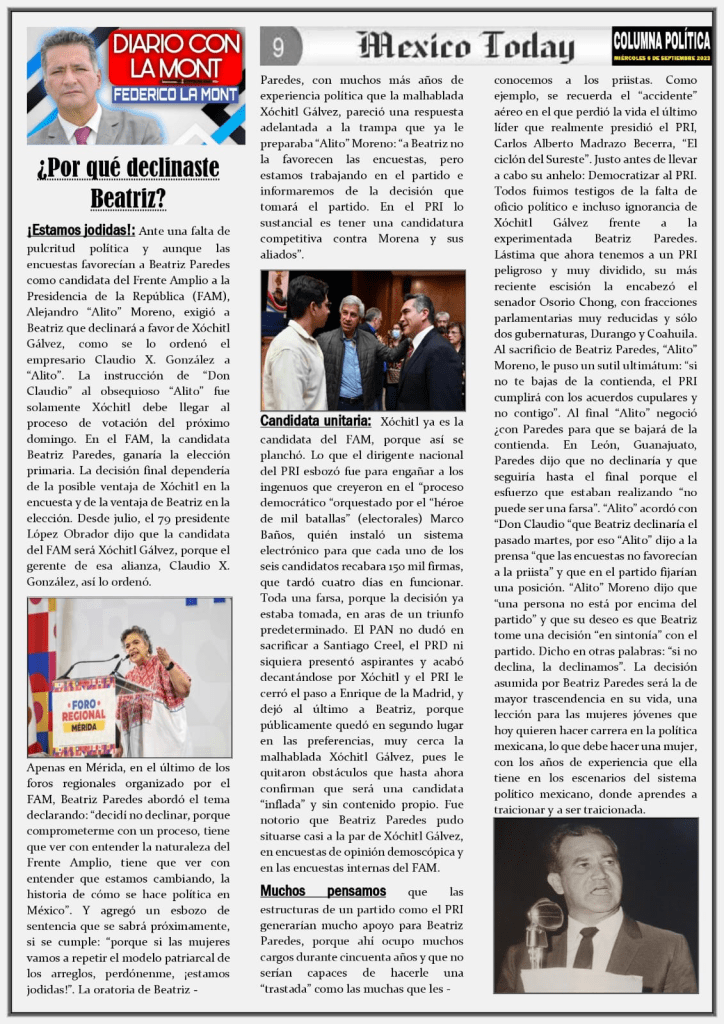
*LAS NOTICIAS CON LA MONT* 📰
📃 *Premio Internacional Periodismo Y Periodismo Migrante*📃
La Información Directa a tu Celular 📲 de HOY *Miércoles 6 de Septiembre 2023* *En El Plano Nacional e Internacional*:
*Ahora también ya estamos en la redes y síguenos a través de nuestros siguientes medios:*
– *TikTok*: https://www.tiktok.com/@federicolamontoficial?_t=8edqqgfd4ac&_r=1
*YouTube:* https://www.youtube.com/@FedericoLamontTv
*Instagram:* https://instagram.com/federicolamontoficial?utm_source=qr&igshid=ZDc4ODBmNjlmNQ%3D%3D
*Twitter:* https://twitter.com/federicolamont_?t=1JFGx2rnaadYGDPKxR_jpA&s=09
*Colaboración Especial En:* http://MexicoTodayUSA.com
*China’s Economic Pain Is a Test of Xi’s Fixation With Control*
The slowdown is posing perhaps the most sustained challenge to President Xi Jinping’s agenda in over a decade in power. He now faces a tangle of difficult choices.
In Xi Jinping’s strategy for securing China’s rise, the Communist Party keeps a firm grip on the economy, steering it out of an old era dependent on real estate and smokestack industries to a new one driven by innovation and consumer spending.
But he may have to relinquish some of that control, as that strategy comes under pressure.
Consumers are gloomy. Private investment is sluggish. A big property firm is near collapse. Local governments face crippling debt. Youth unemployment has continued to rise. The economic setbacks are eroding Mr. Xi’s image of imperious command, and emerging as perhaps the most sustained and thorny challenge to his agenda in over a decade in power.
“It’s a moment of great uncertainty, and arguably the moment of least confidence, surrounding the Xi administration,” Neil Thomas, a fellow at the Asia Society’s Center for China Analysis, said in an interview. “The worse things get for China’s economy, the more likely it is that Xi Jinping has to make some course correction.”
Earlier this year, Mr. Xi started his third term as China’s president, appearing indomitable. He had cast aside three years of bruising pandemic lockdowns and was confident that business would recover. He was committed to taming the debt-laden real estate sector even as home sales fell. And he had a new Communist Party leadership team of loyalists poised to push through his growth plans.
Mr. Xi’s government now confronts a tangle of difficult choices. On the one hand, he may have to give more freedom to private businesses and financial support to debt-saddled local governments. On the other hand, he may have to apply more of his power to push through painful steps that some experts say are needed to fix the economy and state finances, such as introducing new taxes.
Central to the country’s economic troubles is the slump in housing sales, which is at least partly the outcome of Mr. Xi’s choices. The real estate sector has been a main driver in China’s growth for more than two decades, but developers have built up daunting levels of debt, and Mr. Xi has cracked down on excessive borrowing by them. Now, as the real estate crisis ripples through the broader economy, officials have eased restrictions on home sales, and may take bigger steps.
*It’s One of Ukraine’s Fiercest Allies. But an Election Could Change That.*
The vote in Slovakia this month will be a test of European unity on Ukraine, and of Russia’s efforts to undermine it. The front-runner wants to halt arms shipments to Kyiv.
When Ukraine discovered civilian mass graves in an area recaptured from Russian troops, Russia’s ambassador in neighboring Slovakia countered with his own discovery.
The mayor of a remote Slovak village, as the ambassador announced last September, had bulldozed Russian graves from World War I. Ambassador Igor Bratchikov demanded that the Slovak government, a robust supporter of Ukraine, take action to punish the “blasphemous act.”
The Slovak police responded swiftly, dismissing the ambassador’s claims as a “hoax,” but his fabrication took flight, amplified by vociferous pro-Russian groups in Slovakia and news outlets notorious for recycling Russian propaganda.
A month later, the mayor of the village, Vladislav Cuper, lost an election to a rival candidate from a populist party opposed to helping Ukraine.
Today, the same forces that helped unseat Mr. Cuper have mobilized for a general election in Slovakia on Sept. 30 with much bigger stakes.
The vote will not only decide who governs a small Central European nation with fewer than six million people, but will also indicate whether opposition to helping Ukraine, a position now mostly confined to the political fringes across Europe, could take hold in the mainstream.
*In Its First Monopoly Trial of Modern Internet Era, U.S. Sets Sights on Google*
The 10-week trial, set to begin Tuesday, amps up efforts to rein in Big Tech by targeting the core search business that turned Google into a $1.7 trillion behemoth.
The Justice Department has spent three years over two presidential administrations building the case that Google illegally abused its power over online search to throttle competition. To defend itself, Google has enlisted hundreds of employees and three powerful law firms and spent millions of dollars on legal fees and lobbyists.
On Tuesday, a judge in U.S. District Court for the District of Columbia will begin considering their arguments at a trial that cuts to the heart of a long-simmering question: Did today’s tech giants become dominant by breaking the law?
The case — U.S. et al v. Google — is the federal government’s first monopoly trial of the modern internet era, as a generation of tech companies has come to wield immense influence over commerce, information, public discourse, entertainment and labor. The trial moves the antitrust battle against those companies to a new phase, shifting from challenging their mergers and acquisitions to more deeply examining the businesses that thrust them into power.
Such a consequential case over tech power has not unfolded since the Justice Department took Microsoft to court in 1998 for antitrust violations. But since then, companies like Google, Apple, Amazon and Meta, which owns Facebook and Instagram, have woven themselves into people’s lives to an even greater degree. Any ruling from the trial could have broad ripple effects, slowing down or potentially dismantling the largest internet companies after decades of unbridled growth.
The stakes are particularly high for Google, the Silicon Valley company founded in 1998, which grew into a $1.7 trillion giant by becoming the first place people turned to online to search the web. The government has said in its complaint that it wants Google to change its monopolistic business practices, potentially pay damages and restructure itself.
“This is a pivotal case and a moment to create precedents for these new platforms that lend themselves to real and durable market power,” said Laura Phillips-Sawyer, who teaches antitrust law at the University of Georgia School of Law.
*Record Rains Flood Greece Just as Wildfires Let Up*
The deluge caused extensive damage and a death in Greece, just as firefighters contained blazes there. Floods in Bulgaria and Turkey also led to six fatalities in total.
Torrential rain unleashed major floods in Central Greece on Tuesday that submerged streets and wreaked widespread damage, just as firefighters were containing enormous wildfires in the country. One man died, and at least one person was missing.
In neighboring Bulgaria and Turkey, at least six more died in the rain-caused flooding, including two swept away at a campsite in northwest Turkey, two in Istanbul and two on Bulgaria’s southern Black Sea coast, according to The Associated Press. Four more people of a dozen who had been vacationing at the Turkish campsite remained missing Tuesday night.
As Greek television showed semi-submerged cars stuck on flooded streets and vehicles being swept into the sea or onto muddy beaches, the police banned traffic in three regions. The ban came a day after warnings by local authorities and Greece’s fire service for people to avoid unnecessary travel during the onset of the wet front, Storm Daniel.
Greece’s fire service said a 51-year-old Albanian national died after a wall collapsed on him; state news media identified him as a cattle breeder who was trying to reach his animals. A 42-year-old Greek man was missing after getting out of his car to try to push his 16-year-old son to safety amid raging floodwaters, a fire service spokesman, Vassilis Vathrakoyiannis, said by telephone. “The boy was found in the car,” he said. “We’re still looking for the dad.”
The damage came days after major flooding elsewhere in Europe: In Spain, the slow-moving Storm Dana brought exceptional rainfall, leaving a trail of destruction and killing at least five people since Saturday.
On Saturday, two canyon experts drowned in flash flooding in a ravine in the Spanish Pyrenees, according to local news reports, when rain caused the water to increase tenfold in minutes. In Casarrubios del Monte, a village near Toledo that was drenched from Sunday night to Monday, a 20-year-old man died when floodwaters poured into an elevator where he was trapped. Two other victims near Toledo, one of whom was washed away with his car, were located on Monday.
Early Monday morning, a 10-year-old was found up a tree he had clung to all night after his family’s car fell into the Alberche River in Aldea del Fresno, a village outside Madrid that was cut off after three of its bridges collapsed and the fourth was closed. The boy had wounds and symptoms of hypothermia, according to local news reports. His mother and sister were found alive, but Spain’s Civil Guard was still searching for his father.
The storm was expected to wane by Tuesday evening, according to Spain’s weather agency, AEMET. Footage on Tuesday in the Spanish news media showed residents pumping water out of windows and sweeping mud and debris out of their front doors.
*Flooding From Cyclone in Southern Brazil Kills at Least 22*
More than 3,000 people were displaced as towns flooded in the states of Rio Grande do Sul and Santa Catarina. Rains were forecast to continue.
A cyclone battered southern Brazil early this week, killing at least 22 people, displacing 3,000 others and prompting the federal government to dispatch helicopters for rescues, the authorities said late Tuesday.
Since Sunday, the storm has brought strong winds and floods to the states of Rio Grande do Sul and Santa Catarina, submerging dozens of towns, according to the Ministry of Social Development. More than a dozen fatalities were reported in one town.
More rainfall was on the way, and some areas could get more than 11 inches of rain this week, Brazil’s National Institute of Meteorology said. Authorities also warned of further flooding near three rivers in the region.
The storm, which forecasters described as an extratropical cyclone, also spawned a tornado and winds exceeding 62 miles per hour in Santa Catarina, the state’s Civil Defense said on Tuesday.
Damage from the storm was reported in 67 municipalities across Rio Grande do Sul, where roofs were stripped off of more than 300 houses and bridges collapsed, the state government said in a statement. Of the victims, 15 were in Muçum, a small town, where houses and roads were submerged, it said.
“We are dismayed by the lethality of this weather event and mobilized to save all those still in danger,” Gov. Eduardo Leite of Rio Grande do Sul said on social media.
*You Can’t Normalize Relations With a Government That Isn’t Normal*
The more I learn about the complex peace and security deal that the Biden team is trying to put together between the United States, Saudi Arabia, Israel and the Palestinians, the more I’m convinced that if they pull it off, they’ll win both the Nobel Peace Prize and the Nobel Prize in Physics. Because finding a way to balance the different interests of all four of these parties makes quantum mechanics look as easy as tic-tac-toe.
But to make it simple for you, dear reader, given the many permutations this deal could take, let me just focus here on the only one that is in America’s interest and that I would support.
It’s a deal that would normalize relations between Israel and Saudi Arabia, forge a deeper security relationship between the United States and Saudi Arabia, and concretely advance a two-state solution between Israelis and Palestinians — but does it all on terms that would almost certainly cause the breakup of the current Israeli ruling coalition, which is led by far-right Jewish supremacists the likes of which have never held national security powers in Israel before.
Alas, though, this is not the version that Prime Minister Benjamin Netanyahu of Israel is trying to sell us. So, I want to appeal directly to President Biden and the Saudi crown prince, Mohammed bin Salman: Do not let Netanyahu make you his useful idiots. You cannot have normalization with an Israeli government that is not normal. It will never be a stable U.S. ally or Saudi partner. And right now, Israel’s government is not normal.
*The 4 Arguments You Will Hear Against Drug Price Negotiation*
President Biden recently announced the first 10 drugs that will be subject to price negotiations with Medicare. They include drugs to treat diabetes, heart disease, blood cancer, blood clots and rheumatoid arthritis — diseases that affect millions of Americans.
While government-negotiated prices will not take effect until 2026, the list of specific drugs makes this legislative centerpiece of the Inflation Reduction Act more tangible. Drug price negotiation has been prohibited since Medicare coverage of prescription drugs was first authorized. The law that created the benefit — signed by President George W. Bush in 2003 — explicitly prohibited the government from directly negotiating prices, a testament to the historical political power of the pharmaceutical industry. Things have changed.
Although more limited in scope than advocates had originally hoped for — among other things, they wanted drug price reductions to apply to everyone, not just those in Medicare, and to apply to far more drugs — the passage of the I.R.A. was a momentous political victory by Democrats over Big Pharma. (No Republicans voted for it.) And it’s a victory President Biden and other Democrats are expected to trumpet on the campaign trail.
While the drug companies that make the 10 drugs subject to negotiation are expected to start engaging with the government, the industry is publicly attacking the program and has filed a slew of lawsuits to block the government from implementing it.
The issues raised by critics can be complex and nuanced, involving trade-offs not always easily condensed into sound bites. Here are some of the arguments you’re likely to hear against drug price negotiation and the context necessary to evaluate them.
Argument 1: Government-negotiated drug prices will harm innovation and result in fewer lifesaving drugs.
The idea that curbs on drug pricing will stifle innovation has long been the pharmaceutical industry’s go-to argument. At some level, the drugmakers might be right: Lower prices mean lower profits, and that will be less attractive to investors. Drug development is a risky business, and the appeal for investors is the big potential payoff fueled by higher prices.
But it’s reasonable to ask how many fewer drugs might get developed and which drugs those might be.
The Congressional Budget Office, the economic referee in legislative debates, estimated that the drug pricing provisions of the I.R.A. would result in 13 fewer drugs coming to market in the United States over the next three decades. That’s a very small share of the 1,300 new drugs expected over that period. Some of those forgone drugs might be potential lifesaving treatments, but some might be drugs that offer only marginal health benefits. It’s impossible to know for sure.
One of the big reasons any effects on innovation may be muted is that drugs are shielded from government negotiation for quite a while: until nine years after Food and Drug Administration approval for small-molecule drugs like pills and 13 years for injectable biological products. Drugmakers can continue to set their own prices and reap substantial profits before having to submit to negotiation.
*Panorama Nacional*
1.- Excélsior
Morena construye unidad para 2024.
2.- El Universal
Recorte a jueces causara de retroceso de 6 años.
3.- El Heraldo
Diputados eliminan doble congreso.
4.- Reforma
Darán a militares aeropuerto de Toluca.
*Economía*
5.- El Economista.
Recaudación del SAT de enero a agosto creció 7.5% anual, con casi $3 billones.
6.- MILENIO
Pega superpeso a migrantes, que ahora necesitan segundo empleo.
*Internacional*
7.- Washington Post
Campaña antiaborto se topa con un nuevo obstáculo
*Opinón*
8.- Carlos Loret de Mola / El odio a los dueños de los medios
9.- Raymundo Riva Palacio / Entregará el bastón, pero ¿y el mando?
::::::::::::::::::::::::::::::::::
DIVISAS
💵 DÓLAR 17.35
(+0.01%)
💶EURO 18.63
(+0.58%)
💷LIBRA ESTERLINA 21.57
(+0.36%)
⛽ PETRÓLEO USD 83.00
(+3.80%)
*ATENTAMENTE*
*MAESTRO FEDERICO LA MONT*
Sent from my iPod
LAS NOTICIAS CON LA MONT* 📰
📃 *Premio Internacional Periodismo Y Periodismo Migrante*📃
La Información Directa a tu Celular 📲 de HOY *Viernes 1 de Septiembre 2023* *En El Plano Nacional e Internacional*:
*Ahora también ya estamos en la redes y síguenos a través de nuestros siguientes medios:*
– *TikTok*: https://www.tiktok.com/@federicolamontoficial?_t=8edqqgfd4ac&_r=1
*YouTube:* https://www.youtube.com/@FedericoLamontTv
*Instagram:* https://instagram.com/federicolamontoficial?utm_source=qr&igshid=ZDc4ODBmNjlmNQ%3D%3D
*Twitter:* https://twitter.com/federicolamont_?t=1JFGx2rnaadYGDPKxR_jpA&s=09
*Colaboración Especial En:* http://MexicoTodayUSA.com
*Putin and Erdogan will meet as grain talks appear stalled.*
President Vladimir V. Putin of Russia and his Turkish counterpart, Recep Tayyip Erdogan, are set to meet in Russia next week, the Kremlin said on Friday, as international efforts to revive a deal that allowed Ukraine to export grain through the Black Sea appear to be stalled.
The announcement by Dmitri S. Peskov, the Kremlin spokesman, had been long anticipated and came a day after talks between the countries’ top diplomats in Moscow ended with no apparent progress in restoring the grain deal.
Russia dropped out of the agreement, which was mediated by Turkey and the United Nations, about six weeks ago, complaining that it was being carried out unfairly, and has since repeatedly bombarded Ukrainian grain facilities and threatened civilian ships heading to Ukrainian ports.
Turkey’s foreign minister, Hakan Fidan, said on Thursday that his government was still working with the United Nations to try to resurrect the agreement in a way that would take Russian demands into account. The United Nations secretary general, António Guterres, told reporters he had sent the Russian foreign minister, Sergey V. Lavrov, proposals to revive the agreement, known as the Black Sea Grain Initiative.
Moscow is pushing its own plan, one that would allow Russia to ship grain directly to Turkey, which would then deliver the goods to food-insecure nations. That would allow Moscow to profit from its grain, though it leaves Ukraine out entirely.
Ukraine has a separate proposal to Turkey and the United Nations to revive grain shipments without Moscow’s participation. On Thursday, its Ministry of Foreign Affairs said in a statement that “supporting Russian grain exports in the Black Sea without resuming Ukrainian grain exports from Ukrainian ports would deal a severe blow to international obligations and international law.”
Mr. Peskov said that the meeting between the Russian and Turkish leaders would take place on Monday in Sochi, a Russian Black Sea resort where they held a four-hour session last August during which they discussed the grain deal, which had just been finalized, and gas exports, and promised to strengthen economic ties.
Mr. Erdogan has served as an emissary of sorts to Mr. Putin, to the occasional consternation of his allies in NATO, the Western alliance that Russia considers one of its primary foes. Russia, which has been searching for ways to evade Western sanctions over its invasion of Ukraine, sees its relationship with Turkey as a possible route to easing the penalties.
Employers added 187,000 jobs in August, and unemployment rose to 3.8%.
The United States added 187,000 jobs in August but the unemployment rate jumped unexpectedly, reflecting the impact of high interest rates and the U.S. economy’s gradual cooling from the boom that followed pandemic lockdowns.
The data, reported Friday by the Labor Department, is the latest indication that hiring has weakened over the summer. After a run of 29 months in which job growth never dipped below 200,000, seasonally adjusted, the last three months have all fallen short of that mark.
The unemployment rate rose to 3.8 percent from 3.5 percent in July, likely for a good reason: More people started to look for work. The job growth figures for June and July were revised down by a combined 110,000 jobs, contributing to a picture slightly weaker than it previously appeared.
Still, there is no sign of an imminent recession that would result in widespread joblessness, and the August gain was still significantly above the number of jobs required to absorb flow of people into the labor force. Hourly earnings rose 4.3 percent over the month, slightly less than expected, and mostly level with the pace of wage growth since the spring.
The recent hiring figures are subject to further revision, but the generally smooth downward trend is a sign that while the labor market isn’t as hot as it was during the height of the pandemic recovery, it may be stabilizing in a better place than it was before 2020.
“The good news is, it’s a normal that favors workers more than we’re used to over the past 25 years,” said Justin Bloesch, an assistant professor of economics at Cornell University. Moreover, he noted, stability has its own benefits: People are more likely to be part of the work force if they feel confident they’ll be able to stay there awhile.
“This is where we start to get to the time where the duration of a good labor market matters more than how good,” Dr. Bloesch said.
Much of the slowdown has come from industries that are returning to more typical levels after the pandemic’s upheaval. Exhibit A: truck transportation, which grew to serve a stay-at-home online shopping spree and shrank as it died down. Trucking company payrolls have flattened out, which probably masks an outright decline since many contracted owner-operators have also parked their rigs.
The bankruptcy of Yellow, which employed about 30,000 drivers and other staff members, probably accelerated that process as the amount of available work has shrunk.
“The truck job market has gone from excruciatingly tight in 2021 and the first half of 2022 to being as loose as it’s been since sometime shortly after the Great Recession,” said Kenny Vieth, president and senior analyst at ACT Research. “With Yellow taking 20-plus-thousand drivers out of the market, it’s a start in getting supply under control.”
Those shifts are evident in the overall number of job openings per unemployed worker, which declined to about 1.5 in July from more than two in early 2022, indicating that employers’ appetite for labor is nearly sated. The average number of hours worked per week has also fully receded, with overtime becoming less essential as payrolls have filled out.
*Tourists Were Told to Avoid Maui. Many Workers Want Them Back.*
A plunge in tourism after a disastrous fire has already crippled the economy in Maui. Now, some locals who wanted visitors to stay away are urging them back.
In the first few days after an inferno leveled the Hawaiian town of Lahaina, the directive to tourists was emphatic: Stay away. And tourists, with a few exceptions, complied.
As it turns out, maybe too well.
Nearly a month after the fire, Maui, a tourism-dependent island with a hotel room for every seven and a half households, is hosting fewer visitors than at any point since the coronavirus pandemic. Pristine beaches sit empty, even those that are many miles from Lahaina. Hundreds of unused rental cars are parked in fields near the island’s main airport in Kahului, where planes arrive half full. Beds are made and pillows are fluffed in hotel rooms where no one has laid a head in weeks.
All of it means that the workers who form the backbone of Hawaii’s welcoming aloha spirit are now struggling. In some of Maui’s fanciest resorts, employees are being sent home with no work and no pay.
“Right now, it’s hard to think about the future and if we’re going to make next month’s rent,” said Owen Wegner, a line cook at the Grand Wailea resort in South Maui, some 30 miles outside the burn zone. He has only been called in to work two shifts in the past two weeks.
Mr. Wegner, 20, was born and raised in Lahaina and used to play a snare drum during parades down Front Street, the town’s once-idyllic commercial thoroughfare along the ocean. The fire on Aug. 8 turned the street into a graveyard of charred cars and burned buildings — and became the nation’s deadliest wildfire in a century, claiming at least 115 lives. Among them was Mr. Wegner’s grandmother, Lynn Manibog, who had helped raise him.
Mr. Wegner has had almost no time to grieve. Instead, he has been trying to figure out how to provide for his partner, Sabrina Kaitlyn Cuadro; their 1-year-old son and their daughter, who is due to be born on Sept. 5. That’s also the last day they can pay their monthly rent before late fees kick in.
“Me and her are under a lot of stress,” Mr. Wegner said.
The implosion of Maui’s economy, of which tourism comprises about 40 percent, has been swift and severe. State economic officials estimate that the island is seeing about 4,250 fewer visitors each day than normal, representing a loss of $9 million a day. In South Maui, seven of every 10 hotel rooms sit empty, compared with about two in 10 during normal times.
*Cats With Bird Flu? The Threat Grows.*
The global H5N1 avian flu outbreak, already devastating wild birds and poultry, keeps spreading to mammals, bringing it one step closer to a potential human outbreak.
Of course, since the coronavirus pandemic taught us the importance of responding early and aggressively to outbreaks …
Sorry, I’m joking. We don’t seem to have learned much from the Covid outbreak, and it’s not funny.
Not enough has been done about an out-of-control H5N1 outbreak at fur farms in Finland or a mystery outbreak among domestic cats in Poland.
Finland, one of Europe’s biggest fur producers, is battling outbreaks among its captive minks, foxes and raccoon dogs — species that scientists warn have been identified as more likely to evolve a variant that can infect people, leading to a human outbreak.
Even the Finnish Food Authority, in its announcement of animals being culled, noted that minks are susceptible to both human and avian influenza. If one animal is infected by both, the viruses can mix genes and give rise to an avian flu that can infect humans. Fur farms in Finland, however, aren’t being closed. Instead the Finnish Wildlife Agency allowed fur breeders to kill wild birds near their farms in large numbers. The Agency told me the killings were authorized “to prevent contacts between infected birds and animals at fur farms,” but scientists point out this is the wrong approach and likely futile — and more fur farms in Finland have since announced further outbreaks.
Meanwhile, officials said a sizable outbreak of H5N1 among pet cats in Poland this summer killed at least 29 animals, though cat owners have compiled lists with as many as 89 sick animals. The outbreak has many unusual features that make it especially concerning, and yet there still hasn’t been an explanation of how exactly it happened or a vigorous investigation.
The affected cats lived in different areas of Poland, yet their viruses had almost identical genetic sequences. They obviously couldn’t have infected one another. Wild birds are unlikely to be the source, especially since some of the cats never went outside and the outbreak was not detected in Poland’s neighbors. It seems clear that the outbreak originated from a source in Poland.
Scientists and cat owners suspect cat food.
In a further twist, the virus from all the sick cats in Poland had two specific genetic mutations found almost exclusively among mammals, so either all the cats were infected and then their viruses independently developed these mutations or the two mutations were already in whatever infected them.
Tom Peacock, who studies influenza at Britain’s Imperial College, told me the most likely scenarios were that either the cats were eating mammal meat from sick animals or meat from birds where the virus had somehow developed these mutations that are normally associated with mammalian adaptation.
Either of these options is alarming, and we still lack answers about how all these geographically separated cats got infected with H5N1.
Scientists in Poland were able to test only five samples of food, and a single sample — chicken meat meant for human consumption that was also being fed to the cat — turned out to be positive for H5N1. However, as the scientific report notes, it’s only one sample, which could have been contaminated after the animal got sick in the household.
H5N1 was also detected recently in two cat shelters in Seoul, South Korea. The authorities suspected cat food as the source and recalled two varieties from one brand. While the investigation there may yield some answers, the situation differs from Poland’s since the Korean cats lived in the same place.
*#La Polémica | No coman ansias, #MORENA frena a aspirantes #Edomex*
La #Opinión de #Daniel Camargo en #Cuestión De Polémica
💯Aprueban nueva Ley orgánica del Edomex
🤔Veremos si no se les hace bolas el engrudo
🚦En Edomex comenzó efervescencia electoral
💔MORENA pide a aspirantes esperar el 2024
https://www.cuestiondepolemica.com/la-polemica-no-coman-ansias-morena-frena-a-aspirantes/
🇲🇽🤚🏻Desde #Edomex, trataron de reventar elección del #FrenteAmplio
Una fuente cercana, me comenta que fueron varios los presidentes municipales y diputados locales y federales que ordenaron a sus allegados darse de alta en el padrón que integró el Frente Amplio por México
https://www.cuestiondepolemica.com/desde-edomex-trataron-de-reventar-eleccion-del-frente-amplio/
*ATENTAMENTE*
*MAESTRO FEDERICO LA MONT*
Sent from my iPod
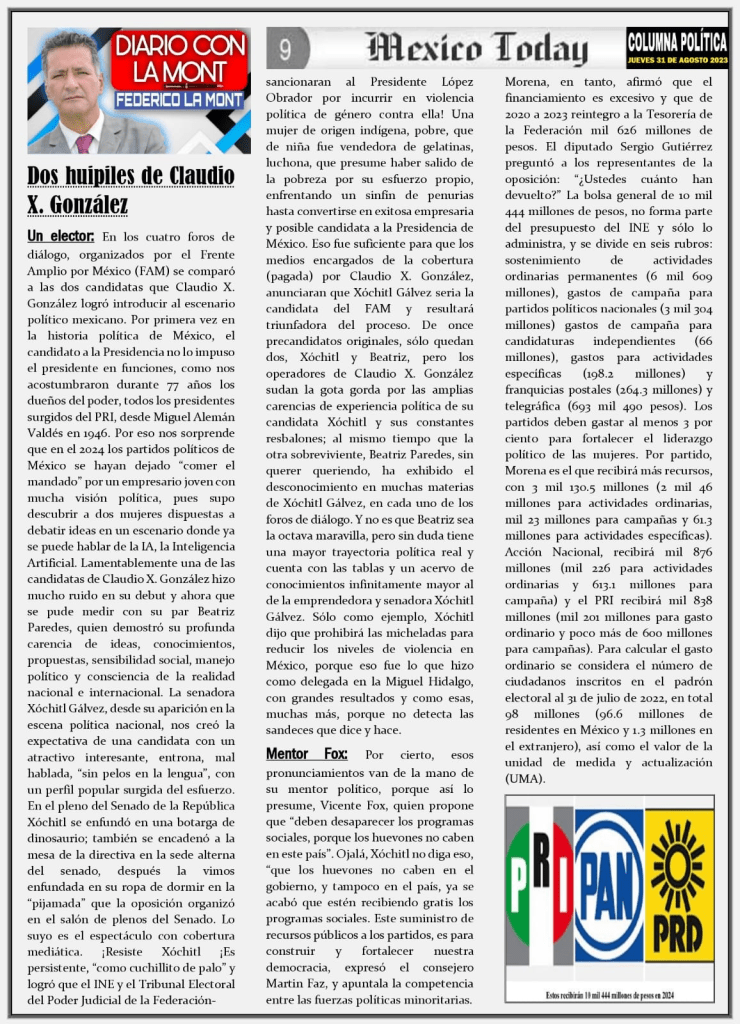
LAS NOTICIAS CON LA MONT* 📰
📃 *Premio Internacional Periodismo Y Periodismo Migrante*📃
La Información Directa a tu Celular 📲 de HOY *Jueves 31 de Agosto 2023* *En El Plano Nacional e Internacional*:
*Ahora también ya estamos en la redes y síguenos a través de nuestros siguientes medios:*
– *TikTok*: https://www.tiktok.com/@federicolamontoficial?_t=8edqqgfd4ac&_r=1
*YouTube:* https://www.youtube.com/@FedericoLamontTv
*Instagram:* https://instagram.com/federicolamontoficial?utm_source=qr&igshid=ZDc4ODBmNjlmNQ%3D%3D
*Twitter:* https://twitter.com/federicolamont_?t=1JFGx2rnaadYGDPKxR_jpA&s=09
*Colaboración Especial En:* http://MexicoTodayUSA.com
*Scenes From Johannesburg: A Deadly Fire Downtown Kills Scores*
The blaze struck an abandoned building that had become a crowded squatter settlement. The authorities were investigating the cause.
A fire consumed a crowded five-story building in downtown Johannesburg early on Thursday, tearing through an informal settlement of homeless people in what was being described as one of the deadliest blazes in South African history.
Owned by the city, the building once provided emergency housing for women but had become home to a large squatter camp, a sign of the scarcity of affordable housing in South Africa’s most populous city.
These are photographs from the fire and its aftermath.
The settlement, pictured here in May, had become a visible symbol of the city’s struggle to address a housing crisis.
*Pope Says a Strong U.S. Faction Offers a Backward, Narrow View of the Church*
In unusually sharp remarks published this week, Pope Francis said some conservative American Catholics wrongly ignore much of the Church’s mission and reject the possibility of change.
Pope Francis has expressed in unusually sharp terms his dismay at “a very strong, organized, reactionary attitude” opposing him within the U.S. Roman Catholic Church, one that fixates on social issues like abortion and sexuality to the exclusion of caring for the poor and the environment.
The pope lamented the “backwardness” of some American conservatives who he said insist on a narrow, outdated and unchanging vision. They refuse, he said, to accept the full breadth of the Church’s mission and the need for changes in doctrine over time.
“I would like to remind these people that backwardness is useless,” Francis, 86, told a group of fellow Jesuits early this month in a meeting at World Youth Day celebrations in Lisbon. “Doing this, you lose the true tradition and you turn to ideologies to have support. In other words, ideologies replace faith.”
His words became public this week, when a transcript of the conversation was published by the Vatican-vetted Jesuit journal La Civiltà Cattolica.
His comments were an unusually explicit statement of the pope’s longstanding lament that the ideological bent of some leading American Catholics has turned them into culture warriors rather than pastors, offering the faithful a warped view of Church doctrine rather than a healthy, well-rounded faith. It has become a major theme of his papacy that he sees himself as bringing the church forward while his misguided conservative critics try to hold it back.
In 2018, in a major document called an apostolic exhortation on the subject of holiness, Francis explicitly wrote that caring for migrants and the poor is as holy a pursuit as opposing abortion. “Our defense of the innocent unborn, for example, needs to be clear, firm and passionate,” he wrote. “Equally sacred, however, are the lives of the poor, those already born, the destitute, the abandoned.”
He has urged priests to welcome and minister to people who are gay, divorced and remarried, and he has called on the whole world to tackle climate change, calling it a moral issue. Francis is set to travel on Thursday to Mongolia for a trip that will highlight interreligious dialogue and the protection of the environment — issues far from the top of the priority list for many American conservatives.
For nearly a decade, Francis’ conservative critics have accused him of leading the church astray and of diluting the faith with a fuzzy pastoral emphasis that blurred — or at times erased — the Church’s traditions and central tenets. Some U.S. bishops have issued public warnings about the Vatican’s direction, with varying degrees of alarm, and clashed with the pope over everything from liturgy and worship styles, to the centrality of abortion opposition in the Catholic faith, to American politics.
*Scorching Heat Is Contributing to Migrant Deaths*
Amid a relentless heat wave, some migrants are succumbing to heat exhaustion. More than 500 people have died of various causes this year while trying to cross from Mexico.
On patrol in the harsh brush along the border in South Texas, Deputy Don White of the Brooks County Sheriff’s Office paused to study some empty water jugs, torn clothing and several indistinct footprints, looking for signs of migrants who might have been lost in the scorching heat.
Through the long summer, temperatures have lingered for days at a time at 100 degrees or higher. The heat has been stifling for many Texans, but deadly for some of those making their way through the hot, barren shrub land where migrants travel to avoid detection from Border Patrol agents.
“These are old,” Deputy White said, gesturing at the faint tracks in the dirt. “No one is in danger right now.” For now, at least, he said under his breath.
Fewer people are crossing from Mexico this year compared with last year, but already there have been more than 500 deaths in 2023 — confirmed by the discovery of bodies or partial remains by Deputy White and others like him as they conduct their grim patrols. In 2022, among the deadliest in recent years, there were 853 confirmed deaths.
Tracking migrant deaths is an imperfect science. Many drown trying to cross the Rio Grande; others succumb to sweltering desert conditions or a lack of water, with their deaths ultimately attributed to dehydration, heat stroke or hypothermia. The unrelenting heat this summer in Texas, combined with suffocating humidity, has contributed to many of the fatalities, local and federal officials said.
“It would be dangerous to be out there for several hours,” said Jeremy Katz, a meteorologist with the National Weather Service in Brownsville, Texas.
*China’s Disinformation Fuels Anger Over Fukushima Water Release*
By exaggerating the risks from Japan’s discharge of treated wastewater, Beijing hopes to cast Japan and its allies as conspirators in malfeasance, analysts say.
In Guangdong Province, on China’s southern coast, a woman posted a photo of a boxed-up Japanese-brand air-conditioner that she planned to return in protest. In southwest China, the owner of a Japanese pub posted a video of himself ripping down anime posters and smashing bottles, saying he planned to reopen the business as a Chinese bistro.
In many social media posts like these, the phrase “nuclear-contaminated wastewater” has appeared — the same wording used by the Chinese government and state media to refer to Japan’s release into the ocean of treated radioactive water from the ruined Fukushima Daiichi nuclear power plant.
Even before Japan started pumping out the first tranche of more than a million tons of wastewater last week, China had mounted a coordinated campaign to spread disinformation about the safety of the release, stirring up anger and fear among millions of Chinese.
The water discharge, 12 years after the nuclear plant was wrecked by a massive earthquake and tsunami, spurred China to fall back on its old playbook of fomenting diplomatic mayhem with its Asian rival. In 2012, Chinese demonstrators, apparently escorted by the police, attacked sushi restaurants after Japanese activists landed on an island that both China and Japan claim as their own.
But, this time, Beijing may have a broader agenda. As the global order has shifted drastically, with China and the United States increasingly seeming to divvy up the world into an us-versus-them framework, experts say China is seeking to sow doubts about Japan’s credibility and cast its allies as conspirators in malfeasance.
With the United States, the European Union and Australia all supporting Japan’s water release, China wants to project a narrative that Japan and its international partners are “so driven and dominated by geopolitical interests that they are waiting to compromise basic ethical standards and international norms and ignore science,” said Tong Zhao, a senior fellow in the nuclear policy program at the Carnegie Endowment for International Peace.
*Rare Protests in Syria Summon Echoes of Arab Spring*
After 12 years of conflict, anger over growing economic hardships has boiled over. Protesters are demanding the ouster of the authoritarian President Bashar al-Assad and an end to the war.
Rare protests in Syria calling for the ouster of the authoritarian government have gathered momentum over the past two weeks, in scenes reminiscent of the Arab Spring uprising that began more than 12 years ago and morphed into a multisided war.
The protests grew out of anger over increasing economic hardships that boiled over into demands for a political settlement to the war, which is largely at a stalemate. They have grown daily, drawing hundreds of people who at times have torn down the ubiquitous posters of President Bashar al-Assad and shuttered offices of the political party loyal to him.
The demonstrations began in the south and spread, even briefly touching the capital, Damascus, and another major city, Aleppo. Most are in government-held areas, far from the front lines of the war in the northwest, where there is still sporadic fighting between government and opposition forces.
The trigger was a government decision this month to slash fuel subsidies, which more than doubled the cost of gasoline. But Syrians are also venting more than a decade of accumulated grievances over government violence and worsening living standards, according to videos from the protests and interviews with people who are following the movement.
“This was the spark for the uprising,” said Rayan Maarouf, editor of the local media group Suwayda24, referring to the fuel subsidy cuts. “But people came out into the streets not calling for this decision to be reversed. They came out into the street to call for the fall of the regime because they realized that the situation won’t change without a change to the political situation.”
A new round of demonstrations are planned across the country on Friday.
Syrian state media has not addressed the protests. But Mr. al-Assad, in a recent interview with the British broadcaster Sky News, reiterated his long-stated positions, blaming destruction in the country on terrorists and claiming that only foreign forces, and never Syrians, had pushed for him to go.
More than a decade of conflict has left Syria divided and mired in economic crisis. Mr. al-Assad has managed over the years to wrest back control over the vast majority of the country, but opposition forces and U.S.-backed Syrian Kurdish fighters still control swaths of the north and east.
Anger in government-controlled territory has been building for years as the economic situation deteriorates. About 90 percent of Syrians are living below the poverty line and about 70 percent — 15.3 million people — need humanitarian assistance, according to the United Nations.
*10 Nutrition Myths Experts Wish Would Die*
We surveyed some of the country’s leading authorities to reveal the truth about fat, dairy, soy and more.
Soy milk can raise the risk of breast cancer. Fat-free foods are healthier than high-fat foods. Vegans and vegetarians are deficient in protein. Some false ideas about nutrition seem to linger in American culture like a terrible song stuck in your head.
So to set the record straight, we asked 10 of the top nutrition experts in the United States a simple question: What is one nutrition myth you wish would go away — and why? Here’s what they said.
Myth No. 1: Fresh fruits and vegetables are always healthier than canned, frozen or dried varieties.
Despite the enduring belief that “fresh is best,” research has found that frozen, canned and dried fruits and vegetables can be just as nutritious as their fresh counterparts.
“They can also be a money saver and an easy way to make sure there are always fruits and vegetables available at home,” said Sara Bleich, the outgoing director of nutrition security and health equity at the U.S. Department of Agriculture and a professor of public health policy at the Harvard T.H. Chan School of Public Health. One caveat: Some canned, frozen and dried varieties contain sneaky ingredients like added sugars, saturated fats and sodium, Dr. Bleich said, so be sure to read nutrition labels and opt for products that keep those ingredients to a minimum.
Myth No. 2: All fat is bad.
When studies published in the late 1940s found correlations between high-fat diets and high levels of cholesterol, experts reasoned that if you reduced the amount of total fats in your diet, your risk for heart disease would go down. By the 1980s, doctors, federal health experts, the food industry and the news media were reporting that a low-fat diet could benefit everyone, even though there was no solid evidence that doing so would prevent issues like heart disease or overweight and obesity.
*ATENTAMENTE*
*MAESTRO FEDERICO LA MONT*
Sent from my iPod
*LAS NOTICIAS CON LA MONT* 📰
📃 *Premio Internacional Periodismo Y Periodismo Migrante*📃
La Información Directa a tu Celular 📲 de HOY *Miércoles 30 de Agosto 2023* *En El Plano Nacional e Internacional*:
*Ahora también ya estamos en la redes y síguenos a través de nuestros siguientes medios:*
– *TikTok*: https://www.tiktok.com/@federicolamontoficial?_t=8edqqgfd4ac&_r=1
*YouTube:* https://www.youtube.com/@FedericoLamontTv
*Instagram:* https://instagram.com/federicolamontoficial?utm_source=qr&igshid=ZDc4ODBmNjlmNQ%3D%3D
*Twitter:* https://twitter.com/federicolamont_?t=1JFGx2rnaadYGDPKxR_jpA&s=09
*Colaboración Especial En:* http://MexicoTodayUSA.com
*Today’s Top News: Florida Braces for Hurricane Idalia, and More*
Exclusively from New York Times Audio, our new app.
The New York Times Audio app is home to journalism and storytelling, and provides news, depth and serendipity. If you haven’t already, download it here — available to Times news subscribers on iOS — and sign up for our weekly newsletter.
The Headlines brings you the biggest stories of the day from the Times journalists who are covering them, all in about 10 minutes. Hosted by Annie Correal, the new morning show features three top stories from reporters across the newsroom and around the world, so you always have a sense of what’s happening, even if you only have a few minutes to spare.
*Trump Could Clinch the Nomination Before the G.O.P. Knows if He’s a Felon*
The federal election interference case — one of four — is set to start just before Super Tuesday and a cascade of consequential primaries.
By the time Donald J. Trump is sitting at his federal trial on charges of criminally conspiring to overturn the 2020 election, he may have already secured enough delegates to effectively clinch the Republican Party’s 2024 presidential nomination.
The former president’s trial is scheduled to start March 4, by which point five states are expected to have held nominating contests. The next day, March 5, is Super Tuesday, when 15 states, including delegate-rich California and Texas, plan to hold votes that will determine if any Trump challenger has enough political oxygen to remain a viable alternative.
Primaries in Florida, Ohio and Illinois come two weeks later. Florida and Ohio will be the first winner-take-all contests, in which the top vote-getter statewide seizes all of the delegates rather than splitting them proportionally. Winner-take-all primaries have historically turbocharged the front-runner’s path to the presidential nomination. Mr. Trump’s federal trial, if it proceeds on its current timeline, won’t be close to finished by then.
The collision course between the Republican Party’s calendar and Mr. Trump’s trial schedule is emblematic of one of the most unusual nominating contests in American history. It is a Trump-dominated clash that will define not only the course of the 2024 presidential primary but potentially the future direction of the party in an eventual post-Trump era.
“It’s a front-runner set of rules now,” said Clayton Henson, who manages the ballot access and delegate selection process for the Trump campaign, which has been instrumental in rewriting the rules to benefit him.
Mr. Trump has complained the March 4 start date of the trial amounts to “election interference” and cited Super Tuesday, but it is likely to have a greater effect on his ability to campaign for primaries in subsequent weeks. About 60 percent of the delegates will be awarded from contests after Super Tuesday.
Generally, defendants are required to be present in the courtroom at their trials. After preliminary matters such as jury selection, prosecutors in Mr. Trump’s election case have estimated they will need about four to six weeks to present their case, after which defense lawyers will have an opportunity to call additional witnesses.
That timeline also means it is likely that a majority of the delegates will have been awarded before a jury determines Mr. Trump’s fate.
*Trump Joins George Washington, John Quincy Adams and Barack Obama*
Eagerly anticipated and immediately meme-ified, the mug shot of Donald Trump that the Fulton County Sheriff’s Office circulated last week was in some ways utterly conventional: a head-and-shoulders view with unflattering lighting and a law enforcement logo in the corner.
In nearly every other way, of course, the image is singular, a photograph for the ages, one that will forever punctuate this moment in the history of the presidency. But that wasn’t its only contribution to posterity.
In ways that have been less widely noted, it is also an important new entry in the history of presidential portraits, whose significance lies in how they invite us to think not just about our leaders but also about the nation itself.
Both politically and symbolically, any president represents the nation; by some significant measure, then, his image is its image. In its mood and in the circumstances of its creation, Mr. Trump’s mug shot initially seems like a jarring disconnect from the most august traditions of presidential portraits, with their carefully constructed air of gravitas. But in its effect, and in the way its subject has begun to deploy it, the picture is the natural evolution of all the images that came before it.
Since the first days of the Republic, portraits of our commanders in chief have proved to be important and versatile political tools. Few presidents have failed to note their power. George Washington was known to proudly display his portraits to Mount Vernon visitors, while Barack Obama surprised many by selecting the painter Kehinde Wiley in a clear bid to define himself — visually as well as politically — as something new.
The standard line is that successful presidential images make their subjects look strong, active and, above all else, presidential. When we look deeper, however, we find that the history is more complex and consequential. Time and time again, presidents have wrestled with or in some cases openly fought back to challenge the ways they were being pictured. They sought control. By that standard, Mr. Trump’s mug shot is no outlier. Not all presidential portraits look like the ones hanging in our museums.
*The Blue Supermoon: A Gem in the Night Sky*
The next full moon, the second this month, is a celestial rarity. It will also be bigger and brighter than usual.
The lunar fanfare of August is wrapping up with a treat: a blue supermoon that will occur on Wednesday at 9:36 p.m. Eastern time.
The blue moon is the second of two full moons in a single month. Each month usually hosts only one full moon, but blue moons sometimes arise because the lunar cycle is 29.5 days long — just short of the length of an average calendar month. This difference means that some months see two full moons.
That is exactly what will happen in August: The first full moon popped up on Aug. 1, and the second will come the evening of Aug. 30.
What is a blue supermoon?
A supermoon occurs when the full moon phase of the lunar cycle syncs up with the perigee, or when it is nearest to the Earth. Supermoons appear brighter and bigger than regular full moons. According to NASA, the apparent size increase is 14 percent, which is about the difference between a nickel and a quarter.
Supermoons are generally seen every three or four months. This one will be the third this year and the second this August. Blue moons, on the other hand, only happen every two or three years (hence the phrase “once in a blue moon”). Blue supermoons are even rarer, occurring once every 10 years or so. The last one was in 2018 during a lunar eclipse, and the next blue supermoons will occur as a pair in 2037.
Will the moon actually look blue?
No. The term “blue moon” doesn’t really describe its color, and the moon will mostly appear to be its usual milky gray. (Certain phenomena, like wildfires and volcanic eruptions, can tint the moon blue, the same visual effect that gave North American skies an orange hue this summer.)
According to NASA, the term “blue moon” used to refer to the third full moon in a season that had four full moons. The newer definition — the second full moon in a month — was coined by the magazine Sky & Telescope in 1946.
How can I see it?
Unlike some other celestial events, everyone on Earth sees the same phases of the lunar cycle at night, so the blue supermoon will be visible everywhere. That means all you have to do is look up at the night sky to see it. NASA recommends using binoculars or a telescope to see more of the moon’s texture.
In the United States, the moon will appear full on Tuesday, Wednesday and Thursday night. On Wednesday evening, you might also spot a bright dot to the upper right of the moon. That’s Saturn, a few days shy of reaching its closest point to Earth. The ringed planet will swing clockwise around the moon during the night.
*Pressure Mounts on Spanish Soccer Chief Over Nonconsensual Kiss at World Cup*
Luis Rubiales has defied calls to resign, now echoed by his own federation. Soccer’s world governing body has suspended him, and prosecutors have opened an investigation.
The pressure is growing on Luis Rubiales, president of Spain’s national soccer federation, to quit, nine days after he forcibly kissed a member of the country’s victorious women’s World Cup team, igniting a national controversy over sexism in soccer and prompting calls for his resignation from government ministers.
Spanish prosecutors opened a preliminary investigation on Monday into whether the kiss on Jennifer Hermoso, a star forward, had been an act of sexual aggression — a crime punishable by years in prison. In an emergency meeting that stretched into Monday night, the federation unanimously called on him to step down immediately. And in Madrid, hundreds of people took to the streets, waving red cards and demanding Mr. Rubiales’s resignation. FIFA, the soccer world’s governing body, has already provisionally suspended him.
But the embattled soccer chief has given no sign he would change course since he forcefully defended himself in a speech on Friday, telling his federation five times in a row, “I will not resign.”
Mr. Rubiales later traveled to his hometown, Motril, in southern Spain. There, his mother has been on a hunger strike in a church since Monday, protesting what she told reporters was an “inhumane and bloody hunt” against her son, according to the Spanish wire service EFE. On Tuesday, wearing the same dress as the day before and visibly tired, she said in a news conference inside the church, “I just want Jenni to tell the truth.”
Responding to a call from Mr. Rubiales’s family, about 200 people congregated outside the church in a show of support on Monday, Spanish news outlets reported, citing a police estimate.
Mr. Rubiales has insisted that the kiss was “spontaneous, mutual, euphoric and consensual.” But Ms. Hermoso described it as “an impulse-driven, sexist, out-of-place act without any consent on my part.”
The protest and hunger strike were for a man who at first denounced his critics as losers, then offered what some called a weak apology, and then hunkered down as the controversy swirled in Spain, where some soccer players and feminist activists have said the kissing episode encapsulated the male entitlement and entrenched sexism that have long plagued soccer.
Mr. Rubiales, 46, who was born in the Canary Islands and raised in Motril, began playing for his local soccer club at age 14, according to a biography on the soccer federation’s website. He never became a household name playing for clubs in Spain and Scotland, but had a professional career in the Spanish league.
Javier Paredes, a former defender who played for several Spanish clubs, recalled encountering Mr. Rubiales on the soccer field. “He was never going to be Messi or Zidane, but anyone who has played in the first division has my respect,” Mr. Paredes said.
But Mr. Rubiales later found success off the field. During the 2008 global financial crisis, when his team, Levante UD, ran into financial troubles, Mr. Rubiales led a team strike to ensure that he and his teammates got paid.
He then became chief of the Spanish soccer players’ association in 2010, according to his official biography. It was seen as a natural career move for Mr. Rubiales, who was viewed by many teammates as “someone who could defend their rights,” according to Christian Lapetra, a former member of the governing board of the Spanish soccer federation.
Mr. Rubiales took over the presidency of the Royal Spanish Football Federation — Spanish soccer’s governing body — in 2018.
Guillem Balagué, a Spanish football commentator, said Mr. Rubiales was initially seen as a reformer who aimed to shake things up after one of his predecessors at the federation, Ángel María Villar Llona, was arrested on corruption charges.
But Mr. Balagué said that while Mr. Rubiales “changed the faces,” the system remained much the same under his leadership.
Mr. Rubiales had some successes as federation leader, including huge fund-raising, which he invested in amateur soccer clubs across the country, Mr. Balagué said. His tenure as federation chief was turbulent, however, and his management style was that of a “macho man, where you’re either with him or against him,” Mr. Balagué said.
One of his first decisions after taking over was to fire the men’s national team coach, Julen Lopetegui, on the eve of the 2018 World Cup. Mr. Lopetegui had taken a job with Real Madrid, but did not inform the federation until five minutes before the news went public, Mr. Rubiales told reporters.
Then, in 2022, some 15 elite Spanish players refused to take the field for the women’s national team amid complaints of unequal pay, intrusive treatment by their coach, Jorge Vilda, and a general culture of sexism. During the controversy Mr. Rubiales backed Mr. Vilda.
“He showed very, very little sympathy for the complaints of the female players,” said Mr. Balagué. “It was another battle for power, and Vilda was one of his guys.”
Several attempts to reach Mr. Rubiales for comment were not successful. A spokesperson for the Spanish soccer federation did not immediately respond on Tuesday afternoon to an email seeking comment.
In an interview with the Spanish newspaper El País in October 2022, Mr. Rubiales ascribed the success of the women’s team to Mr. Vilda’s coaching skills and dismissed allegations of ill treatment. And in his speech on Friday, he doubled down on his support for the embattled coach, vowing to increase his salary to 500,000 euros ($543,000) after the World Cup win — Spain’s first in the women’s tournament.
“You deserve it,” he told the coach. “I’ve always said you were one of the best coaches in the world of women’s soccer.”
Now, Mr. Rubiales is facing a reckoning. Ms. Hermoso was given 15 days to come forward with a formal complaint that would allow the prosecutors to proceed with their investigation, according to a prosecutor’s statement.
At a news conference on Tuesday morning, Spain’s acting sports minister, Miquel Iceta, when questioned about what steps the government was taking to remove Mr. Rubiales, said serious complaints had been made against him that were now in a Spanish administrative court for sporting disputes. The government would not immediately terminate him under the procedure, Mr. Iceta indicated.
“We all want this matter to be resolved as soon as possible, but we must also ensure that it is done rigorously and with all the legal guarantees,” Mr. Iceta said, adding that otherwise any decision could be reversed on appeal.
In his hometown on Saturday, Mr. Rubiales had hoped to put on his old team jersey and play a friendly game of soccer on Saturday evening at the municipal stadium. But groups threatened to protest outside the gates, and the town council ordered the match canceled to head off any possible disturbances.
*Typhoon Saola, Nearing Category 5 Strength, Threatens China*
The tropical cyclone was passing near Taiwan on Wednesday and edging closer to Hong Kong and the Chinese mainland.
Typhoon Saola, a powerful tropical cyclone with wind speeds approaching those of the strongest Atlantic hurricanes, was passing close to Taiwan on Wednesday. It was also edging northward toward Hong Kong and the Chinese mainland.
Saola was about 111 miles southwest of Taiwan on Wednesday morning and producing some rain there, according to the island’s Central Weather Bureau. It was passing through a body of water, the Luzon Strait, that separates Taiwan from the Philippines.
The storm has already prompted evacuations in the Philippines and some school closures and travel disruptions in Taiwan, but has not been linked to any deaths or injuries.
Saola was generating sustained winds of 155 miles per hour on Wednesday, according to the Joint Typhoon Warning Center, a meteorological service operated by the U.S. Navy. That is 2 m.p.h. below a Category 5 storm on the five-tier wind scale that is used to measure tropical cyclones in The Atlantic.
Saola was more powerful than Hurricane Idalia, a Category 3 storm that was advancing on Florida’s west coast. Idalia was expected to reach Category 4 strength before making landfall on Wednesday morning.
Saola was also stronger than Hurricane Franklin, a Category 3 storm that was near Bermuda early Wednesday and has been producing life-threatening surf and rip currents along the coasts of that island and along the East Coast of the United States.
Hurricanes and typhoons are tropical cyclones with sustained winds of at least 74 m.p.h. The term “hurricane” refers to tropical cyclones in The Atlantic basin; “typhoon” refers to ones that develop in the northwestern Pacific and affect Asia.
Typhoon Saola is named for an elusive species of wild ox that is native to parts of Southeast Asia.
Forecasters say it is hard to say exactly where — or if — the storm will make landfall. That is partly because Haikui, a tropical storm swirling farther east, might influence its trajectory. Saola could also be influenced by the annual summer monsoon, according to the Hong Kong’s Observatory, the meteorological agency for the Chinese territory.
The Philippine meteorological agency said that Saola would likely move parallel to the coast of the southern Chinese province of Guangdong on Saturday, and that a landfall in mainland China was possible on Sunday.
Either way, the agency said, the storm was expected to weaken as it moved through the South China Sea, becoming a tropical storm by Monday.
*ATENTAMENTE*
*MAESTRO FEDERICO LA MONT*
Sent from my iPod
 Mexico Today USA