
Premio Internacional Periodismo Y Periodismo Migrante*📃
La Información Directa a tu Celular 📲 de HOY *Viernes de 24 de Noviembre 2023* *En El Plano Nacional e Internacional*:
*Ahora también ya estamos en la redes y síguenos a través de nuestros siguientes medios:*
– *TikTok*: https://www.tiktok.com/@federicolamontoficial?_t=8fbL5yfdiiM&_r=1
*YouTube:* https://www.youtube.com/@FedericoLamontTv
*Instagram:* https://instagram.com/federicolamontoficial?utm_source=qr&igshid=ZDc4ODBmNjlmNQ%3D%3D
*Twitter:* https://twitter.com/federicolamont_?t=1JFGx2rnaadYGDPKxR_jpA&s=09
*Colaboración Especial En:* http://MexicoTodayUSA.com
*My Brother’s Thanksgiving Lament*
Thanksgiving began as a time of prayer. We could use some prayers right now, in a country inflamed with hate and prejudice and generational mistrust. Americans are at each other’s throats, living in different realities, fraught by two brutal, calamitous wars. So, as this annus horribilis lurches to a close, with the hope that we can understand each other better, or at least eat pie together, here is the annual holiday column from a man I frequently disagree with, but always love, my conservative brother, Kevin.
Less than a year before the country chooses a president, President Biden’s poll numbers are almost catastrophic. The overwhelming majority of voters say he is too old, and Donald Trump is beating him in five of six battleground states, according to one recent survey.
While majorities of the country find both Trump and Biden unacceptable, Trump remains the Republican front-runner, bolstered by what his supporters see as overeager Democratic prosecutions. This scenario holds great peril for Republicans because Trump is the weakest candidate against Biden. He already lost to him in 2020 and the reflexive hatred he generates, especially among women, could boost Democratic turnout as only Trump could manage.
Biden’s three years have been a disaster. An exorbitant round of unnecessary Covid spending sent inflation through the roof, leading to a destructive rise in interest rates and further squeezing consumers.
We should fear that John Kerry and Antony Blinken are projecting weakness, leading to an unimaginable alliance of China, Russia and Iran that threatens our future. Our botched and tragic withdrawal from Afghanistan set Putin’s invasion of Ukraine into motion.
The disgraceful show of support by college students for Hamas exposed the underlying antisemitism being taught and tolerated in our “best” universities. There should be no moral confusion here. This is a battle between good and evil, and encouraging the side that just massacred 1,200 people and is holding scores more hostages is a pretty clear example of what happens when you get your news from TikTok. It is incomprehensible to see Osama bin Laden lauded online as if he were a great writer, much less a visionary, a mere two decades after his orchestration of the worst terrorist attack in American history.
Biden’s posture toward Iran, the leading sponsor of terror in the world, is inexplicable. He tried to restart the Iran nuclear deal, thankfully to no avail. He even handed over $6 billion to release five hostages, money to which Iran was denied access only after Hamas’s attack.
Biden’s border policies unwittingly created a national security crisis, with asylum seekers and undocumented immigrants pouring over our Southern border; since Biden took office, border patrol estimates approximately 6.5 million encounters. Many of them remain in the United States, unvetted. The tidal wave of migrants has flooded many major cities.
The 2024 election may well decide the future of our republic. Biden is too old, both cognitively and physically, to serve out another term. It is unthinkable that we could have Kamala Harris as an accidental president. His policies have weakened us at home and abroad and invited our enemies to test our resolve. He is in the midst of a House impeachment inquiry, setting the stage for two impeached presidents to run against each other.
Trump’s nomination would distract from framing the conversation on Biden and his job performance. He would have to mount a vigorous presidential campaign while defending himself in four separate criminal cases. The Democrats show no signs of letting up on making the campaign about him and the evil MAGA Republicans. Not to mention that some voters might object to casting a ballot for a convicted felon if any of the cases bear fruit.
Trump has already announced that his second term would essentially be a revenge tour, settling old scores and fighting the deep state. Under less heavy hands, the Justice Department and the F.B.I. could use a deep cleaning, after their disgraceful conduct in the Russia collusion hoax and their handling of the multiple sins of Hunter Biden.
I am conflicted. Trump’s behavior since the 2020 election has been reprehensible, and I fear it will grow worse. I am not sure he could beat Biden and I would find it difficult, if not impossible, to vote for anyone convicted of a felony.
*Israel-Hamas War First Hostages Are Released; Truce Holds as More Aid Enters Gaza*
Twenty-five hostages, including 12 Thai citizens and 13 other women and children, had been freed, Egypt said. At the start of a four-day cease-fire, no fighting was reported since the morning and dozens of trucks carrying aid, including fuel, entered Gaza.
Here’s the latest on the cease-fire.
Twenty-five hostages held in Gaza, including 12 Thai nationals and 13 other women and children, were released from captivity on Friday, the Egyptian government said, the first people to be freed under a cease-fire between Israel and Hamas that took effect hours earlier.
The hostages were transferred to Egypt as part of a prisoner exchange that was set to see 39 Palestinian prisoners and detainees released from Israeli custody on the first day of a four-day truce, which could be the longest pause in fighting in the seven-week war between Israel and Hamas.
All the released hostages were expected to be swiftly moved to Israel to receive urgent medical care.
The cease-fire that took effect Friday morning has already enabled the delivery of more aid supplies to Gaza, where roughly two-thirds of its 2.2 million people have been displaced by the war. By the afternoon, dozens of trucks carrying humanitarian aid had entered Gaza from Egypt, a spokesman for the border crossing, Wael Abu Omar, said by phone.
Israel said that eight aid trucks contained fuel and cooking gas, a small but significant amount for a territory that has all but run out of fuel.
Here’s what to know:
The cease-fire deal, brokered by Qatar in weeks of talks, calls for Hamas to return 50 of the women and children taken hostage during its Oct. 7 attacks in Israel, and for Israel to release 150 imprisoned Palestinian women and teenagers. The exchange would occur in phases across the four days of the cease-fire. Read more about the deal.
The freed Thai hostages were agricultural workers living in southern Israel, and were among scores of foreign nationals who were abducted alongside Israelis on Oct. 7.
In Israel, family members of hostages were hopeful they would soon see their loved ones. Among the roughly 240 people abducted to Gaza is a girl who turned 4 on Friday, whose parents were slain in the Hamas attacks.
Palestinian and Israeli officials said that 39 Palestinians jailed in Israel, including 24 women and 15 teenage males, would be freed on Friday. Among those expected to be released were two women whose families in the West Bank were eagerly awaiting their return.
Israel and Hamas have signaled that they will resume fighting after the truce, but officials from both sides said they would abide by the cease-fire. Hamas’s top political official said his group was committed to the truce “as long as the enemy also commits to its implementation.”
*Black Friday Isn’t What It Used to Be*
Big discounts, many of them online only, start appearing well before Thanksgiving and will run long after. Some people still go to the mall, though.
Black Friday was once a hallmark celebration of American consumerism. Lately, it has lost some of its thunder.
It’s true that shoppers looking for big discounts can still line up early at Macy’s or Best Buy on the day after Thanksgiving, in hopes of snagging a bargain. But for many, the bargain has already been had.
Check your inbox: Those emails offering the “Best Prices of the Year” have been coming in for days or weeks as retailers try to beat one another to your wallet.
“When you think about Black Friday, the competitive landscape has really shifted to Black Friday deals prior to Black Friday,” Jeffrey Gennette, chief executive of Macy’s, told investors on a recent call as he explained why the company was spreading out its promotions. “We’re in the midst of that along with our competitors.”
That’s not to say that Black Friday has lost all meaning. The days when scores of customers camped out at big-box retailers or trampled one another in the rush to get cheap televisions may be gone, but Black Friday is still shorthand for the shopping frenzy that grips Americans this time each year.
“It’s still a cultural event, but it’s not what it was some years ago,” said Craig Johnson, founder of the retail consultancy Customer Growth Partners. “It’s nothing like it used to be.”
Here is what you need to know about Black Friday shopping.
How did Black Friday come to be?
The term “Black Friday” was coined around the 1960s by Philadelphia police officers. On the day after Thanksgiving and before the annual Army-Navy football game on Saturday, tourists would storm retailers in the city and the crowds would overwhelm law enforcement.
Retailers embraced the interest but the original meaning was lost on many people — who came to understand being in the “black” as a reference to profits at retailers (compared with red, which signifies losses).
Over the decades, thanks to retail promotions, it became a fixture on the national calendar, — eventually defined by long lines, unruly crowds and occasional casualties. As stores sought to compete for shoppers, they extended their hours — first to the crack of dawn on Friday, then to midnight, then to the night of Thanksgiving.
That trend, facing a backlash from retail workers, began to reverse a few years ago. Many retailers now make a point of staying closed on Thanksgiving.
In the past 20 or so years, Black Friday sales have also spread internationally, said Dale Rogers, a business professor at Arizona State University. “It started off as a little American thing,” he said. “Now it’s really global.”
Sales now start long before Friday.
Retailers slowly introduced sales earlier, and now deals can be found as early as October, said Mr. Johnson, the retail consultant.
“If you’re a retailer, you don’t want to capture demand by dropping your prices so low that you don’t make money,” he said. “The way most people capture demand is by targeting early demand.”
Consumers have spent 5 percent more online in the first 20 days of November than they did in the same period last year, according to Adobe Analytics.
Many retailers say that spending on the other end of the holiday shopping calendar, in the days approaching Christmas, is more important as people rush to nab last-minute gifts.
Barnes & Noble, for example, sells more than 20 million books in December alone, with the seven days before Christmas accounting for 20 times the sales of an average week. In 2022, Christmas Eve and the Saturday before Christmas were the busiest days for dollar stores, according to Placer.ai, a market research company.
Mr. Johnson said his firm predicted that Black Friday would be the third-busiest day for retailers this year, behind Dec. 23 and Dec. 16, the last two Saturdays before Christmas.
What are retailers saying about holiday shopping?
Companies have spent much of the past year celebrating a surprisingly resilient consumer who has continued to spend despite inflation and rising interest rates.
But there are signs that that’s starting to change. Last quarter, many executives told analysts that shoppers had started pulling back.
The Federal Reserve has raised interest rates rapidly starting in March 2022 in an effort to slow down the economy and curb inflation. Though the rate at which prices are rising has eased significantly, the overall increase in prices is starting to weigh on consumers, limiting the amount of discretionary income at their disposal.
“Consumers are feeling the weight of multiple economic pressures, and discretionary retail has borne the brunt of this weight for many quarters now,” Christina Hennington, chief growth officer of Target, told analysts on a recent earnings call.
That doesn’t necessarily mean consumers won’t turn out, but they are more likely to take advantage of promotions and less likely to make big purchases like furniture or certain electronics, analysts expect.
Corie Barry, chief executive of Best Buy, told analysts on an earnings call Tuesday that the company was “preparing for a customer who is very deal focused” and was expecting sales to concentrate on days like Black Friday, Cyber Monday and the days just before Christmas.
The National Retail Federation, an industry trade group, forecasts that holiday sales will increase 3 to 4 percent from last year, which is in line with prepandemic levels but not as high as the past two years. Holiday sales rose 5.3 percent in 2022 and 12.7 percent in 2021.
*Once a Homeless Addict, a Mayor Takes On Housing and Drug Crises*
Dan Carter was on the streets for 17 years. His experience informs his policy agenda as mayor of Oshawa, Ontario, a city of 175,000 struggling with overdoses and affordability.
There are politicians — almost all of them — who try to put the best possible shine on their professional résumés and past lives. Then there is Dan Carter.
“For 17 years, I was an absolutely horrible individual,” said Mr. Carter, the mayor of Oshawa, Ontario. “Horrible individual. I lied, cheated, stole.”
Homeless and addicted to drugs from his teenage years until he was 31, and essentially illiterate because of severe dyslexia, he was fired from more jobs than he could remember, Mr. Carter said, adding, “I really had no skills, no abilities, no education, no nothing.”
But it was perhaps this atypical background that appealed to voters in Oshawa, a city of 175,000 on Lake Ontario’s shoreline, who first elected him mayor in 2018. Or at least his story positioned him as someone who could bring his personal experience to bear on the city’s most pressing problems.
Written with colored markers on a whiteboard in the meeting room next to Mr. Carter’s office in city hall are the issues facing Oshawa: the number of overdoses (398 last year); the number of homeless people (currently about 350); the costs to the city for the overdoses (over half a million Canadian dollars, or about $365,000, last year). Next to this list is a flow chart of his plans to change things.
“It’s going to be expensive, it’s going to be labor intensive, but that’s what it’s going to take,” said Mr. Carter, 63, during a stroll around city hall. He gestured toward a nearby park where several homeless people congregate in the cold: “Or,” he said, “we can just keep doing this.”
Born in New Brunswick, Mr. Carter was adopted by a family in Agincourt, Ontario, a farming village that rapidly became a suburb — part of Toronto’s Scarborough neighborhood.
Growing up, Mr. Carter had trouble connecting with his stern adoptive father, their one bond a current affairs radio program. After each show, he and his father debated politics.
His dyslexia, unrecognized in his school years, made learning nearly impossible. But a bright spot was his relationship with his three older siblings, especially Michael, a Toronto police officer whose death at 28 in a motorcycle accident deeply shook the 13-year-old Mr. Carter.
*How Viral Infections Cause Long-Term Health Problems*
In a few patients, the immune system becomes misdirected, attacking the body instead of the virus.
Every day, Davida Wynn sets herself one task: Take a bath. Or wash the dishes. Or make an elaborate meal. By the end of the chore, she is exhausted and has to sit or lie down, sometimes falling asleep wherever she happens to be.
“Anything beyond that is truly excruciating,” Ms. Wynn, 42, said.
Her heart races even during small tasks, and she often gets dizzy. At least once a month, she falls at her home outside Atlanta. Once she badly bruised her face, and another time she banged up her knee.
Ms. Wynn was infected with the coronavirus in May 2020, when she was a nurse in a hospital Covid unit, and became so ill she was put into a medically induced coma for six weeks. Ever since, her bloodwork has indicated that she is experiencing extreme inflammation, a hallmark of autoimmune disease.
Infection with the coronavirus is known to leave behind a long legacy of health problems, many of which are characterized as long Covid. But mounting evidence suggests that independent of that syndrome, the coronavirus also befuddles the immune system into targeting the body, causing autoimmune disorders in some people.
This outcome is more likely in those who, like Ms. Wynn, were severely ill with Covid, multiple studies suggest.
Covid is not unique in this aspect. Scientists have long known that infection can set the body down the path of autoimmune disease. The classic example is Epstein-Barr virus.
About one in 10 people who have mononucleosis, which is caused by the virus, go on to develop myalgic encephalomyelitis/chronic fatigue syndrome. A landmark study last year even linked the virus to multiple sclerosis.
Many other pathogens can also seed autoimmunity — but only in an unlucky few people.
“We are all infected with a multitude of viruses, and in the majority of cases, we don’t get any autoimmunity,” said Dr. Alberto Ascherio, an epidemiologist at the Harvard T.H. Chan School of Public Health who led the multiple sclerosis study.
Infections with bacteria such as chlamydia and salmonella can inflame the joints, skin and eyes — a condition called reactive arthritis. Enteroviruses can mislead the body into attacking its own pancreatic cells, leading to Type 1 diabetes.
Like Epstein-Barr virus, dengue and H.I.V. are thought to cause autoimmunity in some people. Still, Covid seems to foment a long-term reaction that is distinct, said Dr. Timothy Henrich, a virologist at the University of California, San Francisco.
“There’s something specific about SARS-CoV-2 that seems to set it apart, in terms of the severity and duration,” he said, referring to the coronavirus.
*W.H.O. Says China Has Shared Data Indicating No Novel Pathogen*
The W.H.O. had requested detailed information about a reported surge in respiratory illnesses in children in China. Chinese data suggested the surge was caused by known bacteria and viruses.
The World Health Organization said that China had shared data about a recent surge in respiratory illnesses in children, one day after the agency said it was seeking information about the possibility of undiagnosed pneumonia cases there.
The Chinese data indicated “no detection of any unusual or novel pathogens,” according to a W.H.O. statement on Thursday. The data, which included laboratory results from infected children, indicated that the rise in cases was a result of known viruses and bacteria, such as influenza and mycoplasma pneumoniae, a bacterium that causes usually mild illness.
Hospital admissions of children had increased since May, as had outpatient visits, but hospitals were able to handle the increase, China told the global health agency.
The W.H.O. requested information after Chinese news reports, and social media posts, indicated a notable surge in sick children in recent weeks. Parents reported long lines, sometimes of eight hours or more, at children’s hospitals. China’s National Health Commission acknowledged the reports of overcrowding.
Some of those reports also caught the attention this week of members of ProMED, a disease tracking site run by the International Society for Infectious Diseases that health officials monitor for early warnings of potential emerging diseases.
China’s transparency in reporting outbreaks has been the subject of intense global scrutiny, after it covered up early cases of both the SARS virus in 2003 and the virus that led to the coronavirus pandemic in 2020. The W.H.O. early this year rebuked Chinese officials for withholding data that the agency said could shed light on the coronavirus’s origins.
The W.H.O. issued its formal request for data one day after a ProMED member shared a news report from Taiwan about an uptick in sick children in Beijing and Liaoning, a northeastern Chinese province. Chinese officials had already publicly acknowledged an increase in respiratory diseases among children, but the W.H.O. said it was unclear at the time whether that increase was caused by known pathogens.
“A key purpose was to identify whether there have been ‘clusters of undiagnosed pneumonia’ in Beijing and Liaoning, as referred to in media reports,” the W.H.O. statement said.
The W.H.O. said the increased infections in China were earlier in the season than historically expected but “not unexpected,” given that this was the first winter since China had lifted the stringent coronavirus restrictions it imposed in 2020. Other countries experienced similar leaps in other illnesses after lifting their Covid controls.
*ATENTAMENTE*
*MAESTRO FEDERICO LA MONT*
Sent from my iPod
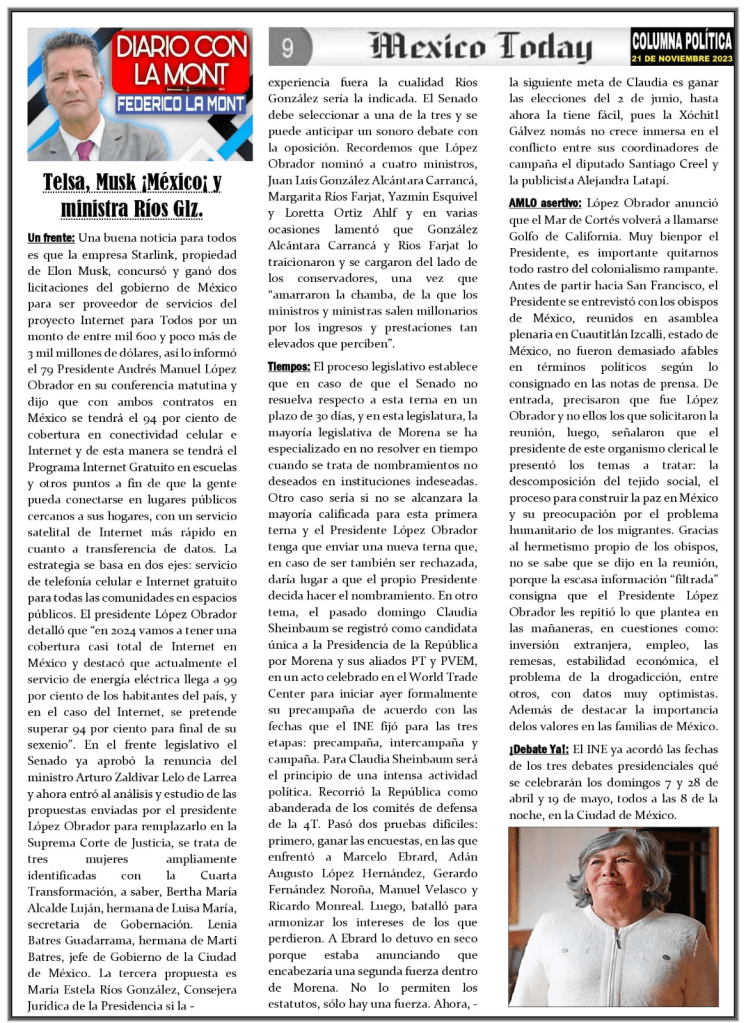
LAS NOTICIAS CON LA MONT* 📰
📃 *Premio Internacional Periodismo Y Periodismo Migrante*📃
La Información Directa a tu Celular 📲 de HOY *Martes 21 de Noviembre 2023* *En El Plano Nacional e Internacional*:
*Ahora también ya estamos en la redes y síguenos a través de nuestros siguientes medios:*
– *TikTok*: https://www.tiktok.com/@federicolamontoficial?_t=8fbL5yfdiiM&_r=1
*YouTube:* https://www.youtube.com/@FedericoLamontTv
*Instagram:* https://instagram.com/federicolamontoficial?utm_source=qr&igshid=ZDc4ODBmNjlmNQ%3D%3D
*Twitter:* https://twitter.com/federicolamont_?t=1JFGx2rnaadYGDPKxR_jpA&s=09
*Colaboración Especial En:* http://MexicoTodayUSA.com
*Thirty years ago, a negotiated settlement of the Israeli-Palestinian conflict seemed achievable. The story of how it fell apart reveals why the fight remains so intractable today.*
The state of Israel was born in war. The year before its founding in 1948, the United Nations produced a partition plan that proposed to divide the stretch of land from the Jordan River to the Mediterranean Sea into two states, Arab and Jewish. The surrounding Arab countries rejected the plan, as did Palestinians living on the land. And on May 15, a day after Israel declared itself a state, four Arab countries attacked. Jewish Israelis saw the ensuing war, which they won, as an existential fight for survival, one that came just a few years after the Holocaust. To Palestinians, 1948 marked the Nakba, or catastrophe, in which 700,000 people fled or were forcibly expelled from their homes. Many went to the West Bank, where Jordan took control, or the Gaza Strip, which Egypt occupied.
Chronic conflict followed. So too did periodic efforts to resolve it. None brought lasting peace. Negotiations between Israel and Palestinians barely existed for decades, and subsequent military conflicts made the situation more difficult. When Egypt mobilized troops on the border in 1967, Israel launched pre-emptive airstrikes, and in a war fought in six days against a coalition of Arab states, Israel took over contested territory, beginning a military occupation in the West Bank and Gaza. Many Palestinians, living under occupation or as refugees around the world, still saw the founding of Israel as an act of dispossession that had robbed them of their land and homes. In 1968, when Yasir Arafat became chairman of the Palestine Liberation Organization, the group’s charter called the establishment of Israel illegal and sanctioned armed resistance in what it saw as a struggle for liberation. Some P.L.O. factions conducted bombings, hijackings and other attacks, including the killing of Israeli athletes at the 1972 Olympic Games in Munich. As a result, Israel refused to negotiate with the P.L.O., considering it a terrorist group.
A political shift began in the late 1980s. With Arafat and other P.L.O. leaders in exile in Tunisia, Palestinians in the West Bank and Gaza mounted a locally led popular uprising in December 1987. Television footage of the First Intifada (which means “shaking off” in Arabic) showed Israeli soldiers beating children throwing stones, eroding Israel’s international standing.
Over the following years, with Israel and the P.L.O. under pressure for different reasons, momentum built for the two sides to negotiate a resolution. An opportunity for something unprecedented began to take shape: the first direct dialogue between Israel and the P.L.O. and what would become their most sustained effort to reach a settlement. This was known as the Oslo peace process, named for the city where the secret talks took place. It ran through most of the 1990s and came as close as any negotiated process ever has to resolving this intractable conflict. In the end, Oslo failed. The reasons for that failure — and the lessons it has to teach us — have been debated ever since.
We assembled a panel of scholars and experts — three Palestinian, three Israeli and an American — to help us understand the history of Oslo: Was it a genuine chance for peace? Was it doomed from the start? Why did it unravel?
This conversation has been edited and condensed for clarity, with some material reordered and added from follow-up interviews.
In the 1990s, the international order in the Middle East realigned as a result of the gulf war. When Saddam Hussein’s Iraqi forces invaded Kuwait, most Arab countries joined the U.S.-led coalition to push them out. The P.L.O., however, backed Hussein. The decision cost the P.L.O. the financial and diplomatic backing of many of its Arab allies.
President George H.W. Bush and his secretary of state, James A. Baker III, saw an opening for international intervention. In October 1991, the United States and the Soviet Union hosted the Madrid peace conference, with delegations from Israel, Lebanon and Syria, as well as a joint Jordanian-Palestinian delegation. The gathering represented a breakthrough, but it did not include the P.L.O. Yitzhak Shamir, Israel’s prime minister, objected to the group’s presence, and Arab countries went along with his wishes.
*Families Fear for the Health of Ailing, Frail Israelis Held Hostage*
Many of the more than 200 people seized by Hamas when it raided Israel had serious medical conditions. Some were badly injured in the attack. Doctors say they need medical care urgently.
When armed Hamas terrorists invaded her home on Oct. 7, Karina Engelbert was still recovering from a double mastectomy and breast reconstruction surgery that had gone terribly awry. She was weak and easily fatigued, and a buildup of painful scar tissue on her chest caused tightness, limiting her mobility.
The militants kidnapped Ms. Engelbert, 51, and her entire family, including her husband, Ronen Engel, 54, and their daughters, 18-year-old Mika and 11-year-old Yuval, snatching them from the safe room inside their home on the Nir Oz kibbutz and taking them to the Gaza Strip, where they have been held for over 40 days.
“The last I heard from my sister was on that black sabbath at 9:30 in the morning, and she spoke very quietly, and she said, ‘They’re inside the house,’” Ms. Engelbert’s brother Diego Engelbert said in an interview.
He has not received any information about his sister’s condition, and she has not been visited by the International Red Cross, he said.
“We don’t know if she’s getting any medical treatment, if anyone is taking care of her, if she is getting any pain relief or any of the medication she needs to keep the cancer from coming back,” Mr. Engelbert said.
Ms. Engelbert is one of about 240 hostages abducted from Israel, many of whom need urgent medical attention.
They range in age from infants to octogenarians, and include a Thai foreign worker who was nine months pregnant on Oct. 7 and may have given birth in captivity. There are many kibbutz members in their mid-80s who were taking medications for chronic conditions like high blood pressure, and younger adults who have both psychiatric conditions and medical conditions that can be fatal if left untreated.
And then there were those who sustained potentially life-threatening injuries in the raid itself, which killed an estimated 1,200 people, most of them civilians.
Ms. Engelbert is one of three women abducted who had breast cancer. Another was 65-year-old Yehudit Waiss, whose body was discovered by Israeli soldiers as they closed in on a hospital in Gaza last week. Israeli officials say she and Noa Marciano, a 19-year-old female soldier, were murdered by their captors. And a few days ago, Hamas said that an 86-year-old kibbutznik, Arye Zalmanovich, had died after suffering a heart attack during the Israeli bombings of Gaza.
Most elderly captives depend on medications to manage high blood pressure, diabetes and heart disease, according to Hagai Levine, an Israeli physician who has been working with the families of the hostages.
Among the roughly 40 children being held, most of whom are girls, there is a 4-year-old boy whose growth is delayed and who takes a nutritional supplement because he is underweight, and the boy’s 10-month-old brother. A photo of the two redheads in the arms of their mother when they were abducted has been widely circulated.
*Before Hillary Clinton, There Was Rosalynn Carter*
When Americans look back and take stock of their most impressive first ladies, they rarely think of Rosalynn Carter.
In a 2020 poll that asked historians and other experts to rank first ladies on a score of exemplary characteristics, Mrs. Carter came in ninth, trailing Dolley Madison, Betty Ford and Jackie Kennedy. When Apple TV+ produced “First Ladies,” a series of six documentary portraits, in 2020, it ignored Mrs. Carter entirely. So too did Showtime’s 2022 drama series “The First Lady.” Both, again, featured Mrs. Ford, who only served a partial term, and whose primary contribution to White House history was her candid persona. While Mrs. Ford’s personal charm and willingness to confront Republican pieties made her a star, she made no lasting change to the institution of the East Wing itself; the only way to understand the first lady entertainment complex’s posthumous preference for Mrs. Ford over Mrs. Carter is that she is the first lady equivalent of Princess Diana, a glamorous, tragic figure whose personal agonies produce riveting television. Mrs. Carter — cheerful, stable, staid — makes for less compelling drama, but much better lessons in wielding power from that singular office.
We are in the midst of a re-evaluation of the Carter presidency — long considered a failure — prompted in part by a celebrated 2021 biography that declared Mr. Carter the “most misunderstood president of the last century.” But his first lady, so far, has merited no second look; perhaps, on the occasion of her death, it is finally time to give Mrs. Carter her due.
Only two first ladies in the 20th century can claim to have transformed the institution. Eleanor Roosevelt shaped America’s highest expectations of a first lady — but it was Rosalynn Carter who built a fully staffed Office of the First Lady to match her activist ambitions, creating a power base not just for herself but for all of her successors.
Serving as an equal partner to her husband, the president, advancing a mental health policy agenda, brokering peace between Israel and Egypt: These were high aspirations. Mrs. Carter had the canny instincts to know that a player who courts influence requires a court. She hired a seasoned Washington journalist as press secretary, set up a separate office led by a highly trained adviser — the director of projects — to handle policy and brought on a chief of staff to oversee it all. She assembled a highly competent team and moved the first lady’s personal office from the residence to the East Wing itself to join them.
Mrs. Carter’s charismatic press secretary, Mary Hoyt, led the fight for decent East Wing salaries, despite stiff opposition. If Mrs. Carter wanted staffers capable of preparing her to testify before Congress and lead a diplomatic tour across Latin America discussing hard policy with government leaders, the White House would need to pay them in accordance with their experience. But it was a time of austerity. President Carter was demanding sacrifice from all Americans and turning down the heat in the White House to cut costs. Ms. Hoyt wore cashmere mittens while typing, to keep her fingers from freezing.
So many Americans wrote in to complain about the office’s staff members getting paid anything at all that Ms. Hoyt prepared a form letter in response. With Mrs. Carter’s backing, she managed to get raises for herself and for most of her colleagues, and also extracted a reserved parking spot next to the vice president’s as a perk. (Up until the Ford administration, East Wing staff members had been chauffeured to work in a government town car, a little privilege that softened the paltry pay.) This remunerated, professionalized, sizable Office of the First Lady that Mrs. Carter established helped her pursue her agenda. It also created the model for the modern East Wing as an office with the stature and capacity to wield profound influence as an arena for setting policy, shaping the presidency and shifting cultural attitudes.
At the time, though, Mrs. Carter’s achievements were largely dismissed. Late ’70s press coverage mocked her as “Rosé Rosalynn,” a dour Southern Baptist who canceled hard liquor, dancing and French cooking at White House dinners — all seen as not elegant or remnants of Kennedy-era decadence — and allowed her staffers to shuffle around in clogs. Feminists like Gloria Steinem faulted Mrs. Carter for not being sufficiently outré in her activism. “I am disappointed in her altogether,” complained Ms. Steinem in 1978. Even women reporters like United Press International’s Helen Thomas, an old White House hand who had witnessed far lazier and media-hostile first ladies, were unimpressed. “There’s no ferment, no mystique,” she wrote. “She creates neither love nor hate.”
*Sunak’s Dilemma: When to Hold an Election He’ll Probably Lose*
Prime Minister Rishi Sunak is 20 percentage points behind in opinion polls. But history suggests the timing of a vote might make a difference.
No question in British politics will be more regularly asked, and reliably brushed aside, over the next few months than when Prime Minister Rishi Sunak plans to call the country’s next general election.
He must do so by January 2025. The conventional wisdom is that with his Conservative Party trailing the opposition Labour Party by 20 percentage points in the polls, Mr. Sunak will wait as long as he can. Given the fact that Britons do not like electioneering around Christmas or in the dead of winter, that would suggest a vote next fall.
But some of Mr. Sunak’s colleagues last week pushed for an earlier timetable. Having lost a critical legal ruling on his flagship immigration policy, the prime minister came under pressure from the right of his party to go to the polls in the spring if the House of Lords blocks the government’s efforts to revamp legislation to deport asylum seekers to Rwanda.
Turning the election into a referendum on immigration might deflect attention from the economic woes plaguing Britain. But that assumes voters could be persuaded to swing to the Conservatives out of a fear of asylum seekers crossing the English Channel in small boats, rather than blaming the party for a stagnant economy, a cost-of-living crisis and hollowed out public services.
Britain’s Supreme Court last week struck down the policy of deporting asylum seekers to Rwanda as unlawful. But Mr. Sunak has vowed to keep the matter alive by negotiating a new treaty with the East African country that would include a legally binding commitment not to remove migrants sent there by Britain — one of the court’s objections.
Mr. Sunak also pledged emergency legislation that would declare Rwanda a safe country for asylum seekers. It remains unclear whether that would survive legal challenges and in the House of Lords, the unelected upper chamber of Parliament that has the right to review the legislation and could block it (though its appetite for a full-scale clash with the government was not clear.)
“I know the British people will want this new law to pass so we can get flights off to Rwanda,” Mr. Sunak told reporters last week. “Whether it’s the House of Lords or the Labour Party standing in our way, I will take them on because I want to get this thing done and I want to stop the boats.”
Political analysts say immigration remains a resonant issue in England’s north and Midlands, where support for the Conservatives in 2019 gave the party a landslide general election victory. Those voters, many of whom traditionally supported the Labour Party, were drawn to the Tory slogan, “Get Brexit done.”
“Immigration is now the top priority for 2019 Conservative Party voters, above even the cost-of-living crisis and the dire state of the country’s National Health Service,” said Matthew Goodwin, a professor of politics at the University of Kent, who has written about populism and identity politics.
“This means, in short, that Rishi Sunak has no way of winning the next election unless he connects with these voters by reducing immigration and regaining control of the country’s borders,” he said. “Yet both of those things currently look unlikely.”
Far from accelerating the date of an election, Professor Goodwin argued that the salience of immigration would pressure Mr. Sunak to delay a vote. It will take months to surmount the legal problems with the existing policy, the professor said, let alone begin one-way flights to Rwanda.
*The Mediterranean Diet Really Is That Good for You. Here’s Why.*
It has become the bedrock of virtuous eating. Experts answer common questions about how it leads to better health.
In the 1950s, researchers from across the globe embarked on a sweeping and ambitious study. For decades, they scrutinized the diets and lifestyles of thousands of middle-aged men living in the United States, Europe and Japan and then examined how those characteristics affected their risks of developing cardiovascular disease.
The Seven Countries Study, as it later became known, famously found associations between saturated fats, cholesterol levels and coronary heart disease. But the researchers also reported another notable result: Those who lived in and around the Mediterranean — in countries like Italy, Greece and Croatia — had lower rates of cardiovascular disease than participants who lived elsewhere. Their diets, rich in fruits, vegetables, legumes, whole grains, nuts, seeds, lean proteins and healthy fats, seemed to have a protective effect.
Since then, the Mediterranean diet has become the bedrock of heart-healthy eating, with well-studied health benefits including lower blood pressure and cholesterol, and a reduced risk of Type 2 diabetes.
“It’s one of a small number of diets that has research to back it up,” said Dr. Sean Heffron, a preventive cardiologist at NYU Langone Health. “It isn’t a diet that was cooked up in the mind of some person to generate money. It’s something that was developed over time, by millions of people, because it actually tastes good. And it just happens to be healthy.”
Here are some of the most searched questions about the Mediterranean diet, answered by experts.
What exactly is the Mediterranean diet?
The Mediterranean diet isn’t as much a strict meal plan as it is a lifestyle, said Julia Zumpano, a registered dietitian who specializes in preventive cardiology at the Cleveland Clinic in Ohio. People who follow the Mediterranean diet tend to “eat foods their grandparents would recognize,” Dr. Heffron added: whole, unprocessed foods with few or no additives.
The diet prioritizes whole grains, fruits, vegetables, legumes, nuts, herbs, spices and olive oil. Fish rich in omega-3 fatty acids, like salmon, sardines and tuna, are the preferred animal protein source. Other lean animal proteins, like chicken or turkey, are eaten to a lesser extent. And foods high in saturated fats, like red meat and butter, are eaten rarely. Eggs and dairy products like yogurt and cheese can also be part of the Mediterranean diet, but in moderation. And moderate alcohol consumption, like a glass of wine at dinner, is allowed.
Breakfast might be smashed avocado on whole-grain toast with a side of fresh fruit and a low-fat Greek yogurt, Dr. Heffron said. For lunch or dinner, a vegetable and grain dish cooked with olive oil and seasoned with herbs — roasted root vegetables, leafy greens, a side of hummus and small portions of pasta or whole grain bread, with a lean protein like grilled fish.
“It’s very easy to follow, very sustainable, very realistic,” Ms. Zumpano said.
What are the health benefits of the Mediterranean diet?
A number of rigorous studies have found that the Mediterranean diet contributes to better health, and in particular better heart health, in a variety of ways. In one study, published in 2018, researchers assessed nearly 26,000 women and found that those who followed the Mediterranean diet most closely for up to 12 years had about a 25 percent reduced risk of developing cardiovascular disease. This was mainly because of changes in blood sugar, inflammation and body mass index, the researchers reported. Other studies, in men and women, have reached similar conclusions.
Research has also found that the diet can protect against oxidative stress, which can cause DNA damage that contributes to chronic conditions like neurological disease and cancer. And some studies suggest it can help reduce the risk of developing Type 2 diabetes.
The diet may also have profound health benefits during pregnancy, said Dr. Anum Sohail Minhas, an assistant professor of medicine at Johns Hopkins Medicine. In a recent study of nearly 7,800 women published in December, researchers found that those who followed the Mediterranean diet most closely around the time they conceived and during early pregnancy had about a 21 percent reduced risk of any pregnancy complications, such as pre-eclampsia, gestational diabetes or preterm birth.
“There definitely seems to be a protective effect,” Dr. Minhas said.
On its own, though, the Mediterranean diet isn’t a panacea, Dr. Heffron said — it won’t eliminate your chances of developing cardiovascular disease, and it won’t cure a disease, either. It’s important that people also pay attention to other tenets of good heart health, like getting regular exercise and adequate sleep and not smoking.
Will the Mediterranean diet help with weight loss?
The diet can be conducive to weight loss, Ms. Zumpano said, but you’ll still need to pay attention to calories.
“Nutrient-rich foods aren’t necessarily low in calories,” said Dr. Heffron, who noted that the diet includes foods like olive oil and nuts, which are heart-healthy yet high in calories and can lead to weight gain if consumed in large portions. But if you’re changing your diet from one that is rich in calories, saturated fats and added sugars, for instance, with one that prioritizes vegetables, fruits and leaner proteins, that can result in some weight loss, he said.
The Mediterranean diet is not meant to be a hack for rapid weight loss, though. Rather, it should inspire a long-term shift in eating behavior. In one study of more than 30,000 people living in Italy, for instance, researchers found that those who followed the Mediterranean diet most closely for about 12 years were less likely to become overweight or obese than those who followed the diet less closely. A smaller study, published in 2020, enrolled 565 adults who had intentionally lost 10 percent or more of their body weight in the year prior. It found that those who reported adhering to the Mediterranean diet closely were twice as likely to maintain their weight loss as those who did not closely follow the diet.
How long do you need to follow the Mediterranean diet to gain benefits?
If you’re just starting to follow the Mediterranean diet, limited evidence suggests that you may notice some cognitive improvements — including in attention, alertness and contentment, according to one review of studies published in 2021 — within the first 10 days or so. But for there to be sustained, long-term payoffs in terms of heart health, people need to stick with it, Ms. Zumpano said, ideally for their whole lives.
That being said, she added, the diet allows for some flexibility; the occasional cake or steak won’t undo its overall benefits.
*Why Do Evil and Suffering Exist? Religion Has One Answer, Literature Another.*
In the third installment of an essay series on literature and faith, Ayana Mathis explores how writers have grappled with one of theology’s oldest conundrums.
In the church of my childhood, we believed God’s angels battled demons in a war for our souls. This was not a metaphor. We were Pentecostals, though not strictly and not always. We weren’t picky about denomination; what mattered was belief in the redeeming blood of Christ, in the Bible literally interpreted and in God’s endless love. And evil. We believed in evil.
Sometimes evil was obvious — lies, betrayals, the misfortunes of innocents — but just as often it was camouflaged and seductive. It lurked in the card game, in the pop song and on the movie screen. It was in the allure of those things prohibited by religious or moral standards. The world was sunk in an evil passed down through Adam and Eve’s original sin and their fall from Eden.
I long ago abandoned this version of reality, but the questions it meant to address persist: Are the sensational evils that continue to plague us — murder and torture and its ilk — an expression of a (metaphorically) fallen world? Why these wars and more wars, these repeating atrocities of every stripe? How do we navigate a world beset by dark forces, and what do we do in the face of the suffering they cause?
Evil looms large in James Baldwin’s first novel, “Go Tell It on the Mountain,” set in 1930s Harlem. The novel unfolds on the protagonist John Grimes’s 14th birthday, a moment of spiritual and psychic reckoning for his fervently Pentecostal family. Young John is pious, though he has not yet given his heart to Jesus Christ. His salvation is nigh, but first he must wrangle with temptation. He takes the few coins his mother gives him as a present and leaves Harlem on foot by way of Central Park. The Grimeses are a poor family, squeezed by the ubiquitous racism of the times, and further beleaguered by John’s father’s weaponized Christianity, which slaps and shoves and bellows at his wife and children.
In Midtown, luxe shop windows beckon and well-heeled white women stride down the wide avenues in furs. John takes in this Manhattan of plenty: “The way of the cross had given him a belly filled with wind … but here, where the buildings contested God’s power and where the men and women did not fear God, here he might eat and drink to his heart’s content.” Baldwin’s language recalls Christ’s temptation in the wilderness in the Gospel of Matthew, where Satan “showed Him all the kingdoms of the world and their splendor. ‘All these things I will give you,’ he said, ‘if you will fall down and worship me.’”
John’s temptation is short-lived. Baldwin quickly reminds us that the wealthy white world below the park is not available to John, nor to any Grimes. Evil here is double-edged: The spiritual threat John fears in secular godlessness is yoked to the social evils of economic inequality and racism that circumscribe his family.
With a heavy heart, John returns home to his family’s troubles and the safety of the church, “not daring to feel it God’s injustice that he must make so cruel a choice.” Despite the demands of their faith, John and his family hold fast — belief buoys them and transcends the hardships of their lives. It is fiercely and utterly theirs, and cannot be taken from them, even in a world in which so many other things are denied. There is a pragmatic utility as well: The Grimeses believe religious strictures around behavior — including prohibitions against alcohol and sex outside of marriage — protect their bodies and minds, the sanctity and value of which are under constant threat. Social evils — racism, economic disparity and homophobia — take center stage in the novel and cause immense suffering, as evil of any kind inevitably leads to agony.
In S.M. Hulse’s novel “Black River” (2015), the protagonist, Wes Carver, wrestles with his faith, and a painful past, in the aftermath of evil. After many years, Wes returns home to the fictional Montana town of the title following his wife Claire’s slow death from cancer. He left behind a now adult stepson, Dennis, with whom he has a troubled relationship, along with a slew of frayed social connections and the state prison in which he worked as a corrections officer. Bone-aching winter is coming soon and Wes’s grief is so intense that it’s a haunting: “Wes kept seeing Claire at the periphery of his vision. … Not quite hallucinations. Not quite ghosts.”
Black River is a company town — most residents are employed by the prison in some way, sons following their fathers into the work. People in Black River have known one another all their lives. They are polite, if laconic; they go to church, help one another in tough times. They are decent people, but they view the world in stark dichotomies: good versus evil, the law-abiding versus criminals. Such divisions are perhaps inevitable in a town where livelihoods and identities are tied to the bleak carceral system. In Black River, and for Wes, bad folk and bad behavior have a fated quality; evil is immutable and cannot be vanquished, even if it goes dormant for a time. Wes helped raise his stepson, Dennis — born to Claire after she was sexually assaulted — all the while “waiting for the poisonous half of Dennis’s blood to show itself.”
Wes’s departure from Black River was occasioned by a riot in the prison during which Wes was held captive and tortured for 39 hours by a man named Bobby Williams. The torture was methodical and sadistic: Williams burned Wes with cigarettes, broke two ribs, carved letters into his flesh and snapped his fingers one by one. Wes was a gifted fiddler; when we meet him his gnarled fingers can hardly curve around his bow. Now, after decades in prison, Williams is up for parole and proclaims himself a changed man, born again in Christ.
Wes doesn’t buy it. He’s convinced Williams has invented his faith to sway the parole board. “He’s an inmate,” Wes tells a local pastor. “Saying he’s dishonest is redundant.” The pastor initiates a discussion about forgiveness, but Hulse pivots to the dark heart of Wes’s righteous outrage. “When I said he doesn’t deserve it, I didn’t mean Williams doesn’t deserve forgiveness,” Wes says. “I mean God. He doesn’t deserve God.” Wes goes on: “A man like that doesn’t deserve to believe when I spent my whole life trying and still can’t do it.”
Williams is paroled. Wes meets him on a cold morning as Williams waits for the bus that will take him out of town. Wes’s hands ache where his broken bones fused badly; a gun weighs in his pocket. Wes hopes he can look into Williams’s eyes and see whether he is a changed man. But his seeking yields nothing: “I know I don’t like you and I wish more than anything you were still locked up. … All I got’s your word that you are what you say you are.” Williams responds, “So. … What are you going to do?” And Wes says: “I’m going to believe you.”
Like Job in the Hebrew Bible, Wes voices his indignation at the injustice of all that has transpired, at how he’ll never know why such evil has befallen him. He imagines the satisfaction he’d feel from firing his revolver. Ultimately, though, he keeps the gun in his pocket and drives home. He may not actually believe Williams but he has taken the harder path, and chosen to believe him.
Wes’s choice calls to mind the philosopher Paul Ricoeur’s ideas about what’s left to us when theodicy reaches its limits: “We believe in God in spite of evil,” he writes. It’s a bitter pill, but to believe in spite of is the only way Wes will ever be able to attend to what yet lives in his life. It’s a way to retain his humanity in the face of all that he has lost, and may yet lose if he cannot find some means of spiritual survival.
Hulse implies, too, some shift in Wes’s belief in the indelibility of evil. As the biblical prophet Jeremiah wrote: “In those days they shall no longer say: ‘The parents have eaten sour grapes, and the children’s teeth are set on edge.’” That is, the children need not pay for the sins of their parents. Wes returns home to find his stepson undone, unable to put down a suffering horse too old to survive another harsh winter. “I could be there with you,” Wes says. “When the vet comes. If you want.” His words convey more tenderness than he has ever shown his stepson.
Hulse doesn’t shortchange the horror of Wes’s experience. Both Wes and Williams are part of a penal system so poisonous and compromised that it multiplies evils rather than curbs them. Prisons beget more prisoners, which beget more prisons. In “Black River,” these political and social realities don’t negate Williams’s crime, nor the spiritual aspects of Wes’s trajectory toward a subtle redemption. But they do argue against a conception of evil as anomalous and unalterable, always and only supernaturally derived. If we think of evil purely in metaphysical terms, we risk overlooking our collective responsibility to work toward its eradication. If we consider Dylann Roof, for example, to be an anomalous evil, we miss the fact that he is the product of the endemic social evils of white supremacy and our nation’s staggering number of easily accessible firearms. What he did is singular, but the evil that created him is no mystery.
*¡Buenos días, excelente martes!*
🔹Emite AMLO decreto para habilitar 7 rutas de trenes de pasajero.
🔹Arrancan precampañas Claudia, Xóchitl y Samuel.
🔹Ejército, el ángel de la guarda de México: AMLO.
🔹Nearshoring detonará 50 mil mdd a exportaciones: Julio Carranza.
🔹Estudiantes mayas crean UMUUK’IIK, buscan solucionar falta de agua y luz.
🔹Milei promete ola de privatizaciones y acabar con la inflación en Argentina. Asumirá el 10 de diciembre.
Versión digital👉🏻 https://www.elfinanciero.com.mx/graficos/edicion-impresa/flip/el-financiero.html
*MAGACÍN CDMX EN EL INDEPENDIENTE*
*•* *MENSAJE POLÍTICO*
*Podrían ‘congelar’ ratificación de Godoy*
https://cdmx.info/podrian-congelar-ratificacion-de-godoy/
*•* *GLORIETA DE COLÓN*
*✓ Brugada y Taboada arrancan raspados y abollados*
*✓ Godoy, Cuevas y Rubalcava*
*✓ Se completan en Coyoacán*
https://cdmx.info/brugada-y-taboada-arrancan-raspados-y-abollados/
*•* *CDMX MAGACÍN*
*Brugada quiere ‘segundo piso de la 4T’*
https://cdmx.info/brugada-quiere-segundo-piso-de-la-4t/
*Taboada va por decepcionados de Clara*
https://cdmx.info/taboada-va-por-decepcionados-de-clara/
*Sí hay mejor futuro para la ciudad: Chertorivksi*
https://cdmx.info/si-hay-mejor-futuro-para-la-ciudad-chertorivksi/
*•* *NACIONAL*
*Refrenda Ana Lilia Rivera compromiso con protección de niñas y niños*
https://cdmx.info/refrenda-ana-lilia-rivera-compromiso-con-proteccion-de-ninas-y-ninos/
*ATENTAMENTE*
*MAESTRO FEDERICO LA MONT*
Sent from my iPod
 Mexico Today USA