

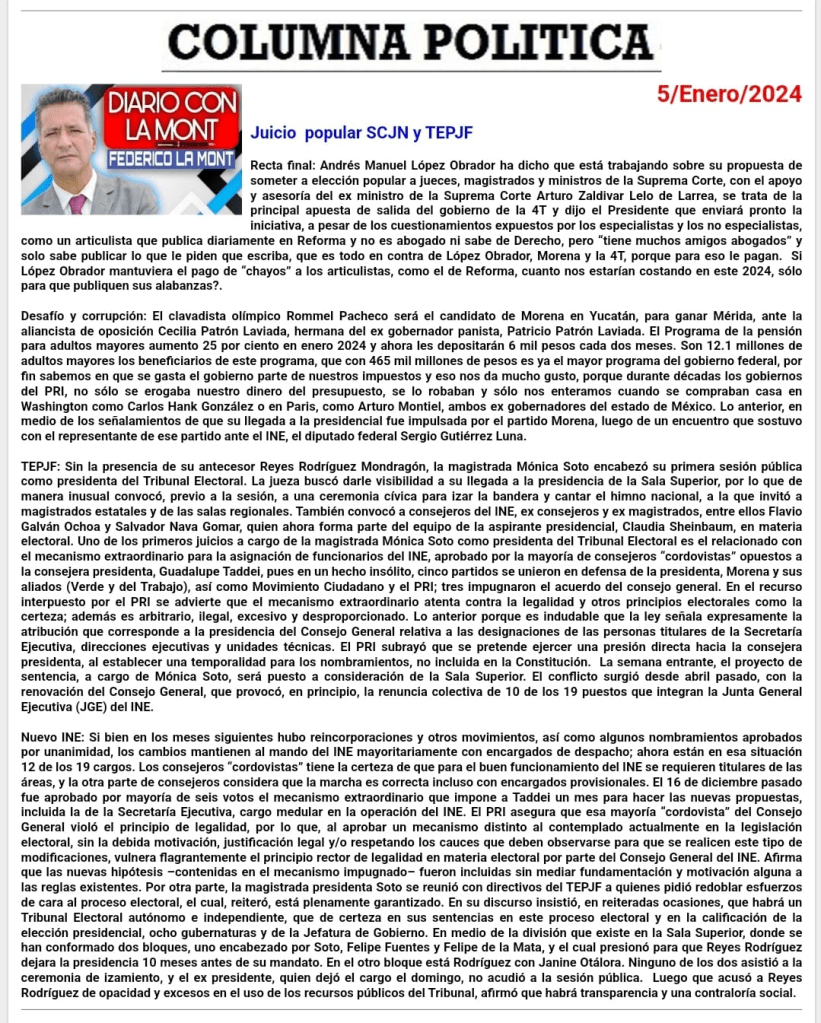
Premio Internacional Periodismo Y Periodismo Migrante*📃
La Información Directa a tu Celular 📲 de HOY *Viernes 5 de Enero 2024* *En El Plano Nacional e Internacional*:
*Ahora también ya estamos en la redes y síguenos a través de nuestros siguientes medios:*
– *TikTok*: https://www.tiktok.com/@federicolamontoficial?_t=8fbL5yfdiiM&_r=1
*YouTube:* https://www.youtube.com/@FedericoLamontTv
*Instagram:* https://instagram.com/federicolamontoficial?utm_source=qr&igshid=ZDc4ODBmNjlmNQ%3D%3D
*Twitter:* https://twitter.com/federicolamont_?t=1JFGx2rnaadYGDPKxR_jpA&s=09
*Colaboración Especial En:* http://MexicoTodayUSA.com
*December Jobs Report U.S. Job Growth Remains Strong*
The labor market showed continued resiliency in December, with employers adding 216,000 jobs last month, a sign that economic growth remains vigorous.
The labor market ended the year with a bang.
Employers added 216,000 jobs in December on a seasonally adjusted basis, the Labor Department reported on Friday, surpassing the expectations of economists. It was the 36th consecutive month of gains.
Altogether, the U.S. economy added roughly 2.7 million jobs over the past year. That’s a smaller gain than in 2021 or 2022, during the economy’s initial resurgence from the pandemic lockdowns. Yet the gains of 2023 would still be impressive by the standards of the previous decade.
The numbers are buoying expectations of what has been called a soft landing — in which the economy is able to avoid significant job loss while shifting into a calmer, more sustainable gear, after the years of disorienting volatility that began with the arrival of Covid-19 roughly four years ago.
Many experts caution that data for December is notoriously hard to calculate in any year because of the hiring churn caused by the holiday season.
The unemployment rate, based on a survey of households, was unchanged at 3.7 percent.
Average hourly earnings for workers — a common measure of wage gains — rose 0.4 percent from the previous month and were up 4.1 percent from December 2022.
Layoffs remain near record lows, beneath prepandemic levels.
A mixture of economic data in the past couple of months that appears neither too hot nor too cold has given a lift to both investors and policymakers at the Federal Reserve, who have been pleasantly surprised at the continuing balance between falling inflation and sustainable growth.
*What Investors and the Fed Will Look For in the Jobs Report*
All eyes will be on the latest nonfarm payrolls data scheduled for release on Friday. Here’s what to look out for.
Jobs report: the numbers to watch
Wall Street, the White House and the Fed will all be watching Friday’s jobs report for signs of how the labor market is holding up. The numbers may also deliver clues on the central bank’s next move on interest rates.
The Bureau of Labor Statistics is set to release the nonfarm payrolls number at 8:30 a.m. Eastern. Here are the data points to watch:
160,000. Economists polled by FactSet expect the report to show that employers added roughly 160,000 jobs last month, a drop from the 199,000 positions created in November. They also forecast that the unemployment rate ticked up to 3.8 percent in December, from 3.7 percent the previous month.
2.7 million. If those predictions are correct, it would bring total hiring in 2023 to about 2.7 million, a strong showing in a year marked by strikes and layoffs by large firms across multiple sectors. Heading into an election year, it’s a data point that President Biden is expected to trumpet to voters still unconvinced about his handling of the economy.
3.9 percent. The big number investors will be watching is wage growth. The consensus estimate is that average hourly wages grew by 3.9 percent on an annualized basis last month, roughly in line with figures from November.
ADVERTISEMENT
A hot number here could spook markets. Wall Street is divided over how the Fed’s interest rate policy will unfold this year. The central bank has signaled that a trio of cuts could be coming, but officials have since warned that a resurgence in inflation could stall such a dovish pivot — and even reopen the door for rate increases.
1.7 percent. The past two jobs reports have been good ones for investors, with the S&P 500 climbing after the data was released. Market watchers will be hoping for a similar performance. The benchmark index is on a four-day losing streak, and has lost 1.7 percent in 2024.
Inflation F.A.Q.
Card 1 of 5
What is inflation? Inflation is a general increase in prices, which will cause a loss of purchasing power over time, meaning your dollar will not go as far tomorrow as it did today. It is typically expressed as the annual change in prices for everyday goods and services such as food, furniture, apparel, transportation and toys.
What causes inflation? It can be the result of rising consumer demand. But inflation can also rise and fall based on developments that have little to do with economic conditions, such as limited oil production and supply chain problems.
Is inflation bad? It depends on the circumstances. Fast price increases spell trouble, but moderate price gains can lead to higher wages and job growth.
How does inflation affect the poor? Inflation can be especially hard to shoulder for poor households because they spend a bigger chunk of their budgets on necessities like food, housing and gas.
Can inflation affect the stock market? Rapid inflation typically spells trouble for stocks. Financial assets in general have historically fared badly during inflation booms, while tangible assets like houses have held their value better.
Image
HERE’S WHAT’S HAPPENING
Foreign governments paid millions to Donald Trump’s companies during his presidency. A report by House Democrats found that Trump businesses received at least $7.8 million — most of it from China. Democrats argued that the findings, drawn from court documents, show that the former president engaged in the kind of activity that Republicans accuse the Biden family of; G.O.P. lawmakers and Trump’s son Eric dismissed the report.
ADVERTISEMENT
Eurozone inflation rises. Prices in the 20-country region rose 2.9 percent in December, ending months of declines. The rise spurred new questions about when the European Central Bank would begin cutting interest rates. Relatedly, the big French retailer Carrefour stopped carrying PepsiCo products over “unacceptably” high prices.
Bill Ackman’s wife is accused of plagiarism by Business Insider. The publication said that Neri Oxman, a prominent academic and architect who formerly taught at M.I.T., had failed to use quotation marks around several passages in her 2010 doctoral dissertation that were taken from other papers, though she cited her sources. Oxman posted on X that she was checking the accusations, apologized and would request any necessary corrections; Ackman, who was a leading advocate for ousting Claudine Gay as Harvard’s president over plagiarism accusations, posted in support of his wife.
Image
Hedge fund winners (and losers) of 2023
Last year presented challenges for hedge fund moguls, given volatility in the bond markets, economic uncertainty and the U.S.’s regional banking crisis. But some of the industry’s top players were still able to mint money.
ADVERTISEMENT
2023 proved to be a good, but not stellar, year for big hedge funds. Take Citadel, one of the industry’s best performers, which fell far short of the 38 percent gain it reported for 2022. (That said, it’s returning $7 billion to investors.)
The picture was murkier for the broader industry. Hedge funds on average returned 4.5 percent, according to the data provider HFR. And they were vastly outperformed by the S&P 500, which gained 24 percent.
Here’s how some hedge-fund titans fared in 2023, according to news reports:
Cliff Asness, AQR Capital Management: Its AQR Absolute Return fund rose 18.5 percent.
Ken Griffin, Citadel: Its flagship Wellington fund gained 15.3 percent.
Steve Cohen, Point72 Asset Management: It rose 10.6 percent.
Izzy Englander, Millennium Management: The firm gained 10 percent.
Ray Dalio, Bridgewater Associates: Its Pure Alpha II fund lost 7.6 percent last year.
Trying not to kill The Messenger
The Messenger was started last year by the veteran media mogul Jimmy Finkelstein with $50 million in funding to become the next big name in digital news publishing.
ADVERTISEMENT
But the start-up is now under severe financial pressure and looking to raise more money, The Times’s Ben Mullin reports, as its business model soured and it ran into editorial difficulties.
Among The Messenger’s problems:
The site generated about $3 million in revenue last year, and lost $38 million as costs mounted, including $8 million for leases on offices in New York, Washington and West Palm Beach, Fla.
It has told potential investors that it had only $1.8 million in cash on hand at the end of December.
It is laying off two dozen employees, including reporters covering national politics, science and technology.
A spokeswoman for The Messenger said the company wasn’t in “dire” straits, saying that it booked as much revenue in January as it did for all of 2023. She added that the company had already raised more than $10 million in a new funding round.
The State of Jobs in the United States
Too Few Workers: Employers in Vermont are battling a labor shortage as the local population grows older. The state’s struggles offer an early look at where the rest of the country could be headed.
Seasonal Hiring: After scrambling to fill out work forces the last few holiday seasons, many retailers are reporting more modest goals for temporary employment this year.
Truck Drivers: The trucking industry has complained for years about a dire shortage of drivers. But some women say many companies have made it effectively impossible for them to get those jobs.
A Surge in Start-ups: The Covid-19 pandemic hurt the U.S. economy in a lot of ways. But it might have also broken America out of a decades-long entrepreneurial slump.
What went wrong: The Messenger bet on digital advertising even though that market remains troubled. It also wagered that it could draw big traffic numbers by optimizing for search, which hasn’t paid off nearly as well as the company had hoped. (It is gaining some traction, having drawn 24 million visitors in December, up 24 percent month on month.)
A highly regarded politics editor quit last year after clashing with a senior colleague, while some reporters have chafed at demands to write articles based on competitors’ stories.
ADVERTISEMENT
The Messenger is now in talks with conservative investors to sell a majority stake, according to Axios. They include Omeed Malik, a financier who has backed Tucker Carlson’s new media venture, and George Farmer, the former C.E.O. of the right-wing social media site Parler.
The investors recently met with Finkelstein at Donald Trump’s Mar-a-Lago estate to discuss a deal for $30 million for 51 percent of the company that valued The Messenger at $60 million.
“I think I wasn’t actually torturing some poor A.I. artist who could suffer. But it’s not a good sign for our civilization that we don’t seem to have any way of knowing for sure.”
— Eliezer Yudkowsky, an artificial intelligence researcher who pushed ChatGPT to produce more “normal” images after it created absurd pictures and resisted some of his requests.
Meet the “C.E.O.” of Hamas
As the Israel-Hamas war grinds on, more attention has fallen on how the Islamist group finances its military operations, including the Oct. 7 attacks.
That’s in part because of Zaher Jabarin, who over several years built a financial network across the Middle East to secure funding for Hamas. (A former Israeli security officer called him the “C.E.O.” of Hamas.) The Wall Street Journal takes a close look at Jabarin, who operates from an office building in Istanbul and says he isn’t part of Hamas’s militant wing or involved in raising money for the group:
Jabarin, working closely with other Hamas officials, developed a real-estate portfolio in the country, which made up the bulk of its $500 million worth of assets globally, the U.S. said a few years later. It included stakes in companies based in Algeria and the U.A.E., which didn’t respond to requests for comment.
The highest-profile asset was real-estate developer Trend GYO. Listed on the Turkish stock exchange, it was owned 75% by front men for Hamas, according to the U.S., which sanctioned the firm in May 2022.
The Turkish government granted one of Trend’s founders citizenship and a new name, according to U.S. officials. Hamas officials based in Turkey have opened Turkish bank accounts to move cash and transfer it to operatives in the West Bank, they said.
In a statement, Trend said it didn’t know Hamas or people associated with the group.
In other Middle East news: Secretary of State Antony Blinken will begin another diplomatic tour of the region. Here’s why the oil industry has largely shrugged off the threats against shipping traffic in the Red Sea. And the McDonald’s C.E.O., Chris Kempczinski, said that the war “and associated misinformation” was having a “meaningful business impact” on several of its markets.
Image
THE SPEED READ
Deals
A group including Jeff Bezos and Nvidia has invested $74 million in Perplexity AI at a $520 million valuation, betting that the search start-up can steal market share from Google. (WSJ)
Deutsche Bank has hired Alison Harding-Jones, Citigroup’s former M.&A. chief for Europe, the Middle East and Asia, as its global head of M.&A. (FT)
Amer Sports, the Chinese-backed group that makes Wilson tennis rackets and Salomon hiking boots, filed to go public in the U.S., reportedly eyeing a $10 billion valuation. (Bloomberg)
Policy
Names being floated for a potential Nikki Haley administration include Gary Cohn, the former Goldman Sachs president, as Treasury secretary and Dina Powell, a former top Goldman executive, as chief of staff. (The Messenger)
Donald Trump met with the Teamsters’ chief, Sean O’Brien, as the former president and President Biden compete for union support. (NYT)
SpaceX sued the National Labor Relations Board a day after the agency accused it of illegally firing employees, arguing that the regulator operates unconstitutionally. (Politico)
Best of the rest
A trial will begin next week over a Russian oligarch’s claim that the auction house Sotheby’s abetted a scheme to defraud him of millions via overinflated art sales. (NYT)
Social media influencers are worried that A.I. might cost them valuable brand partnerships, but there’s reason to believe that those fears are overstated. (FT, Business Insider)
BlackRock has hired Leigh Farris, the former head of communications at the Carlyle Group, as global communications chief; Carlyle named Meg Starr, who recently led its E.S.G. efforts, as global head of corporate affairs. (PR Week, Axios)
*America Must Face Up to Israel’s Extremism*
Two far-right members of Israel’s cabinet, the national security minister Itamar Ben-Gvir and the finance minister Bezalel Smotrich, caused an international uproar this week with their calls to depopulate Gaza. “If in Gaza there will be 100,000 or 200,000 Arabs and not two million the entire conversation on ‘the day after’ will look different,” said Smotrich, who called for most Gazan civilians to be resettled in other countries. The war, said Ben-Gvir, presents an “opportunity to concentrate on encouraging the migration of the residents of Gaza,” facilitating Israeli settlement in the region.
The Biden administration has joined countries all over the world in condemning these naked endorsements of ethnic cleansing. But in doing so, it acted as if Ben-Gvir and Smotrich’s provocations are fundamentally at odds with the worldview of Prime Minister Benjamin Netanyahu, to whom America continues to give unconditional backing. In a statement denouncing the ministers’ words as “inflammatory and irresponsible,” the State Department said, “We have been told repeatedly and consistently by the government of Israel, including by the prime minister, that such statements do not reflect the policy of the Israeli government.” Representative Jim McGovern, a Democrat who has called for a cease-fire, thanked the State Department in a social media post, saying, “It must be clear that America will not write a blank check for mass displacement.”
But it’s not clear, because we’re writing a blank check to a government whose leader is only a bit more coy than Ben-Gvir and Smotrich about his intentions for Gaza. As Israeli news outlets have reported, Netanyahu said this week that the government is considering a “scenario of surrender and deportation” of residents of the Gaza Strip. According to a Times of Israel article, “The ‘voluntary’ resettlement of Palestinians from Gaza is slowly becoming a key official policy of the government, with a senior official saying that Israel has held talks with several countries for their potential absorption.”
Some in Israel’s government have denied this, mostly on grounds of impracticality. “It’s a baseless illusion, in my opinion: No country will absorb two million people, or one million, or 100,000, or 5,000,” one official, speaking on the condition of anonymity, told Israeli journalists. And on Thursday, Israel’s defense minister, Yoav Gallant, released a plan for the day after the war that said that, contrary to the dreams of the ultranationalists, there would be no Israeli settlement in Gaza.
But with its widespread destruction of Gaza’s civilian infrastructure, including roughly 70 percent of its housing, Israel is making most of Gaza uninhabitable for the foreseeable future. Disease is rampant in Gaza, hunger almost universal, and the United Nations reports that much of the enclave is at risk of famine. Amid all this horror, members of Netanyahu’s Likud party — such as Danny Danon, Israel’s former ambassador to the United Nations, and Gila Gamliel, Israel’s intelligence minister — are pushing emigration as a humanitarian solution.
“Instead of funneling money to rebuild Gaza or to the failed UNRWA,” the United Nations agency that works with Palestinian refugees, “the international community can assist in the costs of resettlement, helping the people of Gaza build new lives in their new host countries,” wrote Gamliel in The Jerusalem Post. Right now, this is a grotesque fantasy. But as Gaza’s suffering ratchets up, some sort of evacuation might come to appear like a necessary last resort. At least, that’s what some prominent Israeli officials seem to be counting on.
Image
A group of Palestinians ride in the back of a crowded truck.
Palestinians heading south to Rafah, on the Egyptian border.Credit…Haitham Imad/EPA, via Shutterstock
After Hamas’s sadistic attack on Israel on Oct. 7, Israel was justified in retaliating; any country would have. But there is a difference between the war Israel’s liberal supporters want to pretend that the country is fighting in Gaza, and the war Israel is actually waging.
Pro-Israel Democrats want to back a war to remove Hamas from Gaza. But increasingly, it looks as if America is underwriting a war to remove Gazans from Gaza. Experts in international law can debate whether the forced displacement of Palestinians from Gaza can be classified as genocidal, as South Africa is claiming at the International Court of Justice, or as some lesser type of war crime. But whatever you want to call attempts to “thin out” Gaza’s population — as the Hebrew newspaper Israel Hayom described an alleged Netanyahu proposal — the United States is implicated in them.
By acting as if Ben-Gvir and Smotrich can be hived off from the government in which they serve, U.S. policymakers are fostering denial about the character of Netanyahu’s rule. Joe Biden often speaks of his 1973 meeting with Golda Meir, then the prime minister, and like many American Zionists, his view of Israel sometimes seems stuck in that era.
If you grew up in a liberal Zionist household, as I did, you’ve probably heard this (possibly apocryphal) Meir quote: “When peace comes we will perhaps in time be able to forgive the Arabs for killing our sons, but it will be harder for us to forgive them for having forced us to kill their sons.” There’s much to criticize in this sentiment — its self-regard, the way it positions Israel as the victim even when it’s doing the killing; still, it at least suggests a tortured ambivalence about meting out violence. But this attitude, which Israelis sometimes call “shooting and crying,” is now as obsolete as Meir’s Zionist socialism, at least among Israel’s leaders.
Among both American and European politicians, said my friend Daniel Levy, a former Israeli negotiator with the Palestinians who now heads the U.S./Middle East Project, there’s a “willful refusal to take seriously just how extreme this government is — whether before Oct. 7 or subsequently.” I’m tempted to say that Ben-Gvir and Smotrich said the quiet part out loud, but in truth they just said the loud part louder.
*Should Trump Be on the Ballot? And Other 2024 Sticky Wickets*
New year, new problems. The hosts try to make sense of it.
Is Donald Trump an insurrectionist who should be barred from the ballot? On this episode of “Matter of Opinion,” the hosts discuss who should get to decide if the former president can try to return to the White House. Plus, the hosts lay out what other stories are on their 2024 political bingo cards.
*Ron DeSantis, Nikki Haley and Politically Obtuse Plutocrats*
All Wall Street wants is a good hypocrite — someone who can convince the Republican base that he or she shares its extremism, but whose real priority is to enrich the 1 percent. Is that too much to ask?
Apparently, yes.
If you’re not a politics groupie, you may find the drama surrounding Nikki Haley, the former governor of South Carolina, puzzling. Until recently, few would have considered her a significant contender for the Republican presidential nomination — indeed, she arguably still isn’t. But toward the end of last year, she suddenly attracted a lot of support from the big money. Among those endorsing her were Jamie Dimon, the head of JPMorgan Chase, a new business-oriented super PAC called Independents Moving the Needle and the Koch political network.
If this scramble sounds desperate, that’s because it is. And it looks even more desperate after Haley’s recent Civil War misadventures — first failing to name slavery as a reason the war happened, then clumsily trying to walk back her omission.
But there is a logic behind this drama. What we’re witnessing are the death throes of a political strategy that served America’s plutocrats well for several decades but stopped working during the Obama years.
That political strategy was famously described by Thomas Frank in his diatribe “What’s the Matter With Kansas?,” which drew criticism from some political scientists but nonetheless seemed to capture a key political dynamic: Wealthy political donors wanted policies, especially low taxes on high incomes, that were generally unpopular; but they could get these policies enacted by supporting politicians who won over working-class white voters by appealing to their social conservatism, then devoted their actual energy to right-wing economics.
Thus in 2004, Republicans mobilized socially conservative voters in part by organizing referendums banning gay marriage; then, having won re-election on social issues and the perception that he was strong on national security, President George W. Bush proceeded as if he had a mandate to privatize Social Security. (He didn’t.)
This strategy didn’t always succeed, but it worked pretty well for a long time — until the G.O.P. establishment lost control of the base, which wanted genuine extremists, not business-friendly politicians who just played extremists on TV.
If I had to identify the moment it all went wrong, I’d point to a largely forgotten event: Eric Cantor’s shocking June 2014 primary defeat by an obscure Tea Party challenger. Cantor, the House majority leader, was so deeply embedded in conservative economic ideology that he once marked Labor Day by celebrating … business owners. By booting him, Republican primary voters in effect signaled that they no longer trusted that kind of figure.
ADVERTISEMENT
And then, of course, the 1 percent-friendly establishment was unable to block the rise of Donald Trump who, whatever else you may say about him, is the real thing when it comes to extremism. But Trump was more a consequence than a cause of the Republican unraveling.
At the beginning of 2023, however, the big money thought it had found a way to resurrect the old strategy. Wall Street, in particular, believed that it had found its next George W. Bush in the form of Ron DeSantis, the Florida governor who was supposed to offer a Trump-like appeal to the Republican base while in reality being mainly a defender of elite privilege. The campaign contributions data reveal just how all-in Wall Street went for DeSantis. Even though his campaign is now in free fall, the financial industry has given far more to DeSantis in this election cycle than to anyone else, including President Biden.
But it was all wasted money. Part of the problem is that DeSantis turns out to be a terrible politician. At the start of 2023, betting markets considered him the Republican front-runner; now he’s a punchline.
Beyond that, DeSantis wasn’t playacting at being a cultural and social extremist. Who gets into a gratuitous fight with Disney or has his handpicked surgeon general crusade against Covid vaccines?
ADVERTISEMENT
Hence the last-minute pivot to Haley. But the slavery contretemps reveals why this pivot has very little chance of succeeding.
Haley went off the rails basically because she was trying to avoid antagonizing the G.O.P. base, which hates anything that hints at social liberalism. A politician who admits that slavery caused the Civil War, or that climate change is a real threat, or that Covid vaccines are safe, just might be a little bit, you know, woke. Yet the big money doesn’t want politicians who are genuine extremists. Haley failed to walk that tightrope; probably nobody could.
What’s so striking to me is the political obtuseness of big money. Any moderately well-informed observer could have told big bankers that a MAGAfied Republican Party isn’t going to nominate anyone who might make them comfortable. Someday, perhaps, reasonable people will once again have a role to play within the G.O.P. But that day is at least several election cycles away.
For now, rationality has a well-known Democratic bias. And throwing money at Nikki Haley won’t change that.
*Should Trump Be Removed From the Ballot?*
To the Editor:
Re “Seeing Threat to Democracy, With Trump on Ballot or Not” (front page, Dec. 31):
The argument by Republicans like J.D. Vance and Chris Christie and Democrats like Gavin Newsom that removing Donald Trump from the ballot would be anti-democratic and would deprive voters of the right to choose their president is flawed in two respects.
First, the 14th Amendment — like the rest of the Constitution — was adopted through a democratic process. It is no more anti-democratic to deny Mr. Trump a place on the ballot because he engaged in insurrection than it is to disqualify a 34-year-old from running for president because of the age requirement.
Second, if the Supreme Court chooses not to enforce the 14th Amendment on the premise that voters should be able to make an unfettered decision, it must give voters an opportunity to assess all of the facts for themselves. If the court were to reverse the Colorado decision to keep Mr. Trump off the ballot, a necessary corollary must be an expedited criminal trial on the Jan. 6-related indictment so that voters can be fully informed before deciding whether to vote for Mr. Trump.
The polls suggest that the results of this trial could change the votes of a significant number of Mr. Trump’s supporters and could determine the outcome of the election.
Randy Speck
Washington
To the Editor:
“Seeing Threat to Democracy, With Trump on Ballot or Not” leaves out a crucial problem: the glacial pace of the criminal justice system. Whether former President Donald Trump is guilty of insurrection should have already been decided in court. But our justice system is too slow, and too vulnerable to Mr. Trump’s favorite legal strategy, to delay, delay, delay.
Since March 2023, Mr. Trump has been charged with 91 felonies in four cases: falsifying business records, mishandling classified documents, and attempting to overturn the 2020 election through an insurrection and by trying to strong-arm Georgia officials. But we haven’t seen Mr. Trump cleared or convicted of these charges, charges filed only years after the fact.
With courtroom justice delayed, and mountains of compelling evidence publicly available, it’s no surprise that challenges have been filed in 32 states to consider whether Mr. Trump is guilty of insurrection and thus ineligible to run for president.
Deciding Mr. Trump’s guilt or innocence before the next election is still possible. But it will require judicial officials to act faster than may be comfortable or usual. American democracy is at stake, making it imperative that justice not be denied through delay.
ADVERTISEMENT
Tom Levy
Oakland, Calif.
To the Editor:
Re “How Justices May Weigh Trump Case,” by Adam Liptak (news analysis, front page, Dec. 30):
In 2000, I wrote a statement eventually signed by 673 law professors (and run as a full-page ad in The Times) denouncing the Bush v. Gore justices for acting as “political partisans, not judges of a court of law.” Will they do so again?
The Republican-appointed justices can escape partisanship by rejecting the feeble arguments against removing Donald Trump from the ballot.
First, the 14th Amendment plainly applies to the presidency. Who can take seriously the notion that the amendment’s authors wanted to prevent insurrectionists from running for dogcatcher but not the most powerful office in the land?
Second, Jan. 6 was obviously an insurrection — a violent attempt to overturn an election and prevent a lawfully elected president from taking office.
ADVERTISEMENT
Finally, those who argue “let the voters decide” ignore that it was precisely the point of the constitutional provision to prevent voters from deciding to put insurrectionists back into power.
Anti-democratic? In a way. Those who wrote Section 3 of the 14th Amendment recognized that American democracy remained at risk from those who had once tried to overthrow our government. When it came to insurrection, their view was: “One strike, you’re out.”
We face the very same risks today. An insurrectionist wants another shot at dictatorship. The Constitution says no way.
Mitchell Zimmerman
Palo Alto, Calif.
To the Editor:
Re “In Trump Case, Voters’ Will vs. Rule of Law,” by Charlie Savage (news analysis, Dec. 23):
Mr. Savage considers the argument that removing Donald Trump’s name from the ballot based on the 14th Amendment would deprive voters of the right to pick their leaders, and he sees a clash between voters’ rights and the principle that no one is above the law.
ADVERTISEMENT
But there is no such conflict here. We must of course respect voters’ rights, if our democracy is to endure. Which is all the more reason to enforce the 14th Amendment and keep Mr. Trump off the ballot.
He was already rejected by the voters in 2020, and he refused to accept their decision. He refused to honor his constitutional duty to enable the peaceful transfer of power. He attempted to deprive millions of voters of their right to have their votes counted. One purpose of Section 3 of the 14th Amendment is to prevent such people from repeating such a travesty.
Let us also dispense with the argument that we should keep Mr. Trump on the ballot to avoid social unrest. The coming election — assuming a rematch between President Biden and Mr. Trump — will be fraught with problems, no matter the outcome.
If Mr. Trump wins, he will keep his promises to destroy many of our democratic institutions; if he loses, he will not accept his defeat, and we will see a replay of 2020, and possibly of Jan. 6, 2021.
The consequences of enforcing the law might be dire, but the consequences of not enforcing it might be worse.
Larry Hohm
Seattle
Reflections After Claudine Gay’s Resignation at Harvard
Image
A gate at Harvard.
Credit…Adam Glanzman for The New York Times
To the Editor:
Re “What Happened at Harvard Is Bigger Than Me,” by Claudine Gay, the former president of Harvard (Opinion guest essay, Jan. 4):
I applaud Dr. Gay’s guest essay. She emphasizes how her position as a Black woman in a position of power partly explains the venom with which she has been attacked. The press, including The New York Times, should be drawing greater attention to the rampant misogyny unleashed in these attacks on leading women in academia.
Susan Laird Mody
Plattsburgh, N.Y.
The writer is emerita associate professor of education and gender and women’s studies at SUNY Plattsburgh.
To the Editor:
Claudine Gay wraps herself in Harvard’s toga of integrity. It simply won’t work, not for herself nor for Harvard. Plagiarism allegations are serious, especially for an academic researcher — or for a president of a leading academic institution. The best she can do now is to leave gracefully, without excuses or explanations.
Mark Castelino
Newark
The writer is an associate professor of finance at Rutgers Business School.
To the Editor:
As a Harvard alumnus, I for one am sorry to see Claudine Gay go. Not because she was a perfect president. But because she demonstrated several qualities often lacking in public figures today: kindness, humility and a commitment to growth.
I also don’t understand people who say she wasn’t “qualified” because she didn’t have a voluminous research record. The presidency of Harvard is not a Nobel Prize. It’s an administrative role, and Dr. Gay was an accomplished university administrator. We should consider the agendas of those who suggest otherwise.
*ATENTAMENTE*
*MAESTRO FEDERICO LA MONT*
Sent from my iPod
 Mexico Today USA