As Israeli soldiers regain control of areas near Gaza that came under attack, they are finding evidence seen in videos and photos and confirmed by witness accounts of the massacre of civilians by Hamas gunmen.
They were killed waiting for the bus, dancing at a festival, doing morning chores and hiding as best they could. Searching bullet-riddled houses, streets and lawns, Israeli soldiers are still finding them.
The soldiers, retaking control of the kibbutzim, towns and settlements near the Gaza Strip that came under attack by Palestinian terrorists over the weekend, have recovered body after body after body.
Hamas gunmen, hitting more than 20 sites in southern Israel, killed more than 1,000 people, including women and children, and abducted an estimated 150 more people. Officials from Israel, the United States, Europe and the United Nations have condemned the violence in the starkest terms, with the U.N. secretary general saying, “Nothing can justify these acts of terror and the killing, maiming and abduction of civilians.”
The evidence emerging from Israeli sites near Gaza is being found by the authorities, emergency workers and survivors tentatively returning to their homes. It includes security camera footage and cellphone videos, photographs from residents and professionals, and the accounts of witnesses who survived the initial attacks.
The material shows that Palestinian gunmen attacked Israeli civilians in all the mundane places of a Saturday morning in southern Israel — at an outdoor festival and in their homes, on familiar roads and in the middle of town — places where soldiers and the police were as surprised by the violence as neighbors, families and friends.
The assault on Be’eri began around 6 a.m. on Saturday, with security cameras at the kibbutz gate showing two armed men trying to break through. When a car pulls up on the road, the two men fire at its occupants and then enter the kibbutz.
By 7 a.m., at least eight armed men were inside the kibbutz. About two hours later, gunmen can be seen in a video removing three bodies from the ambushed car. Other video appears to show several Israelis being taken captive, and later apparently dead on the street.
Israeli emergency workers eventually removed the bodies of more than 100 people killed in the kibbutz, said Moti Bukjin, a spokesman for the ZAKA relief organization, which ran the effort. “It was horrible work — there were killed children there,” he said, adding that there were dozens of dead gunmen in the town, as well. “We still haven’t gone through all of the homes.”
Just after dawn on Saturday, hundreds of Palestinian gunmen who broke through the barricades between Gaza and Israel sped through farmland in the border area, reaching a festival that had gone through the night. They opened fire.
“Smoke and flames and gunfire,” said Andrey Peairie, 35, a survivor. “I have a military background, but I never was in a situation like this.”
The gunmen abducted an unknown number of people from the event, about three miles from the Gaza border. One video shows a person — on the ground by a car but moving — being shot by a man with a rifle and then lying still. Another video verified by The New York Times shows Hamas members driving off on a motorcycle with an Israeli woman squeezed between them, screaming as her boyfriend is marched off on foot, his arm wrenched behind his back.
Four days after the attack on Kfar Azza, a village just across some fields from the border with Gaza, Israeli soldiers moved from house to house, checking for traps and pulling out the dead. Journalists with The New York Times who traveled to the village saw bodies on pathways and lawns, and in houses and other locations.
“It’s not a war or a battlefield; it’s a massacre,” said Maj. Gen. Itai Veruv, an Israeli commander on the scene. “It’s something I never saw in my life, something more like a pogrom from our grandparents’ time.”
The attack on Sderot, a city about a mile from Gaza, also began early Saturday morning, with at least two pickups carrying armed men — and a mounted machine gun — into the city. Civilians were shot in their cars or on their feet. They were shot under an overpass and while apparently waiting for the bus. At one bus stop, seven civilians were found dead.
“Everyone died,” a man can be heard saying in one video. Videos filmed by residents in Sderot captured the gunmen firing on civilians, battling with the police in the street and taking over the police station.
*Hamas Leaves Trail of Terror in Israel*
As Israeli soldiers regain control of areas near Gaza that came under attack, they are finding evidence seen in videos and photos and confirmed by witness accounts of the massacre of civilians by Hamas gunmen.
They were killed waiting for the bus, dancing at a festival, doing morning chores and hiding as best they could. Searching bullet-riddled houses, streets and lawns, Israeli soldiers are still finding them.
The soldiers, retaking control of the kibbutzim, towns and settlements near the Gaza Strip that came under attack by Palestinian terrorists over the weekend, have recovered body after body after body.
Hamas gunmen, hitting more than 20 sites in southern Israel, killed more than 1,000 people, including women and children, and abducted an estimated 150 more people. Officials from Israel, the United States, Europe and the United Nations have condemned the violence in the starkest terms, with the U.N. secretary general saying, “Nothing can justify these acts of terror and the killing, maiming and abduction of civilians.”
The evidence emerging from Israeli sites near Gaza is being found by the authorities, emergency workers and survivors tentatively returning to their homes. It includes security camera footage and cellphone videos, photographs from residents and professionals, and the accounts of witnesses who survived the initial attacks.
The material shows that Palestinian gunmen attacked Israeli civilians in all the mundane places of a Saturday morning in southern Israel — at an outdoor festival and in their homes, on familiar roads and in the middle of town — places where soldiers and the police were as surprised by the violence as neighbors, families and friends.
*Zelensky Visits NATO as Alliance Considers More Aid to Ukraine*
The surprise appearance by President Volodymyr Zelensky of Ukraine came as much of the West has turned its focus to the war between Israel and Hamas militants in Gaza.
President Volodymyr Zelensky of Ukraine made a surprise visit to NATO headquarters on Wednesday, as top defense officials representing members of the military alliance gathered to consider how many more weapons — and for how much longer — the West can give Ukraine in its war against Russia.
Mr. Zelensky’s appearance at the meeting was a stark reminder of the 19-month-old conflict on NATO’s doorstep even as much of the West has turned its attention to the war between Israel and Hamas assailants in Gaza. That war broke out this past weekend and, if it drags out, threatens to divert resources from Ukraine.
But that is not expected to happen in the near future, officials and experts said, since Israel and Ukraine are using different kinds of air defenses to protect their respective territories. And two of NATO’s largest members, Britain and Germany, announced large packages of additional military assistance to Ukraine hours before the two days of meetings began on Wednesday.
Nevertheless, Mr. Zelensky has spent the days since the attack on Israel imploring Western allies to continue to provide Ukraine with aid and weapons, comparing the assault by Hamas to Russia’s invasion of Ukraine. He also accused Russia of seeking to foment chaos and conflict in the Middle East to undermine support for Kyiv.
On Wednesday he again emphasized how valuable it was to have the support of allies.
“I remember the first days of our full-scale war — it began from terroristic attacks,” he told journalists shortly after arriving at NATO headquarters, standing next to the alliance’s secretary-general, Jens Stoltenberg. “It was very important to not be alone.”
“So my recommendation to the leaders is to go to Israel and add their support,” Mr. Zelensky said.
He did not directly address whether the assault on Israel would divert weapons that he is demanding for Ukraine — such as air defenses, long-range missiles and artillery that he said would help his country “survive this next winter.”
The United States alone has given Ukraine billions in military aid, and Germany announced an estimated $1 billion in weapons on Tuesday night, largely in air defense systems, including Patriot missiles.
Britain also pledged about $122 million in new aid, including mine-clearing trucks that Ukraine hopes will help it push through Russian defenses on the front line. Britain also said it would send an additional $86 million in air defense systems under a contract for the MSI-DS Terrahawk Paladin that was previously announced.
NATO officials will hear on Thursday from Israel’s defense minister, Yoav Gallant, in a video briefing at the close of the military alliance’s meetings this week. But Mr. Stoltenberg sought to make clear Wednesday morning that Ukraine remained foremost on NATO’s minds.
“Your fight is our fight. Your security is our security, and your values are our values,” Mr. Stoltenberg said. “And we will stand by Ukraine for as long as it takes.”
*‘The Wrath of God’: Afghans Mourn Unimaginable Loss From Quake*
The deadliest earthquake to strike the country in decades leveled entire hamlets. Many people lost most, if not all, of their immediate family.
Wails echoed across what was left of the village when the ambulance arrived. Inside was the body of a 12-year-old girl, Roqia. She had died in a nearby hospital Tuesday morning, days after a devastating earthquake hit this stretch of northwestern Afghanistan and sent her mud-brick home crashing down on top of her.
The vehicle drove to the top of a nearby hill where mounds of dirt marked around 70 freshly dug graves. A crowd of men gathered and opened its back door, gently pulling out the girl, whose small frame was wrapped in a thick, white blanket.
Seeing her, her uncle, Shir Ahmad, stumbled backward. “Oh God, oh God,” he cried, gasping for breath. A man slipped his arms around his back to steady him as he sank to the ground in sobs.
“I lost four relatives,” the man said. “Don’t cry.”
Since Saturday, when the deadliest earthquakes to strike Afghanistan in decades occurred, hundreds of Afghans in one of the worst-hit districts, Zinda Jan, have been struggling to come to terms with the almost unfathomable destruction.
In a matter of minutes, a handful of entire villages — once clusters of mud-brick homes, their thick, beige walls blending into the endless desert — were transformed into mounds of dust. Nearly everyone in the area lost at least one relative when their homes crumbled. Many have lost most, if not all, of their immediate family.
The district is little more than a stretch of desert punctuated by villages where people live hand-to-mouth along Afghanistan’s western border. Most families survive by growing wheat, corn and figs in modest gardens and shepherding small livestock herds. Many men work as day laborers in neighboring Iran, earning only a few hundred dollars a month.
By Tuesday, the death toll from two 6.3-magnitude quakes had climbed to at least 1,053 people, according to the United Nations, while Taliban officials have said the true figure could be closer to 2,000. The vast majority of those dead belonged to only 11 villages, some of which lost a quarter or more of their populations in the quake. Early Wednesday, another 6.3-magnitude earthquake hit near Herat City, sending people running out of their homes for the second time in five days.
Across the hamlets struck by the earlier disasters, the grief and loss are palpable. The air is tinged with the smell of rotting flesh — whether from victims whose bodies have yet to be recovered or from livestock that were crushed under rubble, no one is quite sure. Rows upon rows of dirt mounds marking mass graves now outline the edges of villages that have been decimated. Sporadic screams and sobs pierce the quiet as waves of anguish overwhelm the few survivors.
In Seya Aab village, moments after the men lowered Roqia’s body into a grave on Tuesday afternoon, a young man whose mother had also been killed collapsed on top of her grave in tears. “Oh God, oh God, please help me,” he yelled.
Farther down the hill, now a newly dug cemetery, a grandfather let out a cry and dropped to his knees, drawing a crowd around him. Minutes later, another man howled in tears and screamed: “They are all of us! They are all of us!”
In Nayeb Rafi, a nearby village, the only building to survive the quake was a concrete school built by an aid group. Every single mud-brick home was destroyed. Residents told a visiting team of journalists from The New York Times that they estimate that of the roughly 2,000 people living there, 750 were killed.
At the edge of the hamlet, a man in his 70s sat on the edge of a pile of mud brick — what was once his home — in a daze. He had wrapped a hefty brown blanket dug from the rubble around his shoulders to protect himself from the chilly morning air. Behind him, black smoke from a small fire another survivor had lit for warmth clouded the sky.
The man, who goes by one name, Zarin, said he had just slaughtered a sheep for his family to eat on Saturday when the earth beneath him began to shake violently, throwing him to the ground. When the convulsions finally ended, he was up to his chest in crumbled mud brick. He could hear a child’s voice crying for help but could barely see anything amid clouds of white dust, he said.
*Israel’s Plan to Destroy Hamas*
The country’s leaders long believed they could coexist with Hamas. The weekend’s attacks have changed that.
For years, Israel’s leaders believed that they could coexist with Hamas. After this weekend’s massacre, that belief is over.
Steven Erlanger, a former Jerusalem bureau chief at The New York Times, explains what Israel’s plan to destroy Hamas will mean for Palestinians and Israelis.
A rally in Gaza City in 2021 marking the 34th anniversary of Hamas’s founding. The group has controlled the territory for more than a decade.Credit…A rally in Gaza City in 2021 marking the 34th anniversary of Hamas’s founding. Photo: Mohammed Salem/Reuters Background reading The attack ended Israel’s hope that Hamas might come to embrace stability. Now senior Israeli officials say that Hamas must be crushed.
Follow The Times’s latest updates on the Israel-Gaza war.
*War in Israel*
Palestinian militants launched the biggest attack against Israel in 50 years, prompting intense retaliation.
Warning: this episode contains descriptions of violence.
Over the weekend, Palestinian militants with Hamas, the Islamic group that controls the Gaza Strip, mounted a stunning and highly coordinated invasion of Israel, rampaging through Israeli towns, killing people in their homes and on the streets, and taking hostages.
Isabel Kershner, who covers Israeli and Palestinian politics and society for The Times, talks about the attack and the all-out war that it has now prompted.
*Across the Mideast, a Surge of Support for Palestinians as War Erupts in Gaza*
The escalation laid bare the limitations of diplomatic deals between Israel and Arab governments as long as the underlying conflict continues. “We told you so,” a Saudi scholar said.
When the United Arab Emirates, Bahrain and Morocco announced that they were establishing relations with Israel in 2020, Emirati officials said the deals were symbols of peace and tolerance, while then President Donald J. Trump declared “the dawn of a new Middle East.”
Those words rang hollow to many in the region, though. Even in the countries that signed the deals, branded the Abraham Accords, support for the Palestinians — and enmity toward Israel over its decades-long occupation of their land — remained strong, particularly as Israel’s government expanded settlements in the Palestinian West Bank after the agreements.
On Saturday, when Palestinian gunmen from the blockaded territory of Gaza surged into Israel, carrying out the boldest attack in the country in decades, it set off an outpouring of support for the Palestinians across the region. In some quarters, there were celebrations — even as hundreds of Israelis and Palestinians were killed and Prime Minister Benjamin Netanyahu of Israel threatened a “long and difficult war” ahead.
“This is the first time that we rejoice in this way for our Palestinian brothers,” said Abdul Majeed Abdullah Hassan, 70, who joined a rally with hundreds of people in the island kingdom of Bahrain. In the context of the Israeli occupation and blockade, the Hamas operation “warmed our hearts,” he said, calling his government’s deal to recognize Israel “shameful.”
Demonstrations in solidarity with the Palestinians took place across the region, including in Bahrain, Morocco, Turkey, Yemen, Tunisia and Kuwait. In Lebanon, Hashem Safieddine, head of the executive council for the Iran-backed militia Hezbollah, delivered a fiery speech lauding “the era of armed resistance.” And in Egypt’s coastal city of Alexandria, a policeman opened fire on Israeli tourists, killing two Israelis and an Egyptian.
The ripples spreading from Gaza underscored what many officials, scholars and citizens in the region have been saying for years: The Palestinian cause is still a deeply felt rallying cry that shapes the contours of the Middle East, and Israel’s position in the region will remain unstable as long as its conflict with the Palestinians continues.
*The Global Context of the Hamas-Israel War*
The Hamas attack is a sign of a new world order.
Russia has started the largest war in Europe since World War II.
China has become more bellicose toward Taiwan.
India has embraced a virulent nationalism.
Israel has formed the most extreme government in its history.
And on Saturday morning, Hamas brazenly attacked Israel, launching thousands of missiles and publicly kidnapping and killing civilians.
All these developments are signs that the world may have fallen into a new period of disarray. Countries — and political groups like Hamas — are willing to take big risks, rather than fearing that the consequences would be too dire.
The simplest explanation is that the world is in the midst of a transition to a new order that experts describe with the word multipolar. The United States is no longer the dominant power it once was, and no replacement has emerged. As a result, political leaders in many places feel emboldened to assert their own interests, believing the benefits of aggressive action may outweigh the costs. These leaders believe that they have more sway over their own region than the U.S. does.
“A fully multipolar world has emerged, and people are belatedly realizing that multipolarity involves quite a bit of chaos,” Noah Smith wrote in his Substack newsletter on Saturday.
Zheng Yongnian, a Chinese political scientist with ties to the country’s leaders, has similarly described the “old order” as disintegrating. “Countries are brimming with ambition, like tigers eyeing their prey, keen to find every opportunity among the ruins of the old order,” Zheng wrote last year.
A weaker U.S. … Why has American power receded? Some of the change is unavoidable. Dominant countries don’t remain dominant forever. But the U.S. has also made strategic mistakes that are accelerating the arrival of a multipolar world.
Among those mistakes: Presidents of both parties naïvely believed that a richer China would inevitably be a friendlier China — and failed to recognize that the U.S. was building up its own rival through lenient trade policies, as the political scientist John Mearsheimer has argued. In Afghanistan and Iraq, the U.S. spent much of the early 21st century fighting costly wars. The Iraq war was especially damaging because it was an unprovoked war that George W. Bush chose to start. And the humiliating retreat from Afghanistan, overseen by President Biden, made the U.S. look weaker still.
Perhaps the biggest damage to American prestige has come from Donald Trump, who has rejected the very idea that the U.S. should lead the world. Trump withdrew from international agreements and disdained successful alliances like NATO. He has signaled that, if he reclaims the presidency in 2025, he may abandon Ukraine.
In the case of Israel, Trump encouraged Benjamin Netanyahu, Israel’s prime minister, to show little concern for Palestinian interests and instead seek a maximal Israeli victory. Netanyahu, of course, did not start this new war. Hamas did, potentially with support from Iran, the group’s longtime backer, and Hamas committed shocking human rights violations this past weekend, captured on video.
But Netanyahu’s extremism has contributed to the turmoil between Israel and Palestinian groups like Hamas. An editorial in Haaretz, an Israeli newspaper, yesterday argued, “The prime minister, who has prided himself on his vast political experience and irreplaceable wisdom in security matters, completely failed to identify the dangers he was consciously leading Israel into when establishing a government of annexation and dispossession.” Netanyahu, Haaretz added, adopted “a foreign policy that openly ignored the existence and rights of Palestinians.”
*Fighting in Israel and Gaza, in Photos*
Destruction around the Ahmed Yassin Mosque, which was leveled by Israeli airstrikes, in Gaza City on Monday.Credit…Samar Abu Elouf for The New York Times A multipronged surprise attack by Palestinian militants put Israel and Gaza on a war footing. Here are images from the assault and its aftermath.
Prime Minister Benjamin Netanyahu of Israel warned on Sunday of a “long and difficult war” ahead, a day after Palestinian militants launched one of the biggest attacks in years from the Gaza Strip, sending thousands of rockets into central and southern parts of the country as heavily armed gunmen crossed border fences into Israeli communities.
Israel responded with heavy airstrikes on Gazan cities, which continued into Monday morning. Hamas, a militant group that controls Gaza, also continued to fire rockets into Israel overnight.
Here are images from the confrontation.
This gallery contains graphic images.
Monday Israel’s Iron Dome antimissile system intercepting rockets launched from the Gaza Strip, as seen from Ashkelon, Israel.
Palestinians inspecting damage to their homes in Gaza City.
*Where This Summer Was Relentlessly Hot*
The planet just experienced its hottest months on record, and by a large margin, scientists said.
The exceptional heat, driven in part by a warming climate, has exacerbated extreme weather events around the world, including wildfires, heat waves and dangerous flooding.
Hot, dry and windy conditions fueled an early and intense wildfire season in Canada that, by mid-July, had already become the country’s worst on record. Much of the wider Arctic region experienced warmer-than-normal temperatures that accelerated ice melt.
In many places, the heat persisted for days and days on end. Phoenix saw 31 straight days at or exceeding 110 degrees Fahrenheit, and a total of 55 days above that mark from June through Sept. 23.
El Paso faced 44 consecutive days above 100 degrees Fahrenheit, beginning in the middle of June. The punishing heat in the borderlands between Texas and Mexico became deadly for some migrants on their journey to the United States, officials said.
Parts of the southeastern United States like Louisiana also sweltered under seemingly endless hotter-than-normal days, accompanied by high humidity that made the air feel swampy and suffocating.
*Trump Said to Have Revealed Nuclear Submarine Secrets to Australian Businessman*
Soon after leaving office, the former president shared sensitive information about American submarines with a billionaire member of Mar-a-Lago, according to people familiar with the matter.
Shortly after he left office, former President Donald J. Trump shared apparently classified information about American nuclear submarines with an Australian businessman during an evening of conversation at Mar-a-Lago, his private club and residence in Florida, according to two people familiar with the matter.
The businessman, Anthony Pratt, a billionaire member of Mar-a-Lago who runs one of the world’s largest cardboard companies, went on to share the sensitive details about the submarines with several others, the people said. Mr. Trump’s disclosures, they said, potentially endangered the U.S. nuclear fleet.
Federal prosecutors working for the special counsel, Jack Smith, learned about Mr. Trump’s disclosures of the secrets to Mr. Pratt, which were first revealed by ABC News, and interviewed him as part of their investigation into the former president’s handling of classified documents, the people said.
According to another person familiar with the matter, Mr. Pratt is now among more than 80 people whom prosecutors have identified as possible witnesses who could testify against Mr. Trump at the classified documents trial, which is scheduled to start in May in Federal District Court in Fort Pierce, Fla.
Mr. Pratt’s name does not appear in the indictment accusing Mr. Trump of illegally holding on to nearly three dozen classified documents after he left office and then conspiring with two of his aides at Mar-a-Lago to obstruct the government’s attempts to get them back.
But the account that Mr. Trump discussed some of the country’s most sensitive nuclear secrets with him in a cavalier fashion could help prosecutors establish that the former president had a long habit of recklessly handling classified information.
And the existence of the testimony about the conversation underscores how much additional information the special prosecutor’s office may have amassed out of the public’s view.
During his talk with Mr. Pratt, Mr. Trump revealed at least two pieces of critical information about the U.S. submarines’ tactical capacities, according to the people familiar with the matter. Those included how many nuclear warheads the vessels carried and how close they could get to their Russian counterparts without being detected.
It does not appear that Mr. Trump showed Mr. Pratt any of the classified documents that he had been keeping at Mar-a-Lago. In August last year, the F.B.I. carried out a court-approved search warrant at the property and hauled away more than 100 documents containing national security secrets, including some that bore the country’s most sensitive classification markings.
Mr. Trump had earlier returned hundreds of other documents he had taken with him from the White House, some in response to a subpoena.
A spokesman for Mr. Trump did not immediately respond to a request for comment. A spokesman for Mr. Smith declined to comment. Representatives for Mr. Pratt did not immediately respond to requests for comment.
Even though Mr. Pratt has been interviewed by prosecutors, the people familiar with the matter said, it remained unclear whether Mr. Trump was merely blustering or exaggerating in his conversation with him.
Still, Mr. Trump has been known to share classified information verbally on other occasions. During an Oval Office meeting in 2017 shortly after he fired the F.B.I. director James B. Comey, Mr. Trump revealed sensitive classified intelligence to two Russian officials, according to people briefed on the matter.
Well into his presidency, he also posted on X, formerly known as Twitter, a classified photo of an Iranian launch site.
The indictment in the documents case also accused Mr. Trump of showing a classified battle plan to attack Iran to a group of visitors to his club in Bedminster, N.J. Prosecutors claim that a recording of the meeting with the visitors depicts Mr. Trump as describing the document he brandished as “secret.”
Mr. Trump has not had access to more updated U.S. intelligence since leaving the presidency; President Biden cut off the briefings that former presidents traditionally get when Mr. Trump left office in the wake of Mr. Trump’s efforts to overturn the election and the attack on the Capitol by a pro-Trump mob on Jan. 6, 2021.
“I just think that there is no need for him to have the intelligence briefings,” Mr. Biden said at the time.
“What value is giving him an intelligence briefing?” he said. “What impact does he have at all, other than the fact he might slip and say something?”
Mr. Trump’s interactions with Mr. Pratt appear to fit a pattern of the former president’s collapsing his public office and its secrets into his private interests.
Mr. Pratt cultivated a relationship with Mr. Trump once he became president. He joined Mar-a-Lago in 2017, then was invited to a state dinner and had Mr. Trump join him at one of his company’s plants in Ohio.
Treasury Secretary Janet Yellen calls on Congress to authorize more economic support for Ukraine.
As she traveled to Morocco, Ms. Yellen affirmed America’s support for Israel.
“The United States stands with the people of Israel and condemns yesterday’s horrific attack against Israel by Hamas terrorists from Gaza,” Ms. Yellen said in a post on X, formerly Twitter, on Sunday. “Terrorism can never be justified and we support Israel’s right to defend itself and protect its citizens.”
In an interview on Sunday during her flight to Marrakesh, Ms. Yellen acknowledged that other nations feel concerned and anxious about the political gridlock that has gripped the United States. However, she pointed out that other democracies face similar obstacles and that she believed America’s allies would continue to be supportive of the Biden administration’s efforts on issues such as protecting Ukraine and addressing climate change.
“I think they have been delighted over the last two years to see the United States resume a very strong global leadership role and they want to work with us and they want us to be successful,” Ms. Yellen said.
Yet America’s role as an economic bulwark against Russia’s war in Ukraine has been undercut by its own domestic politics, including Republican opposition to providing more economic support to Ukraine. The United States’s huge debt load and its inability to find a more sustainable fiscal path has also hurt its economic credibility.
“The rest of the world can only look aghast with trepidation at our dysfunction — lurching from threats of default, to shutdowns, the adjournment of the House because there is no speaker,” said Mark Sobel, a former longtime Treasury Department official who is now the U.S. chairman of the Official Monetary and Financial Institutions Forum, a think tank. “While foreign governments have always expected a degree of hurly-burly U.S. behavior, the current level of dysfunction will surely erode trust in U.S. leadership, stability and reliance on the dollar’s global role.”
Eswar Prasad, the former head of the I.M.F.’s China division, added that instability in the U.S. economy could be problematic for some of the world’s most vulnerable economies that rely on America to be a source of stability.
“For countries that are already struggling to prop up their economies and financial markets, the added uncertainty from the political drama in Washington is most unwelcome,” Mr. Prasad said.
The gathering comes at a delicate moment for the global economy. While the world appears poised to avoid a recession and achieve a so-called soft landing, the fight against inflation remains a challenge and output remains tepid. Economic weakness in China and Russia’s ongoing war in Ukraine continue to be headwinds.
The higher borrowing costs that central banks have deployed to tame inflation have also made it more difficult for countries to manage their debt loads.
That is a problem across the globe, including in the United States, where the gross national debt stands just above $33 trillion. Foreign appetite for government bonds has been weak in recent months and concerns about the sustainability of America’s debt have become more prevalent. That is making it somewhat more challenging for the United States to counsel other nations on how they should manage their finances.
The most challenging task for Ms. Yellen will be persuading other nations to continue to provide robust economic aid to Ukraine as its war with Russia drags on. European nations are coping with economic stagnation, and with Congress in disarray, it is unclear how the U.S. will continue to help Ukraine prop up its economy.
Ms. Yellen said she would tell her counterparts that supporting Ukraine remains a top priority. Explaining that the Biden administration lacks good options for providing assistance on its own, she called on Congress to authorize additional funding.
“Fundamentally we have to get Congress to approve this,” Ms. Yellen said. “There’s no gigantic set of resources that we don’t need Congress for.”
Dismissing concerns that the U.S. cannot afford to support Ukraine, Ms. Yellen argued that the cost of letting the country fall to Russia would ultimately be higher.
“If you think about what the national security implications are for us if we allow a democratic country in Europe to be overrun by Russia and what that’s going to mean in the future for our own national defense needs and those of our neighbors, we can’t not afford it,” Ms. Yellen said.
¡Buenos días, excelente inicio de semana! #MeetPoint Ajedrez 2024: comienza el juego político 🔹Revisiones de Texas a camiones agravan la crisis. 🔹México necesita elevar productividad con digitalización: WEF 🔹Pierden 412 mdd autopartes por paro en EU. 🔹Recaudación aumenta 8.9% a septiembre: SAT. 🔹Dos mexicanos son rehenes de Hamás; otros 500, en zona de guerra.
El estallido de violencia en Israel provocó otro encontronazo en las redes sociales entre políticos de la 4T y de la oposición; convertidos, de manera súbita, en expertos de la problemática histórica del Medio Oriente.
Como es natural abundaron las barbaridades.
Lo importante, en lo que deben estar todos concentrados, es en salvaguardar la integridad de los mexicanos sorprendidos en la zona de conflicto.
Ricardo Monreal calculó en 3 mil 500 los mexicanos que requieren solidaridad y apoyo.
La cancillería, que es la institución que maneja los datos oficiales, reportó hasta la tarde de ayer 500 compatriotas registrados en el formulario de emergencia y hay dos mexicanos entre los secuestrados.
Las consecuencias de lo que ocurre se extenderán por tiempo indefinido mucho más allá del territorio de Israel y afectarán, lo hacen ya, a la comunidad internacional en su conjunto. La prioridad para nosotros es que los mexicanos regresen sanos y salvos.
2024, la cuestión del género La sesión de hoy de la Comisión de Prerrogativas y Partidos Políticos del INE dará nota. Trascendió que podría ordenar que los partidos postulen al menos 5 mujeres para las ocho gubernaturas y la jefatura de Gobierno de la CDMX que estarán en juego el año próximo.
Lo que busca el instituto es que la paridad de género sea una realidad concreta y no solo material para discursos floridos que no aterrizan.
No será, en caso de aprobarse, una resolución de fácil aplicación. Al contrario, pueden adelantarse inconformidades mayores de políticos varones que se sentirán desplazados de manera injusta.
Hay, según los sondeos conocidos, entidades en las que dos, incluso tres hombres de un mismo partido, están mejor posicionados que las mujeres. De manera que las decisiones en el INE pueden provocar una revuelta al interior de los partidos.
Claudia, pisa fuerte en Jalisco Se esperaba con interés la presencia de Claudia Sheinbaum en Jalisco, sobre todo porque el estado occidental ha sido bastión del Movimiento Ciudadano, que es gobierno es el estado y en la capital.
La respuesta fueron eventos masivos, exitosos, como el de Tlajomulco donde las crónicas periodísticas hablan de 15 mil personas reunidas en la arena VFG, dedicada a don Vicente Fernández
El mensaje de la doctora Sheinbaum se centró en la unidad y en la participación activa de los seguidores para atraer más personas a su causa.
Ahí queda el saldo de la visita. Ya se verá si los otros contendientes logran una movilización semejante y si la presencia de Claudia mueve las encuestas que han estado muy cerradas.
Trejo Delarbre El columnista de Crónica, Raúl Trejo Delarbre, doctor en Sociología, fue distinguido con el Premio Universidad Nacional 2023 en el área de investigación en Ciencias Sociales.
El doctor Trejo es especialista en medios, sociedad y cibercultura. Su más reciente libro “Adiós a los medios”, es la mejor guía para conocer la comunicación contemporánea. Felicidades, Raúl.
*As His Fraud Trial Begins, Trump Looks to Capitalize on It*
The former president is making the case to his supporters that he is being wrongfully targeted. And it might bring him more support.
Follow our live coverage of Trump’s fraud trial.
Former President Donald J. Trump detoured from the campaign trail on Monday to attend the opening of the civil trial in the New York attorney general’s fraud case against him, as his political team seeks to turn the spectacle into a rallying cry for supporters.
The decision to show up voluntarily in court by Mr. Trump, who has already been compelled to courthouses in four different criminal arraignments this year, underscores how personally aggrieved he feels by the accusations of fraud, as well as his own self-confidence that showing up will help his legal cause.
The move also reveals how inverted the norms of politics have become in the Trump-era Republican Party: Being accused of wrongdoing could be politically beneficial despite the very real legal jeopardy.
“This is a continuation of the single greatest witch hunt of all time,” Mr. Trump said at the courthouse, in remarks that were carried live on Fox News.
Mr. Trump, whose son Eric was also at the courthouse, was joined by several of his political aides, including Walt Nauta, his co-defendant in the federal case accusing him of mishandling classified documents, in a sign of how his legal and political fortunes are increasingly blurred.
In a political age in which candidates are defined as much by their critics and opponents as by their stances, some of Mr. Trump’s advisers see an opportunity in a case first brought by the Democratic attorney general in New York, Letitia James, even if the accusations cut to the heart of his identity.
*Halting Progress and Happy Accidents: How mRNA Vaccines Were Made*
The stunning Covid vaccines manufactured by Pfizer-BioNTech and Moderna drew upon long-buried discoveries made in the hopes of ending past epidemics.
Thousands of miles from Dr. Barney Graham’s lab in Bethesda, Md., a frightening new coronavirus had jumped from camels to humans in the Middle East, killing one out of every three people infected. An expert on the world’s most intractable viruses, Dr. Graham had been working for months to develop a vaccine, but had gotten nowhere.
Now he was terrified that the virus, Middle East Respiratory Syndrome, or MERS, had infected one of his lab’s own scientists, who was sick with a fever and a cough in the fall of 2013 after a pilgrimage to the holy city of Mecca.
A nose swab came back positive for a coronavirus, seeming to confirm Dr. Graham’s worst fears, only for a second test to deliver relief. It was a mild coronavirus, causing a common cold, not MERS.
Dr. Graham had a flash of intuition: Perhaps it would be worth taking a closer look at this humdrum cold virus.
It was an impulse born more of convenience and curiosity than foresight, with little to no expectation of glory or profit. Yet the decision to study a colleague’s bad cold gave rise to critical discoveries. Together with other chance breakthroughs that seemed insignificant at the time, it would lead eventually to the mRNA vaccines now protecting hundreds of millions of people from Covid-19.
The shots were developed at record speed, arriving just over a year after a mysterious pneumonia surfaced in China, while so much else — political feuds, public distrust and botched government planning — went wrong.
They remain a marvel: Even as the Omicron variant fuels a new wave of the pandemic, the vaccines have proved remarkably resilient at defending against severe illness and death. And the manufacturers, Pfizer, BioNTech and Moderna, say that mRNA technology will allow them to adapt the vaccines quickly, to fend off whatever dangerous new version of the virus that evolution brings next.
Skeptics have seized on the rapid development of the vaccines — among the most impressive feats of medical science in the modern era — to undermine the public’s trust in them. But the breakthroughs behind the vaccines unfolded over decades, little by little, as scientists across the world pursued research in disparate areas, never imagining their work would one day come together to tame the pandemic of the century.
*Maybe in Your Lifetime, People Will Live on the Moon and Then Mars*
Through partnerships and 3-D printing, NASA is plotting how to build houses on the moon by 2040.
The moon is a magnet, and it is pulling us back.
Half a century ago, the astronauts of Apollo 17 spent three days on that pockmarked orb, whose gravitational pull tugs not just on our oceans but our imaginations. For 75 hours, the astronauts moonwalked in their spacesuits and rode in a lunar rover, with humanity watching on television sets 240,000 miles away. The Apollo program was shuttered after they splashed back down to the Pacific Ocean in December 1972, and since then, the moon has hung, uncharted and empty, a siren in the sky.
NASA is now plotting a return. This time around, the stay will be long-term. To make it happen, NASA is going to build houses on the moon — ones that can be used not just by astronauts but ordinary civilians as well. They believe that by 2040, Americans will have their first subdivision in space. Living on Mars isn’t far behind. Some in the scientific community say NASA’s timeline is overly ambitious, particularly before a proven success with a new lunar landing. But seven NASA scientists interviewed for this article all said that a 2040 goal for lunar structures is attainable if the agency can continue to hit their benchmarks.
The U.S. space agency will blast a 3-D printer up to the moon and then build structures, layer by additive layer, out of a specialized lunar concrete created from the rock chips, mineral fragments and dust that sits on the top layer of the moon’s cratered surface and billows in poisonous clouds whenever disturbed — a moonshot of a plan made possible through new technology and partnerships with universities and private companies.
“We’re at a pivotal moment, and in some ways it feels like a dream sequence,” said Niki Werkheiser, NASA’s director of technology maturation. “In other ways, it feels like it was inevitable that we would get here.”
Ms. Werkheiser, whose family owned a small construction business when she was growing up in Franklin, Tenn., guides the creation of new programs, machinery and robotics for future space missions.
NASA is more open than ever before to partnering with academics and industry leaders, which has made the playing field much wider than it was in the days of the Apollo missions, Ms. Werkheiser said. “We’ve got all the right people together at the right time with a common goal, which is why I think we’ll get there,” she said. “Everyone is ready to take this step together, so if we get our core capabilities developed, there’s no reason it’s not possible.”
*Who’s Rooting Hardest for a Sam Bankman-Fried Conviction? The Crypto Industry.*
Crypto insiders, who have been trying to distance themselves from the FTX founder, are united in their zeal to see Mr. Bankman-Fried held to account.
Travis Kling has spent a lot of time this year focusing on his mental, physical and spiritual health. That has been his coping mechanism since his cryptocurrency firm, Ikigai Asset Management, lost most of its assets from last year’s collapse of the cryptocurrency exchange FTX, where he was a customer.
Mr. Kling said he harbored no hatred for Sam Bankman-Fried, FTX’s founder. But as Mr. Bankman-Fried’s criminal fraud trial kicks off on Tuesday, Mr. Kling is eager to see the onetime crypto mogul — who is now viewed as its biggest villain — held accountable for his actions.
“That will be cathartic for the crypto ecosystem,” Mr. Kling said.
Eleven months after FTX’s implosion sent an already declining cryptocurrency market into a doom spiral, Mr. Bankman-Fried’s trial is set to reopen wounds that have barely had time to heal in the crypto industry. As painful as it may be to relive FTX’s downfall, the industry is united in its zeal to see Mr. Bankman-Fried held to account.
“Sam should get convicted because he’s a criminal,” said Sheila Warren, the chief executive of the Crypto Council for Innovation, a lobbying group. “The industry supports that because a lot of people felt burned by him.”
The distancing is partly a matter of self-interest. Mr. Bankman-Fried’s trial is seen as a referendum on the crypto industry, which has struggled for more than a decade to shake its associations with lawlessness and fraud.
*Vatican Assembly Puts the Church’s Most Sensitive Issues on the Table*
Pope Francis’ calls for open-minded discussion will be tested this week as bishops meet with lay people, including women, to debate topics such as married priests and the blessing of gay couples.
Throughout his decade as leader of the Roman Catholic Church, Pope Francis has allowed debates on previously taboo topics and set in motion subtle shifts toward liberalizing changes that have enraged conservatives for going too far and frustrated progressives for not going far enough.
This month, starting on Wednesday, Francis’ desire for the church to discuss the concerns of its faithful, even the most sensitive topics, will culminate at the Vatican in an assembly of bishops from around the world that will allow, for the first time, lay people, including women, to attend and vote.
The issues under discussion will include priestly celibacy, married priests, the blessing of gay couples, the extension of sacraments to the divorced and the ordination of female deacons.
Detractors are wary of the very nature of the assembly, known as a synod, and have criticized it as a bureaucratic talkathon or as an insidious Trojan horse for progressives to erode the church’s traditions under the cloak of collegiality.
Supporters see a chance to put into practice the pope’s bottom-up view of the church as an inclusive institution that upends the traditional hierarchy and forces bishops to listen to and work with their flock more.
For them, more than any single issue on the table — and more even than culture war favorites like abortion, same-sex marriage or euthanasia, which were left off it — it is the process of bishops and lay people working and voting together that amounts to the most potentially transformative change.
“It is an amazing moment,” said Renée Köhler-Ryan, the dean of the School of Philosophy and Theology at the University of Notre Dame Australia, who will be a voting participant in the meeting, one of the first women ever to do so.
*What to Know About the New Covid Shots*
The updated shots are now available in the U.S. Here’s who should get them and what to expect.
Two new Covid shots have received the green light from the Food and Drug Administration as well as the Centers for Disease Control and Prevention. The vaccines, developed by Pfizer-BioNTech and Moderna, are recommended for everyone 6 months and up and are available at pharmacies across the country.
The vaccines provide much-needed protection as Covid cases continue to rise in some parts of the United States. Although the numbers of Covid hospitalizations and deaths have slowed over the last year, the virus has evolved and mutated into more than two dozen different variants. Most people’s immunity has also waned.
Less than 20 percent of Americans got the previous booster — a bivalent shot that arrived last fall and was designed to protect against the original virus as well as Omicron subvariants BA.4 and BA.5. And while some parts of our immune system have long memories, the antibodies that help prevent infections decrease significantly in a matter of months.
The reformulated Covid shots can better help fight off the latest set of subvariants circulating in the U.S. Here’s what to know before you roll up your sleeve.
How are the new Covid shots different from the last ones? Unlike the bivalent shots from last fall, the latest mRNA vaccines developed by Pfizer and Moderna are monovalent, meaning they are designed to protect against just one variant: XBB.1.5, a recent descendant of Omicron that emerged earlier this year.
While XBB.1.5 is no longer the dominant circulating version, preliminary research has shown that the new jabs should nonetheless offer protection against the variant EG.5, which is currently dominant, as well as other variants that have raised some concern among scientists, like BA.2.86. Data from a handful of academic labs suggests that patients infected with XBB.1.5 who had yet to receive the vaccine had developed enough neutralizing antibodies to “adequately handle” current versions of the virus, according to Dr. David Ho, a virologist at Columbia University. “We believe that would be equivalent to getting the XBB.1.5-based vaccine,” he said.
Vaccine makers Pfizer and Moderna have also announced that, according to their initial research, the new Covid vaccines provide good protection against both EG.5 and BA.2.86. Regulators will also consider a third monovalent shot developed by Novavax against XBB.1.5 in the coming months. The Novovax shot is protein-based, meaning it works differently from an mRNA vaccine.
The new vaccines do not include protection against the original virus, which may actually help broaden protection against new variants.
“Our immune system, when we have seen something, is biased to seeing that again,” Dr. Ho said. “So if you include the original components, the immune system will react mostly to the original component and not to the new version of the virus.” Initial data from preprint studies has suggested that the bivalent formula from last year was no more effective against BA.4 and BA.5 than the original vaccine it replaced because of this so-called “immune imprinting” bias.
The number of doses of the new vaccine you should get will depend on your age and prior immunizations: Everyone 5 years and older will be eligible for a single dose of an updated mRNA shot, regardless of their vaccination status. Children 6 months through 4 years old who have previously been vaccinated against Covid will be eligible for one or two doses, depending on which vaccine they received previously and the number of doses they got in the past. Children in that age group who have not been previously vaccinated will be eligible for two doses of the new Moderna vaccine or three doses of the new Pfizer vaccine.
Where can you get the new Covid vaccines? Representatives of Walgreens and CVS have both said that their pharmacies will provide Covid shots to all who are eligible under the C.D.C. guidelines.
You may also be able to get the new vaccine at your local pharmacy, doctor’s office or public health department.
*MARCHA 2 DE OCTUBRE A 55 AÑOS 1968-2023 , PLAZA LAS TRES CULTURAS RUMBO A LA EXPLANADA DEL ZÓCALO CAPITALINO*
El 2 de Octubre se conmemora la Masacre de Estudiantes en Nonualco Tlatelolco, un acontecimiento trágico que sucedió durante una Manifestación en la Plaza de las Tres Culturas.
Este Lunes 2 de Octubre se Realizará en CDMX, la Marcha CONMEMORATIVAS por el 55 Aniversario del Movimiento Estudiantil de 1968.
*La manifestación iniciará a las 16:00 horas desde la Plaza de las Tres Culturas en Tlatelolco hasta el Zócalo Capitalino.* El contingente se movilizará por las Siguientes Vías :
*- Ricardo Flores Magón.*
*- Eje Central Lázaro Cárdenas.*
*- 5 de Mayo.*
*- Plaza de la Constitución.*
Debido a que la Marcha durará varias horas, los automovilistas que Circulan por las zonas donde caminará el Contingente pueden utilizar algunas de las siguientes alternativas viales:
– Avenida de los Insurgentes – Circuito Interior – Avenida Congreso de la Unión – Eje 2 Oriente. – Eje 1 Oriente. – Avenida Chapultepec – Doctor Río de la Loza – José María Izazaga. – Fray Servando Teresa de Mier.
Se prevé, coloquen Ofrendas y pronuncien palabras en memoria de los Estudiantes asesinados para recordar que “la impunidad es la puerta abierta a la repetición de estos crímenes en contra del pueblo”.
Ya se colocaron Vallas Metálicas tipo Heavy o Rompeolas en el Zócalo del Centro Histórico, resguardando Palacio Nacional y Catedral Metropolitana por la Marcha del 2 de Octubre.
Se Apostará personal Fuerzas de Seguridad de la SSC-CDMX de Agrupamientos Metropolitanos qué Resguardarán los Edificios Históricos de los Alrededores.
Personal de vialidad para dar Seguimiento y libre paso al Contingente.
Los Estudiantes protestaran por el respeto de la Autonomía Universitaria, y recuerdo las Víctimas de dicho hecho.
Hasta el día de hoy no existe un registro oficial sobre la cantidad de Estudiantes fallecidos, de acuerdo a investigaciones realizadas por Archivo Nacional de Seguridad, se habrían arrebatado entre 300 y 400 vidas, además de que hubo más de mil 300 personas detenidas.
*Se recomienda salir con tiempo este Lunes para trasladarse por la Ciudad y consultar las redes sociales del transporte como el Metro y Metrobús.*
*_AGENDA DE MOVILIZACIONES DEL DIA LUNES 02 DE OCTUBRE 2023._*
*_MARCHA:_*
*_COMITÉ 68 “PROLIBERTADES DEMOCRATICAS”._* *_HORA:_* 16:00 *_LUGAR:_* Plaza de las Tres Culturas al Zócalo de la Ciudad de México. *_MOTIVO:_* Marcha conmemorativa por el “55º Aniversario de los hechos ocurridos el 02 de octubre de 1968”, para exigir verdad y justicia; así como en contra de la militarización del país, ya que esta provoca la violación sistemática de los derechos humanos, principalmente entre los movimientos sociales. *_POSIBLE RUTA:_* Av. Ricardo Flores Magón-Av. Paseo de la Reforma-Eje Central Lázaro Cárdenas-Av. 5 de Mayo-Plaza de la Constitución. *_ORGANIZACIONES EN APOYO:_* Sindicato Nacional de Trabajadores de la Educación Sección XXII, Comités Estudiantiles del CCH-Oriente, Sindicato de Trabajadores Académicos de la Universidad Autónoma Chapingo (STAUACH), Frente de la Juventud Comunista (FJC), Colectivo ENP 6, Conservatorio Nacional de Música, Comité de Lucha Prepa 4 UNAM, Bloque Estudiantil Inter-Politécnico, Comité de Participación y Acompañamiento Estudiantil Unidad Zacatenco (COPAE), Estudiantes en Lucha por la ESIME, Brigada Estudiantil #23 de ña UPIBI, Asamblea Interna Estudiantil ESCA Tepepan, Comité Estudiantil de Esiqie, Comité Estudiantil Independiente, Mesa de Trabajo 2 de Septiembre, Centro Nacional de Comunicación Social Sección XXII, Colectivo Feminista “Libres Ya!! Comisión por Karla y Magda”, Consejo de Representantes Estudiantiles de la Facultad de Estudios Superiores Cuautitlán, Agrupación Juvenil Anticapitalista, Colectivo Axolotl y Colectivo Comisión por la libertad de presos políticos *_ACTIVIDADES:_* -12:00 Se prevé se comiencen a concentrar los contingentes participantes *_OBSERVACIÓNES:_* No se descarta el arribo de autobuses que transportarán a los manifestantes al punto de concentración y que acudan en apoyo otras organizaciones sociales, sindicales, políticas y colectivos estudiantiles, además de grupos con perfil anarquista que puedan realizar pintas y actos vandálicos, durante el desarrollo de la marcha.
*_CONCENTRACIONES:_*
*_PADRES Y MADRES DE FAMILIA._* *_HORA:_* 07:30 *_LUGAR:_* Secundaria Diurna No. 231 “Sigmud Freud” Vasco de Quiroga s/n., Col. Estrella, Alc. Álvaro Obregón. *_MOTIVO:_* Reunión con autoridades escolares para el programa “Mejora tu escuela” ÷÷÷÷÷÷÷÷÷÷÷÷÷÷÷÷÷÷÷÷÷÷÷÷÷÷÷÷÷÷÷÷÷÷÷÷÷÷÷÷÷÷÷÷÷÷÷÷÷÷÷÷ *_ASAMBLEA GENERAL DE TRABAJADORES DE LA CDMX (AGT)._* *_HORA:_* 09:00 *_LUGAR:_* Instalaciones del Instituto de la Juventud (INJUVE) en Calz. México Tacuba No.235, Col. Un Hogar para Nosotros, Alc. Miguel Hidalgo. *_MOTIVO:_* Solicitan el pago salarial correspondiente a las quincenas del 15 al 30 de septiembre del año en curso; así como el tema de discriminación por parte de autoridades del Instituto de la Juventud. ÷÷÷÷÷÷÷÷÷÷÷÷÷÷÷÷÷÷÷÷÷÷÷÷÷÷÷÷÷÷÷÷÷÷÷÷÷÷÷÷÷÷÷÷÷÷÷÷÷÷÷÷ *_TRABAJADORES DE LA SECRETARÍA DE INCLUSIÓN Y BIENESTAR SOCIAL._* *_HORA:_* 10:00 *_LUGAR:_* Oficinas del Gobierno de la Ciudad de México (Secretaría de Gobierno) en Plaza de la Constitución No. 1, Col. Centro Histórico, Alc. Cuauhtémoc *_MOTIVO:_* Solicitan la destitución de la directora ejecutiva del Instituto de Atención a Poblaciones Prioritarias. ÷÷÷÷÷÷÷÷÷÷÷÷÷÷÷÷÷÷÷÷÷÷÷÷÷÷÷÷÷÷÷÷÷÷÷÷÷÷÷÷÷÷÷÷÷÷÷÷÷÷÷÷ *_COLECTIVO “GORDI FEMINISTA”_* *_HORA:_* 10:00 *_LUGAR:_* Tribunal Superior de Justicia de la Ciudad de México Sede “Reclusorio Norte” en Rio de la Loza s/n., Col. Loma La Palma, Alc. Gustavo A. Madero. *_MOTIVO:_* Exigen justicia para víctima de feminicidio del pasado 28 de junio del 2013 Observaciones: No se descarta se sumen colectivos afines a esta causa. ÷÷÷÷÷÷÷÷÷÷÷÷÷÷÷÷÷÷÷÷÷÷÷÷÷÷÷÷÷÷÷÷÷÷÷÷÷÷÷÷÷÷÷÷÷÷÷÷÷÷÷÷ *_TRABAJADORES DE SIBISO._* *_HORA:_* 10:00 *_LUGAR:_* SIBISO en Fernando de Alva Ixtlixóchitl No. 185, Col. Transito, Alc. Cuauhtémoc Motivo:Solicitan la destitución del encargado de la Brigada de la calle.
*Across the Mideast, a Surge of Support for Palestinians as War Erupts in Gaza*
The escalation laid bare the limitations of diplomatic deals between Israel and Arab governments as long as the underlying conflict continues. “We told you so,” a Saudi scholar said.
When the United Arab Emirates, Bahrain and Morocco announced that they were establishing relations with Israel in 2020, Emirati officials said the deals were symbols of peace and tolerance, while then President Donald J. Trump declared “the dawn of a new Middle East.”
Those words rang hollow to many in the region, though. Even in the countries that signed the deals, branded the Abraham Accords, support for the Palestinians — and enmity toward Israel over its decades-long occupation of their land — remained strong, particularly as Israel’s government expanded settlements in the Palestinian West Bank after the agreements.
On Saturday, when Palestinian gunmen from the blockaded territory of Gaza surged into Israel, carrying out the boldest attack in the country in decades, it set off an outpouring of support for the Palestinians across the region. In some quarters, there were celebrations — even as hundreds of Israelis and Palestinians were killed and Prime Minister Benjamin Netanyahu of Israel threatened a “long and difficult war” ahead.
“This is the first time that we rejoice in this way for our Palestinian brothers,” said Abdul Majeed Abdullah Hassan, 70, who joined a rally with hundreds of people in the island kingdom of Bahrain. In the context of the Israeli occupation and blockade, the Hamas operation “warmed our hearts,” he said, calling his government’s deal to recognize Israel “shameful.”
Demonstrations in solidarity with the Palestinians took place across the region, including in Bahrain, Morocco, Turkey, Yemen, Tunisia and Kuwait. In Lebanon, Hashem Safieddine, head of the executive council for the Iran-backed militia Hezbollah, delivered a fiery speech lauding “the era of armed resistance.” And in Egypt’s coastal city of Alexandria, a policeman opened fire on Israeli tourists, killing two Israelis and an Egyptian.
The ripples spreading from Gaza underscored what many officials, scholars and citizens in the region have been saying for years: The Palestinian cause is still a deeply felt rallying cry that shapes the contours of the Middle East, and Israel’s position in the region will remain unstable as long as its conflict with the Palestinians continues.
Diplomatic “normalization” agreements between Israel and Arab governments — even with the powerhouse of Saudi Arabia, where American officials have been pushing recently for normalization — will do little to change that, many regional analysts say.
*The Attack on Israel Demands Unity and Resolve*
The brutal terrorist attack on Israel by Hamas is a tragedy, one that may change the course of the nation and the entire region.
Israelis are reeling, in shock over the toll of people killed, wounded and taken hostage, and the world is mourning with them. The militants killed more than 800 Israelis in a series of coordinated rocket attacks and continued fighting. To the world’s horror, they attacked civilians — including older people, women and children — and took them hostage. More than 150 people remain captive in Gaza, in a further atrocity.
The attack was a tragic and painful reminder of how vulnerable Israel has always been — and continues to be, at a time of rising global antisemitism. The terrorists burst through border fences without warning or any immediate provocation, landed on Israeli beaches and fired thousands of rockets into Israel early on Saturday, the Jewish Sabbath and a Jewish holiday. Many Israelis have called this attack their 9/11.
Hamas struck Israel 50 years and one day after the surprise invasion from Egypt and Syria that launched the Yom Kippur War of 1973, prompting comparisons with one of the major battles of the Arab-Israeli conflict. But this time the attackers were not Arab armies against military targets; they were militants from a Palestinian enclave randomly terrorizing civilians, and this attack was organized by armed groups that have long questioned Israel’s right to exist.
Israel responded to this aggression with strikes in Gaza, killing at least 687 Palestinians so far, and Prime Minister Benjamin Netanyahu warned Israelis that this will be “a long war.”
President Biden is right to express America’s full support for Israel at this painful moment. The United States, as its closest ally, has a critical role to play. Moderate Israeli opposition leaders said they were prepared to join Mr. Netanyahu in an emergency government. The Biden administration, and all of Israel’s friends and allies, should encourage such a broad coalition. A unity government is the best chance Israel has to come together to defend itself against aggression, as it has at so many times in its history, and emerge from this war able to keep working toward a stable, secure future that includes peace with the Palestinians.
It is also the administration’s duty to work to prevent this terrible eruption of violence from spreading from Gaza to involve Palestinians in the West Bank. Mr. Biden, Secretary of State Antony Blinken and others have an invaluable role to play in maintaining open communication with leaders of the Palestinian Authority in the West Bank and of neighboring Arab states to urge calm.
For Republicans in Congress, this is an occasion to rise above political dysfunction and stand with the Biden administration to show resolve, in support of Israel and for peace and stability in the region. Israel and Hezbollah, an armed group based in Lebanon, exchanged fire on Sunday across Israel’s northern border. Hezbollah, like Hamas, which has controlled Gaza since 2007, is sponsored by Iran. Representatives of Hamas and Hezbollah have claimed that Iran helped prepare the attack, and while those reports are so far unconfirmed, the danger of a wider war is real and significant.
The U.S.-brokered efforts to establish relations between Israel and Saudi Arabia, a potential breakthrough in bolstering the security of the Middle East, are suddenly in jeopardy. Iran opposes that step toward peace, and if it was, in fact, behind the Hamas attacks, derailing this rapprochement may have been a major goal. Israel and Saudi Arabia should continue this effort and deny terrorists a veto over the nations’ futures.
The crisis unfolded as Israel was embroiled in a debilitating internal conflict. Ultranationalist and ultra-Orthodox members of Mr. Netanyahu’s coalition are trying to curb the power of the judiciary to serve as a check on the government. Hundreds of thousands of Israelis, including reservists, have rightfully gathered week after week to protest these dangerous changes and preserve their democracy.
But Israel’s military strength depends on its national unity, and Israelis have now come together to defend themselves. The government has promised a severe and protracted response against Hamas. It began with multiple strikes on cities in Gaza, and Israel should do everything it can to avoid the loss of civilian lives. Already the Israeli government is cutting off power and water to Gaza, and it ordered a siege to starve Hamas of resources. This tactic, if it continues, will be an act of collective punishment. All sides involved in the conflict are bound by international law, and it is important to note that violations by one side do not permit violations by another.
The United States has an important role to play here as well. It can and should offer diplomatic support and emergency military assistance and work with the Israeli government, Palestinian leaders and humanitarian organizations to help ensure that civilian casualties and suffering in Israel and Gaza do not spin out of control.
*We Just Saw What the World Is About to Become*
The history of Armenians in Nagorno-Karabakh was ended in the old manner of conflict resolution: siege, conquest, expulsion. After a 10-month blockade, Azerbaijan launched an attack on Sept. 19, claiming the enclave in a day and causing nearly the entire ethnic Armenian population to flee. Give war a chance, as the saying goes.
For Armenians, a classic relic ethnic minority whose Christianity and peculiar alphabet date to the epic struggles between the Romans and the Parthians, it was another genocide. For the Azerbaijanis, Turkic in language and historically Shia Muslim, a great triumph. Yet despite appearances, the conflict is not a Samuel Huntington-style clash of civilizations. Instead, in its emboldening of traditional regional powers like Turkey, scrambling for geopolitical spoils after the retreat of superpowers, it’s a harbinger of the coming world disorder.
Nagorno-Karabakh, a mountainous region in the South Caucasus, is perennially contested. Ceded by Persia to Russia in the 19th century, it fell into dispute with the emergence of the Soviet Union, Armenia and Azerbaijan both claiming it. In 1921, Stalin attached the enclave to Azerbaijan, home to oil resources and a thriving intellectual culture. Yet the thin crust of Azeri modernist intelligentsia was eliminated in Stalin’s purges of the 1930s and replaced by corrupt functionaries overseen by the formidable K.G.B. general Heydar Aliyev. (His son, Ilham Aliyev, is the dynastic president of Azerbaijan.)
In 1988, Mikhail Gorbachev’s dreams of achieving a more rational, humane Soviet Union emboldened Armenian intellectuals to start a tremendous popular movement for uniting the Armenian-populated Nagorno-Karabakh with mainland Armenia. This seemed deceptively easy: transfer a province from one Soviet republic to another. But the Armenian demands ran into protests in Azerbaijan that almost immediately turned violent. Gorbachev looked impotent in the face of disasters he had provoked. From there to the end of the superpower, it took just three years.
In the chaotic aftermath of Soviet collapse, the Armenians undertook to defend Nagorno-Karabakh by force. Instead of poetic intellectuals, the wartime generation of Armenian leaders became militia commanders. They proved earthier and, soon, brazenly corrupt. Defending the country became their sole means of legitimacy, ruling out the concessions that peace would require. By 1994 the Armenians, mobilizing around the traumatic memories of genocide, succeeded in expelling scores of Azeris from the enclave. Last month, Azerbaijan got more than even.
In that project, it had a powerful backer: Turkey. President Recep Tayyip Erdogan, a master of vertiginous visions, has already tried Islamic liberalism, joining Europe, leading the Arab revolts, challenging Israel and negotiating peace in Ukraine. He now has another dream: opening a geopolitical corridor from Europe through Central Asia, all the way to China. This is the “Zangezur corridor,” a 25-mile-long strip of land to be carved through Armenia as part of a peace deal imposed at gunpoint.
Iran is not happy with Azerbaijan’s victory. As openly as the Iranians ever do, they’ve threatened to use force against any changes to the borders of Armenia. Iran, a millenniums-old civilization central to a whole continent, cannot tolerate being walled off behind a chain of Turkish dependencies. India, similarly, is on Armenia’s side and has been sending a regular supply of weapons. One spur for such support, no doubt, is Pakistan’s joining the Azeri-Turkish alliance. In the jargon of American lawyers, this opens a whole new can of worms.
*Special Counsel Interviewed Biden About Classified Documents*
Robert Hur, the special counsel appointed to investigate how sensitive material ended up at the home and office of President Biden, met with the president over the past two days.
President Biden met over the past two days with Robert K. Hur, the special counsel investigating how classified documents improperly ended up at Mr. Biden’s home and an office he used after leaving the vice presidency, the White House disclosed on Monday.
“The voluntary interview was conducted at the White House over two days, Sunday and Monday, and concluded Monday,” Ian Sams, a White House spokesman, said in a statement.
The interview played out amid the dramatic events in the Middle East, as Hamas militants carried out a major attack on Israel and Mr. Biden met with his national security team and consulted with foreign leaders. The interview’s timing had been arranged several weeks ago, according to a person familiar with the matter.
Wyn Hornbuckle, a spokesman for Mr. Hur, declined to comment.
The interview raises the possibility that Mr. Hur is nearing the end of his investigation, which the Justice Department began after Mr. Biden’s lawyers reported that they had found several classified documents mixed in with other papers in a storage closet while packing up an office at a Washington think tank, the Penn Biden Center for Diplomacy and Global Engagement.
Mr. Biden had periodically used the space after leaving the vice presidency in 2017 and before he began his presidential campaign. A search of Mr. Biden’s house in Delaware later turned up several more such documents, and in January Attorney General Merrick B. Garland appointed Mr. Hur, a former Trump-era U.S. attorney for Maryland, as a special counsel — a prosecutor with a degree of day-to-day autonomy to handle sensitive investigations — to investigate the matter.
The inquiry has unfolded against the charged backdrop of another special counsel investigation, into former President Donald J. Trump’s handling of classified documents he took to his Florida club and residence, Mar-a-Lago, and his refusal to give them all back even after being subpoenaed.
Mr. Trump has repeatedly claimed that he had a right to hold onto the documents, and the prosecutor in that case, Jack Smith, has charged him with unauthorized retention of national security secrets and obstruction, among other counts.
By contrast, Mr. Biden has portrayed himself as surprised to learn that classified documents were improperly mixed in with copies of papers from his previous office, and his team has sought to portray itself as being cooperative with the investigation.
*Hurricane Lidia Nears the West Coast of Mexico*
The storm is expected to strengthen more before it makes landfall on Tuesday. It could bring heavy rains leading to mudslides, forecasters said.
Hurricane Lidia was forecast to make landfall on the west coast of Mexico on Tuesday afternoon, bringing strong wind and heavy rains that may trigger flooding and mudslides.
Early Tuesday, The storm, which strengthened into a hurricane on Monday night, was about 235 miles west southwest of Puerto Vallarta on Mexico’s west coast, and had sustained winds of 85 miles per hour, with higher gusts, according to the National Hurricane Center. Once a storm’s winds exceed 74 m.p.h., it is considered a hurricane.
It’s unclear exactly where on Mexico’s west coast Lidia will make landfall, but it is projected to approach land at the Islas Marías, off the coast of Nayarit, Mexico, on Tuesday and move inland over west-central Mexico on Tuesday night, forecasters say. Once the storm moves inland, “rapid weakening is forecast,” according to the Weather Service.
Exact population estimates for the areas that might be affected weren’t available but AccuWeather meteorologists said it will likely hit a “sparsely populated area.”
Hurricane conditions were expected to reach the coast by Tuesday afternoon. A hurricane warning was in effect for Las Islas Marías and for the coast of west-central Mexico from Playa Pérula to Escuinapa. A tropical storm warning was in effect from Manzanillo to Playa Pérula and from Escuinapa to Mazatlan early Tuesday.
Lidia is expected to produce four to eight inches of rain — and in some areas up 12 inches — through Wednesday across the state of Nayarit, southern portions of the state of Sinaloa and coastal portions of the state of Jalisco in western Mexico, the Hurricane Center said.
These rains will likely produce flash and urban flooding, along with possible mudslides in areas of higher terrain near the coast. A “dangerous storm surge” is expected to cause significant coastal flooding, forecasters said.
“Preparations to protect life and property should be rushed to completion,” forecasters warned on Monday.
Swells from Lidia will affect the west coast of Mexico and the Baja California peninsula over the next few days. These swells will likely cause life-threatening surf and rip current conditions.
Models indicate Lidia will make landfall as a Category 1, Alex DaSilva, a meteorologist with AccuWeather, said on Sunday.
The waters are warm enough for Lidia to intensify but meteorologists don’t expect it to strengthen further because of wind shear, meaning that the wind will change direction, disrupting the storm’s formation.
A hurricane made landfall in Nayarit in late October last year. That storm, Hurricane Roslyn, was a Category 4 hurricane that contributed to the deaths of four people, according to the Hurricane Center.
“That was a much more significant system,” Mr. DaSilva said. “While we don’t expect it to be of that strength, we are always concerned about the flooding downpours.”
Areas inland on the west coast of Mexico have mountainous terrain, meaning that a lot of rain there can lead to mudslides, washouts and other flooding issues, he said.
*ATENTAMENTE* *MAESTRO FEDERICO LA MONT*
Sent from my iPod
LAS NOTICIAS CON LA MONT* 📰
📃 *Premio Internacional Periodismo Y Periodismo Migrante*📃
La Información Directa a tu Celular 📲 de HOY *Lunes 9 de Octubre 2023* *En El Plano Nacional e Internacional*:
*Ahora también ya estamos en la redes y síguenos a través de nuestros siguientes medios:*
*Across the Mideast, a Surge of Support for Palestinians as War Erupts in Gaza*
The escalation laid bare the limitations of diplomatic deals between Israel and Arab governments as long as the underlying conflict continues. “We told you so,” a Saudi scholar said.
When the United Arab Emirates, Bahrain and Morocco announced that they were establishing relations with Israel in 2020, Emirati officials said the deals were symbols of peace and tolerance, while then President Donald J. Trump declared “the dawn of a new Middle East.”
Those words rang hollow to many in the region, though. Even in the countries that signed the deals, branded the Abraham Accords, support for the Palestinians — and enmity toward Israel over its decades-long occupation of their land — remained strong, particularly as Israel’s government expanded settlements in the Palestinian West Bank after the agreements.
On Saturday, when Palestinian gunmen from the blockaded territory of Gaza surged into Israel, carrying out the boldest attack in the country in decades, it set off an outpouring of support for the Palestinians across the region. In some quarters, there were celebrations — even as hundreds of Israelis and Palestinians were killed and Prime Minister Benjamin Netanyahu of Israel threatened a “long and difficult war” ahead.
“This is the first time that we rejoice in this way for our Palestinian brothers,” said Abdul Majeed Abdullah Hassan, 70, who joined a rally with hundreds of people in the island kingdom of Bahrain. In the context of the Israeli occupation and blockade, the Hamas operation “warmed our hearts,” he said, calling his government’s deal to recognize Israel “shameful.”
Demonstrations in solidarity with the Palestinians took place across the region, including in Bahrain, Morocco, Turkey, Yemen, Tunisia and Kuwait. In Lebanon, Hashem Safieddine, head of the executive council for the Iran-backed militia Hezbollah, delivered a fiery speech lauding “the era of armed resistance.” And in Egypt’s coastal city of Alexandria, a policeman opened fire on Israeli tourists, killing two Israelis and an Egyptian.
The ripples spreading from Gaza underscored what many officials, scholars and citizens in the region have been saying for years: The Palestinian cause is still a deeply felt rallying cry that shapes the contours of the Middle East, and Israel’s position in the region will remain unstable as long as its conflict with the Palestinians continues.
*The Global Context of the Hamas-Israel War*
The Hamas attack is a sign of a new world order.
Russia has started the largest war in Europe since World War II.
China has become more bellicose toward Taiwan.
India has embraced a virulent nationalism.
Israel has formed the most extreme government in its history.
And on Saturday morning, Hamas brazenly attacked Israel, launching thousands of missiles and publicly kidnapping and killing civilians.
All these developments are signs that the world may have fallen into a new period of disarray. Countries — and political groups like Hamas — are willing to take big risks, rather than fearing that the consequences would be too dire.
The simplest explanation is that the world is in the midst of a transition to a new order that experts describe with the word multipolar. The United States is no longer the dominant power it once was, and no replacement has emerged. As a result, political leaders in many places feel emboldened to assert their own interests, believing the benefits of aggressive action may outweigh the costs. These leaders believe that they have more sway over their own region than the U.S. does.
“A fully multipolar world has emerged, and people are belatedly realizing that multipolarity involves quite a bit of chaos,” Noah Smith wrote in his Substack newsletter on Saturday.
Zheng Yongnian, a Chinese political scientist with ties to the country’s leaders, has similarly described the “old order” as disintegrating. “Countries are brimming with ambition, like tigers eyeing their prey, keen to find every opportunity among the ruins of the old order,” Zheng wrote last year.
A weaker U.S. … Why has American power receded? Some of the change is unavoidable. Dominant countries don’t remain dominant forever. But the U.S. has also made strategic mistakes that are accelerating the arrival of a multipolar world.
Among those mistakes: Presidents of both parties naïvely believed that a richer China would inevitably be a friendlier China — and failed to recognize that the U.S. was building up its own rival through lenient trade policies, as the political scientist John Mearsheimer has argued. In Afghanistan and Iraq, the U.S. spent much of the early 21st century fighting costly wars. The Iraq war was especially damaging because it was an unprovoked war that George W. Bush chose to start. And the humiliating retreat from Afghanistan, overseen by President Biden, made the U.S. look weaker still.
Perhaps the biggest damage to American prestige has come from Donald Trump, who has rejected the very idea that the U.S. should lead the world. Trump withdrew from international agreements and disdained successful alliances like NATO. He has signaled that, if he reclaims the presidency in 2025, he may abandon Ukraine.
In the case of Israel, Trump encouraged Benjamin Netanyahu, Israel’s prime minister, to show little concern for Palestinian interests and instead seek a maximal Israeli victory. Netanyahu, of course, did not start this new war. Hamas did, potentially with support from Iran, the group’s longtime backer, and Hamas committed shocking human rights violations this past weekend, captured on video.
But Netanyahu’s extremism has contributed to the turmoil between Israel and Palestinian groups like Hamas. An editorial in Haaretz, an Israeli newspaper, yesterday argued, “The prime minister, who has prided himself on his vast political experience and irreplaceable wisdom in security matters, completely failed to identify the dangers he was consciously leading Israel into when establishing a government of annexation and dispossession.” Netanyahu, Haaretz added, adopted “a foreign policy that openly ignored the existence and rights of Palestinians.”
*Fighting in Israel and Gaza, in Photos*
Destruction around the Ahmed Yassin Mosque, which was leveled by Israeli airstrikes, in Gaza City on Monday.Credit…Samar Abu Elouf for The New York Times A multipronged surprise attack by Palestinian militants put Israel and Gaza on a war footing. Here are images from the assault and its aftermath.
Prime Minister Benjamin Netanyahu of Israel warned on Sunday of a “long and difficult war” ahead, a day after Palestinian militants launched one of the biggest attacks in years from the Gaza Strip, sending thousands of rockets into central and southern parts of the country as heavily armed gunmen crossed border fences into Israeli communities.
Israel responded with heavy airstrikes on Gazan cities, which continued into Monday morning. Hamas, a militant group that controls Gaza, also continued to fire rockets into Israel overnight.
Here are images from the confrontation.
This gallery contains graphic images.
Monday Israel’s Iron Dome antimissile system intercepting rockets launched from the Gaza Strip, as seen from Ashkelon, Israel.
Palestinians inspecting damage to their homes in Gaza City.
*Where This Summer Was Relentlessly Hot*
The planet just experienced its hottest months on record, and by a large margin, scientists said.
The exceptional heat, driven in part by a warming climate, has exacerbated extreme weather events around the world, including wildfires, heat waves and dangerous flooding.
Hot, dry and windy conditions fueled an early and intense wildfire season in Canada that, by mid-July, had already become the country’s worst on record. Much of the wider Arctic region experienced warmer-than-normal temperatures that accelerated ice melt.
In many places, the heat persisted for days and days on end. Phoenix saw 31 straight days at or exceeding 110 degrees Fahrenheit, and a total of 55 days above that mark from June through Sept. 23.
El Paso faced 44 consecutive days above 100 degrees Fahrenheit, beginning in the middle of June. The punishing heat in the borderlands between Texas and Mexico became deadly for some migrants on their journey to the United States, officials said.
Parts of the southeastern United States like Louisiana also sweltered under seemingly endless hotter-than-normal days, accompanied by high humidity that made the air feel swampy and suffocating.
*Trump Said to Have Revealed Nuclear Submarine Secrets to Australian Businessman*
Soon after leaving office, the former president shared sensitive information about American submarines with a billionaire member of Mar-a-Lago, according to people familiar with the matter.
Shortly after he left office, former President Donald J. Trump shared apparently classified information about American nuclear submarines with an Australian businessman during an evening of conversation at Mar-a-Lago, his private club and residence in Florida, according to two people familiar with the matter.
The businessman, Anthony Pratt, a billionaire member of Mar-a-Lago who runs one of the world’s largest cardboard companies, went on to share the sensitive details about the submarines with several others, the people said. Mr. Trump’s disclosures, they said, potentially endangered the U.S. nuclear fleet.
Federal prosecutors working for the special counsel, Jack Smith, learned about Mr. Trump’s disclosures of the secrets to Mr. Pratt, which were first revealed by ABC News, and interviewed him as part of their investigation into the former president’s handling of classified documents, the people said.
According to another person familiar with the matter, Mr. Pratt is now among more than 80 people whom prosecutors have identified as possible witnesses who could testify against Mr. Trump at the classified documents trial, which is scheduled to start in May in Federal District Court in Fort Pierce, Fla.
Mr. Pratt’s name does not appear in the indictment accusing Mr. Trump of illegally holding on to nearly three dozen classified documents after he left office and then conspiring with two of his aides at Mar-a-Lago to obstruct the government’s attempts to get them back.
But the account that Mr. Trump discussed some of the country’s most sensitive nuclear secrets with him in a cavalier fashion could help prosecutors establish that the former president had a long habit of recklessly handling classified information.
And the existence of the testimony about the conversation underscores how much additional information the special prosecutor’s office may have amassed out of the public’s view.
During his talk with Mr. Pratt, Mr. Trump revealed at least two pieces of critical information about the U.S. submarines’ tactical capacities, according to the people familiar with the matter. Those included how many nuclear warheads the vessels carried and how close they could get to their Russian counterparts without being detected.
It does not appear that Mr. Trump showed Mr. Pratt any of the classified documents that he had been keeping at Mar-a-Lago. In August last year, the F.B.I. carried out a court-approved search warrant at the property and hauled away more than 100 documents containing national security secrets, including some that bore the country’s most sensitive classification markings.
Mr. Trump had earlier returned hundreds of other documents he had taken with him from the White House, some in response to a subpoena.
A spokesman for Mr. Trump did not immediately respond to a request for comment. A spokesman for Mr. Smith declined to comment. Representatives for Mr. Pratt did not immediately respond to requests for comment.
Even though Mr. Pratt has been interviewed by prosecutors, the people familiar with the matter said, it remained unclear whether Mr. Trump was merely blustering or exaggerating in his conversation with him.
Still, Mr. Trump has been known to share classified information verbally on other occasions. During an Oval Office meeting in 2017 shortly after he fired the F.B.I. director James B. Comey, Mr. Trump revealed sensitive classified intelligence to two Russian officials, according to people briefed on the matter.
Well into his presidency, he also posted on X, formerly known as Twitter, a classified photo of an Iranian launch site.
The indictment in the documents case also accused Mr. Trump of showing a classified battle plan to attack Iran to a group of visitors to his club in Bedminster, N.J. Prosecutors claim that a recording of the meeting with the visitors depicts Mr. Trump as describing the document he brandished as “secret.”
Mr. Trump has not had access to more updated U.S. intelligence since leaving the presidency; President Biden cut off the briefings that former presidents traditionally get when Mr. Trump left office in the wake of Mr. Trump’s efforts to overturn the election and the attack on the Capitol by a pro-Trump mob on Jan. 6, 2021.
“I just think that there is no need for him to have the intelligence briefings,” Mr. Biden said at the time.
“What value is giving him an intelligence briefing?” he said. “What impact does he have at all, other than the fact he might slip and say something?”
Mr. Trump’s interactions with Mr. Pratt appear to fit a pattern of the former president’s collapsing his public office and its secrets into his private interests.
Mr. Pratt cultivated a relationship with Mr. Trump once he became president. He joined Mar-a-Lago in 2017, then was invited to a state dinner and had Mr. Trump join him at one of his company’s plants in Ohio.
Treasury Secretary Janet Yellen calls on Congress to authorize more economic support for Ukraine.
As she traveled to Morocco, Ms. Yellen affirmed America’s support for Israel.
“The United States stands with the people of Israel and condemns yesterday’s horrific attack against Israel by Hamas terrorists from Gaza,” Ms. Yellen said in a post on X, formerly Twitter, on Sunday. “Terrorism can never be justified and we support Israel’s right to defend itself and protect its citizens.”
In an interview on Sunday during her flight to Marrakesh, Ms. Yellen acknowledged that other nations feel concerned and anxious about the political gridlock that has gripped the United States. However, she pointed out that other democracies face similar obstacles and that she believed America’s allies would continue to be supportive of the Biden administration’s efforts on issues such as protecting Ukraine and addressing climate change.
“I think they have been delighted over the last two years to see the United States resume a very strong global leadership role and they want to work with us and they want us to be successful,” Ms. Yellen said.
Yet America’s role as an economic bulwark against Russia’s war in Ukraine has been undercut by its own domestic politics, including Republican opposition to providing more economic support to Ukraine. The United States’s huge debt load and its inability to find a more sustainable fiscal path has also hurt its economic credibility.
“The rest of the world can only look aghast with trepidation at our dysfunction — lurching from threats of default, to shutdowns, the adjournment of the House because there is no speaker,” said Mark Sobel, a former longtime Treasury Department official who is now the U.S. chairman of the Official Monetary and Financial Institutions Forum, a think tank. “While foreign governments have always expected a degree of hurly-burly U.S. behavior, the current level of dysfunction will surely erode trust in U.S. leadership, stability and reliance on the dollar’s global role.”
Eswar Prasad, the former head of the I.M.F.’s China division, added that instability in the U.S. economy could be problematic for some of the world’s most vulnerable economies that rely on America to be a source of stability.
“For countries that are already struggling to prop up their economies and financial markets, the added uncertainty from the political drama in Washington is most unwelcome,” Mr. Prasad said.
The gathering comes at a delicate moment for the global economy. While the world appears poised to avoid a recession and achieve a so-called soft landing, the fight against inflation remains a challenge and output remains tepid. Economic weakness in China and Russia’s ongoing war in Ukraine continue to be headwinds.
The higher borrowing costs that central banks have deployed to tame inflation have also made it more difficult for countries to manage their debt loads.
That is a problem across the globe, including in the United States, where the gross national debt stands just above $33 trillion. Foreign appetite for government bonds has been weak in recent months and concerns about the sustainability of America’s debt have become more prevalent. That is making it somewhat more challenging for the United States to counsel other nations on how they should manage their finances.
The most challenging task for Ms. Yellen will be persuading other nations to continue to provide robust economic aid to Ukraine as its war with Russia drags on. European nations are coping with economic stagnation, and with Congress in disarray, it is unclear how the U.S. will continue to help Ukraine prop up its economy.
Ms. Yellen said she would tell her counterparts that supporting Ukraine remains a top priority. Explaining that the Biden administration lacks good options for providing assistance on its own, she called on Congress to authorize additional funding.
“Fundamentally we have to get Congress to approve this,” Ms. Yellen said. “There’s no gigantic set of resources that we don’t need Congress for.”
Dismissing concerns that the U.S. cannot afford to support Ukraine, Ms. Yellen argued that the cost of letting the country fall to Russia would ultimately be higher.
“If you think about what the national security implications are for us if we allow a democratic country in Europe to be overrun by Russia and what that’s going to mean in the future for our own national defense needs and those of our neighbors, we can’t not afford it,” Ms. Yellen said.
¡Buenos días, excelente inicio de semana! #MeetPoint Ajedrez 2024: comienza el juego político 🔹Revisiones de Texas a camiones agravan la crisis. 🔹México necesita elevar productividad con digitalización: WEF 🔹Pierden 412 mdd autopartes por paro en EU. 🔹Recaudación aumenta 8.9% a septiembre: SAT. 🔹Dos mexicanos son rehenes de Hamás; otros 500, en zona de guerra.
El estallido de violencia en Israel provocó otro encontronazo en las redes sociales entre políticos de la 4T y de la oposición; convertidos, de manera súbita, en expertos de la problemática histórica del Medio Oriente.
Como es natural abundaron las barbaridades.
Lo importante, en lo que deben estar todos concentrados, es en salvaguardar la integridad de los mexicanos sorprendidos en la zona de conflicto.
Ricardo Monreal calculó en 3 mil 500 los mexicanos que requieren solidaridad y apoyo.
La cancillería, que es la institución que maneja los datos oficiales, reportó hasta la tarde de ayer 500 compatriotas registrados en el formulario de emergencia y hay dos mexicanos entre los secuestrados.
Las consecuencias de lo que ocurre se extenderán por tiempo indefinido mucho más allá del territorio de Israel y afectarán, lo hacen ya, a la comunidad internacional en su conjunto. La prioridad para nosotros es que los mexicanos regresen sanos y salvos.
2024, la cuestión del género La sesión de hoy de la Comisión de Prerrogativas y Partidos Políticos del INE dará nota. Trascendió que podría ordenar que los partidos postulen al menos 5 mujeres para las ocho gubernaturas y la jefatura de Gobierno de la CDMX que estarán en juego el año próximo.
Lo que busca el instituto es que la paridad de género sea una realidad concreta y no solo material para discursos floridos que no aterrizan.
No será, en caso de aprobarse, una resolución de fácil aplicación. Al contrario, pueden adelantarse inconformidades mayores de políticos varones que se sentirán desplazados de manera injusta.
Hay, según los sondeos conocidos, entidades en las que dos, incluso tres hombres de un mismo partido, están mejor posicionados que las mujeres. De manera que las decisiones en el INE pueden provocar una revuelta al interior de los partidos.
Claudia, pisa fuerte en Jalisco Se esperaba con interés la presencia de Claudia Sheinbaum en Jalisco, sobre todo porque el estado occidental ha sido bastión del Movimiento Ciudadano, que es gobierno es el estado y en la capital.
La respuesta fueron eventos masivos, exitosos, como el de Tlajomulco donde las crónicas periodísticas hablan de 15 mil personas reunidas en la arena VFG, dedicada a don Vicente Fernández
El mensaje de la doctora Sheinbaum se centró en la unidad y en la participación activa de los seguidores para atraer más personas a su causa.
Ahí queda el saldo de la visita. Ya se verá si los otros contendientes logran una movilización semejante y si la presencia de Claudia mueve las encuestas que han estado muy cerradas.
Trejo Delarbre El columnista de Crónica, Raúl Trejo Delarbre, doctor en Sociología, fue distinguido con el Premio Universidad Nacional 2023 en el área de investigación en Ciencias Sociales.
El doctor Trejo es especialista en medios, sociedad y cibercultura. Su más reciente libro “Adiós a los medios”, es la mejor guía para conocer la comunicación contemporánea. Felicidades, Raúl.
*ATENTAMENTE* *MAESTRO FEDERICO LA MONT*
Sent from my iPod
LAS NOTICIAS CON LA MONT* 📰
📃 *Premio Internacional Periodismo Y Periodismo Migrante*📃
La Información Directa a tu Celular 📲 de HOY *Jueves 28 de Septiembre 2023* *En El Plano Nacional e Internacional*:
*Ahora también ya estamos en la redes y síguenos a través de nuestros siguientes medios:*
*Who’s Gaining Ground in Ukraine? This Year, No One.*
Although both sides have launched ambitious offensives, the front line has barely shifted. After 18 months of war, a breakthrough looks more difficult than ever.
The front line in Ukraine changed little last winter. Russia aimed to capture the entirety of the Donbas, but it only inched forward.
Less territory changed hands in August than in any other month of the war, according to a New York Times analysis of data from the Institute for the Study of War. While Ukraine made small gains in the south, Russia took slightly more land overall, mostly in the northeast. Across the front line, every mile of territory has been a grinding fight, with no repeat of the rapid breakthrough that Kyiv managed in Kharkiv in September last year, when Russia’s defenses collapsed after a surprise Ukrainian counterattack. Russia and Ukraine have faced similar challenges this year. Both sides are fighting for positions that have remained largely entrenched for months, or even years in some parts of eastern Ukraine. Seasoned troops and commanders who were killed earlier in the war have been replaced with new recruits who often lack sufficient training. Ukraine’s counteroffensive has struggled to push forward across the wide-open fields in the south. It is facing extensive minefields and hundreds of miles of fortifications — trenches, anti-tank ditches and concrete obstacles — that Russia built last winter to slow Ukrainian vehicles and force them into positions where they could be more easily targeted. When both sides’ gains are added up, Russia now controls nearly 200 square miles more territory in Ukraine compared with the start of the year.
*5 Takeaways From Another Trump-Free Republican Debate*
The party’s front-runner took few hits as his rivals bickered, Nikki Haley delivered an assured performance, Tim Scott reasserted himself and Ron DeSantis took his first debate swipes at Trump.
As he sat in the spin room with the Fox News host Sean Hannity after the second Republican debate on Wednesday night, Gov. Ron DeSantis of Florida accurately summed up the spectacle he had just participated in.
“If I was at home watching that,” Mr. DeSantis said, “I would have changed the channel.”
The meandering and at times indecipherable debate seemed to validate former President Donald J. Trump’s decision to skip it. With only occasional exceptions, the Republicans onstage seemed content to bicker with one another. Most of them delivered the dominant front-runner only glancing blows and did little to upend the political reality that Mr. Trump is lapping all of his rivals — whose cumulative support in most national polls still doesn’t come close to the former president’s standing.
Here are five takeaways from 120 minutes of cross-talk, unanswered questions, prepackaged comebacks and nary a word mentioning the heavy favorite’s legal jeopardy.
The first time he spoke, Mr. DeSantis finally took on Mr. Trump in front of a national audience.
“Donald Trump is missing in action,” Mr. DeSantis said. “He should be on this stage tonight. He owes it to you to defend his record where they added $7.8 trillion to the debt. That set the stage for the inflation that we have now.”
Allies and some donors had long been itching for such forcefulness.
But by the end of the 120-minute slog of a debate, that line felt more like an aberration that blended into the background. The candidates mostly seemed to intentionally ignore Mr. Trump’s overwhelming lead — other than Mr. Christie, who took an awkward stab at a nickname (“Donald Duck”).
*Forget About Living to 100. Let’s Live Healthier Instead.*
When I ask my patients about their long-term health goals, they seldom say they want to live to be 100. Instead they talk about aging with independence and dignity, being free from aches and pains or having the strength to play with their grandchildren. “I’d just like to blow out the candles on my birthday cake without coughing,” a 60-something patient suffering from emphysema told me.
Yet our national dialogue around aging doesn’t reflect this basic reality about what people value in their lives.
Our country is long overdue for an audacious health goal. The average life span in the United States doubled during the last century, a stunning achievement. Equally stunning is that life expectancy is now stagnating, a revelation that has mostly been met with a collective shrug.
The Census Bureau predicts that by 2034, there will be more people in the United States age 65 or older than under 18, for the first time in history. Increasingly people are suffering from addiction, other chronic diseases and injuries, even at younger ages. Our current state of politics, mired in narrow debates about who does and does not deserve health insurance, is not up to meeting these challenges. We need a fresh approach to talking about health before we can improve it.
A new health moonshot should not just be oriented around increasing life spans but should focus, too, on what’s referred to as health span — the years people can expect to live in good health. As President John F. Kennedy said decades ago: “It is not enough for a great nation merely to have added new years to life. Our objective must also be to add new life to those years.”
Let’s start with what already matters to each of us: healthy birthdays. When we are younger, many of us take for granted having our faculties intact with the passing years. But as we age, every birthday spent flourishing versus feeling frail becomes an increasingly precious experience.
Peer nations have already taken steps to center health span in their policies. Singapore, with a longer average life span and an even more rapidly aging society than the United States, committed in its national health reforms last year “to prevent or delay the onset of ill health.” Britain has set an explicit goal of increasing healthy life expectancy by five years by 2035. And in Japan, local programs already invest in initiatives to help older adults share their skills and wisdom across generations, such as teaching youths how to cook, make art and garden, with benefits for young and old alike.
Yet in the United States, we do not rigorously measure and report health span as we do life expectancy. Best estimates indicate that the average American can expect to celebrate only a single birthday in good health after the traditional retirement age of 65. Meanwhile, Singapore, Britain and Japan (along with Canada, Costa Rica and Chile) already report average health spans of at least 70 years.
A bold but common-sense national goal would be to add a decade of healthy birthdays after retirement age. Achieving a target health span of 75 years would push us to think about health equity, given the lower healthy life expectancies for certain groups, such as Native Americans, Black Americans and low-income Americans.
Measuring health span, however, must go hand in hand with re-engineering our health and social systems. Doubling our national investment in primary care — to at least 10 cents of every dollar spent on health services — would make our medical infrastructure more proactive. We would be more effective at catching and treating diseases earlier and centering patient care on trusted relationships built over time. Increased access to primary care would mean that medical innovations offering hope for reversing diabetes or curing hepatitis could be made more available to those who would benefit from them.
Rebalancing national health expenditures toward primary care should be part of a broader shift toward disease prevention. For instance, President Biden’s cancer moonshot has emphasized the importance of reducing tobacco use and getting more people vaccinated against human papillomavirus to prevent new diagnoses of cancer. The National Institutes of Health could build on these efforts by advancing the science of healthy longevity and developing better ways to stall cognitive and physical decline, particularly by facilitating behavioral changes like reducing sedentary time.
The quest to improve health span should integrate mental and emotional health. Health departments have tackled smoking, infectious diseases and blood pressure — often resulting in remarkable gains in life expectancy. Extending health span would require taking on other major causes of morbidity, too, such as anxiety and loneliness. A lack of social connection can increase the risk of depression and dementia, often leading to a vicious cycle of illness and isolation. The role of public health must be to interrupt those vicious cycles and seed virtuous ones, particularly for emotional support and connection.
Adding a decade of healthy birthdays to Americans’ lives would also require us to reckon with issues beyond health care. When I take care of patients experiencing homelessness, who have a markedly lower healthy life expectancy than average, I measure their blood pressure and check their bloodwork as I do for any other patient. But the most definitive treatment for any issues they may be experiencing is not medicine or surgery; it’s housing. One of my patients who struggled for years to give up cigarettes quit smoking the day he moved into his new apartment. When I asked him what changed, he had a laconic answer: “Less stress and more sleep.” It was a recipe for better health I wish I could prescribe to everyone.
Housing costs money, of course, as do other basic needs, such as healthy food and quality education. But they should be seen as investments for the economic benefits of extending health span. One study published in the journal Nature Aging in 2021 estimated that improving health spans and increasing the average life span by one year would be worth $725 billion annually.
A better quality of life in older age could provide cascading returns for society. “As we age, we gain knowledge and expertise, along with the intellectual and cognitive abilities to decide if something matters,” Linda P. Fried, a geriatrician and the dean of the Columbia Mailman School of Public Health, has said.
But unlocking this longevity dividend would require new narratives about healthy aging. Older Americans already contribute to society through working, caring for grandchildren, volunteering and civic participation. Social infrastructure could be further adapted around older age as a latent natural resource, waiting for us to tap it in ways that build purpose and connection. Schools could host youth mentoring programs. Employers could create additional part-time or flexible work opportunities. Even smaller campaigns that combat ageist stereotypes, like reimagining birthday cards to ditch denigrating jokes in favor of celebratory pride, could change these narratives. “Great stories take time,” reads one, depicting a stylish woman in sunglasses with flowing white hair.
In Spanish, the word for retirement is “jubilación.” Its English cognate matches what I most wish for my parents after a half-century of working: that their birthdays are not just healthy but jubilant, too. For my patient with emphysema, a dockworker originally from South America, our primary care team has painstakingly helped get his symptoms under better control. But to truly thrive, he would also need a more dignified place to live, larger public investments in indoor air quality and stronger social connections to supplant screen time. All of these seem like tall orders until I reflect on the boldness it took for him to immigrate across a continent and carve out a life for his family in the United States, like so many of our forebears. It’s that boldness our nation would have to channel to make a moonshot for health span a reality. It wouldn’t happen in weeks, months or even the next couple of years — but then again, great stories take time.
*Pope Francis Has Put His Stamp on the Cardinals. Or Has He?*
When Pope Francis anoints 21 new princes of the Roman Catholic Church on Saturday, he will seem to have consolidated his grip on the powerful College of Cardinals — and on the direction of the church, possibly for decades to come.
With that consistory, as the ceremony is called, the Argentine pontiff will have appointed 99 of the 137 churchmen who are eligible to elect his successor — at least as long as they remain under 80 years old, the maximum voting age per church rules. A candidate needs only two-thirds of the vote to win.
As a result, many observers say Francis has shaped the college to elect a “new Bergoglio,” to use the pope’s family name: a socially liberal Latin American cleric who would keep the leadership of roughly 1.3 billion Catholics on a path of inclusiveness, doctrinal openness and non-Western leadership.
But that is a hazardous prediction. History shows the Catholic Church follows strange dynamics when it is called to select the successor of St. Peter inside the Sistine Chapel.
The next conclave could well be shaped by growing dissatisfactions among the cardinals with the Francis papacy — over his management of the Vatican, his approach to global politics and doctrinal measures, to name a few of the grievances church leaders have aired since Francis’ election in 2013.
Francis himself was a beneficiary of the church’s unpredictable dynamics. When his conservative predecessor, Benedict XVI, resigned in an extremely rare and traumatic move, the accepted wisdom among outside observers at the time was that Benedict’s protégé, Cardinal Angelo Scola, who was then the archbishop of Milan, would succeed him.
But things took a different turn. In the 2013 conclave, the unspoken slogan became “Not an Italian pope,” given the maneuvers and scandals in the Vatican bureaucracy that may have contributed to Benedict’s resignation. At the same time, a feeling had taken hold in the conclave that the future of Catholicism lay in South America, home to a young, growing and ambitious community of Catholics ready to lead the church and evangelize a secularized West.
That year, Cardinal Jorge Mario Bergoglio became the first non-European pope in nearly 13 centuries, and the first Jesuit ever. (He also helped himself with a powerful speech before the election to his fellow electors about the need for the church’s renewal.) His papacy began with a fresh sense of reform, a focus on the poor and a more open doctrinal approach. He brought a novel sense of humility to the role, paying his own hotel bill after the conclave and eschewing the apostolic palace for a more modest residence in the Vatican. He has compared the church to a “field hospital” for the suffering.
In Francis’ mind, while the West remains influential, it is destined to decline for demographic, geopolitical and cultural reasons. So he has continued to favor the “periphery” of the church, choosing cardinals from remote dioceses with few Catholics, while leaving dioceses with millions of followers without cardinals at their helms.
The cardinals Francis will appoint this week reflect that view of the world. After Sept. 30, the churchmen leading Catholics in Juba in South Sudan, Tabora in Tanzania, Cape Town in South Africa and Penang in Malaysia will have cardinal red hats, while the archbishops of Paris, Los Angeles, Venice and Milan — cities all but guaranteed to have a cardinal in the past — will continue without them. The pope’s top theological adviser, Archbishop Victor Manuel Fernández of La Plata, Argentina, will become a cardinal, along with two other Argentines. Francis will also add another Jesuit, Bishop Stephen Chow Sau-yan of Hong Kong, to the cardinals’ ranks, another sign that Jesuits are emerging more and more as his trusted advisers and members of his inner circle.
Over the course of his papacy, Francis has reduced the proportion of voting European cardinals to 39 percent from 52 percent and North Americans to 10 percent from 12 percent. He has raised the proportion of Asians to 18 percent from 9 percent, Latin Americans to 18 percent from 16 percent and Africans to 13 percent from 9 percent.
But while Francis remains a broadly popular figure more than 10 years into his papacy, for many church leaders and followers, the shine has worn off. He has marginalized official bureaucracies with his “kitchen cabinet” of informal advisers. His peace efforts regarding the Russian invasion of Ukraine, admiring comments about imperial Russia in off-the-cuff remarks and expression of good will toward China have also made many in the church uncomfortable.
Conservatives, especially in the United States, have become increasingly aggressive in opposing Francis’ supposed progressive doctrinal agenda. Latin American religious elites have not met expectations, despite becoming the leading force of this pontificate for the positions of power they have gained.
Francis’ embrace of liberal social values has confronted Catholics with different ways to read the teachings of the church: on the acceptance of gays and married priests, and extending the concept of “nonnegotiable” values from a ban on abortion and euthanasia to required action by church leaders on social matters, such as migration and helping the poor. Francis doesn’t give a strong response to the different messages. He tends to welcome diversity.
Nevertheless, the next conclave will determine whether the pope’s reform agenda has gone too far. This time the sentiment among the cardinals — even those he has appointed — may be “Not a Latin American pope, nor a Jesuit one,” people close to the pontiff say.
The church’s distancing itself from being centered in the West was inevitable: Eurocentrism is an outdated concept. But the image of the Catholic Church as a sort of moral arm of non-Western nations would be equally divisive. It’s a problem the princes of the church will have to figure out.
*Decades Later, Closed Military Bases Remain a Toxic Menace*
Cities hoped for new businesses and housing on former military sites. But many are still waiting for poisonous pollution to be cleaned up, a wait that for some may never come.
For much of the 20th century, Fort Ord was one of the largest light infantry training bases in the country, a place where more than a million U.S. Army troops were schooled in the lethal skills of firing a mortar and aiming a rifle — discharging thousands of rounds a day into the scenic sand dunes along the coast of central California.
Later, when it became clear with the end of the Cold War that the colossal military infrastructure built up to fight the Soviet Union would no longer be necessary, Fort Ord was one of 800 U.S. military bases, large and small, that were shuttered between 1988 and 2005.
The cities of Seaside and Marina, Calif., where Fort Ord had been critical to the local economy, were left with a ghost town of clapboard barracks and decrepit, World War II-era concrete structures that neither of the cities could afford to tear down. Also left behind were poisonous stockpiles of unexploded ordnance, lead fragments, industrial solvents and explosives residue, a toxic legacy that in some areas of the base remains largely where the Army left it.
Across the country, communities were promised that closed bases would be restored, cleaned up and turned over for civilian use — creating jobs, spurring business growth and providing space for new housing.
But the cleanup has proceeded at a snail’s pace at many of the facilities, where future remediation work could extend until 2084 and local governments are struggling with the cost of making the land suitable for development.
Marina and Seaside city officials say the land they received costs more to service than it generates in new taxes, and future growth is unpredictable.
“They say Fort Ord is the biggest success in the United States, but if you ask me it is the biggest failure,” Marina’s city manager, Layne Long, said. “They didn’t do anything to remove the blight — 28 years after the base closed.”
At more than 1,000 sites within the closed bases, the land is so badly contaminated that no one will ever be allowed to live on it. Sites that were supposed to be clean were later found full of asbestos, radioactivity and other health threats.
In most cases, fixing up the bases is costing far more than expected and taking longer, federal reports show. The Government Accountability Office found last year that the projected costs for closing the bases had escalated to $65 billion from $43 billion. And while the Pentagon officially reports that it is saving $12 billion a year as a result of the Base Realignment and Closure process, the G.A.O. said that Pentagon officials did not have complete records of how those estimates were calculated.
*North Korea May Have Seen Little Benefit in Keeping U.S. Soldier*
Why did the North expel Pvt. Travis T. King, rather than use him for its own purposes? Analysts say he was probably considered more of a burden than an asset.
When Pvt. Travis T. King fled to North Korea in July, he looked like a potential propaganda bonanza for Kim Jong-un’s government.
He was the first American soldier to cross from South Korea into the North since 1982. The North Korean state media claimed that Private King, who is Black, had complained of racial discrimination in the Army and said he wanted asylum. All the U.S. soldiers who deserted to the North during the Cold War were welcomed and used for anti-American propaganda, a fate that seemed entirely possible for Private King.
But instead, North Korea deported him on Wednesday after weeks of diplomacy mediated by Sweden. American officials took custody of him in China and flew him to the United States.
The North has said little about its reasons for expelling Private King. But several experts on the isolated country said it boiled down to this: Times have changed, and North Korea is now more likely to see an American deserter as a burden than as a benefit, unless the defector is a high-profile person privy to secret information.
“Mr. King, to Pyongyang, is a low-value asset,” said Lee Sung-Yoon, a fellow with the Woodrow Wilson International Center for Scholars in Washington who has written a book about the North.
During the Cold War, American soldiers who defected to the North were allowed to settle there and start families. They became propaganda assets, domestically as well as internationally. North Korea was producing countless films meant to teach its people to fear and hate the United States, and the deserters came in handy for roles as American characters, usually evil ones.
But while the North still makes such movies, its nuclear arsenal has become a vastly more important domestic propaganda tool for Mr. Kim, said Cheong Seong-chang, a longtime North Korea analyst at the Sejong Institute, a South Korean think tank.
“Kim Jong-un’s nuclear weapons have become the most effective means for him to elicit the loyalty of his people, as he told them that their country has become a nuclear power that the United States cannot mess with,” Mr. Cheong said.
Some American civilians detained by North Korea have been used as bargaining chips with Washington, released only when prominent figures like former Presidents Bill Clinton and Jimmy Carter visited Pyongyang, the capital. But Mr. Kim has shown little interest in restarting talks with the United States since his direct diplomacy with President Donald J. Trump collapsed in 2019.
And North Korea has learned that detaining Americans can backfire, from a propaganda perspective. It found itself in an ignoble global spotlight after the death of Otto F. Warmbier, a University of Virginia student, in 2017. Mr. Warmbier, who had visited the North as a tourist, was held there for 17 months on charges of stealing a propaganda poster. When released to American officials, he was in a coma, and he died soon afterward.
“Kim Jong-un may have wondered, ‘What’s the use of keeping an American soldier?’” Mr. Cheong said. “It was not as if Private King came over with a load of valuable information on the U.S. military with him.”
Nor is there any indication, even from the North’s dubious state media accounts, that Private King had praised the country’s political system. His reasons for crossing into the North, at the border village of Panmunjom in the Demilitarized Zone that divides the Koreas, remain unclear.
Private King had spent time in a South Korean jail on assault charges, and U.S. military personnel had escorted him to Incheon International Airport near Seoul. He was supposed to board a plane to Texas to face further disciplinary action from the military, but instead he left the airport and made his way to Panmunjom.
“North Korea is sensitive about how the rest of the world sees its human rights condition,” said Hong Min, an analyst at the Korea Institute for National Unification in Seoul. “It may have wanted to prove that it was not an abnormal country by treating Private King’s case in a ‘gentlemanly manner’ and showing that it has its own internationally acceptable protocol of handling cases like his.”
Keeping Private King in the North indefinitely might also have seemed more trouble than it was worth to Mr. Kim, said Mr. Cheong, who described the North Korean leader as more “practical minded” than his grandfather and his father, who led the country before him.
During the Cold War, the North’s totalitarian government took pains to prevent American military deserters from coming in contact with the general public because it feared the spread of news from the outside world among its people (as it still does). The soldiers were kept in special zones, provided with housing and language and ideological training and kept under constant surveillance.
The fact that Private King is Black may also have played a role in the decision to expel him, said Kim Dong-sik, a former North Korean spy who defected to the South and worked in a government-run research institute in Seoul before opening his own consultancy.
*ATENTAMENTE* *MAESTRO FEDERICO LA MONT*
Sent from my iPod
LAS NOTICIAS CON LA MONT* 📰
📃 *Premio Internacional Periodismo Y Periodismo Migrante*📃
La Información Directa a tu Celular 📲 de HOY *Miércoles 27 de Septiembre 2023* *En El Plano Nacional e Internacional*:
*Ahora también ya estamos en la redes y síguenos a través de nuestros siguientes medios:*
*A Stunningly Sudden End to a Long, Bloody Conflict in the Caucasus*
After decades of wars and tense stalemates, almost no one saw it coming: Azerbaijan seized Nagorno-Karabakh from Armenian control seemingly overnight.
Tens of thousands died fighting for and against it, destroying the careers of two presidents — one Armenian, one Azerbaijani — and tormenting a generation of American, Russian and European diplomats pushing stillborn peace plans. It outlasted six U.S. presidents.
But the self-declared state in the mountainous enclave of Nagorno-Karabakh — recognized by no other country — vanished so quickly last week that its ethnic Armenian population had only minutes to pack before abandoning their homes and joining an exodus driven by fears of ethnic cleansing by a triumphant Azerbaijan.
After surviving more than three decades of on-off war and pressure from big outside powers to give up, or at least narrow, its ambitions as a separate country with its own president, army, flag and government, the Republic of Artsakh inside the internationally recognized borders of Azerbaijan collapsed almost overnight.
Slava Grigoryan, one of the thousands this week who fled Nagorno-Karabakh, said he had only 15 minutes to pack before heading to Armenia along a narrow mountain road controlled by Azerbaijani troops. On the way, he said, he saw the soldiers grab four Armenian men from his convoy and take them away.
Mr. Grigoryan took with him only a few shirts and the negatives of family photographs, leaving behind his apartment and a country house with beehives and a garden.
One of his last acts, he said, was to destroy a personal video record of his homeland’s journey from triumph to destruction. His videos started in 1988, when both Armenia and Azerbaijan were part of the Soviet Union and Nagorno-Karabakh first erupted in violence as ethnic Armenians demanded and then secured self-determination.
“With tears in my eyes,” he said, “I burned 100 cassettes.”
Sergey Danilyan, a former Artsakh soldier, fled to Armenia on Saturday, after the village headman told everyone to leave because “the Turks” — a common slur for Azerbaijanis — were gathering nearby. “They will slaughter children, cut off their heads,” he said.
He said he had fled his village, Nerkin Horatagh, three times before because of eruptions of fighting. “Always war, war — 30 years of war.”
Life had been unbearable for months under an Azerbaijani blockade, said his brother, Vova. “There was hunger. No cigarettes, no bread, nothing,” he said.
Until last week, the tiny self-declared republic, with fewer than 150,000 people, had been an enduring feature of the political and diplomatic landscape of the former Soviet Union. Russia, Armenia’s traditional protector and ally since 1992 in a Moscow-led collective security organization, sent peacekeepers to the area in 2020 and promised to keep open the only road linking the enclave to Armenia, a vital lifeline for Artsakh.
*American Soldier Who Went to North Korea in July Is in U.S. Custody*
Pvt. Travis T. King dashed across the inter-Korean Demilitarized Zone in July. North Korea expelled him after finding him guilty of “illegally intruding” into its territory.
Pvt. Travis T. King, the American soldier who fled across the inter-Korean border into North Korean territory on July 18, was in United States custody on Wednesday, according to a senior U.S. administration official, after the North’s state news media announced that it had decided to expel him.
The U.S. official spoke on condition of anonymity to discuss the efforts to release Private King.
After 70 days of investigation, North Korea found Private King guilty of “illegally intruding” into its territory and decided to expel him, according to the North’s official Korean Central News Agency. The news agency said that Private King had confessed to illegally entering North Korea because, it said, he “harbored ill feeling against inhuman maltreatment and racial discrimination within the U.S. Army and was disillusioned about the unequal U.S. society.”
North Korea had not said how or when it planned to deport Private King. He had fled to the North through the Demilitarized Zone, which separates North and South Korea.
There was no immediate comment from the Pentagon.
It is unusual for North Korea to expel an American soldier who has expressed a wish to seek asylum there. In the past, the country allowed American G.I.s who deserted to its side to live and even start families there. It often used them as propaganda tools, casting them as evil United States military officers in anti-American movies.
Private King, 23, had been assigned to South Korea as a member of the First Brigade Combat Team, First Armored Division. After being released in July from a South Korean detention center where he had spent time on assault charges, he was escorted by U.S. military personnel to Incheon International Airport outside Seoul to board a plane to the United States, where he was expected to face additional disciplinary action.
He never boarded the plane. Instead, he took a bus the next day to the border village of Panmunjom, which lies inside the DMZ and allows tourists to visit.
The soldier “willfully and without authorization crossed the Military Demarcation Line into the Democratic People’s Republic of Korea,” Colonel Taylor, the public affairs officer for U.S. Forces Korea, said at the time.
Last month, North Korea said that Private King wanted to seek refuge in the isolated Communist country or in a third country. In its announcement on Wednesday, it did not elaborate on why it had decided not to grant his wish.
Private King was the first known American held in North Korean custody since Bruce Byron Lowrance was detained for a month after illegally entering the country from China in 2018.
Civilian Americans accused of illegal entry have been prosecuted and sentenced to hard labor, or sometimes released and expelled.
Robert Park, a Korean American missionary who walked across the border between China and North Korea in 2009, was held for 43 days in the North before being deported by plane to Beijing. In 2013, Merrill Newman, an American retiree, was held for 42 days before being flown from Pyongyang, the North Korean capital, to Beijing.
In the cases of some civilian Americans accused of illegal entry, North Korea has also used them as bargaining chips in negotiations with Washington, with which it has no formal diplomatic ties.
*As Menendez’s Star Rose, Fears of Corruption Cast a Persistent Shadow*
The New Jersey Democrat broke barriers for Latinos. But prosecutors circled for decades before charging him with an explosive new bribery plot.
Robert Menendez’s education in political corruption came unusually early. In 1982, he turned against his mentor, Mayor William V. Musto of Union City, N.J., the popular leader of their gritty hometown.
Mr. Menendez took the witness stand and testified that city officials had pocketed kickbacks on construction projects, helping to put a man widely seen as his father figure behind bars. Mr. Menendez, then 28, wore a bulletproof vest for a month.
The episode, which Mr. Menendez has used to cast himself as a gutsy Democratic reformer, helped fuel his remarkable rise from a Jersey tenement to the pinnacles of power in Washington as the state’s senior senator. The son of Cuban immigrants, Mr. Menendez broke barriers for Latinos and has used his perch as chairman of the Senate Foreign Relations Committee to influence presidents and prime ministers.
But those who have closely followed his career say the years he spent enmeshed in Mr. Musto’s machine also set the tone for another, more sinister undercurrent that now threatens to swallow it — one in which Mr. Menendez became a power broker himself whose own close ties to moneyed interests have repeatedly attracted the scrutiny of federal prosecutors.
Those two sides of his life collided on Wednesday in federal court in Manhattan, where Mr. Menendez, 69, surrendered to face his second bribery indictment in less than a decade.
The explosive charges, unveiled on Friday, accuse the senator and his wife of taking hundreds of thousands of dollars in bribes in exchange for helping increase U.S. assistance to Egypt and trying to throttle a pair of criminal investigations involving New Jersey businessmen. Investigators who searched their suburban home found piles of cash squirreled away, gold bars worth $100,000 and what they described as an ill-gotten Mercedes-Benz.
Mr. Menendez insists he is innocent and refuses to resign. He has already begun accusing the government of twisting facts to try to criminalize legitimate congressional activity — the same defense that helped him bottle up the last charges in a hung jury.
*How Benjamin Netanyahu Pushed Israel Into Chaos*
The nation’s current crisis can be traced back, in ways large and small, to the outsize personality of its longest-serving prime minister.
Flanked by two bickering ministers, Benjamin Netanyahu appeared to shrivel in his seat. It was late July in the Knesset, the last week before the summer recess, but there was no anticipatory buzz in the air. While lawmakers were preparing to vote, anti-government protesters, walled off from Parliament by newly installed barbed wire, chanted “Busha!” — “Shame!”
Sitting to Netanyahu’s left was Yariv Levin, Israel’s dour justice minister, a man “with less charisma than that of a napkin,” in the mordant opinion of Anshel Pfeffer, a Haaretz journalist and Netanyahu biographer. To Netanyahu’s right was Yoav Gallant, a former major general who serves as Israel’s defense minister. The two ministers hail from the right-wing Likud party, as does Netanyahu himself. But their consensus — much like every other consensus in the country — had splintered. Levin’s camp was bent on using the government’s majority to pass a package of bills that would do away with judicial oversight in the country and concentrate power in its hands. Gallant’s camp, seeing the extraordinary blowback that the bills had touched off around the nation, worried that this was a step too far.
The manner of the proposed legislative package (unilateral; rushed through) and scope (total overhaul of the system) had managed to rattle a public that had already accepted the most extremist coalition in Israeli history. Israel has no written constitution. Its Parliament is largely toothless as a check on power: The governing coalition has the majority and the means to impose its decisions there. Now it was proposing to neutralize the only curb to executive overreach: the country’s Supreme Court.
*What the U.S.-China Chip War Means for a Critical American Ally*
South Korea’s vital semiconductor sector depends on China. A deadline looms for how it could be affected by U.S. efforts to control China’s tech advance.
Samsung and SK Hynix, the semiconductor titans of South Korea, have spent over $52 billion to build up their operations in China. Business with China has long made up a sizable portion of their sales.
But the ties between South Korea’s chip companies and China are under strain from geopolitics.
South Korea, which relies heavily on its semiconductor sector for jobs and revenue, is wedged between China and the United States, South Korea’s longstanding ally, in their trade war over technology.
To curb China’s access to advanced chips that could power its military, Washington has escalated steps to control the sale of such technologies. The Biden administration imposed restrictions last October, raising alarms in Seoul and setting off furious lobbying in Washington to try to minimize damage to South Korea’s semiconductor industry.
A one-year waiver the companies received in mid-October 2022 that temporarily exempted them from the export rules is set to expire soon. While a new waiver is widely expected to be extended, uncertainty surrounds how long it might last.
“Geopolitical issues have become the biggest risk for companies to manage,” South Korean President Yoon Suk-yeol said in June, speaking at a meeting of government officials and business executives about a national semiconductor strategy. “Companies cannot resolve this problem alone,” he said, calling the competition over chips an “all-out war.”
Manufacturing semiconductors requires supply chains that cross national borders, and the efforts to impose new rules on the industry have tested commercial alliances in Asia, Europe and the United States. But few countries have wrestled with the potential economic disruption from trade restrictions as much as South Korea.
China is not only a big customer of chips made in South Korea. Both Samsung and SK Hynix have major production facilities in China.
Semiconductors account for 20 percent of South Koreas exports. Samsung and SK Hynix have long dominated the market for memory chips, which are used in smartphones and laptops to store data. Samsung sold 36 percent of all memory chips and SK Hynix 25 percent as of June, according to data calculated from TrendForce, a market research firm.
Over the past decade, China has received more than half — at one point almost 67 percent — of South Korean chip exports. That number dropped to 55 percent last year, according to a calculation of South Korean government data by The New York Times.
Samsung does not provide semiconductor sales numbers for China. Partly because of a drop in demand for chips and China’s economic slowdown, two of the company’s chip-related subsidiaries in China that disclosed their financial information showed a 35 percent fall in sales of chips and displays in the first half of this year.
SK Hynix’s share of revenue from China peaked at nearly 47 percent in 2019. It shrank to 27 percent last year, still an important part of the company’s business.
“To give up the large market that is China? We won’t be able to recover,” Chey Tae-won, SK Hynix’s chairman, said at a news conference in July.
One of the most outspoken South Korean politicians on the issue is Yang Hyang-ja, a lawmaker in the National Assembly and a former Samsung executive. She called the country “a victim” in the trade dispute and proposed tax cuts to help chip makers. Her bill, called the K-Chips Act, was passed in March.
“We are taking a direct hit,” she said.
Samsung uses its facilities in China to produce 40 percent of its NAND chips, one of two kinds of memory chips that help devices store data. SK Hynix produces 30 percent of its NAND chips in China and almost half of its DRAM chips, which enable short-term storage for personal computers and servers.
The companies’ exposure to China is a challenge, said Avril Wu, a senior research vice president at TrendForce. “It’s not easy to withdraw, yet continuing to invest further is unwise, as nobody knows what might happen in the future,” she said.
Samsung said in a statement that its investments were made to address the needs of global customers and other demands.
Samsung and SK Hynix are not alone in facing uncertainty caused by the China-U.S. tensions. Taiwan Semiconductor Manufacturing Company, the world’s largest chip maker, is also waiting to hear from the U.S. Department of Commerce on the fate of their waivers to the export controls.
The Commerce Department declined to comment but referred to a statement by Don Graves, deputy Commerce secretary, who said during a trip to Korea last week that the United States would “do everything” it can to ensure companies could continue their businesses.
*Hunter Biden Sues Giuliani for Spreading Information From Laptop*
The president’s son accused Rudolph Giuliani of breaking California law about data privacy by disseminating personal messages from a computer he left at a repair shop in Delaware.
Hunter Biden sued Rudolph W. Giuliani and Mr. Giuliani’s former lawyer on Tuesday for their roles in disseminating personal information about Mr. Biden said to have been taken from a laptop he left at a Delaware repair shop before the 2020 election.
The suit is the latest move by Mr. Biden, the president’s son, to take a more adversarial approach with opponents who have used his troubles as the basis for political attacks on his father. Mr. Biden, who long struggled with addiction to crack cocaine and alcohol, was indicted by federal prosecutors this month on charges of lying about his drug use when he purchased a handgun in 2018, and he faces a potential indictment on tax charges.
Earlier this year, Mr. Biden sued the owner of the store where he left the laptop, and last week he sued the Internal Revenue Service for the way it divulged his tax returns to Congress and a former Trump administration aide who has publicized information about him.
In the suit filed on Tuesday in federal court in Los Angeles, Mr. Biden claimed that Mr. Giuliani and his former lawyer, Robert J. Costello, “have been primarily responsible for what has been described as the ‘total annihilation’” of Mr. Biden’s privacy.
“For the past many months and even years, defendants have dedicated an extraordinary amount of time and energy toward looking for, hacking into, tampering with, manipulating, copying, disseminating and generally obsessing over data that they were given that was taken or stolen from plaintiff’s devices or storage platforms,” including what they claim to have taken from the laptop, the suit says.
Among the laws Mr. Biden says that Mr. Giuliani and Mr. Costello should be held accountable for violating are the Computer Fraud and Abuse Act and California’s Computer Data Access and Fraud Act. The suit did not name a dollar figure that Mr. Biden is seeking, saying only that it was over $75,000.
Ted Goodman, an adviser to Mr. Giuliani, responded in a statement: “Hunter Biden has previously refused to admit ownership of the laptop. I’m not surprised he’s now falsely claiming his laptop hard drive was manipulated by Mayor Giuliani, considering the sordid material and potential evidence of crimes on that thing.”
Mr. Giuliani began trying to promote the contents of the laptop in the weeks before the November 2020 election, hoping to give Mr. Trump an October surprise that could catapult him to victory over Joseph R. Biden Jr. The contents that Mr. Giuliani said came from the laptop included salacious photos of Mr. Biden as well as a trove of emails and text messages describing foreign business contacts and family matters.
As the contents of the laptop became public, Mr. Biden’s aides tried to raise questions about the validity of the material, and dozens of former intelligence officials released a letter that cast information becoming public as having “all the classic earmarks of a Russian information operation.”
Mr. Biden has never directly acknowledged that the laptop from the repair shop was his, and the suit does not directly concede that it was. But some news organizations, including The New York Times, have authenticated some of the messages from it, and the suit appears to acknowledge that at least some of the information from the laptop was his, saying “some of the data that defendants obtained, copied, and proceeded to hack into and tamper with belongs to plaintiff.”
The suit appears to walk that line carefully, however. It contains a footnote saying that Mr. Biden was not making an “admission” that the computer store owner “possessed any particular laptop containing electronically stored data belonging to Mr. Biden.”
Instead, the footnote says, Mr. Biden “simply acknowledges that at some point,” the store owner “obtained electronically stored data, some of which belonged to Mr. Biden.”
The suit adds to a heaping pile of legal troubles for Mr. Giuliani. Last month, the Fulton County District Attorney’s office indicted him in connection with trying to reverse that state’s 2020 election result. Last week, Mr. Giuliani was sued by a lawyer seeking over a million dollars in unpaid legal fees.
*#La Polémica | #Higinio se dejá sentir en #Edomex*
La #Opinión de #Daniel Camargo en #Cuestión De Polémica
*In U.S. Visit, Zelensky to Make a Case for More Aid, and Say Thank You*
The Ukrainian leader’s second trip to America comes at a more delicate diplomatic moment, as he tries to navigate political currents while expressing gratitude for Western support.
A hero’s welcome awaited President Volodymyr Zelensky of Ukraine on his first trip to the United States after Russia’s full-scale invasion, which came on the heels of two back-to-back military advances that showcased Ukrainian momentum to the West. Mr. Zelensky spoke to a joint session of Congress last December, highlighting the successes and appealing for continued aid.
Mr. Zelensky’s second visit, beginning on Tuesday, is a more delicate political mission, coming in the face of skepticism over assistance to Ukraine from some Republican lawmakers and amid a slow-moving and so far inconclusive counteroffensive on which many hopes in the war had been pinned.
Mr. Zelensky will attend the U.N. General Assembly meeting in New York, where he is expected to continue an effort to win support among developing nations that have wavered or leaned toward Russia. Then he will travel to Washington to meet with congressional leaders and visit the White House.
The Ukrainian president is approaching his appearances with a more balanced message. He remains a tireless advocate for military assistance for the Ukrainian Army, but has infused his pleas with deep expressions of gratitude for what the West has already provided.
It’s a shift in tone and approach for Mr. Zelensky after criticism that he was scolding his allies and appearing ungrateful as he pressed them for weapons.
At a NATO summit in July, Ben Wallace, then Britain’s defense minister, said, “Like it or not, people want to see a bit more gratitude.” He said he was offering advice for Ukraine to win over those who have been skeptical of aid.
At the same summit, in Vilnius, Lithuania, Jake Sullivan, the Biden administration’s national security adviser, said that “the American people do deserve a degree of gratitude” for ammunition, air-defense systems, armored vehicles and mine-clearing equipment.
At the time, preparations were already underway for the military operation that began in southern Ukraine this June, after a monthslong wait for American and European weaponry, including tanks and armored vehicles. Mr. Zelensky has complained that the delay gave Russia time to dig in and lay vast minefields, thwarting any fast advance.
*Today’s Top News: A Rising Spy Battle Between the U.S. and China, and More*
Exclusively from New York Times Audio, our new app.
The New York Times Audio app is home to journalism and storytelling, and provides news, depth and serendipity. If you haven’t already, download it here — it’s available to Times news subscribers on iOS — and sign up for our weekly newsletter.
The Headlines brings you the biggest stories of the day from the Times journalists who are covering them, all in about 10 minutes. Hosted by Annie Correal, the new morning show features three top stories from reporters across the newsroom and around the world, so you always have a sense of what’s happening, even if you only have a few minutes to spare.
*U.N. to Meet Amid Growing Divisions, and Demands From the Global South*
With major world leaders skipping the annual event, discussions will focus on climate change, sovereign debt relief and development goals.
The United Nations General Assembly convenes on Tuesday in the shadow of the second year of war in Ukraine, amid a series of climate related catastrophes and at a time of increasing divisions in the world that will hamper efforts to address the litany of problems contributing to the strains.
Underscoring the tensions, only President Biden among the leaders of the five permanent members of the Security Council — the United States, Russia, China, France and Britain — will attend the meeting. Ukraine’s president, Volodymyr Zelensky, will be there in person for the first time since Russia invaded his country, though Ukraine is not dominating the agenda as it did last year.
This year’s gathering was planned with an eye to growing demands from the nations of the “global south,” an informal group of developing and underdeveloped countries. They have been frustrated by the world’s attention on the conflict in Ukraine while their crises have received minimal attention and funding, diplomats said.
Responding to those demands, the U.N. has scheduled discussions during the General Assembly on climate change, sovereign debt relief and ways to help struggling countries reach the U.N.’s development goals on prosperity, health, development, education and gender equality.
“We will be gathering at a time when humanity faces huge challenges, from the worsening climate emergency to escalating conflicts, the global cost-of-living crisis, soaring inequalities and dramatic technological disruptions,” António Guterres, the secretary general of the U.N., said in a briefing for reporters last week. “People are looking to their leaders for a way out of this mess.”
Mr. Guterres acknowledged, however, that it was becoming increasingly difficult to bring U.N. member states together, given the depth of the divisions that were revealed by the absence of world leaders at the forum.
President Vladimir V. Putin of Russia and President Xi Jinping of China will sit out the event for the second year in a row. But more surprising were the absences of President Emmanuel Macron of France, the British prime minister, Rishi Sunak, and India’s prime minister, Narendra Modi.
*Iran Lets 5 Americans Leave as U.S. Unfreezes Billions in Oil Revenue for Tehran*
The terms of the deal have generated intense criticism from Republicans, who accused President Biden of helping to finance Iran’s terrorist activities.
Five Americans who had been imprisoned in Iran were allowed to leave the country on Monday, according to White House officials, after two years of high-stakes negotiations in which the United States agreed to unfreeze $6 billion in Iranian oil revenue and dismiss federal charges against five Iranians accused of violating U.S. sanctions.
The announcement that the Americans took off in a plane from Tehran just before 9 a.m. eastern, came as President Biden and Ebrahim Raisi, Iran’s president, were to attend the annual United Nations General Assembly meeting of world leaders on Tuesday.
The five Americans, some of whom had been held for years in Evin Prison, one of the most notorious detention centers in Iran, were expected to fly to Doha, the capital of Qatar, for a Cold War-style exchange with two of the five Iranian nationals. Three others declined to return to Iran, according to U.S. officials.
The Americans will be given a brief medical checkup in Doha before boarding a U.S. government plane to be flown back to Washington, officials said.
At the same time, the United States informed Iran that it had completed the transfer of about $6 billion in Iranian oil revenue from South Korea to a Qatari bank account.
Top aides to Mr. Biden have said financial sanctions and strict monitoring will prevent Iran from spending the money on anything except food, medicine and other humanitarian goods. But they acknowledge that the deal might free up money that Iran is already spending on those items for other purposes.
The terms of the deal have generated intense criticism from Republicans, who accused Mr. Biden of helping to finance Iran’s terrorist activities around the world.
“Iran’s leaders will take the money and run,” Senator Tom Cotton, Republican of Arkansas, wrote last week on X, the social media platform formerly called Twitter. “What on earth did Joe Biden think would happen?”
Administration officials have said the agreement with Iran was the only way to win the release of the five Americans, who the United States said had been wrongfully detained by the Iranians in deplorable conditions.
The Americans — Siamak Namazi, Emad Sharghi and Morad Tahbaz, as well as two others who have not been named at their families’ request — had been jailed on unsubstantiated charges of spying. They had spent the last several weeks in Iran in home detention after Tehran agreed to release them from prison while the $6 billion transfer, a complicated process, was completed.
American officials said that Mr. Namazi’s mother and Mr. Tahbaz’s wife are also on the plane out of Iran. Both women are Americans and had been previously prevented from leaving Iran by the government there.
The deal comes as part of a larger effort by the Biden administration to de-escalate tensions with Iran, which had soared in the years since President Donald J. Trump abandoned the 2015 Iran nuclear deal, which placed limits on Tehran’s nuclear program in exchange for sanctions relief.
The release took place two days after the first anniversary of the uprising in Iran that erupted after the death of 22-year-old Mahsa Amini in the custody of the country’s morality police. Hundreds were killed in the ensuing government crackdown, including at least 44 minors, while around 20,000 Iranians were arrested, the United Nations calculated. In the past few weeks, the government has arrested dozens of dissidents and activists in an attempt to prevent a fresh round of protests.
Critics of Iran’s government say Iran most likely timed the release to distract the news media from the anniversary of the protests and to provide Mr. Raisi with a tangible foreign policy success as he meets world leaders and conducts rounds of interviews in New York.
“The international attention is now diverted from the ongoing horrific human rights situation in the country,” said Hadi Ghaemi, the executive director of the Center for Human Rights in Iran, a New York-based advocacy group. “To coincide with the anniversary of the uprising in Iran is seen as a slap in the face of Iranian people inside the country and has angered many.”
But officials at Iran’s mission to the United Nations dismissed the criticism, saying that the timing of the American detainees’ release was conditional on the $6 billion arriving in the Doha bank account and that Iran did not control that process.
In an interview last week in Tehran with Lester Holt, the NBC News anchor, Mr. Raisi said that the American detainees held in Iran were in “good health” and that Tehran had authority over how it used its released funds.
“This money belongs to the Iranian people, the Iranian government, so the Islamic Republic of Iran will decide what to do with this money,” Mr. Raisi said.
Only some of the Iranians involved in the deal were jailed in the United States, though all of them faced federal charges. Those charges will be dropped under the terms of the deal.
Several of them are permanent residents of the United States. American officials said that two of the jailed Iranians decided to return to Iran on Monday. Iran’s foreign ministry spokesman Naser Kanaani said that two would remain in the U.S. and one would return to a third country where he has family.
The Iranians were identified as Kaveh Afrasiabi, 65, who was charged with being an unregistered lobbyist; Reza Sarhangpour Kafrani, 48, a dual Iranian Canadian citizen charged with exporting lab equipment for Iran’s nuclear program; Mehrdad Ansari, who is serving a five-year prison sentence for obtaining military gear; Kambiz Attar Kashani, 45, a dual Iranian American businessman who pleaded guilty to conspiring to illegally export technologies; and Amin Hasanzadeh, who was charged with stealing sensitive technical plans.
Mr. Hasanzadeh has said he will return to Iran.
Negotiations to release the Americans accelerated in the spring, according to people familiar with the discussions, when Brett H. McGurk, the coordinator for the Middle East and North Africa at the White House, met with officials in Oman in early May.
In August, after Iran released the Americans to house arrest, U.S. officials said they would not celebrate until the Americans were out of Iran and on friendly soil.
“Of course, we will not rest until they are all back home in the United States,” Adrienne Watson, a spokeswoman for the National Security Council at the White House, said at the time.
The Biden administration has made considerable efforts during the last three years to win the release of Americans held in other countries.
In March, the United States secured the release of Paul Rusesabagina, a human-rights activist detained in Rwanda. In December, Russia agreed to release Brittney Griner, an American basketball star, in exchange for Viktor Bout, a convicted Russian arms dealer known as the “Merchant of Death.”
But other Americans remain in detention. In March, Russia accused the Wall Street Journal reporter Evan Gershkovich of espionage and detained him. Mr. Biden has said that his administration is working to secure Mr. Gershkovich’s release.
*This China Trade War Isn’t About Semiconductors*
Cosmetics sales in China are soaring, but a group of exporting nations led by France are pushing Beijing to lift restrictions they say are blocking them unfairly.
In the gloom of China’s economy, one area of business is booming: cosmetics.
After enduring nearly three years of mandatory masks and frequent lockdowns during the pandemic, many Chinese consumers, wary of big-ticket purchases like apartments, are now splurging on lipstick, perfume, moisturizers and other personal care products.
But cosmetics companies from France, Japan, South Korea and the United States, which have invested heavily in China, are missing out on a lot of the action.
As China’s cosmetics companies are booming, imports of cosmetics are wilting under regulations that the country imposed on foreign manufacturers during the pandemic.
While China’s trade conflicts with the West over semiconductors pivot on national security and technological innovation, the dispute over cosmetics is largely about money.
“I’m not talking about peanuts,” said Bruno Le Maire, France’s finance minister. “For many French companies,” he added, China “represents between 30 and 35 percent of their total revenues.”
During a visit to China last month, Gina M. Raimondo, the U.S. commerce secretary, said the United States wanted to expand its exports of personal care products. “No one can argue that health and beauty aids interfere in our national security,” Ms. Raimondo said.
Under rules that China introduced in 2021, companies must divulge every ingredient in their products and the precise quantities used. They must upload to a Chinese database the addresses of all ingredient suppliers as well as where the ingredients are assembled. Foreign companies fear that divulging those details could allow low-cost Chinese manufacturers to copy their products.
One of the most contested Chinese mandates is that many products, such as hair dyes or sun creams, must be tested on live animals before they can be sold to Chinese consumers — a practice that many global cosmetics companies have stopped.
“It’s not only the requirements that are onerous but the timelines under which things need to be done — they are unrealistically short,” said Gerald Renner, the director of technical regulatory affairs at Cosmetics Europe, an industry association.
Big companies like LVMH or L’Oréal have the resources to meet the regulatory demands. But some smaller players are pausing sales to China until there is a less time intensive and expensive way to meet the requirements.
Led by the French government, the European Union and 11 cosmetics-exporting nations, including the United States and Japan, are pushing China this year to repeal many of the requirements. President Emmanuel Macron of France raised the issue with China’s leaders during his visit to the country in April. Mr. Le Maire pressed it again when he visited Beijing in July, saying the concerns had been “at the core of discussions” with his Chinese counterparts.
Mr. Le Maire said he and Vice Premier He Lifeng of China had agreed to set up a working group to create common standards that would meet in Paris before the end of this year. But there is no guarantee that talks will resolve the dispute.
China is the second-largest beauty market in the world, trailing only the United States. Yet doing business there has long been difficult for foreign companies.
For decades, China mandated animal tests for most cosmetics, even for those that had been proven safe and sold by brands elsewhere. Brands either quietly tested their products on animals in China or gave up on their imports.
China dropped the animal test requirements a decade ago for many products made in China and, in 2021, for imported cosmetics that do not make health claims.
But China still requires animal testing for “special cosmetics,” which include products with sunscreen or antiperspirant as well as products like hair dye or skin lightener. According to Jason Baker, senior vice president for PETA Asia, these animal tests include forcing animals to swallow or inhale a test substance or applications to their skin or eyes. Rabbits, guinea pigs and mice are most commonly used.
Michelle Thew, the chief executive of Cruelty Free International, an advocacy group, added that China topped the list of countries using animals in testing and research for a variety of purposes — about 20 million animals annually — followed far behind by Japan and the United States.
The international beauty and personal care industry supports efforts to reduce animal testing for products sold in China, for both domestic and foreign manufacturers. Unilever, which makes Dove and Vaseline and owns the Dermalogica skin care brand, said it had been working with academics and the Chinese authorities to phase out the need for imported cosmetics to undergo animal testing.
*Benjamin Netanyahu and Elon Musk to Meet, as Both Seek to Shrug Off Criticism*
Mr. Netanyahu, the Israeli leader, flew to California, where he plans to discuss artificial intelligence investments with Mr. Musk, the owner of X, formerly Twitter. The encounter gives each a stage to set a new narrative.
Benjamin Netanyahu, the Israeli prime minister, and Elon Musk, the owner of X, the social media platform formerly called Twitter, have both faced intense scrutiny and criticism for most of the year.
Mr. Netanyahu has been the target of a nine-month wave of mass protests against his deeply contentious effort to reduce the power of Israel’s Supreme Court. Mr. Musk, among other things, has been accused of tolerating and even encouraging a surge of antisemitic abuse on X.
On Monday morning, the two men were set to find a respite from those furors — in each other’s company. Mr. Netanyahu took a 15-hour overnight flight to meet Mr. Musk in California, where the Israeli prime minister has said they will discuss artificial intelligence and how to develop it in Israel.
For Mr. Netanyahu, an encounter with the world’s richest man — ostensibly to promote tech investment in Israel — provides a riposte to claims that his government’s judicial overhaul has put off investors and harmed Israel’s tech sector.
For Mr. Musk, the meeting with the leader of the world’s only Jewish state gives him a chance to deflect a barrage of criticism from American Jews who say he has allowed X to become a vessel for antisemitic hatred.
“Netanyahu is looking for any victories he can get, and if he is able to get Musk to promise high-tech investment in Israel and declare that Israel remains an A.I. leader, it will burnish his argument that he remains the best shepherd of Israel’s economy,” said Michael J. Koplow, an analyst at the Israeli Policy Forum, a research group in New York.
“As for Musk, he will point to a warm meeting with Netanyahu as a shield against accusations of antisemitism,” Mr. Koplow added.
The meeting was arranged at Mr. Musk’s suggestion and followed several calls in recent weeks between the two men, according to Mr. Netanyahu’s office.
Mr. Netanyahu was scheduled to leave again on Monday evening on another overnight flight, to New York, where he is set to meet President Biden and make a speech to the United Nations General Assembly later in the week.
The visit comes against a backdrop of rising unrest in Israel over Mr. Netanyahu’s effort to weaken the power of the judiciary. Mr. Netanyahu says his judicial program enhances democracy by giving elected lawmakers greater autonomy from unelected judges, but critics say it will make the government unaccountable, undermine the rule of law, and make Israel a riskier place to do business.
Economists, senior bankers and Israeli business leaders, including tech entrepreneurs who helped make Israel a cyber superpower, have said the overhaul, which has yet to be enacted in full, will harm Israel’s economy.
*ATENTAMENTE* *MAESTRO FEDERICO LA MONT*
Sent from my iPod
LAS NOTICIAS CON LA MONT* 📰
📃 *Premio Internacional Periodismo Y Periodismo Migrante*📃
La Información Directa a tu Celular 📲 de HOY *Viernes 15 de Septiembre 2023* *En El Plano Nacional e Internacional*:
*Ahora también ya estamos en la redes y síguenos a través de nuestros siguientes medios:*
The walkout by thousands of factory workers presents economic and political risks for the Big Three automakers, Midwestern states and President Biden.
Autoworkers put down their tools Thousands of autoworkers walked off the job on Friday morning at three Midwest plants in an unprecedented strike, as the United Automobile Workers and Detroit’s three big carmakers remained miles apart on contract talks.
The move could be the most costly yet in a “summer of strikes.” Thousands of workers in many sectors have joined picket lines to demand higher wages, job security and clarity on how employers will deal with disruptive technologies like artificial intelligence. For President Biden, who is trying to revive his poll numbers by talking up his handling of the economy to help the working class, the strike presents a political challenge heading into the election next year.
The carmakers are already feeling some pain. Ford and General Motors were down in premarket trading. Shares in Stellantis, which makes Dodge, Chrysler, Jeep, and Ram vehicles, fell at the open in Amsterdam, only to recover their losses.
A lengthy strike could dent the Big Three’s profits, analysts say, at a time when the companies are investing heavily in electric vehicles to catch up to Tesla and Chinese rivals. Mary Barra, G.M.’s chief, warned that meeting all or most of the union’s demands could hobble the company’s prospects. “Make no mistake: If we don’t continue to invest, we will lose ground, and it will happen fast,” she said. “Nobody wins in a strike.”
The unions are using new tactics. As The Times’s Neal Boudette reports, this is the first time the U.A.W. has called a strike at all three big carmakers simultaneously. (Typically it’s just one, as in 2019 against G.M.). Union leaders are also focusing on factories that make the most profitable models, including the Ford Bronco and the Chevrolet Colorado pickups.
They’ve also warned that they could expand the strike at any moment. “It’s going to keep them guessing on what might happen next,” Shawn Fain, the U.A.W.’s president, said. “And it’s going to turbocharge the power of our negotiators.”
The union’s demands include:
A 40 percent pay raise over four years, which would bring wages for many full-time workers to roughly $32 per hour.
Reinstate cost-of-living adjustments, which have become a central plank in contract negotiations amid high inflation.
A four-day workweek, a demand that’s grown in popularity since the pandemic scrambled workplace culture.
The political costs loom large. A 10-day strike could send Michigan into recession, according to a recent economic analysis. If the work stoppage were to last six weeks — the 2019 strike at G.M. lasted 40 — it could push the U.S. economy “close to the edge of a recession,” Mark Zandi, an economist for Moody’s, told The Times.
The strike is a big test for Biden. He often speaks of his pro-union roots, but doesn’t have a deep relationship with Fain, a relative newcomer in D.C. circles.
*How Biden’s View on Presidential War Powers Has Shifted*
The president says he can direct limited military operations without lawmakers’ approval. Most G.O.P. presidential candidates, including Donald J. Trump, did not answer a survey on executive power.
If he is elected to a second term, President Biden pledged that he will go to Congress to start any major war but said he believed he was empowered “to direct limited U.S. military operations abroad” without such approval when such strikes served critical American interests.
“As president, I have taken great care to ensure that military actions carried out under my command comply with this constitutional framework and that my administration consults with Congress to the greatest extent possible,” he wrote in response to a New York Times survey of presidential candidates about executive power.
“I will continue to rigorously apply this framework to any potential actions in the future,” he added.
The reply stood in contrast to his answer in 2007, when he was also running for president and, as a senator, adopted a narrower view: “The Constitution is clear: Except in response to an attack or the imminent threat of attack, only Congress may authorize war and the use of force.”
In the survey, The New York Times asked major presidential candidates to lay out their understanding of issues that can be critical to the outcome of policy fights but about which they are rarely asked: the scope and limits of a president’s power to act unilaterally or in defiance of statutes, particularly in war, secrecy and law enforcement.
*Casey v. Kevin on U.S. v. Google + Walter Isaacson on Two Years With Elon Musk*
It’s been a bumpy ride for the most important players in tech.
Is Google allowed to spend billions of dollars to make its search product the default browser? That is the question at the center of U.S. et al. v. Google — the most important tech trial of the modern internet era — and Kevin and Casey disagree on the answer.
Then, a conversation with the journalist who spent the last two years shadowing Elon Musk.
*Ireland’s Latest Fiscal Headache: What to Do With 10 Billion Euros*
The government in Dublin has a big budget surplus, thanks to a boom in tax revenue from multinational companies. Build more housing? Or a subway? Sock it away? Whatever the case, someone will be unhappy.
Fifteen years after a collapsed housing bubble forced Ireland to borrow tens of billions of dollars or risk going bust, the country is discovering that having too much money can also be a problem.
Swollen by rising corporate tax revenue, mainly from American tech and pharmaceutical corporations, the government is expecting to have a record budget surplus of 10 billion euros ($10.9 billion) this year. Next year, the windfall is projected to be even larger, reaching €16 billion.
For years, Ireland’s low corporate tax rate has lured multinational organizations to set up overseas subsidiaries here. Their tax payments have created a financial cushion for the government, while stirring the ire of other countries.
Although plans promoted by the United States and others to create a global corporate tax rate have slowly progressed — a change that could undermine Dublin’s position as a low-tax haven — the payments to Ireland have ballooned.
Which leaves Irish lawmakers in a quandary. As the government prepares its annual budget statement in October, it must settle the tricky question of what to do with this pot of money.
Chief among the options: save it for the future; pay off debts; invest in badly needed housing or some other infrastructure, like hospitals, schools and a subway system for Dublin; or give it away in tax cuts and support payments.
Yet for peculiarly Irish reasons, none of these apparent boons would be, in itself, an easy option.
“Whatever they do, it will leave some people feeling very grumpy,” said Cliff Taylor, a business columnist at The Irish Times. There is talk, he said, of putting the money aside in a sovereign wealth fund, to help support rising pension costs as the population ages.
*A Trip to Ukraine Clarified the Stakes. And They’re Huge.*
While visiting Kyiv last week, my first trip to Ukraine since Vladimir Putin’s invasion in February 2022, I tried to get my exercise every morning by walking the grounds of St. Michael’s Golden Domed Monastery. Its serenity, though, has been disrupted by a jarring exhibit of destroyed Russian tanks and armored personnel carriers. During my walks, I’d poke my head into these jagged, rocket-pierced hulks, wondering what a terrible death must have come to the Russian soldiers operating them.
But the shock of this tangled mass of rusting steel, sitting in the middle of this grand, whitish-stone piazza, evoked a different image in my mind’s eye: a meteor.
It looked as if a giant meteor had plummeted from space, disrupting life as we knew it — nearly eight decades without a “great power” war in Europe, a continent where centuries of invasions and conquest had given way to security and prosperity. Now we have this ugly pile sitting here in our midst, smoldering, and we, both Ukrainians and the world community, are struggling with how to deal with it.
Nearly every Ukrainian I spoke to in Kyiv was at once exhausted by the war and passionately determined to recover every inch of their Russian-occupied territory — but no one had clear answers about the road ahead, the painful trade-offs that await, only certainty that defeat would mean an end to Ukraine’s democratic dream and a smashing of the post-World War II era that had produced a Europe more whole and free than ever before in its history.
What Putin is doing in Ukraine is not just reckless, not just a war of choice, not just an invasion in a class of its own for overreach, mendacity, immorality and incompetence, all wrapped in a farrago of lies. What he is doing is evil. He has trumped up any number of shifting justifications — one day it was removing a Nazi regime in power in Kyiv, the next it was preventing NATO expansion, the next it was fending off a Western cultural invasion of Russia — for what ultimately was a personal flight of fancy that now requires his superpower army turning to North Korea for help. It’s like the biggest bank in town having to ask the local pawnshop for a loan. So much for Putin’s bare-chested virility.
What is so evil — beyond the death and pain and trauma and destruction he has inflicted on so many Ukrainians — is that at a time when climate change, famine, health crises and so much more are stressing Planet Earth, the last thing humanity needed was to divert so much attention, collaborative energy, money and lives to respond to Putin’s war to make Ukraine a Russian colony again.
Putin lately has stopped even bothering to justify the war — maybe because even he is too embarrassed to utter aloud the nihilism that his actions scream: If I can’t have Ukraine, I’ll make sure Ukrainians can’t have it, either.
“This is not a war in which the aggressor has some vision, some outline of the future. Rather, on the contrary, for them, everything is black, formless, and the only thing that matters is force,” Timothy Snyder, the Yale historian, remarked on a panel we did together at a conference in Kyiv last weekend.
Being in the city has been clarifying for me in three regards. I understand even better just how sick and disruptive this Russian invasion is. I understand even better just how hard, maybe even impossible, it will be for Ukrainians to evict Putin’s army from every inch of their soil.
Perhaps most of all, I understand even better something that the former U.S. national security adviser Zbigniew Brzezinski observed almost 30 years ago: “Without Ukraine, Russia ceases to be an empire, but with Ukraine suborned and then subordinated, Russia automatically becomes an empire.”
Most Americans don’t know a lot about Ukraine, but I say this without any hyperbole: Ukraine is a game-changing country for the West, for better or for worse depending on the war’s outcome. Its integration into the European Union and NATO someday would constitute a power shift that could rival the fall of the Berlin Wall and German unification. Ukraine is a country with impressive human capital, agricultural resources and natural resources — “hands, brains and grains,” as Western investors in Kyiv like to say. Its full-fledged integration into Europe’s democratic security and economic architecture would be felt in Moscow and Beijing.
Putin knows that. His war, in my view, has never been primarily about countering NATO expansion. It has always been much more about stopping a Slavic Ukraine from joining the European Union and becoming a successful counter example to Putin’s Slavic thieving autocracy. NATO expansion is Putin’s friend — it allows him to justify militarizing Russian society and to present himself as the indispensable guardian of Russia’s strength. E.U. expansion to Ukraine is a mortal threat — it exposes Putinism as the source of Russia’s weakness. And the Ukrainians I met, to a person, seemed to understand that they and Europe were bound up together in an epochal moment against Putinism — a moment, though, that cannot succeed without a steadfast United States. Which is why one of the most frequent — and worried — questions I got on my visit were variations of “Do you think Putin’s pal Trump can be president again?”
One need only look into the eyes of Ukrainian soldiers back from the front, or talk to parents in the streets of Kyiv, to be stripped of any illusions about the moral balance of this war. I was in the country for just three days — far shorter than my Times colleagues and other war journalists who have borne remarkable witness to this fighting and suffering. But my relatively brief interactions brought to life the photos we see of bomb-ravaged cities and villages in Eastern Ukraine, and the chilling findings we read from the United Nations documenting cases in which children have been “raped, tortured and unlawfully confined” by invading Russians.
This is as obvious a case of right versus wrong, good versus evil, as you find in international relations since World War II.
Yet the closer you come to this conflict and think about how to resolve it, that stark black-and-white moral balance sheet doesn’t offer an easy road map to a solution.
It is clear as day what defines a just outcome. It’s a Ukraine that is whole and free — with reparations paid by Russia. But it isn’t at all clear how much such justice is attainable, and at what price, or whether some dirty compromise will be the least-worst option, and if so, what kind of compromise, just how dirty, when and guaranteed by whom.
In other words, the minute you step out of the justice framework of this war — and into the realm of realpolitik diplomacy — the whole picture turns from black-and-white to different shades of gray. Because the bad guy is still powerful and still has friends and therefore a say. Ukraine, too, has lots of friends committed to helping it fight as long it wants to — until “as long as it wants to” becomes too long in Washington and other capitals of the West.
It is very hard to stop a leader who has no shame or conscience. On Tuesday Putin told an economic conference in Russia that the 91 felony counts filed against Donald Trump in four different U.S. jurisdictions represent the “persecution of one’s political rival for political motives” and show “the rottenness of the American political system, which cannot pretend to teach democracy to others.” The hall erupted in applause for a leader renowned for using poison underwear, an exploding airplane and Siberian labor camps to “teach democracy” to his rivals.
The shamelessness is breathtaking. And while his beseeching of North Korea for military help is pathetic, the fact that he’s prepared to seek it underscores that he intends to continue this war until he can come away with some chunk of Ukraine that he can hold up as a face-saving success.
I went to Kyiv to participate in the annual meeting of the Yalta European Strategy, organized in partnership with the Victor Pinchuk Foundation. (Pinchuk is a Ukrainian businessman.) The first speaker was Ukraine’s president, Volodymyr Zelensky, who right from the top argued that if we abandon considerations of justice, and do a dirty deal with Putin, we will sow the wind and reap the whirlwind.
“Human morality must win this war,” Zelensky said. “Everyone in the world who values freedom, who values human life, who believes that people must win. And our success, the specific success of Ukraine, depends not only on us, on Ukrainians, but also on the extent to which the entire vast moral space of the world wants to preserve itself.”
But securing justice in war almost always requires the total defeat and occupation of the aggressor. Russia has more than three times the population of Ukraine. And when you listen to Ukrainian soldiers speak, you hear a cocktail of Zelensky-like defiance, mixed with admissions of exhaustion.
The conference featured a panel of four male Ukrainian soldiers, one missing a forearm and one an eye, and a woman soldier. All had fought at the front. Here is how Dmytro Finashyn, an intelligence officer of the National Guard of Ukraine, whose left forearm was a black prosthetic, put it: “Our best people are dying, those who should shape the future of Ukraine. That is why it is necessary to reduce our losses. The world must help us, because we are fighting for global democracy.”
Alina Mykhailova, an officer who has been in the field for well over a year, started to cry during her presentation, mourning the loss of a beloved commander. “We are suffering huge casualties; there is no romanticizing battle and war. It is dirty, it is nasty and bad,” she said. “Every time you go to bed you should remind yourself how hard it is” for the soldiers at the front. “What we see at the front lines today, you would not learn from TV.” She added, “Each of us needs personal support, every soldier should have support: a family or a loved one, or any person who does not avert their eyes and understands what we are fighting for.”
Don’t get me wrong, this is a Ukrainian army ready to fight on — and any politician in this country, including Zelensky, who just hints at a territorial compromise will be run out of office. But the math is cruel. Everyone who volunteered, right after the invasion, has gone to the front, which means more and more Ukrainians will have to be drafted. While many show up, they often look to join drone units — not the trench warfare infantry — and more and more have been trying to bribe or flee their way out of the draft. That is why Zelensky recently had to fire the entire top leadership of his regional military recruitment centers.
It gets back to that meteor. No one in this modern European country was ready to have his or her life turned upside down by this kind of all-out war that, despite all the threats from Russia, always seemed a remote possibility. One mother remarked to me that her social life now is occasional dinners with friends, kids’ birthday parties “and funerals.” That was not the plan.
You know a country has been at war a long time when the fight starts spawning its own language. When the Ukrainian fund-raising platform United24 seeks donations to buy the army more drones, it now asks for a “dronation,” and everyone knows what it means.
*Dominican Republic Will Close Border With Haiti Amid Water Dispute*
The Dominican president said the military would enforce the measure on Friday morning. Experts warned the closure could deepen Haiti’s economic crisis.
The Dominican Republic said it would seal its border with Haiti on Friday morning amid a conflict over access to a river shared between the two historically contentious neighbors. The move would further isolate Haiti, a nation that has descended into gang violence and growing hunger.
Tensions have grown in recent days over construction in the Massacre River, which straddles both nations.
President Luis Abinader of the Dominican Republic, who claimed that the excavation of a canal on the river in Haiti would harm Dominican farmers, froze Haitian visas this week and threatened to close the more than 220 miles of border if the two sides did not reach a resolution.
A Haitian delegation met with the Dominicans in Santo Domingo, the capital, on Wednesday for 11th-hour negotiations, but there was no apparent resolution, and on Thursday, Mr. Abinader announced his decision to shut the boundary between the two Caribbean island nations starting at 6 a.m. local time Friday.
“The entire border of the Dominican Republic, both land, sea and air, will be closed,” Mr. Abinader told reporters as he stood in a military base in Santo Domingo among 20 armored vehicles that he said would soon be dispatched to the border. “The Army, the Navy and the Air Force will be prepared to comply with this decision.”
The Haitian government on Thursday evening released a statement saying it “can sovereignly decide on the exploitation of its natural resources.”
The government said it has “the full right” to access the Massacre River, according to the statement, and also called for calm in the wake of the potential border closure.
The decision is likely to deepen the economic turmoil in Haiti, where nearly half of the population is at risk of starvation, according to the United Nations. More than 25 percent of Haiti’s official imports come from the Dominican Republic, though another large share of goods, including food, enters unofficially along the porous border, according to a report from the International Monetary Fund.
Haiti is heavily reliant on trade with the Dominican Republic, as well as the United States, according to the U.S. Department of Commerce. Haiti is the Dominican Republic’s third-largest trading partner.
“Haitians are already in a very difficult position in terms of food security and I’m anticipating this will exacerbate that problem,” said Daniel Foote, the Biden administration’s former special envoy to Haiti. “It’s going to have a particular negative impact on these desperate people who are barely surviving.”
Closing the border between the two countries could also hurt the Dominican Republic since so many of the country’s goods are destined for the Haitian market.
“This border closure generates an evident lose-lose situation,” said Antonio Ciriaco, an economist at the Autonomous University of Santo Domingo. The Dominican Republic also relies on Haitian laborers who cross into the country every day to work in industries like agriculture and construction, he added.
The Dominican Republic last closed its border with Haiti after the assassination of the Haitian president, Jovenel Moïse, in July 2021.
Mr. Abinader has since occasionally closed parts of the border and begun constructing a wall between the two nations after violence escalated in Haiti. Dominican officials said they sought to stop the smuggling of weapons and illegal crossings into the Dominican Republic.
On Thursday morning, Dominican military forces were already gathering on the border.
The use of the Massacre River, named for a bloody battle between Spanish and French colonizers in the 1700s, has long been a source of tension between the two nations. The river was also the site of a massacre of thousands of Haitians by Rafael Trujillo, the Dominican dictator, in 1937.
In 2021, Haiti and the Dominican Republic issued a joint declaration acknowledging a 1929 agreement between the nations establishing that both countries had the right to use water from the river.
The excavation of the river, Mr. Abinader said, was not sanctioned by the Haitian government and was being carried out by former politicians and local businessmen. Dominican officials said the unauthorized construction was another example of the rising disorder in Haiti and the government’s lack of control over the country.
Some water experts said they believed the Dominican government was overreacting given that there are 11 existing canals on the Dominican side of the Massacre River.
“I think it is something that has been completely blown out of proportion, where the political is reigning more than the technical,” said Martín Meléndez, an engineering professor at the Santo Domingo Institute of Technology, adding that Haitians “have the right” to draw water from the river, too.
“This can be resolved taking turns as to who is going to take water, on what day, and how much,” Mr. Meléndez said.
The United States embassy in Santo Domingo issued a warning to American citizens in Haiti that the United States would not be able to help them reach the Dominican Republic in the event of a border closure.
Mr. Abinader said the border would stay shut “for as long as it takes for this provocative action to be eliminated,” and that the closure would be enforced by the military and the national police.
“The Haitian government itself has admitted to having problems controlling its territory,” he said. “And, if there are uncontrollables there, they will be uncontrollable for the Haitian government, but they will not be uncontrollable for the government of the Dominican Republic.”
But Jean Brévil Weston, the leader of a farmers’ group in Haiti that is working on the construction in the canal, said no one in the Haitian government had told any of his members to cease work. And they had no plans to stop doing so.
“We get water or death,” he said in an interview with Magik9, a Haitian radio station. “If we don’t find water for agriculture in the plain, we are already dead.”
*ATENTAMENTE* *MAESTRO FEDERICO LA MONT*
Sent from my iPod
*LAS NOTICIAS CON LA MONT* 📰
📃 *Premio Internacional Periodismo Y Periodismo Migrante*📃
La Información Directa a tu Celular 📲 de HOY *Jueves 14 de Septiembre 2023* *En El Plano Nacional e Internacional*:
*Ahora también ya estamos en la redes y síguenos a través de nuestros siguientes medios:*
*Is Kim Jong-un’s ‘Most Beloved Daughter’ North Korea’s Next Leader?*
Her appearances in state media, most recently in undated photos released on New Year’s Day, have triggered growing speculation about succession plans in the country.
North Korean state media has not revealed much about the cherub-faced young girl who has made several appearances with Kim Jong-un, the country’s leader, in recent weeks.
On New Year’s Day, state media carried undated photos of her and Mr. Kim visiting a nuclear missile facility. Her age and name have not yet been reported; she has simply been referred to as Mr. Kim’s “most beloved daughter.”
That was enough to raise questions about the young girl’s place in the Kim family dynasty and whether she was being groomed as Mr. Kim’s successor.
North Korea is not a monarchy. Its top leader is supposedly elected through a ruling Workers’ Party congress. In reality, though, the Kims have run the country like a private family enterprise since its founding at the end of World War II.
Both Mr. Kim’s grandfather and father ruled until they died. Mr. Kim, who turns 39 next Monday, has already been in power for 11 years and is unlikely to go anywhere any time soon.
Yet the question of who would inherit the regime — and its fast-growing nuclear arsenal — has remained the subject of endless fascination among officials and analysts, especially when doubts about Mr. Kim’s health have emerged.
The speculation of North Korea’s succession plans unfolded as Seoul and Washington said this week that they were discussing how to better cope with North Korea’s growing nuclear threat, employing the full range of American defense capabilities.
The recent guessing game about succession first began after North Korea launched its Hwasong-17 intercontinental ballistic missile on Nov. 18 in one of the country’s most significant weapons tests.
*‘A Ticket to Disney’? Politicians Charge Millions to Send Migrants to U.S.*
The journey into the jungle begins, led by a guide from the New Light Darién Foundation. The Biden administration vowed to “end the illicit movement” of people through the Darién jungle. But the number of migrants moving through the forest has never been greater — and the profits are too big to pass up.
Every step through the jungle, there is money to be made.
The boat ride to reach the rainforest: $40. A guide on the treacherous route once you start walking: $170. A porter to carry your backpack over the muddy mountains: $100. A plate of chicken and rice after arduous climbing: $10. Special, all-inclusive packages to make the perilous slog faster and more bearable, with tents, boots and other necessities: $500, or more.
Hundreds of thousands of migrants are now pouring through a sliver of jungle known as the Darién Gap, the only land route to the United States from South America, in a record tide that the Biden administration and the Colombian government have vowed to stop.
But the windfall here at the edge of the continent is simply too big to pass up, and the entrepreneurs behind the migrant gold rush are not underground smugglers hiding from the authorities.
They are politicians, prominent businessmen and elected leaders, now sending thousands of migrants toward the United States in plain sight each day — and charging millions of dollars a month for the privilege.
“We have organized everything: the boatmen, the guides, the bag carriers,” said Darwin García, an elected community board member and former town councilman in Acandí, a Colombian municipality at the entrance to the jungle.
The crush of migrants willing to risk everything to make it to the United States is “the best thing that could have happened” to a poor town like his, he said.
Now, Mr. García’s younger brother, Luis Fernando Martínez, the head of a local tourism association, is a leading candidate for mayor of Acandí — defending the migration business as the only profitable industry in a place that “didn’t have a defined economy before.”
The Darién Gap has quickly morphed into one the Western Hemisphere’s most pressing political and humanitarian crises. A trickle only a few years ago has become a flood: More than 360,000 people have already crossed the jungle in 2023, according to the Panamanian government, surpassing last year’s almost unthinkable record of nearly 250,000.
In response, the United States, Colombia and Panama signed an agreement in April to “end the illicit movement of people” through the Darién Gap, a practice that “leads to death and exploitation of vulnerable people for significant profit.”
Today, that profit is greater than ever, with local leaders collecting tens of millions of dollars this year alone from migrants in an enormous people-moving operation — one that international experts say is more sophisticated than anything they have seen.
“This is a beautiful economy,” said Fredy Marín, a former town councilman in the neighboring municipality of Necoclí who manages a boat company that ferries migrants on their way to the United States. He says he transports thousands of people a month, charging them $40 a head.
Mr. Marín is now running for mayor of Necoclí, vowing to preserve the thriving migration industry.
“What was first a problem,” he said of the many migrants who began showing up in the last few years, “has become an opportunity.”
American diplomats have visited the towns next to the Darién Gap in recent months, strolling dusty streets and shaking hands with Mr. Marín, Mr. García and others running the migration business. White House officials say they believe that the Colombian government is following through on its commitment to crack down on illicit migration.
But on the ground, the opposite is happening. The New York Times has spent months here in the Darién Gap and surrounding towns, and the national government has, at best, a marginal presence.
When the national authorities can be seen at all, they are often waving migrants through, or in the case of the national police, fist-bumping the men selling expensive travel packages through the jungle.
The top police official in the region, Col. William Zubieta, said it wasn’t his job to halt the flow. Instead, he argued, the nation’s migration authorities should be exerting control.
“Unfortunately, they do not have it,” he said.
Colombia’s president, Gustavo Petro, acknowledged in an interview that the national government had little control over the region, but added that it was not his goal to stop migration through the Darién anyway — despite the agreement his government signed with the United States.
He Was a Hillary Clinton Cheerleader. Now He Calls Democrats a Threat.*
Peter Daou, a former Democratic activist, is running Cornel West’s third-party campaign. He talked to The New York Times about how he came to view the two-party system as a bigger problem than Donald J. Trump.
On Monday, Cornel West, a left-wing scholar and third-party presidential candidate, announced that he had hired Peter Daou as his campaign manager. The choice adds a new twist to one of the most unusual career trajectories in political consulting.
A Lebanese American jazz keyboardist and dance music producer — one of his early club remixes was declared “smokin’” by Billboard in 1991 — Mr. Daou, 58, found his way into politics in the mid-2000s. He started as a liberal blogger and then became a digital adviser for John Kerry’s 2004 presidential campaign and Hillary Clinton’s 2008 campaign.
In 2016, he achieved prominence as the chief executive of Shareblue, a pro-Clinton megaphone that cultivated online outrage against Donald J. Trump, the political media and Bernie Sanders, Mrs. Clinton’s primary rival. (Mr. Daou was not affiliated with the 2016 Clinton campaign, but he did get a shout out in Mrs. Clinton’s subsequent book, “What Happened.”) At the time, a Sanders strategist called Mr. Daou the “pond scum of American politics” — so it was a surprise when, four years later, Mr. Daou transformed from Clinton superfan to an equally loud supporter of Mr. Sanders, the Vermont socialist.
It was the first of a series of record-scratch shifts in Mr. Daou’s politics. He has since quit the Democratic Party, called on President Biden to resign over campaign-trail allegations of groping, and worked briefly for Marianne Williamson’s campaign before signing onto Dr. West’s Green Party candidacy.
*Walking Out of Morocco’s Rubble, Pregnant, Scared and Homeless*
Clambering away from an earthquake’s devastation and death, a family emerges treasuring a single new life.
Essaadia Boukdir stumbled through a valley of death in the throes of labor. Her husband, Brahim Bel Haj, held her up on one side. A cousin supported her on the other.
She worried her baby would die, as so many of her neighbors had only two days earlier, when an earthquake struck high up in a valley on the Atlas Mountains on Friday, cracking concrete, hurling giant boulders down the rocky slopes and burying people in their mud-brick and rock homes.
The earthquake, the most powerful to strike Morocco in more than a century, killed more than 2,900 people, most of them in the small villages scattered in mountains near the southwestern city of Marrakesh.
The valley where Ms. Boukdir lives, in the more distant province of Taroudant, is about 50 miles from the epicenter but reachable only by traveling hours up and down winding dirt roads. Residents say the earthquake killed 80 there, including three of Ms. Boukdir’s immediate neighbors. They are now buried in the local cemetery under stones and brambles.
“I was just hoping to stay alive,” Ms. Boukdir, 32, said softly. “I was so scared that the trauma we suffered would kill the baby.” Her family thought so, too.
Many in her family burst into tears in the terraced field where they had stopped, an area that normally serves as the village’s breadbasket, where residents grow corn and wheat along with almonds and walnuts. It has since become a homeless encampment, filling with makeshift shelters as each extended family has strung up tarps to protect them and the few meager belongings salvaged from the wreckage of their homes. This is where Ms. Boukdir had been sleeping, on a carpet stretched over dirt, since she and her family fled in search of safety.
“We knew if she stayed here, she would die,” said her brother-in-law Lahcen Bel Haj. “Nothing was certain.”
They shepherded her down the sand road, weaving around the boulders that had bounded down the jagged pink mountainside like giant balls bouncing down steep staircases, crushing everything in their path. One had crashed through a brick wall into a neighbor’s bathroom. From the road, it was visible where it had come to rest, hovering next to a small sink, its pointy top reflected in the pink-framed mirror.
*China Conducts Major Military Exercises in Western Pacific*
The drills, which appear to simulate a blockade of Taiwan, are believed to be in response to recent military drills between the United States and allies.
China launched large-scale military drills in the Western Pacific this week, deploying an aircraft carrier and dozens of naval ships and warplanes in a major show of force aimed at pushing back at U.S. pressure.
The joint exercises come after the United States conducted a series of military drills across the region in recent weeks with allies like Japan, Australia and the Philippines. On Saturday, the American and Canadian navies sailed ships through the Taiwan Strait.
What We Know China’s Shandong aircraft carrier was one of at least 20 Chinese naval vessels spotted navigating waters around Japan, Taiwan and the Philippines starting on Tuesday, according to the Japanese and Taiwanese governments.
Other vessels identified by Japanese officials included missile destroyers, frigates and supply ships.
China also sent at least 68 warplanes near Taiwanese airspace on Thursday, up from 35 on Wednesday, Taiwan’s Ministry of National Defense said. Some of those aircraft joined the naval exercises. Planes were spotted taking off and landing on the Shandong, according to Japan’s Ministry of Defense.
China has not announced any exercises involving the Shandong, its first domestically built aircraft carrier, one of two carriers China has in service.
What the Analysts Say The drills appeared to be focusing on some of the People’s Liberation Army’s deficiencies: the ability to keep up operations far from its shores and coordinate between different forces on the water and in the air.
“It looks to me like they were practicing sustained air operations toward the West Pacific in conjunction with their carrier exercises, something we haven’t seen at this scale before,” said Ben Lewis, an independent defense analyst based in Washington, who tracks Chinese military activity around Taiwan.
Mr. Lewis said China’s military was likely practicing enforcing a blockade around Taiwan, the self-governed island that Beijing claims and has threatened to take by force. A blockade would complicate the United States’ ability to come to Taiwan’s aid if it were to be invaded by China.
“China wants to use this exercise to showcase that it has the ability to fly over the first island chain,” said Lin Ying-yu, an assistant professor at Tamkang University in Taipei, referring to the string of major archipelagos — Japan, Taiwan and the Philippines — nearest to China’s coast.
“By sending out big numbers of its jets and vessels, it wants to let the other players in the region know that it possesses the ability to launch joint attacks by sea and air forces,” he added.
*What to Know About the New R.S.V. Immunizations*
New vaccines for older adults and pregnant women, and an antibody therapy for infants, provide options for preventing severe infection.
hospitalizations and 6,000 to 10,000 deaths annually in Americans over the age of 65. (For comparison, flu caused about 171,000 hospitalizations and 16,000 deaths in older adults during the 2019-2020 flu season.)
Despite the harm caused by the disease, R.S.V. historically has not received as much attention as the flu or Covid-19. That’s starting to change, in part because the serious consequences of R.S.V. were on full display last winter with the so-called “tripledemic,” when the virus overwhelmed hospitals alongside the flu and Covid.
Coinciding with rising awareness about the risks of R.S.V., there are finally tools available to prevent severe infections in both infants and older adults. In May, the Food and Drug Administration approved two vaccines for adults 60 and up, in July it approved a monoclonal antibody therapy to protect infants and toddlers who are at high risk for severe disease, and in August it ruled that one of the vaccines could be given to pregnant mothers in order to protect their newborns.
ADVERTISEMENT
SKIP ADVERTISEMENT
Here’s what to know about the different options, who should get them and when.
Vaccines for adults The two adult vaccines, which were created by Pfizer and GSK, are very similar, both in terms of how well they protect against symptomatic R.S.V. infection and in their side effects. They also work the same way biologically — targeting a protein the virus uses to fuse to human cells — and were developed based on the same decade-old scientific discovery, which is why they’ve emerged at the same time.
In clinical trials, the Pfizer vaccine, called Abrysvo, was 89 percent effective at preventing lower respiratory symptoms (such as cough, shortness of breath or wheezing) in the first R.S.V. season after vaccination, while the GSK vaccine, called Arexvy, was 83 percent effective. There weren’t enough people in either trial to determine whether the vaccines also helped reduce hospitalizations and deaths, but experts anticipate that they will.
The vaccines were somewhat less effective at preventing disease in the second R.S.V. season after people received a shot. However, experts say that R.S.V. doesn’t mutate in the same way that influenza and SARS-CoV-2 do, so there shouldn’t be a need to update the vaccine or re-dose people every year.
“At least in terms of the more severe symptoms from the infection, it did not seem to diminish over the two-year period appreciably,” said Dr. Edward Walsh, a professor of medicine at the University of Rochester Medical Center, who led the Pfizer clinical trial. “This would suggest that right now, we’re probably looking at a vaccine that is not given any more frequently than every two years.”
Out of the roughly 38,000 people who received either vaccine, 20 experienced atrial fibrillation and six developed neurological complications, including encephalomyelitis and Guillain-Barré syndrome, in the weeks after vaccination. More common side effects were fatigue, fever and muscle pain at the site of the injection.
Rather than recommend the vaccines outright to everyone 60 and older, the Centers for Disease Control and Prevention advised that people talk to their doctors when deciding whether to get the shot. They included this extra step in part because of the potential for these severe, albeit very rare, side effects.
It’s about weighing the benefit versus the risk, said Dr. Tochi Iroku-Malize, the president of the American Academy of Family Physicians. She and the A.A.F.P. support the federal recommendation that older adults get the vaccine after consulting with “their physician to make sure that this is the right thing for them.”
“Most adults who get infected with R.S.V. usually have mild or no symptoms,” she added. “But some adults may have more severe symptoms,” usually because they have an underlying condition such as chronic obstructive pulmonary disease, asthma, heart disease, diabetes, kidney disease or a compromised immune system. People with these conditions may benefit more from receiving the vaccine.
The vaccines will be available at doctors’ offices and some pharmacies, including Walgreens and CVS, this fall. R.S.V. season typically begins in October, and people are encouraged to get the shot before it starts. The R.S.V. vaccine is safe to get at the same time as the flu shot, Dr. Walsh said, but there isn’t available data yet on receiving it and the Covid vaccine simultaneously.
Monoclonal antibodies for infants While vaccines teach the immune system to produce antibodies against a specific disease, monoclonal antibodies provide an infusion of prefabricated antibodies — but their protection is more temporary. For babies whose immune systems are still developing, that temporary immunity could make a big difference.
A new monoclonal antibody therapy developed by AstraZeneca, called nirsevimab, was approved earlier this year to protect infants against severe R.S.V. In a clinical trial, the drug was about 77 percent effective against both hospitalizations and cases of R.S.V. requiring a doctor’s visit. Side effects were mild, with a rash at the injection site being the most common.
The C.D.C. recommended that all infants who are less than 8 months old at the start of R.S.V. season receive nirsevimab. Children between the ages of 8 months and 19 months are also recommended to get the shot if they have an increased risk for severe disease. That includes not only children who are immunocompromised or have pre-existing lung conditions, but also American Indian and Alaska Native populations. Babies should be able to receive the monoclonal antibody therapy at their pediatrician’s office, and some hospitals may offer the shot to newborns delivered during R.S.V. season.
*#La Polémica | El #Jefe del #Gabinete mexiquense*
La #Opinión de #Daniel Camargo en #Cuestión De Polémica
1. Política interna: Karine Jean Pierre, vocera de la Casa Blanca, consideró que “carece de fundamento” la investigación para someter a Joe Biden a un juicio político pues hasta la fecha no ha presentado evidencia creíble. Además, calificó como una “treta política” el anuncio del martes de Kevin McCarthy (R-California), presidente de la Cámara de Representantes, sobre la apertura de una investigación para un eventual juicio político en contra del mandatario. En sus primeros comentarios sobre el tema, en una reunión con donantes, Biden dijo anoche que los republicanos quieren abrir un juicio político en su contra porque desean también que haya una suspensión de actividades del gobierno federal, en referencia a las discusiones en el Congreso sobre asignaciones presupuestarias para el año fiscal 2024 (citado en Reuters, The Hill, NBC News y AP). 2. Política exterior: Antony Blinken ofreció una conferencia sobre “El poder y el propósito de la diplomacia de Estados Unidos” en The Johns Hopkins School of Advanced and International Studies (SAIS) en la cual delineó su perspectiva de la política exterior estadounidense para el orden internacional actual. Entre otros puntos, resaltó la renovación y profundización de las alianzas de EUA bajo el liderazgo de Biden para cubrir temas tradicionales y nuevos con un mayor alcance geográfico. A su vez, se refirió a la formación de nuevas coaliciones para abordar retos globales. Finalmente, mencionó el trabajo con los aliados y las coaliciones para fortalecer y adecuar a los organismos internacionales para que respondan de mejor forma a los retos globales contemporáneos. Al respecto, nota del Departamento de Estado y comentario en The Daily Beast. 3. Congreso: la bancada republicana de la Cámara de Representantes no llegó a un acuerdo interno para avanzar con la discusión de su propuesta de asignación presupuestaria para el Departamento de Defensa que estaba prevista en el Pleno para ayer por la tarde. Varios miembros del ala extremista manifestaron su oposición, por lo que Kevin McCarthy (R-California) pospuso la consideración al no tener asegurada una mayoría. Esta decisión refleja las dificultades que habrá en el proceso legislativo para aprobar los fondos del gobierno federal para el año fiscal 2024 en las próximas dos semanas. Sobre el tema, notas de Washington Post, Politico, The Hill y Reuters. 4. Temas bilaterales: desde el lunes 11, la Casa Blanca anticipó que vetará la iniciativa republicana de presupuesto para el Departamento de Defensa en sus términos actuales a partir de varias consideraciones, entre ellas, la propuesta para reubicar a México del área de responsabilidad del Comando Norte (USNORTHCOM) al Comando Sur (USSOUTHCOM).
Y es lo más seguro; pero primero quitar votos a la oposición. Ayer vi en Cámara a diputados ebradoristas muy contento tos.
Por otro lado, el que Sheinbaum haya dado la vocería a Fernández Noroña no garantiza otra cosa que una campaña agresiva, violenta, sin miramientos.
No habrá argumentos, Fernández Noroña siempre imprimió el tono en las sesiones, Mier y aliados solamente lo soltaban y él con otras petistas y morenistas hacían el resto.
*ATENTAMENTE* *MAESTRO FEDERICO LA MONT*
Sent from my iPod
MIERCOLES 13 DE SEPTIEMBRE DE 2023
LAS NOTICIAS CON LA MONT* 📰
📃 *Premio Internacional Periodismo Y Periodismo Migrante*📃
La Información Directa a tu Celular 📲 de HOY *Miércoles 13 de Septiembre 2023* *En El Plano Nacional e Internacional*:
*Ahora también ya estamos en la redes y síguenos a través de nuestros siguientes medios:*
*Russia Overcomes Sanctions to Expand Missile Production, Officials Say*
Moscow’s missile production now exceeds prewar levels, officials say, leaving Ukraine especially vulnerable this coming winter.
Russia has managed to overcome sanctions and export controls imposed by the West to expand its missile production beyond prewar levels, according to U.S., European and Ukrainian officials, leaving Ukraine especially vulnerable to intensified attacks in the coming months.
In addition to spending more than $40 billion providing weapons for Ukraine, the United States has made curbing Russia’s military supply a key part of its strategy to support Kyiv.
As a result of the sanctions, American officials estimate that Russia was forced to dramatically slow its production of missiles and other weaponry at the start of the war in February 2022 for at least six months. But by the end of 2022, Moscow’s military industrial manufacturing began to pick up speed again, American officials who spoke on condition of anonymity to disclose the sensitive assessment now concede.
Russia subverted American export controls using its intelligence services and ministry of defense to run illicit networks of people who smuggle key components by exporting them to other countries from which they can be shipped to Russia more easily. In less than a year since the war began, Russia rebuilt trade in critical components by routing them through countries like Armenia and Turkey. U.S. and European regulators have been trying to work together to curb the export of chips to Russia, but have struggled to stop the flow to pass through countries with ties to Moscow.
Russia’s re-energized military production is especially worrisome because Moscow has used artillery to pound Ukrainian soldiers on the front lines, and its missiles to attack the electric grid and other critical infrastructure, and to terrorize civilians in cities. Officials fear that increased missile stocks could mean an especially dark and cold winter for Ukrainian citizens.
In the meantime, the Pentagon is working to find ways to help Ukrainians better take down the missiles and drones fired by Russia at civilian targets in Kyiv and military targets around the country. The Pentagon has provided Patriot air defense systems and cajoled allies to provide S-300 air defense ammunition, both of which have proven effective. It has also provided other air defenses like the Avenger system and the Hawk air defense system.
But Ukraine does not have enough air defense systems to cover the entire country, and must pick the sites it defends. An increased barrage of missiles could overwhelm the country’s air defenses, Ukrainian officials said.
*Ukraine Strikes the Headquarters of Russia’s Black Sea Fleet in Crimea*
The Russian Ministry of Defense said that it shot down seven of 10 cruise missiles that Ukraine fired at the facility in the city of Sevastopol. The area hosts naval operations key to Moscow’s war efforts in Ukraine.
A Ukrainian attack targeting the headquarters of Russia’s Black Sea Fleet in Crimea damaged two ships, and triggered a large blaze at a sprawling naval shipyard that plays a critical role in the Russian war effort, according to Russian and Ukrainian officials.
The pre-dawn attack on Wednesday appeared to be the largest on the Russian naval headquarters in the occupied port city of Sevastopol since Moscow launched its full-scale invasion of Ukraine nearly 19 months ago.
The Russian Ministry of Defense said in a statement that Ukraine had fired 10 cruise missiles at the facility in the city of Sevastopol at the same time as it targeted a Russian warship on the Black Sea with three maritime drones. Air defense systems shot down seven cruise missiles, and the patrol ship Vasily Bykov destroyed the unmanned drones, the ministry said.
Moscow’s rare acknowledgment of a successful Ukrainian attack in Crimea came only after local residents posted images of explosions and raging fires in the shipyard on social media. Mikhail Razvozhaev, the Russian-backed governor of Crimea, later shared a photo that appeared to show the port side of a large landing ship that sustained damage.
Mr. Razvozhaev said that at least 24 people were injured at the Sevmorzavod shipyard. The initial explosions, and sounds of air defenses, were first reported at about 2 a.m local time.
*Morocco’s Quake Zone Now Fears for Its Livelihood, Too*
The towns and villages of the Atlas Mountains were building a thriving tourist economy. The devastation of the earthquake puts that in doubt.
Before the tourists came to marvel at the valley cradled in Morocco’s Atlas Mountains, with its arid red slopes splashed with lush green and its deep-blue lake, the only living to be made was in olive farming, and not much of a living at that.
Then came the modest little hiking lodge and the luxury resort, and the quasi-palace owned by Richard Branson and the inns set up by the people of the Ouirgane Valley, many of whom are members of the Amazigh ethnic group, more commonly known as Berbers.
As more and more tourists discovered over the last few decades that the area was only an hour’s drive from the city of Marrakesh, the residents of villages like Ouirgane got jobs as guides for mule riding and hiking, drivers, waiters, hoteliers, restaurateurs and more.
Many were able to move back home from Moroccan cities like Marrakesh and Essaouira, where they had taken jobs to support families in their villages.
It was a success story that Morocco replicated across the country. By 2019, before the coronavirus pandemic paralyzed the sector, tourism accounted for about 7 percent of the kingdom’s gross domestic product and an estimated half-million jobs, a vital source of growth in a largely agricultural country struggling with drought.
The industry was just starting to recover from the pandemic when the region around Ouirgane was hit by a 6.8 magnitude earthquake, killing more than 2,900 people. Entire villages and towns were destroyed, imperiling the businesses that supported them.
*The C.D.C. Director Explains Why You Should Get the Latest Covid Booster*
We have come a long way since the early days of 2020. Back then, I was the head of North Carolina’s Department of Health and Human Services and working alongside Gov. Roy Cooper to navigate the uncertainty, the challenges and the fear around Covid-19. My extended family was in New York, the epicenter of the U.S. outbreak. I didn’t realize then that it would be over a year until I saw them in person again. All I wanted was for them to be safe.
Now, as I lead the Centers for Disease Control and Prevention, we are in such a different place — no federal mandates, no travel restrictions. With vaccines, testing and treatment, we are once again enjoying fun-filled family vacations and celebrating milestones together.
While we would all love to leave Covid-19 in the rearview mirror for good, the virus is still here. And it will probably always be with us. The good news is that we have the tools to help people avoid serious illness, hospitalization, death and long Covid symptoms. We can minimize the virus’s damage to our lives by using one of our most effective tools in combating the virus: updated Covid-19 vaccines.
Covid-19 vaccines are the best way to give the body the ability to keep the virus from causing significant harm. Extensive studies and real-world experience have shown that they are safe and they work. And most Americans take them. Since the Covid-19 vaccines became widely available in 2021, more than 270 million Americans have received shots, preventing countless deaths and hospitalizations.
Some viruses, however, change over time. This coronavirus is one of them. It finds ways to evade our immune systems by constantly evolving. That’s why our vaccines need to be updated to match the changed virus. Even though many Americans have been exposed to previous versions of the virus because they’ve been infected, that protection decreases over time. This is partly why you can get Covid more than once and why you can still get very sick even if you had it before. That’s why the C.D.C. is recommending an updated Covid-19 vaccine, which is better matched to the currently circulating virus, for everyone age 6 months and older.
Covid-19 continues to pose a health threat, especially to older Americans. From January to July 2023, 88 percent of deaths from Covid-19 were among people who were age 65 years or older. Those with certain underlying health conditions — approximately 70 percent of American adults — and weakened immune systems also are at greater risk than younger, healthier Americans.
What’s more, anyone who gets infected with Covid can develop long Covid, and I don’t want any American to experience that if it can be avoided. People with long Covid can have many ongoing symptoms — like extreme tiredness, shortness of breath and headache — that diminish their quality of life. So far, studies have found that the people who may be more likely than others to get long Covid were unvaccinated against the virus, got severely ill from Covid (though even mild cases can also lead to longer-term symptoms) or had underlying health conditions.
These vaccines were put through extensive clinical trials before they were widely introduced in 2021, and since then, their safety has been intensely monitored, with more than 670 million doses administered in the United States over more than two years. Our understanding of them means that, like the annual flu vaccine, manufacturers can now focus on developing the best match for circulating strains.
*2024’s Field of Nightmares*
In the bottom of the 10th inning of the sixth game of the 1986 World Series, with the Boston Red Sox leading the New York Mets 5-3, Red Sox manager John McNamara sent Bill Buckner — a great hitter dealing with terrible leg problems that made him gimp his way around first base — back out to play the infield instead of putting in Dave Stapleton, Buckner’s defensive replacement. A half-dozen at-bats later, a Mookie Wilson ground ball went through Buckner’s wobbly legs, sending the World Series to Game 7 and a certain 6-year-old Red Sox fan to bed in desperate tears.
Those tears were my first acquaintance with the harsh truth of a baseball aphorism: The ball will always find you. Meaning that if you place a player where he shouldn’t be, or try to disguise a player’s incapacity by shifting him away from the likely action, or give a player you love a chance to stay on the field too long for sentimental reasons, the risk you take will eventually catch up to you, probably at the worst possible moment.
Obviously, this is a column about President Biden’s age. But not only about Biden, because America has been running a lot of Buckner experiments of late. Consider the dreadful-for-liberals denouement of Ruth Bader Ginsburg’s career, where nobody could tell a lifetime-tenured Supreme Court justice who had survived cancer that it was time to step aside and Democrats were left to talk hopefully about her workout regimen as she tried to outlast Donald Trump. And she almost did — but in the end, her legacy was reshaped and even unmade by a decision to stay too long on the political field.
Or consider the Trump presidency itself, in which voters handed a manifestly unfit leader the powers of the presidency and for his entire term, various Republicans tried to manage him and position him and keep him out of trouble, while Dave Stapleton — I mean, Mike Pence — warmed the bench.
This managerial effort met with enough success that by the start of 2020, Trump seemed potentially headed for re-election. But like a series of line drives at an amateur third baseman, the final year of his presidency left him ruthlessly exposed — by the pandemic (whether you think he was too libertarian or too Faucian, he was obviously overmastered), by a progressive cultural revolution (which he opposed but was helpless to impede), by Biden’s presidential campaign and finally by his own vices, which yielded Jan. 6.
Naturally, Republicans are ready to put him on the field again.
These experiences set my expectations for what’s happening with Democrats and Biden now. The increasing anxiety over Biden’s lousy poll numbers, which I discussed in last weekend’s column, has yielded a defensive response from Biden partisans. Their argument is that the president’s decline is overstated, that his administration is going well and he deserves more credit than he’s getting and that, as Vox’s Ian Millhiser suggests, the press is repeating its mistake with Hillary Clinton’s email scandal and making the age issue seem awful when it’s merely, well, “suboptimal.”
*Kim expressed his support for Russia’s war in Ukraine during his meetings with Putin.*
President Vladimir V. Putin of Russia welcomed the leader of North Korea, Kim Jong-un, to a space facility in far eastern Russia on Wednesday for a summit that was being scrutinized for indications that Pyongyang will supply armaments the Kremlin needs for its war in Ukraine.
During the day of events, Mr. Kim expressed confidence in Russia’s ability to win the war, following the Kremlin’s lead in casting the conflict as a war against the collective West rather than against Ukraine. Giving a lunchtime toast, Mr. Kim said Russia would “win a great victory in the sacred struggle to punish the band of evil that aspires to hegemony and feeds on expansionist illusions,” according to Russian news agencies.
Mr. Kim also said he had reached a consensus with Mr. Putin “on further strengthening strategic and tactical cooperation, support and solidarity in the struggle to protect the sovereign right of security.” He didn’t go into detail about what that meant.
The two leaders met at the Vostochny Cosmodrome in Russia’s Amur region, first entering group discussions alongside their respective ministers and later moving into a tête-à-tête. The talks lasted roughly two hours in total before the delegations broke for lunch.
Heading into the talks, Russian officials emphasized that Moscow planned to expand its bilateral relationship with North Korea, despite United Nations Security Council sanctions on the nation over its nuclear weapons program and U.S. warnings against any arms transfers. But they did not directly address the possibility of receiving artillery shells from Pyongyang.
*Is Kim Jong-un’s ‘Most Beloved Daughter’ North Korea’s Next Leader?*
Her appearances in state media, most recently in undated photos released on New Year’s Day, have triggered growing speculation about succession plans in the country.
North Korean state media has not revealed much about the cherub-faced young girl who has made several appearances with Kim Jong-un, the country’s leader, in recent weeks.
On New Year’s Day, state media carried undated photos of her and Mr. Kim visiting a nuclear missile facility. Her age and name have not yet been reported; she has simply been referred to as Mr. Kim’s “most beloved daughter.”
That was enough to raise questions about the young girl’s place in the Kim family dynasty and whether she was being groomed as Mr. Kim’s successor.
North Korea is not a monarchy. Its top leader is supposedly elected through a ruling Workers’ Party congress. In reality, though, the Kims have run the country like a private family enterprise since its founding at the end of World War II.
Both Mr. Kim’s grandfather and father ruled until they died. Mr. Kim, who turns 39 next Monday, has already been in power for 11 years and is unlikely to go anywhere any time soon.
Yet the question of who would inherit the regime — and its fast-growing nuclear arsenal — has remained the subject of endless fascination among officials and analysts, especially when doubts about Mr. Kim’s health have emerged.
The speculation of North Korea’s succession plans unfolded as Seoul and Washington said this week that they were discussing how to better cope with North Korea’s growing nuclear threat, employing the full range of American defense capabilities.
The recent guessing game about succession first began after North Korea launched its Hwasong-17 intercontinental ballistic missile on Nov. 18 in one of the country’s most significant weapons tests.
Days later, the National Intelligence Agency of South Korea identified the young girl as Kim Ju-ae, the baby that retired N.B.A. star Dennis Rodman said he was allowed to hold when he met Mr. Kim in Pyongyang in 2013.
Ju-ae’s public appearance marked the first time Pyongyang confirmed that Mr. Kim had a child. Until her debut in state media, ordinary North Koreans had never seen any of Mr. Kim’s children.
South Korean intelligence officials have said that Mr. Kim has three children, with the eldest likely being a son. Ju-ae is his second child, believed to be 9 or 10, they said.
Outside analysts quickly noted that she was described as “beloved” and had been chosen to represent the next generation of the Kim family. They were also intrigued by Mr. Kim’s decision to introduce her at a missile test site, highlighting the link between the Kim family and the North’s weapons program.
*ATENTAMENTE* *MAESTRO FEDERICO LA MONT*
Sent from my iPod
LAS NOTICIAS CON LA MONT* 📰
📃 *Premio Internacional Periodismo Y Periodismo Migrante*📃
La Información Directa a tu Celular 📲 de HOY *Lunes 4 de Septiembre 2023* *En El Plano Nacional e Internacional*:
*Ahora también ya estamos en la redes y síguenos a través de nuestros siguientes medios:*
*In Wake of Morocco Earthquake, Frustration Fuels Solidarity*
Anger is quietly growing against the government’s slow reaction and reluctance to accept foreign aid. But in a country where protest is a risk, perhaps the loudest response is action.
The line of eight vehicles made its way up the dirt road shuttling loaves of bread, folded sweaters, antibiotics and a warm sense of solidarity up to the broken mountain. An hour up the road into the Atlas Mountains from the provincial capital of Taroudant, the caravan came to stop in a darkened village that a group of volunteers had heard was in need of help.
The volunteers had been driving all day from their homes in distant cities. Pulling out flashlights and attaching headlamps, the motley group clambered over mounds of rubble, peaked at long cracks along walls and bent down to assess the spot where neighbors had dug out a 32-year-old man and his six children who had been eating dinner when the earthquake struck.
They had survived, but their home was destroyed, their wooden front door propped up against a jumbled pile of mud bricks and broken wood.
Much of the rescue efforts in these remote areas has been spearheaded by residents, with relief supplemented by volunteers in the days since an earthquake in Morocco — the strongest to hit the area in more than a century — killed at least 2,862 people and injured another 2,562, according to figures released by the Interior Ministry.
As the days roll forward, the initial shock has turned into a quiet anger against the government’s slow response to accept foreign aid and rescue teams. But in a country where criticism of the king can herald serious consequences, perhaps the loudest expression of protest is action, as people across Morocco come to help those in need.
The volunteers in the village of Douar Bousguine, Morocco, next came to a clearing where 15 women sat in a makeshift communal bedroom — woven plastic mats spread over the dirt, an overhead tarp held up by a long stick. Some wore fluffy bedtime robes over their gowns. “We lost everything,” said Khaddouj Boukrim, 46, who greeted the visitors with a warm handshake and a smile despite the crisis. “It’s very cold. We don’t have mattresses.”
A medical student in the group, dressed in navy scrubs, snapped on blue latex gloves and looked through the cardboard box brimming with medical supplies that he had brought. He treated a pregnant woman’s infected finger and a young mother’s swollen bruise. It was clear his team was offering more than medical help.
“We just wanted to help people,” explained Mehdi Ayassi, his friend, who was holding up his cellphone as a makeshift surgical light. Mr. Ayassi, 22, had quit his job at a Marrakesh hotel to aid in the rescue efforts with his friends. He said the earthquake, and the tragedy that has followed, made him realize that he wanted to do something else with his life.
Many regular citizens are filling their vans with supplies and heading deeper into remote places in the distant Taroudant Province, where professional help had yet to arrive.
“I went expecting misery,” said Yves Le Gall, a French owner of a hotel inside the fortifications of the provincial capital, who spent five hours carrying loaves of bread and bananas up to villages in the nearby Atlas Mountains where he normally sends his guests for hikes. “But I found Moroccan solidarity.”
A large group of volunteers from the coastal city of Safi formed over Facebook, and combined forces with Mr. Ayassi and his friends from Marrakesh after a chance encounter at a gas station en route. At 11 p.m., they handed out bags of flour, cheese, sugar, toilet paper and clothes to a crowd gathered on the dark road.
*Bulletproof, Slow and Full of Wine: Kim Jong-un’s Mystery Train*
Heading to Russia to meet with President Vladimir Putin, the North Korean leader chose to travel by rail, on a train with some unusual features.
When outside intelligence officials seek evidence of North Korea’s leader, Kim Jong-un, leaving on a trip abroad — like his journey to Russia this week to meet with President Vladimir V. Putin — they always look for the whereabouts of a train painted a drab green.
One such train was spotted on Monday heading north, near where the borders of North Korea, Russia and China meet. It was moving in the direction of Vladivostok, where Mr. Putin is attending an economic forum. On Tuesday, North Korean state media confirmed that Mr. Kim had indeed left Pyongyang, the North’s capital, for Russia by train. South Korean officials said soon afterward that he had crossed the border.
The green train that officials look for is the special bulletproof one that Mr. Kim — and his father and grandfather, who ruled North Korea before him — have used to visit China, Russia or the former Soviet Union. Family members were said to lack confidence that they could make a safe long-distance trip using one of their country’s decrepit fleet of old Soviet-era passenger jets.
While much about Mr. Kim’s latest journey remains a mystery, here is what we know about the train:
More powerful than a speeding bullet, but much slower Much of what is known about the train comes from intelligence reports, recollections of officials permitted to travel on board in previous eras and rare state news media footage.
There are believed to be at least 90 high-security carriages at the leader’s disposal, according to a 2009 South Korea news report that relied on classified information. According to the report, written during the era of Mr. Kim’s father, Kim Jong-il, three trains operate each time the leader travels: an advance security train, the leader’s train and a third carrying additional bodyguards and supplies.
Each of the carriages is bulletproof, making them thousands of pounds heavier than average. That additional weight translates to a slow ride. The trains are estimated to reach a maximum speed of just 37 miles per hour.
In Kim Jong-il’s time, according to the 2009 report, 100 security officers traveled in the advance train, searching stations for bombs and other threats and testing the safety of the track. Additionally, military helicopters and airplanes would fly overhead to provide more security.
Twenty train stations have been built across North Korea just for the leader’s personal use, according to the report.
All the comforts of home North Korea’s state news media occasionally covered the leaders from inside the train, offering a rare glimpse at some of the many specialized cars.
When Kim Jong-un made his first state visit to China in 2018, he met a senior Chinese official who boarded his train in a carriage lined with thick pink sofas.
In 2015, Kim Jong-un was seen seated at a long white table in what appeared to be a conference room. In a similar video from 2011, his father, Kim Jong-il, is seen holding court in the same compartment. In the older video, a flat-screen television is clearly visible, and in the more recent one, a laptop computer can be seen.
In footage of the elder Mr. Kim’s trips, the leader is seen in an audience car with plush seats; leading a meeting in a dining car; and attending a banquet in a car paneled in dark wood. In that footage, Mr. Kim is seated at a table filled with food as entertainers perform in tuxedos and evening gowns.
The former leader’s office car, including a desk and computer, is preserved as a museum exhibit at the Kumsusan Palace of the Sun, Kim Jong-il’s mausoleum in Pyongyang, the North Korean capital.
Lobster, wine and ‘lady conductors’ Kim Jong-il was rumored to have had a fear of flying and preferred to travel on his train, which was outfitted with modern communications technology and a large staff that catered to his whims.
“It was possible to order any dish of Russian, Chinese, Korean, Japanese and French cuisine,” wrote Konstantin Pulikovsky, a Russian official who traveled with the former leader during a 2011 trip through Russia.
Mr. Kim insisted that live lobster and other fresh delicacies be delivered to the train as it crossed Siberia on trips to Russia. Cases of Bordeaux and Burgundy wines were flown in from Paris, Mr. Pulikovsky recounted in his memoir of the trip, “Orient Express.”
*Who Has Qualified for the Second Republican Presidential Debate?*
At least six candidates appear to have made the cut so far for the second Republican presidential debate on Sept. 27. Former President Donald J. Trump, the clear front-runner in polling, did not attend the first debate. It is unclear whether Mr. Trump will take part in the second, in part because he has not signed a pledge to support the eventual nominee.
Who appears to have qualified for the second debate so far Qualified according to the campaign
Candidate Qualified for second debate Attended first debate Donald J. Trump
Former president no
no
Ron DeSantis
Governor of Florida Vivek Ramaswamy
Entrepreneur Nikki Haley
Former governor of South Carolina Mike Pence
Former vice president Chris Christie
Former governor of New Jersey Tim Scott
Senator from South Carolina Doug Burgum
Governor of North Dakota no
Asa Hutchinson
Former governor of Arkansas no
Will Hurd
Former congressman from Texas no
no
Ryan Binkley
Businessman and pastor no
no
Larry Elder
Conservative talk radio host no
no
Perry Johnson
Businessman no
no
Francis Suarez
Mayor of Miami dropped out
no
Note: Candidates are sorted according to the FiveThirtyEight Republican primary polling average as of Sept. 11, with ties arranged alphabetically. To participate, each candidate must first satisfy fund-raising and polling criteria set by the Republican National Committee. Financially, they each need at least 50,000 campaign donors, including at least 200 donors from 20 states or territories. And they need support from at least 3 percent of Republican voters in two national polls, or in one national poll and two polls from a short list of competitive early primary states.
These polls must meet R.N.C. standards, but the committee has generally refused to confirm which surveys count. This created some ambiguity in the weeks leading up to the first debate.
Candidates have until Sept. 25 to meet the requirements. If they do, they will also need to sign a pledge to follow several R.N.C. guidelines, including a promise to support the eventual Republican nominee. Many candidates signed this pledge before participating in the first debate.
Where candidates stand on each requirement for the second debate Met goal according to a New York Times analysis
Met financial goal according to the campaign
Appears to have qualified
Candidate Money goal met Polling goal met Signed pledge Donald J. Trump
Former president no
Ron DeSantis
Governor of Florida Vivek Ramaswamy
Entrepreneur Nikki Haley
Former governor of South Carolina Mike Pence
Former vice president Chris Christie
Former governor of New Jersey Tim Scott
Senator from South Carolina Doug Burgum
Governor of North Dakota no
Asa Hutchinson
Former governor of Arkansas no
no
Will Hurd
Former congressman from Texas no
no
no
Ryan Binkley
Businessman and pastor no
no
Larry Elder
Conservative talk radio host no
no
Perry Johnson
Businessman no
no
Francis Suarez
Mayor of Miami dropped out
Note: Candidates are sorted according to the FiveThirtyEight Republican primary polling average as of Sept. 11, with ties arranged alphabetically. To determine whether candidates had met the donor requirements for debate qualification, The New York Times reached out to campaigns directly, because the latest financial disclosures, filed in July, include data going up to only June 30. More recent financial reports will not be available for independent verification until after the debate.
Perry Johnson, a businessman who was disqualified from appearing on the primary ballot for the 2022 Michigan governor’s race, did not respond to requests for comment. He did, however, announce in August that more than 50,000 people had donated to his campaign. Mr. Trump is the only candidate whose filings from July show he has already surpassed the donor requirements to attend the second debate.
To determine whether candidates have met the polling thresholds, The Times analyzed Republican primary polls collected by FiveThirtyEight. The R.N.C. has not shared a full list of qualifying polls, so The Times included in its analysis surveys that appear to have met the R.N.C. criteria. Polling will ultimately be verified by the R.N.C., which is expected to announce the lineup within days of the second debate.
*What’s Next for Israel’s Judicial Overhaul?*
Israel’s Supreme Court on Tuesday began reviewing a contentious law that diminishes the court’s own role. A move to overturn the bill could set off a constitutional crisis.
Israel’s Supreme Court on Tuesday began start hearing an appeal over a contentious law passed in July that diminishes the court’s own role. If the judges eventually decide to overturn the legislation, the stage would be set for a constitutional crisis and even more social turmoil in a country that has been wracked by unrest for months.
Lawmakers in July approved the first step in a plan by the government of Prime Minister Benjamin Netanyahu to restrict the influence of the Supreme Court, defying the opposition movements that had organized the months of protests.
Divisions over the government plan have led to what may be Israel’s gravest domestic political crisis since its founding 75 years ago.
The stakes could hardly be higher for Mr. Netanyahu, and for Israel. The government’s determination to press ahead with the judicial overhaul has disrupted Israel’s economy, strained Israel’s relations with the Biden administration, and led more than a thousand military reservists, a core part of Israel’s armed forces, to refuse to volunteer for duty.
Israel’s Judicial Overhaul What to Know Supreme Court Weighs Law What’s at Stake? A Fractured Nation What’s Next for Israel’s Judicial Overhaul? Israel’s Supreme Court on Tuesday began reviewing a contentious law that diminishes the court’s own role. A move to overturn the bill could set off a constitutional crisis.
Share full article 644 Security forces in front of protesters with Israeli flags. Security forces stood guard outside the Israeli Parliament in Jerusalem in July as protests escalated.Credit…Hazem Bader/Agence France-Presse — Getty Images Isabel KershnerPatrick Kingsley By Isabel Kershner and Patrick Kingsley Reporting from Jerusalem
Sept. 12, 2023, 2:22 a.m. ET Leer en español Sign up for The Interpreter newsletter, for Times subscribers only. Original analysis on the week’s biggest global stories, from columnist Amanda Taub. Get it in your inbox. Israel’s Supreme Court on Tuesday began start hearing an appeal over a contentious law passed in July that diminishes the court’s own role. If the judges eventually decide to overturn the legislation, the stage would be set for a constitutional crisis and even more social turmoil in a country that has been wracked by unrest for months.
Lawmakers in July approved the first step in a plan by the government of Prime Minister Benjamin Netanyahu to restrict the influence of the Supreme Court, defying the opposition movements that had organized the months of protests.
Divisions over the government plan have led to what may be Israel’s gravest domestic political crisis since its founding 75 years ago.
The stakes could hardly be higher for Mr. Netanyahu, and for Israel. The government’s determination to press ahead with the judicial overhaul has disrupted Israel’s economy, strained Israel’s relations with the Biden administration, and led more than a thousand military reservists, a core part of Israel’s armed forces, to refuse to volunteer for duty.
ADVERTISEMENT
SKIP ADVERTISEMENT
Israel’s president, Isaac Herzog, has warned that the schism could lead to civil war. Mr. Netanyahu is caught between stabilizing his coalition, which includes far-right and ultra-Orthodox parties that have their own reasons for wanting to restrict the powers of the Supreme Court, and appeasing the fury of the more-liberal Israelis who oppose giving the government more control over the judiciary.
What’s at stake? The dispute is part of a wider ideological and cultural standoff between Mr. Netanyahu’s government and its supporters, who want to make Israel into a more religious and nationalist state, and their opponents, who hold a more secular and pluralist vision of the country.
The governing coalition says the court has too much leeway to intervene in political decisions and that it undermines Israeli democracy by giving unelected judges too much power over elected lawmakers.
The coalition says the court has too often acted against right-wing interests — for instance by preventing some construction of Israeli settlements in the occupied West Bank or striking down certain privileges granted to ultra-Orthodox Jews, like exemption from military service.
Opponents fear that the measure will make the court much less able to prevent government overreach. They say that the government, unbound by independent courts, may find it easier to end the prosecution of Mr. Netanyahu, who is on trial on corruption charges.
In particular, some warn that the government would have more freedom to replace the attorney general, Gali Baharav-Miara, who oversees Mr. Netanyahu’s prosecution in an ongoing corruption case. Mr. Netanyahu has denied any plan to disrupt his trial.
Critics also fear that the changes might allow the government — the most right-wing and religiously conservative in Israeli history — to restrict civil liberties or undermine secular aspects of Israeli society.
What will the Supreme Court be considering? As part of its effort to to limit the Supreme Court’s influence, the government seeks to stop its judges from using the concept of “reasonableness” to countermand decisions by lawmakers and ministers.
The bill passed in July would strip the court of the right to use that standard when assessing decisions by government ministers, and the justices on Tuesday will start hearing an appeal filed by groups opposing the legislation.
Reasonableness is a legal standard used by many judicial systems, including Australia, Britain and Canada. A decision is deemed unreasonable if a court rules that it was made without considering all relevant factors or without giving relevant weight to each factor, or by giving irrelevant factors too much weight.
The government and its backers say that reasonableness is too vague a concept, that it was never codified in Israeli law, and that judges apply it in subjective ways. The Supreme Court angered the government this year when some of its judges used the tool to bar Aryeh Deri, a veteran ultra-Orthodox politician, from serving in Mr. Netanyahu’s cabinet. They said it was unreasonable to appoint Mr. Deri because he had recently been convicted of tax fraud.
The bill was an amendment to a Basic Law — one of the body of laws that have quasi-constitutional status in Israel — and Israeli analysts say that the Supreme Court has so far never intervened in, or struck down, a Basic Law. The high court has discussed such laws in the past but never ruled on them.
The judicial review process is expected to take months. The Supreme Court could also issue a stay on the law, pausing it from taking effect as it considers the case, but so far it has chosen not to do so.
How have the protests played out? Powerful nonparliamentary groups — like military reservists, technology leaders, academicians, senior doctors and trade union leaders — have been trying to put pressure on the government to back down on its judicial overhaul plans. Hundreds of high-tech industry leaders said they are considering moving their businesses abroad or have already started the process.
Since the bill was passed, more than 1,000 reservists from prestigious units of the military have suspended their volunteer duty, according to reservist alliances, and doctors held a short strike.
Protesters are still gathering on Saturday nights for major demonstrations in Tel Aviv.
What’s next for the government’s plans? Israel’s Parliament, called the Knesset, adjourned for its summer recess at the end of July and does not reconvene until October. But lawmakers from Mr. Netanyahu’s governing coalition have signaled that they intend to push forward with the next part of the process in the fall. They want to give the government greater control over the committee that selects new judges.
*Global Health’s Dirty Secret: Rich Countries Get Good Medicine, and the Poor Sometimes Get Poison*
In April, a pregnant woman died at a hospital in Kandy, Sri Lanka, of complications blamed on an anesthetic manufactured in India. A few months earlier, Indian-made cough syrups were linked to the deaths of children in Gambia and Uzbekistan. Substandard medicines also were found this year in the Marshall Islands and Micronesia before they could do any harm.
These incidents in far-flung corners of the world reveal the contours of a global crisis of unsafe drugs that inordinately affects poor countries. Over the past two decades, India emerged as the pharmacy of the developing world, the leading manufacturer of generic drugs and medicines, producing more than 20 percent of the world’s supply. This has helped to make a range of medicines available to poor patients around the world who previously had to do without.
Today, however, India stands accused of distributing death, as its regulators fail to prevent the manufacture and export of substandard medicines. But this isn’t entirely a made-in-India problem. There is a dirty secret in global health: Rich countries get quality medicines; the poor sometimes get poison.
The problem lies mainly in regulatory inequities between rich and poor nations. Developed countries have well-funded regulators keeping an eye on the safety and quality of drugs. India’s output, however, is overseen by its Central Drugs Standard Control Organization, an opaque agency that has long faced allegations of mismanagement and corruption. Many developing nations don’t have the resources to properly vet imported medicines.
The World Health Organization estimated in 2017 that one-tenth of medicines sold in low- and middle-income countries were thought to be substandard or falsified. Independent modeling studies based on those numbers indicate that this could result in as many as 285,000 children dying every year from malaria and pneumonia. The W.H.O. has not released more recent numbers, and there is limited data on exactly how much of this comes from India.
The global drug supply system is a vast and complex network. As of 2021, India manufactured 62 percent of the raw materials for drugs, known as active pharmaceutical ingredients. China manufactures 23 percent, and the United States and Europe make most of the remainder. These ingredients get shipped all over the world and are turned into drugs that have to be vetted by national regulators with varying levels of oversight and quality standards. The resulting medicines and vaccines enter intricate supply chains and end up being administered to pregnant women in Sri Lanka and coughing children in Gambia.
The recent deaths bring with them a strong sense of déjà vu. As H.I.V. spread in the 1990s, new antiretroviral treatments developed in the United States were locked in patent monopolies, which kept prices high and delayed the introduction of affordable generics. The monopolies prevented these lifesaving treatments from getting to patients in Africa — where the H.I.V. crisis was snowballing — for nearly a decade. In 2003 alone, an estimated three million people in sub-Saharan Africa were newly infected, and 2.2 million died of AIDS. By 2004, the region — then home to around 10 percent of the world’s population — had close to two-thirds of people living with H.I.V., some 25 million.
This tragedy led, however, to one of the greatest and least celebrated successes in global health.
By 2001, the Indian drugmaker Cipla had begun making an antiretroviral treatment that cost less than $1 a day. Patents on pharmaceutical products were not recognized under Indian law at the time, allowing India’s generic pharmaceutical industry to reverse-engineer H.I.V. drugs. It was a watershed moment. By 2002, the average annual cost of antiretrovirals plummeted from as much as $15,000 per patient in the 1990s to as little as $300 — and India was on its way to becoming the pharmacy of the world.
As Indian-made drugs began flowing across the globe, the W.H.O. in 2001 set up a groundbreaking program to monitor safety and quality, called the Prequalification of Medicines Program, or P.Q.P., which set global standards for H.I.V. medicines made by different nations. A year later, it was expanded to include medicines used to treat tuberculosis and malaria. With that, there was new hope in the fight against three of the biggest plagues of our time. The program is one of those unsung policies that keep the global health structure ticking.
The P.Q.P. effectively became a de facto drug approval authority for developing countries, and today it ensures the safety of over 1,700 medical products — including medicines, vaccines, diagnostics and a wide range of other medical and disease-control equipment. Yet it does not cover all essential medicines, a regularly updated W.H.O. list of hundreds of drugs ranging from antibiotics to opioids and anesthetics that are considered vital for any basic health care system.
The program should be expanded to cover all of these medicines. However, it relies largely on voluntary and potentially unsteady philanthropic funding from organizations like the Gates Foundation. Expanding it would surely require more funding, which should be borne by W.H.O. member states.
American and European regulators can and do conduct their own on-site inspections of foreign facilities churning out essential medicines. India has the most Food and Drug Administration-approved plants outside the United States. But many developing nations remain vulnerable.
The recent deaths have drawn new attention to drug safety. The African Union is setting up its own drug regulatory agency. Last month a Gambian government task force recommended suing the Indian government over deadly cough syrup. Yet the administration of Prime Minister Narendra Modi of India last month pushed a bill through Parliament that features lighter punishments for manufacturing substandard medicines, highlighting why individual nations cannot be relied on to address the problem.
India needs to clean up its act for its own good: Its growth into a powerhouse of generic drug production has polluted its rivers with antibiotic waste, spawned dangerous superbugs and made it a global hot spot for drug-resistant tuberculosis. For the rest of the world, the main benefit of India becoming the pharmacy of the poor was to break Big Pharma’s control of lifesaving medicines. More cases involving deadly Indian-made medicines could undo that positive achievement by causing irreparable harm to the global reputation of cheap generics.
Our response to the Covid pandemic was far from perfect, but it showed that the world can come together during an emergency, scaling up vaccine production and vaccination rates. W.H.O. member states are now discussing a new pandemic treaty, which would have been unimaginable a few years ago.
For much of the pandemic the United States, the European Union, Britain and other developed nations presented a unified stand to protect the patent monopolies of their Covid vaccine manufacturers. Similar urgency and solidarity must be shown toward the scourge of substandard medicines.
Equal access to quality health care — regardless of wealth, nationality or race — is a global civil rights issue. Until that right is ensured, millions will remain vulnerable to the next pandemic.
*As Covid-19 Cases Tick Higher, Conspiracy Theorists Stoke New Fears*
A late-summer rise in Covid-19 infections is bringing with it a wave of conspiracy theories.
As Covid-19 cases have climbed as part of a late-summer uptick, right-wing influencers and conspiracy theorists have responded by stoking fears about mass lockdowns and spreading unsubstantiated new ideas about Covid-19’s links to world events.
“Do they want Covid measures back to put us on war footing in preparation for the war with Russia?” Jack Posobiec, a right-wing personality, said to more than 150,000 followers on his Telegram channel.
There is little evidence that the current wave of Covid-19 cases will prompt the kinds of extreme countermeasures seen during the worst of the pandemic. The share of Covid-19 cases nationwide peaked at 14.1 percent in August — in line with most surges since the pandemic began — but hospitalizations were at near historic lows.
Officials have instead responded with targeted efforts, noting that the country was benefiting from wider immunity, better treatments for the sick and more accessible tests that can help prevent surges from becoming full-blown crises.
But to conspiracy theorists and right-wing influencers online, each uptick is an opportunity to sow fear and rile up their supporters, according to disinformation experts. The use of “plandemic” and “scamdemic” — two terms describing Covid-19 as a ruse — rose sharply in August on right-wing websites, according to data from Pyrra, a company that monitors threats and misinformation on alternative social networks.
“I would almost call it an obsession for the Covid denier, anti-vax community,” said Welton Chang, the co-founder and chief executive of Pyrra. “They just make mountains out of molehills for every little thing.”
Misinformation about Covid-19 is as old as the virus itself. Much of it is about vaccines: One-third of Americans said they believed that the Covid-19 vaccines caused thousands of sudden deaths in otherwise healthy people, according to a survey published in August by the KFF, a nonprofit research group. While there is no link between Covid-19 vaccines and sudden deaths, conspiracy theorists have often circulated the idea as celebrities and athletes fall ill from unrelated causes.
In many right-wing spaces online, users still claim without evidence that the virus is a planned bioweapon, that vaccines contain microchips or that unproven medicines offer simple cures for the virus’s symptoms.
As Covid-19 becomes recurring like the flu, disinformation experts warned that the false and misleading ideas swirling around the pandemic will continue evolving.
The latest misleading claims sprung after comments by the Biden administration in late August, when it issued warnings of a fall wave of Covid-19 infections. Health officials recommended Americans get vaccinated against new subvariants using forthcoming booster doses.
The reaction was swift.
“RED ALERT!” ran one headline this week on Infowars, the conspiratorial website run by Alex Jones, the right-wing fabulist. “White House Announces Plan to Reimplement Covid Tyranny.”
The rise in cases has also activated conservative politicians, who have found that criticizing lockdowns and mask mandates is a politically potent message for Republican voters.
*ATENTAMENTE* *MAESTRO FEDERICO LA MONT*
Sent from my iPod
*Premio Internacional Periodismo Y Periodismo Migrante*📃
La Información Directa a tu Celular 📲 de HOY *Viernes 8 de Septiembre 2023* *En El Plano Nacional e Internacional*:
*Ahora también ya estamos en la redes y síguenos a través de nuestros siguientes medios:*
*After Prigozhin’s Death, a High-Stakes Scramble for His Empire*
A shadowy fight is playing out on three continents for control of Yevgeny Prigozhin’s sprawling interests as head of the Wagner mercenary group. The biggest prize: his lucrative operations in Africa.
African leaders allied with Russia had grown used to dealing with Yevgeny V. Prigozhin, the swaggering, profane mercenary leader who traveled the continent by private jet, offering to prop up shaky regimes with guns and propaganda in return for gold and diamonds.
But the Russian delegation that toured three African countries last week was led by a very different figure, the starchy deputy defense minister Yunus-bek Yevkurov. Dressed in a khaki uniform and a “telnyashka” — the horizontally-striped undergarment of Russian armed forces — he signaled conformity and restraint, giving assurances wrapped in polite language.
“We will do our best to help you,” he said at a news conference in Burkina Faso.
The contrast with the flamboyant Mr. Prigozhin could not have been sharper, and it aligned with the message the Kremlin was delivering: After Mr. Prigozhin’s death in a plane crash last month, Russia’s operations in Africa were coming under new management.
It was a glimpse of a shadowy battle now playing out on three continents: the fight for the lucrative paramilitary and propaganda empire that enriched Mr. Prigozhin and served Russia’s military and diplomatic ambitions — until the Wagner leader staged a failed mutiny against the Kremlin in June.
Interviews with more than a dozen current and former officials in Washington, Europe, Africa and Russia — as well as four Russians who worked for Mr. Prigozhin — portray a tug of war over his assets among major players in Russia’s power structure, including two different intelligence agencies. Many of those interviewed spoke on condition of anonymity, to discuss sensitive diplomatic and intelligence issues.
The fight is complicated, these people said, by the lingering allegiance to Mr. Prigozhin in his private army, where some are bridling at being subsumed within Russia’s defense ministry and instead backing a transfer of power to Mr. Prigozhin’s son.
“Wagner is not just about the money — it’s a kind of religion,” said Maksim Shugalei, a political consultant for Mr. Prigozhin, adding that he was proud to be part of the mercenary force. “It’s unlikely that this structure will totally disappear. For me, this is impossible.”
*Elon Musk Acknowledges Withholding Satellite Service to Thwart Ukrainian Attack*
The Starlink satellite internet service, which is operated by Mr. Musk’s rocket company SpaceX, has been a digital lifeline for soldiers and civilians in Ukraine.
Elon Musk has acknowledged that he denied satellite internet service in order to prevent a Ukrainian drone attack on a Russian naval fleet last year, prompting an angry response from a Ukrainian official.
The Starlink satellite internet service, which is operated by Mr. Musk’s rocket company SpaceX, has been a digital lifeline in Ukraine since the early days of the war for both civilians and soldiers in areas where digital infrastructure has been wiped out.
On Thursday, CNN reported that an excerpt from Walter Isaacson’s upcoming biography, “Elon Musk” said the billionaire had ordered the deactivation of Starlink satellite service near the coast of Crimea last September to thwart the Ukrainian attack. The excerpt said that Mr. Musk had conversations with a Russian official that led him to worry that an attack on Crimea could spiral into a nuclear conflict.
Later on Thursday, Mr. Musk responded on his social media platform to say that he hadn’t disabled the service but had rather refused to comply with an emergency request from Ukrainian officials to enable Starlink connections to Sevastopol on the occupied Crimean peninsula. That was in effect an acknowledgment that he had made the decision to prevent a Ukrainian attack.
“The obvious intent being to sink most of the Russian fleet at anchor,” he wrote on X, formerly known as Twitter. “If I had agreed to their request, then SpaceX would be explicitly complicit in a major act of war and conflict escalation.”
That drew an angry response from Mykhailo Podolyak, a senior adviser to President Volodymyr Zelensky of Ukraine. Mr. Musk’s “interference,” he said, had allowed Russia’s naval fleet to continue firing cruise missiles at Ukrainian cities.
“As a result, civilians, children are being killed. This is the price of a cocktail of ignorance and big ego,” he wrote on X.
Within days of Russia’s full-scale invasion of Ukraine in February 2022, Mr. Musk sent Starlink terminals to the country in response to public pleas from Ukrainian officials. Throughout the war, the connectivity provided by Starlink has been pivotal for Ukraine to coordinate drone strikes and gather intelligence.
The more than 42,000 Starlink terminals are also in use by hospitals, businesses and aid organizations across Ukraine.
*Today’s Top News: Biden’s Ambitions at the G20, and More*
Exclusively from New York Times Audio, our new app.
The New York Times Audio app is home to journalism and storytelling, and provides news, depth and serendipity. If you haven’t already, download it here — available to Times news subscribers on iOS — and sign up for our weekly newsletter.
The Headlines brings you the biggest stories of the day from the Times journalists who are covering them, all in about 10 minutes. Hosted by Annie Correal, the new morning show features three top stories from reporters across the newsroom and around the world, so you always have a sense of what’s happening, even if you only have a few minutes to spare.
*Hurricane Lee Is Now a Category 5 Storm, but Its Eventual Path Is Unclear*
The Atlantic hurricane will cause rip currents in the Caribbean and on the East Coast of the U.S. starting Friday. Experts, however, don’t know for sure where the storm is going.
Hurricane Lee has grabbed the attention of forecasters and social media this week as the rapidly intensifying storm moves west across the open waters of the Atlantic.
It is easy to look at a map showing a major hurricane with a forecast path pointed directly at the United States and think the East Coast is in for it. But as of Thursday night, that scenario was not the most probable outcome. Even if it was, Lee wouldn’t arrive until late next week, which is beyond the official forecast from the experts at the National Hurricane Center.
Here’s what we know about the hurricane:
What is Lee’s current location and path? As of 5 a.m. Friday, Hurricane Lee was about 630 miles east of the northern Leeward Islands, which are in the northeastern Caribbean, and the storm was moving west-northwest at 14 miles per hour. Its maximum sustained winds of 165 m.p.h. make it a Category 5 storm, the first of this Atlantic hurricane season.
It currently does not threaten any land, and there are no coastal watches or warnings in effect, but dangerous surf conditions generated by the storm are expected to affect parts of the Caribbean on Friday and most of the U.S. East Coast starting Sunday, according to the Hurricane Center.
Meteorologists are fairly confident that Lee will stay north of the Caribbean. Several forecast models suggest the storm will veer north, but it remains unclear if and when that would happen — and whether it turns before threatening the United States. In a published forecast discussion, the Hurricane Center said, “It is way too soon to know what level of impacts, if any, Lee might have along the U.S. East Coast, Atlantic Canada, or Bermuda late next week, particularly since the hurricane is expected to slow down considerably over the southwestern Atlantic.”
How big is this storm going to get? Lee intensified rapidly on Thursday, with its wind speeds doubling from 80 to 160 m.p.h. It is expected to remain a major hurricane (Category 3 or higher, with wind speeds of at least 111 m.p.h.) through early next week, according to the Hurricane Center.
What are the chances it will hit the U.S. East Coast? There is some chance, but it is currently not the likely outcome. It might also hit Canada or stay farther east and move across Bermuda.
When will we know more? Obviously, the closer we get to next week the better the forecasts will be. But by this weekend, forecasters should be getting a better idea of the forecast path for Lee.
Track Extreme Weather Risks Get notified about extreme weather with custom alerts for places you choose.
Tell me what the models show. (Also, what’s a spaghetti model?) One version of a model last weekend suggested that the East Coast could get hit, a possibility that has lingered in the minds of some forecasters and amateur weather watchers, in part because of widespread social media hype.
But when you look at all the versions of the model, there is not an overwhelming consensus on where the center of the hurricane will go after this weekend, with some outliers close to the East Coast.
*What $50 Million Can Buy: Inside the Sleek New White House Situation Room*
The ultrasecure facility, which was last upgraded in 2006, is returning to use after officials closed it for a year to modernize it in an era of high-tech sparring with China and Russia.
The White House Situation Room, the ultrasecure facility known to West Wing insiders simply as “the whizzer,” has undergone a $50 million renovation, with sophisticated communications equipment and technology to prevent American adversaries from listening in.
To walk into the heart of the refurbished Situation Room, which got its nickname from the acronym WHSR, feels a bit like entering the set of a Hollywood thriller. In the windowless basement, one floor down from the Oval Office, the president’s oversize swivel chair faces three huge screens that he can consult while overseeing covert operations around the world.
“This was enhanced to the highest standard,” said Marc Gustafson, the senior director for the White House Situation Room, who oversaw the renovation. “You constantly enhance to keep up with foreign adversaries.”
During a tour for several journalists on Thursday, a panel built into one wall glowed bright green, with the word “UNCLASSIFIED” and the phrase “MICS OFF,” indicating that the room was not being monitored at that moment. A world clock listed the current times for cities including Tehran and Kyiv. It also listed POTUS, so aides can always know the time wherever the president may be.
The walls, built from sustainably harvested wood, hide what officials say are the most sophisticated technologies in the American arsenal for keeping the room secure. Last upgraded in 2006, the room and the surrounding offices have been closed for a year while contractors gutted the old facility and carried out a complete overhaul.
It was the intelligence arms race that led the president to approve the upgrade. Computer monitors and servers that seemed modern in 2006 — the year before the iPhone was announced — had become old and creaky. The signal-blocking technology was in need of modernizing in the era of high-tech sparring with China and Russia. Even the furniture had become worn from seven-day-a-week use.
(When President Barack Obama wanted to monitor the killing of Osama bin Laden in 2011, Mr. Gustafson said, the main conference room did not have the technology to stream the Defense Department feed, forcing the president and his top aides to watch in a cramped room next door. That has been fixed, he said.)
Movies and spy novels describe the Situation Room as a single place where presidents meet with their aides to make top-secret decisions in a crisis. In fact, it is a warren of rooms that represents what White House officials describe as the most technologically secure spaces in the country.
What had become over the years a slightly grungy workplace now gleams — and smells a bit like a new car, with leather chairs in every room. The reception room feels like entering the lobby of a luxury hotel, with the White House seal etched into a marble slab sourced from a Virginia quarry. Down the hall from the staff entrance is the V.I.P. door, used only by the president and vice president.
“It’s a marriage of the traditional and the modern,” Mr. Gustafson said proudly.
The main conference room is known as the J.F.K. room, in honor of the former president. It was President John F. Kennedy’s staff who decided to build a secure facility under the West Wing after the Cuban missile crisis. Until then, the president did not have a central, secure location for reviewing and discussing classified information.
The small conference room where Mr. Obama watched the bin Laden raid has been torn down. The walls, furniture, lighting and other equipment were saved and will be sent to the Obama Presidential Center. In its place are two small, secure “breakout” rooms for people like the secretary of state, attorney general or secretary of defense to work privately when they come for meetings with the president.
Two other small conference rooms are outfitted much like the J.F.K. room, with similar screens, bug-busting technology and a panel showing those in attendance the classification level of whatever is being discussed. All the rooms have LEDs in the ceiling that can change colors; on Thursday, one of the small conference rooms was bathed in blue light.
Around the corner is a closet just for the official seals, which have magnets so they can be swapped out. There’s one for the president, another for the vice president, and several generic “Office of the President” seals for use when someone like the national security adviser presides in the room.
Down another hall is the nerve center of the Situation Room: the Watch Floor. The largest of rooms, it is outfitted with three rows of desks facing a massive wall of flat screens. During the tour, the screens on the wall and the monitors at the desks were all blank or only showing the seal of the Executive Office of the President.
In normal times, Mr. Gustafson said, the screens would be filled with data, classified and not — video streams, social media, maps of the world and intelligence reports from the C.I.A., the Defense Department and elsewhere in the government. Usually, one TV rotates between major news networks.
At the desks sit 17 officials from agencies around the government; every military branch and spy agency is represented, along with State Department, the Department of Homeland Security and a few others. Day shifts begin at 5 a.m. and end at 5 p.m., when the night crew rotates in.
Those are the people responsible for alerting the president and his top aides to any possible crisis. If North Korea fires a rocket in the middle of the night, it is the Watch Floor that wakes someone up — usually the president’s national security adviser. Mr. Gustafson, who also is wakened, said his sleep got interrupted frequently.
The Watch Floor is also the place that manages the secure calls that flow into and out of the White House. When the president wants to call a world leader, often with little notice, a crew of up to a dozen people from the Watch Floor springs into action, setting up the secure video connections and making sure that both sides of the conversation are in sync.
Mr. Gustafson and his deputy have two offices with glass walls at the back of the Watch Floor, overseeing the operation. In true Hollywood style, though, the glass turns opaque at the flip of a switch — the better to have a discussion without peeping eyes.
During the past year, Mr. Biden and his top aides have been forced into using other secure rooms in the West Wing and facilities in the Eisenhower Executive Office Building, next to the White House. Mr. Biden held his first meeting in the new space on Tuesday, two days before leaving for a foreign trip to India and Vietnam.
Much of the senior staff weighed in on the design of the facility, which retains the dark paneling of the previous one but with sleeker lines and high-tech lighting that make it feel more modern. It was a consensus design, Mr. Gustafson said, without confirming whether Mr. Biden was consulted directly.
In the future, Mr. Gustafson said, a complete, yearlong renovation should not be necessary. The new walls, ceilings and floors are modular and designed to be taken out to allow access to the technology underneath.
“We should not have to do another gut renovation,” he said.
*Antisemitic Comments by Palestinian Leader Cause Uproar*
Mahmoud Abbas, the president of the Palestinian Authority, said in August that European Jews were persecuted for what he said were their predatory lending practices, not their religion.
Video has emerged of Mahmoud Abbas, the president of the Palestinian Authority, recently asserting that European Jews were persecuted by Hitler because of what he said were their predatory lending practices, rather than their religion.
Mr. Abbas’s false claim drew swift condemnation from Israeli and European officials. It also fueled accusations that Mr. Abbas — an architect of interim peace agreements between Israelis and Palestinians in the 1990s — is not genuinely committed to resolving the ongoing conflict.
In a speech late last month, Mr. Abbas said: “They say that Hitler killed the Jews because they were Jews, and that Europe hated the Jews because they were Jews.”
“No,” Mr. Abbas added. Jews were persecuted, he continued, because of “their social role, which had to do with usury, money, and so on.”
Mr. Abbas also repeated a widely discredited theory that European, or Ashkenazi, Jews have no ancient roots in the Middle East. Instead, Mr. Abbas claimed that European Jews were the descendants of a nomadic Turkic tribe that converted to Judaism during the medieval period, and therefore were not victims of antisemitism.
“When we hear them talk about Semitism and antisemitism — the Ashkenazi Jews, at least, are not Semites,” Mr. Abbas said.
Mr. Abbas’s comments were broadcast live on Palestinian television two weeks ago, in a speech to members of his secular political party, Fatah,
The remarks were brought to a wider audience on Wednesday, when the Middle East Media Research Institute, a Washington-based monitoring group that mainly translates extremist comments by Arab and Iranian leaders, distributed a subtitled version of Mr. Abbas’s speech.
Mr. Abbas is the president of the Palestinian Authority, the semiautonomous body that has administered parts of the Israeli-occupied West Bank since the 1990s, when the Israeli and Palestinian leaderships signed interim peace accords.
His comments illustrated why he has developed a checkered reputation among Israeli and Western partners. Mr. Abbas was one of the chief negotiators in the peace process, and often is credited with helping to reduce tensions following a wave of violence in the 2000s. At times, he has also described the Holocaust as a crime against humanity.
But Mr. Abbas also has a long history of antisemitic remarks. He made similar comments in 2018 about usury and Ashkenazi Jews, and last year he accused Israel of committing “50 Holocausts” against Palestinians.
In 1984 he published a book in which he condemned the Holocaust but also cited historians who disputed the widely accepted death toll of as many as six million Jews.
“This is the true face of Palestinian ‘leadership,’” Israel’s ambassador to the United Nations, Gilad Erdan, wrote on social media in response to Mr. Abbas’s latest speech.
“It is no wonder that mere hours ago a Palestinian teenage terrorist hacked innocent Israelis with a meat cleaver,” Mr. Erdan added, referring to an attack on Wednesday in the Old City of Jerusalem that wounded at least two people.
The European Union said in a statement that Mr. Abbas’s “historical distortions are inflammatory, deeply offensive, can only serve to exacerbate tensions in the region and serve no-one’s interests.”
The statement added: “They play into the hands of those who do not want a two-state solution, which President Abbas has repeatedly advocated for.”
*China’s Economic Pain Is a Test of Xi’s Fixation With Control*
The slowdown is posing perhaps the most sustained challenge to President Xi Jinping’s agenda in over a decade in power. He now faces a tangle of difficult choices.
In Xi Jinping’s strategy for securing China’s rise, the Communist Party keeps a firm grip on the economy, steering it out of an old era dependent on real estate and smokestack industries to a new one driven by innovation and consumer spending.
But he may have to relinquish some of that control, as that strategy comes under pressure.
Consumers are gloomy. Private investment is sluggish. A big property firm is near collapse. Local governments face crippling debt. Youth unemployment has continued to rise. The economic setbacks are eroding Mr. Xi’s image of imperious command, and emerging as perhaps the most sustained and thorny challenge to his agenda in over a decade in power.
“It’s a moment of great uncertainty, and arguably the moment of least confidence, surrounding the Xi administration,” Neil Thomas, a fellow at the Asia Society’s Center for China Analysis, said in an interview. “The worse things get for China’s economy, the more likely it is that Xi Jinping has to make some course correction.”
Earlier this year, Mr. Xi started his third term as China’s president, appearing indomitable. He had cast aside three years of bruising pandemic lockdowns and was confident that business would recover. He was committed to taming the debt-laden real estate sector even as home sales fell. And he had a new Communist Party leadership team of loyalists poised to push through his growth plans.
Mr. Xi’s government now confronts a tangle of difficult choices. On the one hand, he may have to give more freedom to private businesses and financial support to debt-saddled local governments. On the other hand, he may have to apply more of his power to push through painful steps that some experts say are needed to fix the economy and state finances, such as introducing new taxes.
Central to the country’s economic troubles is the slump in housing sales, which is at least partly the outcome of Mr. Xi’s choices. The real estate sector has been a main driver in China’s growth for more than two decades, but developers have built up daunting levels of debt, and Mr. Xi has cracked down on excessive borrowing by them. Now, as the real estate crisis ripples through the broader economy, officials have eased restrictions on home sales, and may take bigger steps.
*It’s One of Ukraine’s Fiercest Allies. But an Election Could Change That.*
The vote in Slovakia this month will be a test of European unity on Ukraine, and of Russia’s efforts to undermine it. The front-runner wants to halt arms shipments to Kyiv.
When Ukraine discovered civilian mass graves in an area recaptured from Russian troops, Russia’s ambassador in neighboring Slovakia countered with his own discovery.
The mayor of a remote Slovak village, as the ambassador announced last September, had bulldozed Russian graves from World War I. Ambassador Igor Bratchikov demanded that the Slovak government, a robust supporter of Ukraine, take action to punish the “blasphemous act.”
The Slovak police responded swiftly, dismissing the ambassador’s claims as a “hoax,” but his fabrication took flight, amplified by vociferous pro-Russian groups in Slovakia and news outlets notorious for recycling Russian propaganda.
A month later, the mayor of the village, Vladislav Cuper, lost an election to a rival candidate from a populist party opposed to helping Ukraine.
Today, the same forces that helped unseat Mr. Cuper have mobilized for a general election in Slovakia on Sept. 30 with much bigger stakes.
The vote will not only decide who governs a small Central European nation with fewer than six million people, but will also indicate whether opposition to helping Ukraine, a position now mostly confined to the political fringes across Europe, could take hold in the mainstream.
*In Its First Monopoly Trial of Modern Internet Era, U.S. Sets Sights on Google*
The 10-week trial, set to begin Tuesday, amps up efforts to rein in Big Tech by targeting the core search business that turned Google into a $1.7 trillion behemoth.
The Justice Department has spent three years over two presidential administrations building the case that Google illegally abused its power over online search to throttle competition. To defend itself, Google has enlisted hundreds of employees and three powerful law firms and spent millions of dollars on legal fees and lobbyists.
On Tuesday, a judge in U.S. District Court for the District of Columbia will begin considering their arguments at a trial that cuts to the heart of a long-simmering question: Did today’s tech giants become dominant by breaking the law?
The case — U.S. et al v. Google — is the federal government’s first monopoly trial of the modern internet era, as a generation of tech companies has come to wield immense influence over commerce, information, public discourse, entertainment and labor. The trial moves the antitrust battle against those companies to a new phase, shifting from challenging their mergers and acquisitions to more deeply examining the businesses that thrust them into power.
Such a consequential case over tech power has not unfolded since the Justice Department took Microsoft to court in 1998 for antitrust violations. But since then, companies like Google, Apple, Amazon and Meta, which owns Facebook and Instagram, have woven themselves into people’s lives to an even greater degree. Any ruling from the trial could have broad ripple effects, slowing down or potentially dismantling the largest internet companies after decades of unbridled growth.
The stakes are particularly high for Google, the Silicon Valley company founded in 1998, which grew into a $1.7 trillion giant by becoming the first place people turned to online to search the web. The government has said in its complaint that it wants Google to change its monopolistic business practices, potentially pay damages and restructure itself.
“This is a pivotal case and a moment to create precedents for these new platforms that lend themselves to real and durable market power,” said Laura Phillips-Sawyer, who teaches antitrust law at the University of Georgia School of Law.
*Record Rains Flood Greece Just as Wildfires Let Up*
The deluge caused extensive damage and a death in Greece, just as firefighters contained blazes there. Floods in Bulgaria and Turkey also led to six fatalities in total.
Torrential rain unleashed major floods in Central Greece on Tuesday that submerged streets and wreaked widespread damage, just as firefighters were containing enormous wildfires in the country. One man died, and at least one person was missing.
In neighboring Bulgaria and Turkey, at least six more died in the rain-caused flooding, including two swept away at a campsite in northwest Turkey, two in Istanbul and two on Bulgaria’s southern Black Sea coast, according to The Associated Press. Four more people of a dozen who had been vacationing at the Turkish campsite remained missing Tuesday night.
As Greek television showed semi-submerged cars stuck on flooded streets and vehicles being swept into the sea or onto muddy beaches, the police banned traffic in three regions. The ban came a day after warnings by local authorities and Greece’s fire service for people to avoid unnecessary travel during the onset of the wet front, Storm Daniel.
Greece’s fire service said a 51-year-old Albanian national died after a wall collapsed on him; state news media identified him as a cattle breeder who was trying to reach his animals. A 42-year-old Greek man was missing after getting out of his car to try to push his 16-year-old son to safety amid raging floodwaters, a fire service spokesman, Vassilis Vathrakoyiannis, said by telephone. “The boy was found in the car,” he said. “We’re still looking for the dad.”
The damage came days after major flooding elsewhere in Europe: In Spain, the slow-moving Storm Dana brought exceptional rainfall, leaving a trail of destruction and killing at least five people since Saturday.
On Saturday, two canyon experts drowned in flash flooding in a ravine in the Spanish Pyrenees, according to local news reports, when rain caused the water to increase tenfold in minutes. In Casarrubios del Monte, a village near Toledo that was drenched from Sunday night to Monday, a 20-year-old man died when floodwaters poured into an elevator where he was trapped. Two other victims near Toledo, one of whom was washed away with his car, were located on Monday.
Early Monday morning, a 10-year-old was found up a tree he had clung to all night after his family’s car fell into the Alberche River in Aldea del Fresno, a village outside Madrid that was cut off after three of its bridges collapsed and the fourth was closed. The boy had wounds and symptoms of hypothermia, according to local news reports. His mother and sister were found alive, but Spain’s Civil Guard was still searching for his father.
The storm was expected to wane by Tuesday evening, according to Spain’s weather agency, AEMET. Footage on Tuesday in the Spanish news media showed residents pumping water out of windows and sweeping mud and debris out of their front doors.
*Flooding From Cyclone in Southern Brazil Kills at Least 22*
More than 3,000 people were displaced as towns flooded in the states of Rio Grande do Sul and Santa Catarina. Rains were forecast to continue.
A cyclone battered southern Brazil early this week, killing at least 22 people, displacing 3,000 others and prompting the federal government to dispatch helicopters for rescues, the authorities said late Tuesday.
Since Sunday, the storm has brought strong winds and floods to the states of Rio Grande do Sul and Santa Catarina, submerging dozens of towns, according to the Ministry of Social Development. More than a dozen fatalities were reported in one town.
More rainfall was on the way, and some areas could get more than 11 inches of rain this week, Brazil’s National Institute of Meteorology said. Authorities also warned of further flooding near three rivers in the region.
The storm, which forecasters described as an extratropical cyclone, also spawned a tornado and winds exceeding 62 miles per hour in Santa Catarina, the state’s Civil Defense said on Tuesday.
Damage from the storm was reported in 67 municipalities across Rio Grande do Sul, where roofs were stripped off of more than 300 houses and bridges collapsed, the state government said in a statement. Of the victims, 15 were in Muçum, a small town, where houses and roads were submerged, it said.
“We are dismayed by the lethality of this weather event and mobilized to save all those still in danger,” Gov. Eduardo Leite of Rio Grande do Sul said on social media.
*You Can’t Normalize Relations With a Government That Isn’t Normal*
The more I learn about the complex peace and security deal that the Biden team is trying to put together between the United States, Saudi Arabia, Israel and the Palestinians, the more I’m convinced that if they pull it off, they’ll win both the Nobel Peace Prize and the Nobel Prize in Physics. Because finding a way to balance the different interests of all four of these parties makes quantum mechanics look as easy as tic-tac-toe.
But to make it simple for you, dear reader, given the many permutations this deal could take, let me just focus here on the only one that is in America’s interest and that I would support.
It’s a deal that would normalize relations between Israel and Saudi Arabia, forge a deeper security relationship between the United States and Saudi Arabia, and concretely advance a two-state solution between Israelis and Palestinians — but does it all on terms that would almost certainly cause the breakup of the current Israeli ruling coalition, which is led by far-right Jewish supremacists the likes of which have never held national security powers in Israel before.
Alas, though, this is not the version that Prime Minister Benjamin Netanyahu of Israel is trying to sell us. So, I want to appeal directly to President Biden and the Saudi crown prince, Mohammed bin Salman: Do not let Netanyahu make you his useful idiots. You cannot have normalization with an Israeli government that is not normal. It will never be a stable U.S. ally or Saudi partner. And right now, Israel’s government is not normal.
*The 4 Arguments You Will Hear Against Drug Price Negotiation*
President Biden recently announced the first 10 drugs that will be subject to price negotiations with Medicare. They include drugs to treat diabetes, heart disease, blood cancer, blood clots and rheumatoid arthritis — diseases that affect millions of Americans.
While government-negotiated prices will not take effect until 2026, the list of specific drugs makes this legislative centerpiece of the Inflation Reduction Act more tangible. Drug price negotiation has been prohibited since Medicare coverage of prescription drugs was first authorized. The law that created the benefit — signed by President George W. Bush in 2003 — explicitly prohibited the government from directly negotiating prices, a testament to the historical political power of the pharmaceutical industry. Things have changed.
Although more limited in scope than advocates had originally hoped for — among other things, they wanted drug price reductions to apply to everyone, not just those in Medicare, and to apply to far more drugs — the passage of the I.R.A. was a momentous political victory by Democrats over Big Pharma. (No Republicans voted for it.) And it’s a victory President Biden and other Democrats are expected to trumpet on the campaign trail.
While the drug companies that make the 10 drugs subject to negotiation are expected to start engaging with the government, the industry is publicly attacking the program and has filed a slew of lawsuits to block the government from implementing it.
The issues raised by critics can be complex and nuanced, involving trade-offs not always easily condensed into sound bites. Here are some of the arguments you’re likely to hear against drug price negotiation and the context necessary to evaluate them.
Argument 1: Government-negotiated drug prices will harm innovation and result in fewer lifesaving drugs. The idea that curbs on drug pricing will stifle innovation has long been the pharmaceutical industry’s go-to argument. At some level, the drugmakers might be right: Lower prices mean lower profits, and that will be less attractive to investors. Drug development is a risky business, and the appeal for investors is the big potential payoff fueled by higher prices.
But it’s reasonable to ask how many fewer drugs might get developed and which drugs those might be.
The Congressional Budget Office, the economic referee in legislative debates, estimated that the drug pricing provisions of the I.R.A. would result in 13 fewer drugs coming to market in the United States over the next three decades. That’s a very small share of the 1,300 new drugs expected over that period. Some of those forgone drugs might be potential lifesaving treatments, but some might be drugs that offer only marginal health benefits. It’s impossible to know for sure.
One of the big reasons any effects on innovation may be muted is that drugs are shielded from government negotiation for quite a while: until nine years after Food and Drug Administration approval for small-molecule drugs like pills and 13 years for injectable biological products. Drugmakers can continue to set their own prices and reap substantial profits before having to submit to negotiation.
*Panorama Nacional*
1.- Excélsior Morena construye unidad para 2024.
2.- El Universal Recorte a jueces causara de retroceso de 6 años.
3.- El Heraldo Diputados eliminan doble congreso.
4.- Reforma Darán a militares aeropuerto de Toluca.
*Economía*
5.- El Economista. Recaudación del SAT de enero a agosto creció 7.5% anual, con casi $3 billones.
6.- MILENIO Pega superpeso a migrantes, que ahora necesitan segundo empleo.
*Internacional*
7.- Washington Post Campaña antiaborto se topa con un nuevo obstáculo
*Opinón*
8.- Carlos Loret de Mola / El odio a los dueños de los medios
9.- Raymundo Riva Palacio / Entregará el bastón, pero ¿y el mando?
::::::::::::::::::::::::::::::::::
DIVISAS
💵 DÓLAR 17.35 (+0.01%)
💶EURO 18.63 (+0.58%)
💷LIBRA ESTERLINA 21.57 (+0.36%)
⛽ PETRÓLEO USD 83.00 (+3.80%)
*ATENTAMENTE* *MAESTRO FEDERICO LA MONT*
Sent from my iPod
LAS NOTICIAS CON LA MONT* 📰
📃 *Premio Internacional Periodismo Y Periodismo Migrante*📃
La Información Directa a tu Celular 📲 de HOY *Viernes 1 de Septiembre 2023* *En El Plano Nacional e Internacional*:
*Ahora también ya estamos en la redes y síguenos a través de nuestros siguientes medios:*
*Putin and Erdogan will meet as grain talks appear stalled.*
President Vladimir V. Putin of Russia and his Turkish counterpart, Recep Tayyip Erdogan, are set to meet in Russia next week, the Kremlin said on Friday, as international efforts to revive a deal that allowed Ukraine to export grain through the Black Sea appear to be stalled.
The announcement by Dmitri S. Peskov, the Kremlin spokesman, had been long anticipated and came a day after talks between the countries’ top diplomats in Moscow ended with no apparent progress in restoring the grain deal.
Russia dropped out of the agreement, which was mediated by Turkey and the United Nations, about six weeks ago, complaining that it was being carried out unfairly, and has since repeatedly bombarded Ukrainian grain facilities and threatened civilian ships heading to Ukrainian ports.
Turkey’s foreign minister, Hakan Fidan, said on Thursday that his government was still working with the United Nations to try to resurrect the agreement in a way that would take Russian demands into account. The United Nations secretary general, António Guterres, told reporters he had sent the Russian foreign minister, Sergey V. Lavrov, proposals to revive the agreement, known as the Black Sea Grain Initiative.
Moscow is pushing its own plan, one that would allow Russia to ship grain directly to Turkey, which would then deliver the goods to food-insecure nations. That would allow Moscow to profit from its grain, though it leaves Ukraine out entirely.
Ukraine has a separate proposal to Turkey and the United Nations to revive grain shipments without Moscow’s participation. On Thursday, its Ministry of Foreign Affairs said in a statement that “supporting Russian grain exports in the Black Sea without resuming Ukrainian grain exports from Ukrainian ports would deal a severe blow to international obligations and international law.”
Mr. Peskov said that the meeting between the Russian and Turkish leaders would take place on Monday in Sochi, a Russian Black Sea resort where they held a four-hour session last August during which they discussed the grain deal, which had just been finalized, and gas exports, and promised to strengthen economic ties.
Mr. Erdogan has served as an emissary of sorts to Mr. Putin, to the occasional consternation of his allies in NATO, the Western alliance that Russia considers one of its primary foes. Russia, which has been searching for ways to evade Western sanctions over its invasion of Ukraine, sees its relationship with Turkey as a possible route to easing the penalties.
Employers added 187,000 jobs in August, and unemployment rose to 3.8%. The United States added 187,000 jobs in August but the unemployment rate jumped unexpectedly, reflecting the impact of high interest rates and the U.S. economy’s gradual cooling from the boom that followed pandemic lockdowns.
The data, reported Friday by the Labor Department, is the latest indication that hiring has weakened over the summer. After a run of 29 months in which job growth never dipped below 200,000, seasonally adjusted, the last three months have all fallen short of that mark.
The unemployment rate rose to 3.8 percent from 3.5 percent in July, likely for a good reason: More people started to look for work. The job growth figures for June and July were revised down by a combined 110,000 jobs, contributing to a picture slightly weaker than it previously appeared.
Still, there is no sign of an imminent recession that would result in widespread joblessness, and the August gain was still significantly above the number of jobs required to absorb flow of people into the labor force. Hourly earnings rose 4.3 percent over the month, slightly less than expected, and mostly level with the pace of wage growth since the spring.
The recent hiring figures are subject to further revision, but the generally smooth downward trend is a sign that while the labor market isn’t as hot as it was during the height of the pandemic recovery, it may be stabilizing in a better place than it was before 2020.
“The good news is, it’s a normal that favors workers more than we’re used to over the past 25 years,” said Justin Bloesch, an assistant professor of economics at Cornell University. Moreover, he noted, stability has its own benefits: People are more likely to be part of the work force if they feel confident they’ll be able to stay there awhile.
“This is where we start to get to the time where the duration of a good labor market matters more than how good,” Dr. Bloesch said.
Much of the slowdown has come from industries that are returning to more typical levels after the pandemic’s upheaval. Exhibit A: truck transportation, which grew to serve a stay-at-home online shopping spree and shrank as it died down. Trucking company payrolls have flattened out, which probably masks an outright decline since many contracted owner-operators have also parked their rigs.
The bankruptcy of Yellow, which employed about 30,000 drivers and other staff members, probably accelerated that process as the amount of available work has shrunk.
“The truck job market has gone from excruciatingly tight in 2021 and the first half of 2022 to being as loose as it’s been since sometime shortly after the Great Recession,” said Kenny Vieth, president and senior analyst at ACT Research. “With Yellow taking 20-plus-thousand drivers out of the market, it’s a start in getting supply under control.”
Those shifts are evident in the overall number of job openings per unemployed worker, which declined to about 1.5 in July from more than two in early 2022, indicating that employers’ appetite for labor is nearly sated. The average number of hours worked per week has also fully receded, with overtime becoming less essential as payrolls have filled out.
*Tourists Were Told to Avoid Maui. Many Workers Want Them Back.*
A plunge in tourism after a disastrous fire has already crippled the economy in Maui. Now, some locals who wanted visitors to stay away are urging them back.
In the first few days after an inferno leveled the Hawaiian town of Lahaina, the directive to tourists was emphatic: Stay away. And tourists, with a few exceptions, complied.
As it turns out, maybe too well.
Nearly a month after the fire, Maui, a tourism-dependent island with a hotel room for every seven and a half households, is hosting fewer visitors than at any point since the coronavirus pandemic. Pristine beaches sit empty, even those that are many miles from Lahaina. Hundreds of unused rental cars are parked in fields near the island’s main airport in Kahului, where planes arrive half full. Beds are made and pillows are fluffed in hotel rooms where no one has laid a head in weeks.
All of it means that the workers who form the backbone of Hawaii’s welcoming aloha spirit are now struggling. In some of Maui’s fanciest resorts, employees are being sent home with no work and no pay.
“Right now, it’s hard to think about the future and if we’re going to make next month’s rent,” said Owen Wegner, a line cook at the Grand Wailea resort in South Maui, some 30 miles outside the burn zone. He has only been called in to work two shifts in the past two weeks.
Mr. Wegner, 20, was born and raised in Lahaina and used to play a snare drum during parades down Front Street, the town’s once-idyllic commercial thoroughfare along the ocean. The fire on Aug. 8 turned the street into a graveyard of charred cars and burned buildings — and became the nation’s deadliest wildfire in a century, claiming at least 115 lives. Among them was Mr. Wegner’s grandmother, Lynn Manibog, who had helped raise him.
Mr. Wegner has had almost no time to grieve. Instead, he has been trying to figure out how to provide for his partner, Sabrina Kaitlyn Cuadro; their 1-year-old son and their daughter, who is due to be born on Sept. 5. That’s also the last day they can pay their monthly rent before late fees kick in.
“Me and her are under a lot of stress,” Mr. Wegner said.
The implosion of Maui’s economy, of which tourism comprises about 40 percent, has been swift and severe. State economic officials estimate that the island is seeing about 4,250 fewer visitors each day than normal, representing a loss of $9 million a day. In South Maui, seven of every 10 hotel rooms sit empty, compared with about two in 10 during normal times.
*Cats With Bird Flu? The Threat Grows.*
The global H5N1 avian flu outbreak, already devastating wild birds and poultry, keeps spreading to mammals, bringing it one step closer to a potential human outbreak.
Of course, since the coronavirus pandemic taught us the importance of responding early and aggressively to outbreaks …
Sorry, I’m joking. We don’t seem to have learned much from the Covid outbreak, and it’s not funny.
Not enough has been done about an out-of-control H5N1 outbreak at fur farms in Finland or a mystery outbreak among domestic cats in Poland.
Finland, one of Europe’s biggest fur producers, is battling outbreaks among its captive minks, foxes and raccoon dogs — species that scientists warn have been identified as more likely to evolve a variant that can infect people, leading to a human outbreak.
Even the Finnish Food Authority, in its announcement of animals being culled, noted that minks are susceptible to both human and avian influenza. If one animal is infected by both, the viruses can mix genes and give rise to an avian flu that can infect humans. Fur farms in Finland, however, aren’t being closed. Instead the Finnish Wildlife Agency allowed fur breeders to kill wild birds near their farms in large numbers. The Agency told me the killings were authorized “to prevent contacts between infected birds and animals at fur farms,” but scientists point out this is the wrong approach and likely futile — and more fur farms in Finland have since announced further outbreaks.
Meanwhile, officials said a sizable outbreak of H5N1 among pet cats in Poland this summer killed at least 29 animals, though cat owners have compiled lists with as many as 89 sick animals. The outbreak has many unusual features that make it especially concerning, and yet there still hasn’t been an explanation of how exactly it happened or a vigorous investigation.
The affected cats lived in different areas of Poland, yet their viruses had almost identical genetic sequences. They obviously couldn’t have infected one another. Wild birds are unlikely to be the source, especially since some of the cats never went outside and the outbreak was not detected in Poland’s neighbors. It seems clear that the outbreak originated from a source in Poland.
Scientists and cat owners suspect cat food.
In a further twist, the virus from all the sick cats in Poland had two specific genetic mutations found almost exclusively among mammals, so either all the cats were infected and then their viruses independently developed these mutations or the two mutations were already in whatever infected them.
Tom Peacock, who studies influenza at Britain’s Imperial College, told me the most likely scenarios were that either the cats were eating mammal meat from sick animals or meat from birds where the virus had somehow developed these mutations that are normally associated with mammalian adaptation.
Either of these options is alarming, and we still lack answers about how all these geographically separated cats got infected with H5N1.
Scientists in Poland were able to test only five samples of food, and a single sample — chicken meat meant for human consumption that was also being fed to the cat — turned out to be positive for H5N1. However, as the scientific report notes, it’s only one sample, which could have been contaminated after the animal got sick in the household.
H5N1 was also detected recently in two cat shelters in Seoul, South Korea. The authorities suspected cat food as the source and recalled two varieties from one brand. While the investigation there may yield some answers, the situation differs from Poland’s since the Korean cats lived in the same place.
*#La Polémica | No coman ansias, #MORENA frena a aspirantes #Edomex*
La #Opinión de #Daniel Camargo en #Cuestión De Polémica
*Scenes From Johannesburg: A Deadly Fire Downtown Kills Scores*
The blaze struck an abandoned building that had become a crowded squatter settlement. The authorities were investigating the cause.
A fire consumed a crowded five-story building in downtown Johannesburg early on Thursday, tearing through an informal settlement of homeless people in what was being described as one of the deadliest blazes in South African history.
Owned by the city, the building once provided emergency housing for women but had become home to a large squatter camp, a sign of the scarcity of affordable housing in South Africa’s most populous city.
These are photographs from the fire and its aftermath.
The settlement, pictured here in May, had become a visible symbol of the city’s struggle to address a housing crisis.
*Pope Says a Strong U.S. Faction Offers a Backward, Narrow View of the Church*
In unusually sharp remarks published this week, Pope Francis said some conservative American Catholics wrongly ignore much of the Church’s mission and reject the possibility of change.
Pope Francis has expressed in unusually sharp terms his dismay at “a very strong, organized, reactionary attitude” opposing him within the U.S. Roman Catholic Church, one that fixates on social issues like abortion and sexuality to the exclusion of caring for the poor and the environment.
The pope lamented the “backwardness” of some American conservatives who he said insist on a narrow, outdated and unchanging vision. They refuse, he said, to accept the full breadth of the Church’s mission and the need for changes in doctrine over time.
“I would like to remind these people that backwardness is useless,” Francis, 86, told a group of fellow Jesuits early this month in a meeting at World Youth Day celebrations in Lisbon. “Doing this, you lose the true tradition and you turn to ideologies to have support. In other words, ideologies replace faith.”
His words became public this week, when a transcript of the conversation was published by the Vatican-vetted Jesuit journal La Civiltà Cattolica.
His comments were an unusually explicit statement of the pope’s longstanding lament that the ideological bent of some leading American Catholics has turned them into culture warriors rather than pastors, offering the faithful a warped view of Church doctrine rather than a healthy, well-rounded faith. It has become a major theme of his papacy that he sees himself as bringing the church forward while his misguided conservative critics try to hold it back.
In 2018, in a major document called an apostolic exhortation on the subject of holiness, Francis explicitly wrote that caring for migrants and the poor is as holy a pursuit as opposing abortion. “Our defense of the innocent unborn, for example, needs to be clear, firm and passionate,” he wrote. “Equally sacred, however, are the lives of the poor, those already born, the destitute, the abandoned.”
He has urged priests to welcome and minister to people who are gay, divorced and remarried, and he has called on the whole world to tackle climate change, calling it a moral issue. Francis is set to travel on Thursday to Mongolia for a trip that will highlight interreligious dialogue and the protection of the environment — issues far from the top of the priority list for many American conservatives.
For nearly a decade, Francis’ conservative critics have accused him of leading the church astray and of diluting the faith with a fuzzy pastoral emphasis that blurred — or at times erased — the Church’s traditions and central tenets. Some U.S. bishops have issued public warnings about the Vatican’s direction, with varying degrees of alarm, and clashed with the pope over everything from liturgy and worship styles, to the centrality of abortion opposition in the Catholic faith, to American politics.
*Scorching Heat Is Contributing to Migrant Deaths*
Amid a relentless heat wave, some migrants are succumbing to heat exhaustion. More than 500 people have died of various causes this year while trying to cross from Mexico.
On patrol in the harsh brush along the border in South Texas, Deputy Don White of the Brooks County Sheriff’s Office paused to study some empty water jugs, torn clothing and several indistinct footprints, looking for signs of migrants who might have been lost in the scorching heat.
Through the long summer, temperatures have lingered for days at a time at 100 degrees or higher. The heat has been stifling for many Texans, but deadly for some of those making their way through the hot, barren shrub land where migrants travel to avoid detection from Border Patrol agents.
“These are old,” Deputy White said, gesturing at the faint tracks in the dirt. “No one is in danger right now.” For now, at least, he said under his breath.
Fewer people are crossing from Mexico this year compared with last year, but already there have been more than 500 deaths in 2023 — confirmed by the discovery of bodies or partial remains by Deputy White and others like him as they conduct their grim patrols. In 2022, among the deadliest in recent years, there were 853 confirmed deaths.
Tracking migrant deaths is an imperfect science. Many drown trying to cross the Rio Grande; others succumb to sweltering desert conditions or a lack of water, with their deaths ultimately attributed to dehydration, heat stroke or hypothermia. The unrelenting heat this summer in Texas, combined with suffocating humidity, has contributed to many of the fatalities, local and federal officials said.
“It would be dangerous to be out there for several hours,” said Jeremy Katz, a meteorologist with the National Weather Service in Brownsville, Texas.
*China’s Disinformation Fuels Anger Over Fukushima Water Release*
By exaggerating the risks from Japan’s discharge of treated wastewater, Beijing hopes to cast Japan and its allies as conspirators in malfeasance, analysts say.
In Guangdong Province, on China’s southern coast, a woman posted a photo of a boxed-up Japanese-brand air-conditioner that she planned to return in protest. In southwest China, the owner of a Japanese pub posted a video of himself ripping down anime posters and smashing bottles, saying he planned to reopen the business as a Chinese bistro.
In many social media posts like these, the phrase “nuclear-contaminated wastewater” has appeared — the same wording used by the Chinese government and state media to refer to Japan’s release into the ocean of treated radioactive water from the ruined Fukushima Daiichi nuclear power plant.
Even before Japan started pumping out the first tranche of more than a million tons of wastewater last week, China had mounted a coordinated campaign to spread disinformation about the safety of the release, stirring up anger and fear among millions of Chinese.
The water discharge, 12 years after the nuclear plant was wrecked by a massive earthquake and tsunami, spurred China to fall back on its old playbook of fomenting diplomatic mayhem with its Asian rival. In 2012, Chinese demonstrators, apparently escorted by the police, attacked sushi restaurants after Japanese activists landed on an island that both China and Japan claim as their own.
But, this time, Beijing may have a broader agenda. As the global order has shifted drastically, with China and the United States increasingly seeming to divvy up the world into an us-versus-them framework, experts say China is seeking to sow doubts about Japan’s credibility and cast its allies as conspirators in malfeasance.
With the United States, the European Union and Australia all supporting Japan’s water release, China wants to project a narrative that Japan and its international partners are “so driven and dominated by geopolitical interests that they are waiting to compromise basic ethical standards and international norms and ignore science,” said Tong Zhao, a senior fellow in the nuclear policy program at the Carnegie Endowment for International Peace.
*Rare Protests in Syria Summon Echoes of Arab Spring*
After 12 years of conflict, anger over growing economic hardships has boiled over. Protesters are demanding the ouster of the authoritarian President Bashar al-Assad and an end to the war.
Rare protests in Syria calling for the ouster of the authoritarian government have gathered momentum over the past two weeks, in scenes reminiscent of the Arab Spring uprising that began more than 12 years ago and morphed into a multisided war.
The protests grew out of anger over increasing economic hardships that boiled over into demands for a political settlement to the war, which is largely at a stalemate. They have grown daily, drawing hundreds of people who at times have torn down the ubiquitous posters of President Bashar al-Assad and shuttered offices of the political party loyal to him.
The demonstrations began in the south and spread, even briefly touching the capital, Damascus, and another major city, Aleppo. Most are in government-held areas, far from the front lines of the war in the northwest, where there is still sporadic fighting between government and opposition forces.
The trigger was a government decision this month to slash fuel subsidies, which more than doubled the cost of gasoline. But Syrians are also venting more than a decade of accumulated grievances over government violence and worsening living standards, according to videos from the protests and interviews with people who are following the movement.
“This was the spark for the uprising,” said Rayan Maarouf, editor of the local media group Suwayda24, referring to the fuel subsidy cuts. “But people came out into the streets not calling for this decision to be reversed. They came out into the street to call for the fall of the regime because they realized that the situation won’t change without a change to the political situation.”
A new round of demonstrations are planned across the country on Friday.
Syrian state media has not addressed the protests. But Mr. al-Assad, in a recent interview with the British broadcaster Sky News, reiterated his long-stated positions, blaming destruction in the country on terrorists and claiming that only foreign forces, and never Syrians, had pushed for him to go.
More than a decade of conflict has left Syria divided and mired in economic crisis. Mr. al-Assad has managed over the years to wrest back control over the vast majority of the country, but opposition forces and U.S.-backed Syrian Kurdish fighters still control swaths of the north and east.
Anger in government-controlled territory has been building for years as the economic situation deteriorates. About 90 percent of Syrians are living below the poverty line and about 70 percent — 15.3 million people — need humanitarian assistance, according to the United Nations.
*10 Nutrition Myths Experts Wish Would Die*
We surveyed some of the country’s leading authorities to reveal the truth about fat, dairy, soy and more.
Soy milk can raise the risk of breast cancer. Fat-free foods are healthier than high-fat foods. Vegans and vegetarians are deficient in protein. Some false ideas about nutrition seem to linger in American culture like a terrible song stuck in your head.
So to set the record straight, we asked 10 of the top nutrition experts in the United States a simple question: What is one nutrition myth you wish would go away — and why? Here’s what they said.
Myth No. 1: Fresh fruits and vegetables are always healthier than canned, frozen or dried varieties. Despite the enduring belief that “fresh is best,” research has found that frozen, canned and dried fruits and vegetables can be just as nutritious as their fresh counterparts.
“They can also be a money saver and an easy way to make sure there are always fruits and vegetables available at home,” said Sara Bleich, the outgoing director of nutrition security and health equity at the U.S. Department of Agriculture and a professor of public health policy at the Harvard T.H. Chan School of Public Health. One caveat: Some canned, frozen and dried varieties contain sneaky ingredients like added sugars, saturated fats and sodium, Dr. Bleich said, so be sure to read nutrition labels and opt for products that keep those ingredients to a minimum.
Myth No. 2: All fat is bad. When studies published in the late 1940s found correlations between high-fat diets and high levels of cholesterol, experts reasoned that if you reduced the amount of total fats in your diet, your risk for heart disease would go down. By the 1980s, doctors, federal health experts, the food industry and the news media were reporting that a low-fat diet could benefit everyone, even though there was no solid evidence that doing so would prevent issues like heart disease or overweight and obesity.
*ATENTAMENTE* *MAESTRO FEDERICO LA MONT*
Sent from my iPod
*LAS NOTICIAS CON LA MONT* 📰
📃 *Premio Internacional Periodismo Y Periodismo Migrante*📃
La Información Directa a tu Celular 📲 de HOY *Miércoles 30 de Agosto 2023* *En El Plano Nacional e Internacional*:
*Ahora también ya estamos en la redes y síguenos a través de nuestros siguientes medios:*
*Today’s Top News: Florida Braces for Hurricane Idalia, and More*
Exclusively from New York Times Audio, our new app.
The New York Times Audio app is home to journalism and storytelling, and provides news, depth and serendipity. If you haven’t already, download it here — available to Times news subscribers on iOS — and sign up for our weekly newsletter.
The Headlines brings you the biggest stories of the day from the Times journalists who are covering them, all in about 10 minutes. Hosted by Annie Correal, the new morning show features three top stories from reporters across the newsroom and around the world, so you always have a sense of what’s happening, even if you only have a few minutes to spare.
*Trump Could Clinch the Nomination Before the G.O.P. Knows if He’s a Felon*
The federal election interference case — one of four — is set to start just before Super Tuesday and a cascade of consequential primaries.
By the time Donald J. Trump is sitting at his federal trial on charges of criminally conspiring to overturn the 2020 election, he may have already secured enough delegates to effectively clinch the Republican Party’s 2024 presidential nomination.
The former president’s trial is scheduled to start March 4, by which point five states are expected to have held nominating contests. The next day, March 5, is Super Tuesday, when 15 states, including delegate-rich California and Texas, plan to hold votes that will determine if any Trump challenger has enough political oxygen to remain a viable alternative.
Primaries in Florida, Ohio and Illinois come two weeks later. Florida and Ohio will be the first winner-take-all contests, in which the top vote-getter statewide seizes all of the delegates rather than splitting them proportionally. Winner-take-all primaries have historically turbocharged the front-runner’s path to the presidential nomination. Mr. Trump’s federal trial, if it proceeds on its current timeline, won’t be close to finished by then.
The collision course between the Republican Party’s calendar and Mr. Trump’s trial schedule is emblematic of one of the most unusual nominating contests in American history. It is a Trump-dominated clash that will define not only the course of the 2024 presidential primary but potentially the future direction of the party in an eventual post-Trump era.
“It’s a front-runner set of rules now,” said Clayton Henson, who manages the ballot access and delegate selection process for the Trump campaign, which has been instrumental in rewriting the rules to benefit him.
Mr. Trump has complained the March 4 start date of the trial amounts to “election interference” and cited Super Tuesday, but it is likely to have a greater effect on his ability to campaign for primaries in subsequent weeks. About 60 percent of the delegates will be awarded from contests after Super Tuesday.
Generally, defendants are required to be present in the courtroom at their trials. After preliminary matters such as jury selection, prosecutors in Mr. Trump’s election case have estimated they will need about four to six weeks to present their case, after which defense lawyers will have an opportunity to call additional witnesses.
That timeline also means it is likely that a majority of the delegates will have been awarded before a jury determines Mr. Trump’s fate.
*Trump Joins George Washington, John Quincy Adams and Barack Obama*
Eagerly anticipated and immediately meme-ified, the mug shot of Donald Trump that the Fulton County Sheriff’s Office circulated last week was in some ways utterly conventional: a head-and-shoulders view with unflattering lighting and a law enforcement logo in the corner.
In nearly every other way, of course, the image is singular, a photograph for the ages, one that will forever punctuate this moment in the history of the presidency. But that wasn’t its only contribution to posterity.
In ways that have been less widely noted, it is also an important new entry in the history of presidential portraits, whose significance lies in how they invite us to think not just about our leaders but also about the nation itself.
Both politically and symbolically, any president represents the nation; by some significant measure, then, his image is its image. In its mood and in the circumstances of its creation, Mr. Trump’s mug shot initially seems like a jarring disconnect from the most august traditions of presidential portraits, with their carefully constructed air of gravitas. But in its effect, and in the way its subject has begun to deploy it, the picture is the natural evolution of all the images that came before it.
Since the first days of the Republic, portraits of our commanders in chief have proved to be important and versatile political tools. Few presidents have failed to note their power. George Washington was known to proudly display his portraits to Mount Vernon visitors, while Barack Obama surprised many by selecting the painter Kehinde Wiley in a clear bid to define himself — visually as well as politically — as something new.
The standard line is that successful presidential images make their subjects look strong, active and, above all else, presidential. When we look deeper, however, we find that the history is more complex and consequential. Time and time again, presidents have wrestled with or in some cases openly fought back to challenge the ways they were being pictured. They sought control. By that standard, Mr. Trump’s mug shot is no outlier. Not all presidential portraits look like the ones hanging in our museums.
*The Blue Supermoon: A Gem in the Night Sky*
The next full moon, the second this month, is a celestial rarity. It will also be bigger and brighter than usual.
The lunar fanfare of August is wrapping up with a treat: a blue supermoon that will occur on Wednesday at 9:36 p.m. Eastern time.
The blue moon is the second of two full moons in a single month. Each month usually hosts only one full moon, but blue moons sometimes arise because the lunar cycle is 29.5 days long — just short of the length of an average calendar month. This difference means that some months see two full moons.
That is exactly what will happen in August: The first full moon popped up on Aug. 1, and the second will come the evening of Aug. 30.
What is a blue supermoon? A supermoon occurs when the full moon phase of the lunar cycle syncs up with the perigee, or when it is nearest to the Earth. Supermoons appear brighter and bigger than regular full moons. According to NASA, the apparent size increase is 14 percent, which is about the difference between a nickel and a quarter.
Supermoons are generally seen every three or four months. This one will be the third this year and the second this August. Blue moons, on the other hand, only happen every two or three years (hence the phrase “once in a blue moon”). Blue supermoons are even rarer, occurring once every 10 years or so. The last one was in 2018 during a lunar eclipse, and the next blue supermoons will occur as a pair in 2037.
Will the moon actually look blue? No. The term “blue moon” doesn’t really describe its color, and the moon will mostly appear to be its usual milky gray. (Certain phenomena, like wildfires and volcanic eruptions, can tint the moon blue, the same visual effect that gave North American skies an orange hue this summer.)
According to NASA, the term “blue moon” used to refer to the third full moon in a season that had four full moons. The newer definition — the second full moon in a month — was coined by the magazine Sky & Telescope in 1946.
How can I see it? Unlike some other celestial events, everyone on Earth sees the same phases of the lunar cycle at night, so the blue supermoon will be visible everywhere. That means all you have to do is look up at the night sky to see it. NASA recommends using binoculars or a telescope to see more of the moon’s texture.
In the United States, the moon will appear full on Tuesday, Wednesday and Thursday night. On Wednesday evening, you might also spot a bright dot to the upper right of the moon. That’s Saturn, a few days shy of reaching its closest point to Earth. The ringed planet will swing clockwise around the moon during the night.
*Pressure Mounts on Spanish Soccer Chief Over Nonconsensual Kiss at World Cup*
Luis Rubiales has defied calls to resign, now echoed by his own federation. Soccer’s world governing body has suspended him, and prosecutors have opened an investigation.
The pressure is growing on Luis Rubiales, president of Spain’s national soccer federation, to quit, nine days after he forcibly kissed a member of the country’s victorious women’s World Cup team, igniting a national controversy over sexism in soccer and prompting calls for his resignation from government ministers.
Spanish prosecutors opened a preliminary investigation on Monday into whether the kiss on Jennifer Hermoso, a star forward, had been an act of sexual aggression — a crime punishable by years in prison. In an emergency meeting that stretched into Monday night, the federation unanimously called on him to step down immediately. And in Madrid, hundreds of people took to the streets, waving red cards and demanding Mr. Rubiales’s resignation. FIFA, the soccer world’s governing body, has already provisionally suspended him.
But the embattled soccer chief has given no sign he would change course since he forcefully defended himself in a speech on Friday, telling his federation five times in a row, “I will not resign.”
Mr. Rubiales later traveled to his hometown, Motril, in southern Spain. There, his mother has been on a hunger strike in a church since Monday, protesting what she told reporters was an “inhumane and bloody hunt” against her son, according to the Spanish wire service EFE. On Tuesday, wearing the same dress as the day before and visibly tired, she said in a news conference inside the church, “I just want Jenni to tell the truth.”
Responding to a call from Mr. Rubiales’s family, about 200 people congregated outside the church in a show of support on Monday, Spanish news outlets reported, citing a police estimate.
Mr. Rubiales has insisted that the kiss was “spontaneous, mutual, euphoric and consensual.” But Ms. Hermoso described it as “an impulse-driven, sexist, out-of-place act without any consent on my part.”
The protest and hunger strike were for a man who at first denounced his critics as losers, then offered what some called a weak apology, and then hunkered down as the controversy swirled in Spain, where some soccer players and feminist activists have said the kissing episode encapsulated the male entitlement and entrenched sexism that have long plagued soccer.
Mr. Rubiales, 46, who was born in the Canary Islands and raised in Motril, began playing for his local soccer club at age 14, according to a biography on the soccer federation’s website. He never became a household name playing for clubs in Spain and Scotland, but had a professional career in the Spanish league.
Javier Paredes, a former defender who played for several Spanish clubs, recalled encountering Mr. Rubiales on the soccer field. “He was never going to be Messi or Zidane, but anyone who has played in the first division has my respect,” Mr. Paredes said.
But Mr. Rubiales later found success off the field. During the 2008 global financial crisis, when his team, Levante UD, ran into financial troubles, Mr. Rubiales led a team strike to ensure that he and his teammates got paid.
He then became chief of the Spanish soccer players’ association in 2010, according to his official biography. It was seen as a natural career move for Mr. Rubiales, who was viewed by many teammates as “someone who could defend their rights,” according to Christian Lapetra, a former member of the governing board of the Spanish soccer federation.
Mr. Rubiales took over the presidency of the Royal Spanish Football Federation — Spanish soccer’s governing body — in 2018.
Guillem Balagué, a Spanish football commentator, said Mr. Rubiales was initially seen as a reformer who aimed to shake things up after one of his predecessors at the federation, Ángel María Villar Llona, was arrested on corruption charges.
But Mr. Balagué said that while Mr. Rubiales “changed the faces,” the system remained much the same under his leadership.
Mr. Rubiales had some successes as federation leader, including huge fund-raising, which he invested in amateur soccer clubs across the country, Mr. Balagué said. His tenure as federation chief was turbulent, however, and his management style was that of a “macho man, where you’re either with him or against him,” Mr. Balagué said.
One of his first decisions after taking over was to fire the men’s national team coach, Julen Lopetegui, on the eve of the 2018 World Cup. Mr. Lopetegui had taken a job with Real Madrid, but did not inform the federation until five minutes before the news went public, Mr. Rubiales told reporters.
Then, in 2022, some 15 elite Spanish players refused to take the field for the women’s national team amid complaints of unequal pay, intrusive treatment by their coach, Jorge Vilda, and a general culture of sexism. During the controversy Mr. Rubiales backed Mr. Vilda.
“He showed very, very little sympathy for the complaints of the female players,” said Mr. Balagué. “It was another battle for power, and Vilda was one of his guys.”
Several attempts to reach Mr. Rubiales for comment were not successful. A spokesperson for the Spanish soccer federation did not immediately respond on Tuesday afternoon to an email seeking comment.
In an interview with the Spanish newspaper El País in October 2022, Mr. Rubiales ascribed the success of the women’s team to Mr. Vilda’s coaching skills and dismissed allegations of ill treatment. And in his speech on Friday, he doubled down on his support for the embattled coach, vowing to increase his salary to 500,000 euros ($543,000) after the World Cup win — Spain’s first in the women’s tournament.
“You deserve it,” he told the coach. “I’ve always said you were one of the best coaches in the world of women’s soccer.”
Now, Mr. Rubiales is facing a reckoning. Ms. Hermoso was given 15 days to come forward with a formal complaint that would allow the prosecutors to proceed with their investigation, according to a prosecutor’s statement.
At a news conference on Tuesday morning, Spain’s acting sports minister, Miquel Iceta, when questioned about what steps the government was taking to remove Mr. Rubiales, said serious complaints had been made against him that were now in a Spanish administrative court for sporting disputes. The government would not immediately terminate him under the procedure, Mr. Iceta indicated.
“We all want this matter to be resolved as soon as possible, but we must also ensure that it is done rigorously and with all the legal guarantees,” Mr. Iceta said, adding that otherwise any decision could be reversed on appeal.
In his hometown on Saturday, Mr. Rubiales had hoped to put on his old team jersey and play a friendly game of soccer on Saturday evening at the municipal stadium. But groups threatened to protest outside the gates, and the town council ordered the match canceled to head off any possible disturbances.
The tropical cyclone was passing near Taiwan on Wednesday and edging closer to Hong Kong and the Chinese mainland.
Typhoon Saola, a powerful tropical cyclone with wind speeds approaching those of the strongest Atlantic hurricanes, was passing close to Taiwan on Wednesday. It was also edging northward toward Hong Kong and the Chinese mainland.
Saola was about 111 miles southwest of Taiwan on Wednesday morning and producing some rain there, according to the island’s Central Weather Bureau. It was passing through a body of water, the Luzon Strait, that separates Taiwan from the Philippines.
The storm has already prompted evacuations in the Philippines and some school closures and travel disruptions in Taiwan, but has not been linked to any deaths or injuries.
Saola was generating sustained winds of 155 miles per hour on Wednesday, according to the Joint Typhoon Warning Center, a meteorological service operated by the U.S. Navy. That is 2 m.p.h. below a Category 5 storm on the five-tier wind scale that is used to measure tropical cyclones in The Atlantic.
Saola was more powerful than Hurricane Idalia, a Category 3 storm that was advancing on Florida’s west coast. Idalia was expected to reach Category 4 strength before making landfall on Wednesday morning.
Saola was also stronger than Hurricane Franklin, a Category 3 storm that was near Bermuda early Wednesday and has been producing life-threatening surf and rip currents along the coasts of that island and along the East Coast of the United States.
Hurricanes and typhoons are tropical cyclones with sustained winds of at least 74 m.p.h. The term “hurricane” refers to tropical cyclones in The Atlantic basin; “typhoon” refers to ones that develop in the northwestern Pacific and affect Asia.
Typhoon Saola is named for an elusive species of wild ox that is native to parts of Southeast Asia.
Forecasters say it is hard to say exactly where — or if — the storm will make landfall. That is partly because Haikui, a tropical storm swirling farther east, might influence its trajectory. Saola could also be influenced by the annual summer monsoon, according to the Hong Kong’s Observatory, the meteorological agency for the Chinese territory.
The Philippine meteorological agency said that Saola would likely move parallel to the coast of the southern Chinese province of Guangdong on Saturday, and that a landfall in mainland China was possible on Sunday.
Either way, the agency said, the storm was expected to weaken as it moved through the South China Sea, becoming a tropical storm by Monday.
*China’s Economic Outlook: Pep Talks Up Top, Gloom on the Ground*
Beijing has characterized concerns about the economic slowdown as being inflated by Western critics. Widespread anxiety and pessimism paint a different picture.
To the residents and business owners of Chedun, a working-class neighborhood in the southwestern outskirts of Shanghai, the signs of an anemic economy are all around. The factories that once drew workers from around the country have moved away. Those that remain have slashed wages. Around the affordable eateries and motley shops where workers once crowded, employees eagerly latch onto anyone passing by.
“No one has money now, it’s obvious,” Cherry Qian, 25, said as she sat inside the electronics store she manages, which on Sunday afternoon had seen only one customer.
But there’s one place the downturn isn’t as obvious: in the government’s account of it.
A gulf has emerged between the Chinese economy as many Chinese are experiencing it, and Beijing’s narrative of it — and that gulf is only widening. For many ordinary Chinese, one of the worst economic slowdowns the country has faced in decades has translated into widespread pessimism and resignation. But state media and officials continue to declare that any challenges are blips.
Concerns about the economy, propaganda outlets have insisted, have been inflated by Western politicians and media outlets engaged in “cognitive warfare.” One social media account backed by China’s state broadcaster released a video that purported to investigate how foreign news outlets had cherry-picked statistics that predicted higher economic growth, just so they could later say China fell short. “At the end of the day, they are fated to be slapped in the face by reality,” a spokesman for China’s foreign ministry said this month about the purported Western naysayers.
*U.S. Does Not Want to ‘Decouple’ From China, Commerce Chief Says*
Gina Raimondo, the commerce secretary, also emphasized U.S. concerns over harsh treatment of foreign companies and national security issues in a meeting with top officials in Beijing.
Gina Raimondo, the U.S. secretary of commerce, told Chinese officials on Tuesday that the United States was not seeking to sever economic ties with China, but she expressed a litany of concerns that were prompting the business community to describe China as “uninvestable.”
Ms. Raimondo, who oversees both trade promotion and U.S. limits on China’s access to advanced technology, spoke with several of China’s top officials on Tuesday. That included meeting with Premier Li Qiang, China’s second-highest official, and Vice Premier He Lifeng, who oversees many economic issues, at the Great Hall of the People, next to Tiananmen Square in the heart of Beijing.
Ms. Raimondo said she had pressed Chinese officials on a variety of challenges facing American businesses operating in China. Companies have expressed concerns about long-running issues like intellectual property theft as well as a raft of newer developments, like raids on businesses, a new counterespionage law and exorbitant fines that come without explanations, she said during an extended interview with reporters on a high-speed train from Beijing to Shanghai on Tuesday evening.
“Increasingly, I hear from businesses China is uninvestable because it has become too risky,” she said.
*Today’s Top News: Trump Gets a Trial Date, and More*
Exclusively from New York Times Audio, our new app.
The New York Times Audio app is home to journalism and storytelling, and provides news, depth and serendipity. If you haven’t already, download it here — available to Times news subscribers on iOS — and sign up for our weekly newsletter.
The Headlines brings you the biggest stories of the day from the Times journalists who are covering them, all in about 10 minutes. Hosted by Annie Correal, the new morning show features three top stories from reporters across the newsroom and around the world, so you always have a sense of what’s happening, even if you only have a few minutes to spare.
*America Is Using Up Its Groundwater Like There’s No Tomorrow*
Overuse is draining and damaging aquifers nationwide, a New York Times data investigation revealed.
GLOBAL WARMING HAS FOCUSED concern on land and sky as soaring temperatures intensify hurricanes, droughts and wildfires. But another climate crisis is unfolding, underfoot and out of view.
Many of the aquifers that supply 90 percent of the nation’s water systems, and which have transformed vast stretches of America into some of the world’s most bountiful farmland, are being severely depleted. These declines are threatening irreversible harm to the American economy and society as a whole.
The New York Times conducted a months-long examination of groundwater depletion, interviewing more than 100 experts, traveling the country and creating a comprehensive database using millions of readings from monitoring sites. The investigation reveals how America’s life-giving resource is being exhausted in much of the country, and in many cases it won’t come back. Huge industrial farms and sprawling cities are draining aquifers that could take centuries or millenniums to replenish themselves if they recover at all.
States and communities are already paying the price.
Groundwater loss is hurting breadbasket states like Kansas, where the major aquifer beneath 2.6 million acres of land can no longer support industrial-scale agriculture. Corn yields have plummeted. If that decline were to spread, it could threaten America’s status as a food superpower.
Fifteen hundred miles to the east, in New York State, overpumping is threatening drinking-water wells on Long Island, birthplace of the modern American suburb and home to working class towns as well as the Hamptons and their beachfront mansions.
Around Phoenix, one of America’s fastest growing cities, the crisis is severe enough that the state has said there’s not enough groundwater in parts of the county to build new houses that rely on aquifers.
In other areas, including parts of Utah, California and Texas, so much water is being pumped up that it is causing roads to buckle, foundations to crack and fissures to open in the earth. And around the country, rivers that relied on groundwater have become streams or trickles or memories.
“There is no way to get that back,” Don Cline, the associate director for water resources at the United States Geological Survey, said of disappearing groundwater. “There’s almost no way to convey how important it is.”
But despite the importance, the view of the predicament has often been fragmented. Until now.
This analysis is based on tens of thousands of groundwater monitoring wells that dot the nation. The Times collected data for these wells, which are widely scattered and often poorly tracked, from dozens of federal, state and local jurisdictions.
That database reveals the scope of the crisis in many ways. Every year since 1940, for example, more wells have had falling water levels than rising levels.
*Five Takeaways From Our Investigation Into America’s Groundwater Crisis*
Aquifers are shrinking nationwide, threatening supplies of drinking water and America’s status as a food superpower. Climate change is amplifying the problem.
A New York Times investigation has found that America is depleting its invaluable reserves of groundwater at a dangerous rate.
The practice of overpumping water from vast aquifers is already having consequences nationwide. The majority of U.S. drinking-water systems rely on groundwater, as does farming, one of the nation’s most important industries.
Despite being essential to American life, the health of the country’s aquifers is hard to gauge. The Times spent months collecting data on tens of thousands of wells to conduct one of the most comprehensive examinations of groundwater depletion nationwide.
Here are five takeaways.
Aquifer water levels are falling nationwide. The danger is worse and more widespread than many people realize. Some 45 percent of the wells the Times examined showed a statistically significant decline in water levels since 1980. Four in 10 sites reached record-low water levels during the past decade, and last year was the worst yet.
*Tracking Hurricane Idalia*
Idalia remained a Category 1 hurricane in the Gulf of Mexico as of Tuesday morning Eastern time, according to the National Hurricane Center.
The hurricane had sustained winds of 85 miles per hour. Idalia was strengthening Tuesday morning and forecasters at the Hurricane Center said they were becoming more confident that the storm would rapidly grow into a major hurricane before making landfall on the Florida coast early Wednesday.
Tropical-storm-force winds typically arrive as weather conditions begin to deteriorate, and experts say their estimated arrival time is a good deadline for completing storm preparations and evacuating if asked to do so.
Idalia is the ninth named storm to form in the Atlantic in 2023.
In late May, the National Oceanic and Atmospheric Administration predicted that there would be 12 to 17 named storms this year, a “near-normal” amount. On Aug. 10, NOAA officials revised their estimate upward, to 14 to 21 storms.
There were 14 named storms last year, after two extremely busy Atlantic hurricane seasons in which forecasters ran out of names and had to resort to backup lists. (A record 30 named storms formed in 2020.)
Track Extreme Weather Risks Get notified about extreme weather with custom alerts for places you choose.
Risk Some High Sign up for email alerts
This year features an El Niño pattern, which arrived in June. The intermittent climate phenomenon can have wide-ranging effects on weather around the world, and it typically impedes the formation of Atlantic hurricanes.
In the Atlantic, El Niño increases the amount of wind shear, or the change in wind speed and direction from the ocean or land surface into the atmosphere. Hurricanes need a calm environment to form, and the instability caused by increased wind shear makes those conditions less likely. (El Niño has the opposite effect in the Pacific, reducing the amount of wind shear.)
At the same time, this year’s heightened sea surface temperatures pose a number of threats, including the ability to supercharge storms.
*Hurricane Franklin Generating Life-Threatening Rip Currents on the East Coast*
The storm is a powerful Category 4 hurricane, but its eye is expected to stay far from land.
En Oraculus, la Central de Inteligencia Politica publica el estudio A.R.M.A. aspirantes de Morena a la presidencia.
Aspirantes con mayor cobertura: 1) Marcelo Ebrard 179MDP 2) Claudia Sheinbaum 125MDP 3) Ricardo Monreal 74MDP 4) G. Fernández Noroña 63MDP 5) Adán Augusto López 62MDP 6) Manuel Velasco 60MDP
Cobertura efectiva (positivos-negativos): 1) Marcelo Ebrard 48MDP 2) Ricardo Monreal 30MDP 3) G. Fernández Noroña 5MDP 4) Claudia Sheinbaum 1MDP 5) Manuel Velasco 1MDP 6) Adán Augusto López -9MDP
*A D E L A N T O C O L U M N A S—29— DE AGOSTO- DE 2023.*
*ARSENAL* (Francisco Garfias / Excélsior)
*Alito le mete suspenso al proceso del Frente Amplio; ¿se baja Beatriz?*
El reconocimiento que hizo ayer Alito Moreno en el sentido de que las encuestas no le favorecen a Beatriz Paredes frente a Xóchitl Gálvez huele a que la tlaxcalteca va a declinar.
El jefe nacional del PRI abonó a la idea en declaraciones a los reporteros. Adelantó que este miércoles su instituto político hará un “importante posicionamiento” en torno al proceso interno del Frente Amplio. Preguntamos aquí y allá. “Es obvio”, nos dijeron. Beatriz acusó recibo. No despejó la incógnita. Dijo que le parece conveniente que, antes de que tome cualquier decisión, conocer los resultados de las encuestas que mandó a hacer el Comité Organizador del Frente Amplio, las únicas que reconoce como válidas. “Conocer los resultados de las encuestas que mandó a hacer el Comité Organizador puede clarificar muchas cosas. En la construcción democrática se gana, se pierde, se avanza, se retrocede. Las convicciones prevalecen”.
* En la trinchera de Morena el dedazo disfrazado de encuestas apunta hacia la postulación de Claudia Sheinbaum, una vez que el rally de las corcholatas terminó. Los morenos dejaron atrás la precampaña, mítines incluidos, que disfrazaron de “asambleas informativas” para sacarle la vuelta a la ley. Las precampañas legalmente empiezan hasta la tercera semana de noviembre. Se adelantaron nada más que dos años.
El proceso de Morena fue un ejercicio de simulación que estuvo marcado por el derroche de recursos, el acarreo, las brigadas del bienestar al servicio de Claudia Sheinbaum, según denuncias de Marcelo Ebrard y Ricardo Monreal.
Pero también por un Presidente de la República que, una y otra vez, se pasó por el arco del triunfo la ley y los llamados del INE a no meterse en las elecciones. Una vez que alcanzó el poder, López Obrador se olvidó del célebre “¡Cállate chachalaca!” que le dedicó en el 2006 a Vicente Fox, para convertirse, en las mañaneras, en una de esas aves voladoras y vocingleras.
Todavía el sábado, en su cierre de campaña, Monreal dijo:
La y los cinco aspirantes que buscamos la Coordinación Nacional de los Comités de Defensa de la 4T (Morena, PT y PVEM) concluimos nuestros recorridos y es obligado hacer un balance más allá de los posicionamientos personales.
¿El ejercicio fue favorable o desfavorable para el movimiento de la 4T? Fue altamente favorable, porque sirvió para cohesionar, movilizar y nuclear a la base social de apoyo del lopezobradorismo en el país. Estos 70 días de recorrido de seis aspirantes tuvieron un efecto similar al de movilizaciones anteriores, como las de las consultas ciudadanas para enjuiciar a los ex presidentes y sobre la revocación de mandato. Fue una operación de realineamiento de militantes y simpatizantes de la 4T y de los partidos que la apoyan.
Para no quedarse atrás, el Frente Amplio por México (FAM) tuvo que realizar una práctica similar de posicionamiento, aunque con metodología diferente, que también le sirvió para reagrupar a sus bases, notablemente menores que las de Morena y aliados, pues mientras el frente opositor agrupó un padrón interno de poco más de 2 millones de simpatizantes, la y los seis aspirantes de la 4T tuvimos la oportunidad de hablar, en conjunto, para 7 millones de ciudadanas y ciudadanos. El crecimiento de las marcas en 70 días refleja también esta situación: el bloque de la 4T aumentó un promedio de 11 puntos, mientras que el Frente lo hizo en 5 (un promedio de 4, en encuestas publicadas ayer).
¿Qué riesgo puede enfrentar la 4T? La fractura o una mala operación cicatriz. Una vez que se conozca quién ganó la encuesta, el desafío será cómo sumar e integrar a los equipos y simpatizantes de las otras cinco personas participantes. No solo es un tema de qué candidaturas y puestos se podrían acordar en la mesa (habrá casi 20 mil cargos por elegir en 2024, en los tres órdenes de gobierno), sino de sumar orgánicamente a simpatizantes y operadores de cinco equipos de trabajo. Es una labor que no debe distraer mucho tiempo ni desconcentrar a quien triunfe en la encuesta, pero que tampoco tendría que subestimar o delegarla a segundas instancias. Sin embargo, hoy no se ve un riesgo de fractura o quiebre al interior de los partidos pro-4T.
¿Será posible la “enchilada completa” para la 4T y sus aliados en el 2024? Es decir, ¿ganar la Presidencia de la República, la mayoría calificada en el Congreso de la Unión, la mayoría simple (17 de 32) en los congresos locales y la mayoría de las nueve gubernaturas en juego? Sí, lo es, siempre y cuando converjan puntualmente algunas estrategias:
• Hacer de la elección presidencial un plebiscito sobre la continuidad o no de la 4T.
• Postular a las y los candidatos más competitivos en las 100 alcaldías más importantes del país, donde se ubican también dos terceras partes de las diputaciones federales, y hacer campañas conjuntas.
• Atender con la misma prioridad que las gubernaturas en disputa la renovación de los congresos locales en los 23 estados donde ya gobierna la 4T, pues en cuanto el FAM perciba que no podrá obtener la Presidencia del país buscará concentrar sus recursos y discursos en evitar a toda costa que la 4T alcance la mayoría legislativa a escala federal y local.
La primera fase del proceso de selección de quien representará a la 4T (los recorridos de seis aspirantes) se cumplió exitosamente. Hay que cuidar el resto de las etapas para que haya más transformación en todo el país.
Han pasado del hazmerreir al hazmellorar. Florestán*
Esta semana se agolpan las especulaciones, acusaciones y amenazas desde el palacio presidencial para distraer la crisis de violencia que se traduce al día de hoy en 164 mil 425 mexicanos asesinados y 43 mil desaparecidos en lo que va de este gobierno.
Esta realidad inaceptable ha caído en una normalización de lo anormal hasta llegar al punto, ayer en la mañanera, cuando al referirse a la violencia en la Tierra Caliente de Michoacán donde se registraron tiroteos, bloqueos con autos incendiados y tiendas quemadas, el presidente Andrés Manuel López Obrador salió a apagar ese fuego diciendo que eran actos de publicidad y propaganda del crimen organizado, lo que es inaceptable. Un jefe de gobierno reconociendo la existencia de esos cárteles y tratando de maquillar la gravedad de sus ataques diciendo eso, que son actos de publicidad y propaganda, declaración que confirma y respalda la presencia del crimen.
Que pregunte a las víctimas, a sus deudos y familias, a los habitantes de esa zona michoacana, si en verdad ya fue pacificada, como dijo ayer. Y le pregunto, Presidente, ¿hace cuánto no visita esa región y por qué no ha ido?
Por eso, ante esta crisis de violencia incontrolada y en ascenso, quiere jalar la atención con lo de la sucesión, sus corcholatas, los colores que llevará el bastón de mando que entregará, ha dicho, a su candidato(a) el miércoles 6 y la ofensiva contra la oposición, los periodistas y la Corte.
Hasta ahora le ha funcionado, con su grey todo le funciona, pero ya no con quienes crecientemente han tomado distancia de su apuesta sexenal, que quiere prolongar.
RETALES
1. AVISO. La ministra Norma Piña sentó al triángulo del Poder Judicial, pleno, Tribunal Electoral y Consejo de la Judicatura, para adelantar que pedirá un aumento presupuestal de 4 por ciento, cuando López Obrador ha reiterado que va a quitarles de 15 mil a 25 mil millones de pesos. La mayoría morenista de San Lázaro hará el recorte en diciembre, ayer lo confirmó Ignacio Mier;
2. RETIRO. Contra lo que ha operado, Alejandro Moreno, el impresentable presidente del PRI, salió a anunciar la ventaja que tiene Xóchitl Gálvez sobre Beatriz Paredes y que mañana habrá un anuncio. Lo peor que podría hacer es retirarla, a lo que anoche reiteró Beatriz que no está dispuesta, y evitar el impulso electoral que el proceso dará a Xóchitl y al Frente; y
3. RECURSO. El domingo, a las 23:54, faltando seis minutos para el inicio de la veda morenista, Claudia Sheinbaum subió a su cuenta de Equis un post: ¡Ya terminamos los recorridos! Así vamos en las últimas encuestas. Y aparecía ganadora en las cuatro que publicó. En una de ellas hasta por más del doble que Marcelo Ebrard: 47.9 contra 22.9. Ni Marcelo ni Adán Augusto las comparten.
Nos vemos mañana, pero en privado.
*EL ASALTO A LA RAZÒN* (Carlos Marìn / Milenio Diario)
*Maíz, López-Gatell y Álvarez-Buylla*
El panel de controversia con Estados Unidos y Canadá expone al gobierno mexicano al ridículo: debe probar científicamente que el maíz transgénico “perjudica la salud” y su cultivo daña a las variedades nativas o criollas por el supuesto riesgo de que “se deformen y se vuelvan estériles”.
Como sea, su siembra en el territorio nacional está prohibida, pero la producción de 27 millones de toneladas para consumo humano es suficiente para la elaboración de tortillas o tamales.
Hacen falta, sin embargo,18 millones de toneladas más para producir una gran variedad de artículos, muchos de ellos consumibles por personas y animales. Se importan de EU y son de maíz transgénico, donde lo consume la población, sin que se sepa de un solo caso de estragos a la salud.
Se venden en México alrededor de cinco mil productos que lo tienen como insumo, lo mismo pastas de dientes que edulcorantes, almidones, pastillas de casi todos los medicamentos, aceites de cocina, jugos, mermeladas, cremas de afeitar, carne de cerdo, pollo, barnices, pinturas y jabones, por citar algunos.
El problema con el maíz transgénico empezó a formalizarse en 2016, cuando un juzgado impuso la medida cautelar de prohibir su siembra y el impedimento cobró carta de legitimidad por fallo de la Suprema Corte de Justicia en 2021.
La satanización de lo transgénico (verbigracia Europa) no se limita a este cereal, sino a cualquier planta o animal genéticamente modificados (casi 100 por ciento de la soya de todo el mundo es transgénica), sobre la patraña de que pueden provocar “cáncer, malformaciones congénitas y abortos espontáneos”, lo que jamás ha sucedido en donde las personas consumen esos alimentos con toda naturalidad como China, Estados Unidos, Argentina, Brasil o Canadá.
Bien a bien, se ignoran los efectos de lo que se denominan inserciones de transgenes en el genoma y proteoma, pero, en el caso mexicano todo parece una defensa romántica y patriotera del maíz natural que, se sabe, es originario de Tehuacán, en el estado de Puebla.
En febrero, el gobierno de Andrés Manuel López Obrador suavizó su inicial y extrema oposición (diciembre de 2020) a la importación de maíz transgénico, abriendo las fronteras para las importaciones destinadas al uso industrial y de forraje, a fin de evitar una batalla comercial con EU y Canadá en el contexto del T-MEC, pero al par de socios comerciales no les bastó la enmienda y lo que viene son seis o siete meses de discusiones para ver quién tiene la razón.
Gran, pero gran aprieto para quienes tendrán que presentar evidencia científica de una patraña: los integrantes del Grupo Intersecretarial de Salud, Alimentación y Medio Ambiente, entre quienes sobresalen el teórico de que “los cubrebocas sirven para lo que sirven y no sirven para lo que no sirven”, el impresentable Hugo López-Gatell, y la funesta directora del Conacyt que se propone “acabar con la ciencia neoliberal”, María Elena Álvarez-Buylla, quien incumplió con los ventiladores y la vacuna Patria durante la pandemia…
*DÍA A DÍA* (Héctor Aguilar Camín / Milenio Diario)
*Más de la Corte*
La Corte se vio firme y clara en el caso del INAI, pero también en el caso de los nuevos libros de texto que, sin haber cumplido con los procedimientos legales, mandaron a la imprenta y andan ya repartidos, como hecho cumplido, por las escuelas de la República.
Entre las quejas que llegaron a la Corte sobre los libros, estuvieron las de los estados de Chihuahua y Coahuila, sobre la previa determinación de un juez que había declarado ilegales los libros, en respuesta a una querella de la Unión de Padres de Familia.
Los estados acudían al criterio de la Corte porque, del otro lado, como autoridades, estaban obligados a colaborar en el proceso de distribución de los libros.
El ministro Luis María Aguilar autorizó a los estados a no distribuir los libros, con fundamento en la ilegalidad de todo el proceso.
La respuesta del Ejecutivo no se hizo esperar. Acusó al ministro de corrupto, imputándole una supuesta complicidad para facilitar la evasión de impuestos de una empresa.
Ha sido el tono de Palacio contra la Corte en los últimos meses, pero las invectivas lejos de amedrentar a los ministros, parecen afirmarlos en su decisión de rigor.
Poco a poco la Corte ha ido apareciendo como la cabeza confiable de lo que es, un poder autónomo, que juega en su terreno y no se deja llevar al ruedo político por las provocaciones del poder vecino.
Son poderes literalmente vecinos. Tienen sus sedes en la misma manzana. Vecinos pero no mezclados, dirán los ministros: Good fences make good neighbors (“Buenas cercas hacen buenos vecinos”).
La Corte resolvió otro asunto importante al definir que los ingenieros militares que participaron en la construcción del AIFA están obligados a hacer públicas sus declaraciones patrimoniales, igual que todos los funcionarios públicos.
El criterio adelanta una definición más genérica respecto de la obligación de transparencia de militares en tareas del gobierno civil.
Deberían quedar obligados por las mismas normas que el resto de los funcionarios civiles, entre ellas presentar sus declaraciones patrimoniales.
Con lo cual regresamos al valor de instituciones de transparencia como el INAI, al que la Corte le ha devuelto la capacidad de sesionar.
*El triunfo del huipil o todas son de “izquierda”*
Dice mucho de los tiempos que vivimos el hecho de que las tres mujeres y el hombre que se disputan la Presidencia se digan de izquierda o centro izquierda o expresen su simpatía por estas banderas. Lo hacen por razones obvias Claudia Sheinbaum y Marcelo Ebrard, al pertenecer a una fuerza política que así se define. Pero sorprende que también lo hagan las candidatas de la oposición. Una oposición variopinta, pero claramente dominada por los sectores conservadores y contrarios a las políticas populares del presidente Andrés Manuel López Obrador. Va más allá de la anécdota de que las dos contendientes a las que ha recurrido la oposición suelan vestir de huipil.
No es casual que sea Beatriz Paredes la abanderada del PRI y no sus correligionarios Enrique de la Madrid o José Ángel Gurría, quienes buscaron la candidatura con más ahínco y anticipación. A estos dos se les vincula con el ala neoliberal del partido, mientras que Paredes ha cultivado una imagen asociada a la tradición asistencialista del PRI, sea real o ficticia. Más aún, recordemos que ella hizo campaña en 2012, en sus aspiraciones fallidas de gobernar la capital, bajo el lema “que la verdadera izquierda gobierne a Ciudad de México”. Ya en 2008 fungió varios años como vicepresidenta de la Internacional Socialista, una agrupación mundial de los partidos socialdemócratas y socialistas del mundo. Nada de eso ha impedido que por lo general, en tanto legisladora o dirigente del PRI, haya apoyado las agendas de los gobiernos neoliberales y conservadores, salvo honrosas excepciones cuando gobernó el PAN. Pero en política lo que cuenta es la imagen y es justamente esa imagen lo que la hace más competitiva que a sus pulcros y elegantes compañeros priistas.
Algo similar sucede por el lado del PAN. Xóchitl Gálvez muy probablemente gane la candidatura de la oposición justamente porque es la opción menos “fifí” que pudo encontrar el partido asociado a la derecha o a la centro derecha. No es un secreto que Santiago Creel era la opción preferida de la dirigencia del partido, pero debieron rendirse ante los categóricos sondeos de intención de voto que descartaban toda posibilidad de triunfo de su preferido. La inclinación por Xóchitl no solo remite al atractivo que sus orígenes humildes ofrecen para una campaña mediática, también porque sus ambiguas posiciones ideológicas favorecen la construcción de una narrativa populachera. La única de las opciones de la oposición que claramente se había mostrado favorable a los apoyos sociales que derrama la 4T.
Y dicho sea de paso, justamente este fue el motivo, o el pretexto, que originó la polémica con Andrés Manuel López Obrador, quien erróneamente la acusó de ser contraria a tales apoyos sociales. Ella pidió derecho de réplica para corregirlo, él se lo negó y lo demás es historia. En este espacio he argumentado que esa polémica, que catapultó en términos mediáticos a Xóchitl, puede ser leída como un error de López Obrador, pero también como una astuta estrategia para eliminar a la candidata más peligrosa para la batalla por Ciudad de México, donde Morena enfrenta un escenario mucho más frágil.
Lo cierto es que los comicios presidenciales este verano serán dominados por la disputa del voto de las grandes mayorías. En cierta manera siempre lo son, pero en esta ocasión el interés de esas mayorías claramente está asociado a agendas tradicionalmente vinculadas a la izquierda.
Más allá de las muchas o pocas posibilidades que hubiese tenido Lilly Téllez para avanzar en la búsqueda de una candidatura, llama la atención la rapidez con la cual desapareció de la contienda una vez que ella se decantó por una agenda explícitamente de derecha, con rasgos ultra incluso. Pese al arrastre mediático que habían conseguido sus intervenciones estridentes y llamativas, que la llevaron a puntear las encuestas entre los precandidatos de la oposición, nunca calibró que los tiempos eran contrarios a esas posiciones.
El hecho de que unos y otros intenten presentarse con la casaca más popular posible nos habla de las particularidades de este momento y revela, entre otras cosas, el éxito que tuvo López Obrador en “normalizar” la necesidad de priorizar a los pobres. De una u otra manera impuso un paradigma político al que la propia oposición se ve constreñida. La candidata de la derecha y parte del centro político será Xóchitl o Beatriz, porque es más factible que el votante las crea portadoras de una preocupación por las mayorías empobrecidas que a Santiago Creel, sea o no cierto.
La clave de este desplazamiento de prioridades en realidad reside en que las propias mayorías empobrecidas se identificaron con este paradigma y no exigen menos que eso. La oposición nunca se dio cuenta de que algo había cambiado en 2018 y fue incapaz de desarrollar estrategias y proyectos para responder a esas exigencias a partir de su propia visión del mundo. Creyeron que bastaba con criticar y “desenmascarar” a López Obrador. Hoy sus candidatos tienen que camuflarse con colores que antes habrían repudiado. Hace seis años ni en sus peores pesadillas las élites habrían estado de acuerdo en recurrir a Xóchitl Gálvez o a Beatriz Paredes para gobernar al país.
Lo anterior no se restringe a México. La ola de triunfos que ha teñido de rojo el mapa latinoamericano remite al hartazgo por la desigualdad social, la desconfianza a las élites tradicionales y la molestia frente a los excesos de las políticas neoliberales. Es el signo de los tiempos en esta parte del mundo. No así en las llamadas metrópolis, Europa y Norteamérica, en que el populismo político es claramente de derechas. No solo se advierte en el crecimiento de los partidos conservadores desde Escandinavia hasta la Europa mediterránea, también en el desplazamiento de las agendas de los propios partidos socialdemócratas. Nadie puede permitirse una política abiertamente favorable a la migración y esperar ser elegido, por ejemplo.
Me temo que llegará algún momento en que las prioridades de las mayorías se desplazarán a otra exigencia. En algunos países de Centroamérica la inseguridad comienza a convertirse en una pulsión cada vez más importante para efectos electorales. La dureza de Bukele en El Salvador en contra de la delincuencia alienta imitadores. Espero que no sea esta la “narrativa” determinante en 2030 en México. Sería terrible para todos que el próximo leitmotiv en la intención de voto sean las promesas de mano dura de los candidatos y dejen de lado las propuestas para ver por los que menos tienen.
Hoy la prioridad es otra, por fortuna, aunque exija vestirse de huipil, físico e ideológico.
*RAZONES* (Jorge Fernández Menéndez / Excélsior)
*Michoacán se desangrta*
Lo que está ocurriendo en Michoacán es el paradigma del fracaso de una estrategia de seguridad que no puede, ni quiere, ir al fondo, a la raíz de los problemas.
Por supuesto que el crimen organizado se alimenta de muchos desafíos sociales y carencias, pero la creación, el desarrollo y la operación de las grandes organizaciones criminales se determina por otros factores, pero sobre todo por uno: son organizaciones cuyo único objetivo es obtener ganancias, todas las posibles y desde fuera de cualquier ámbito legal. Por definición, estas organizaciones reemplazan al Estado y expolian a la sociedad. Y, por ende, deben ser combatidas y destruidas por el Estado, al que le disputan, además, el monopolio de la fuerza. Una estrategia que no parte de la exigencia de doblegar y romper estas organizaciones no tiene sentido.
El fin de semana pasado ha sido un verdadero infierno en Michoacán. Ataques, incendios, asesinatos, bloqueos, enfrentamientos feroces entre grupos del crimen organizado, ciudadanos encerrados en sus negocios o casas durante horas, aterrorizados y sin poder salir. Jornadas donde las autoridades se quedaron simplemente al margen. Los dueños de calles y de la violencia fueron los criminales.
En plazas como Michoacán, los negocios ya van mucho más allá que el simple narcotráfico o la instalación de narcolaboratorios. Los enfrentamientos más duros se dieron en Uruapan, Apatzingán y Buenavista. Es toda la zona de producción de limón y aguacate donde los grupos criminales lo que se disputan es el cobro de la extorsión a los productores. La industria de esos productos en Michoacán es muy poderosa, genera miles de millones de dólares y ese “impuesto” es el que quieren cobrar los grupos criminales.
*COLUMNAS POLÍTICAS, 29 DE AGOSTO DE 2023.*
*TEMPLO MAYOR* (Reforma)
MAL ANDAN las cosas en México cuando el gobierno federal y sus funcionarios culpan a jueces y magistrados de la inseguridad… y no a la falta de resultados de su política en contra de la delincuencia.
EN DÍAS recientes, desde el presidente de la República hasta el subsecretario de Seguridad, pasando por el vocero presidencial y hasta el gris director del Sistema Público de Radiodifusión han venido diseminando la especie -o habría que llamarle mentira- de que los delincuentes salen libres por culpa del sistema judicial.
ACUSAN a jueces, magistrados y ministros de liberarlos… pero nada dicen sobre el fracaso de las Fiscalías, tanto federal como estatales, para armar casos sólidos a partir de investigación y peritajes, no de supuestos o venganzas políticas. Desmantelar el sistema de justicia suele ser uno de los objetivos de los regímenes totalitarios para perpetuarse en el poder.
EN MEDIO de este ambiente resalta el mensaje de la ministra presidenta, Norma Piña, quien advirtió sobre los intentos del gobierno de Andrés Manuel López Obrador de asfixiar al Poder Judicial, lo que sólo beneficiará a quienes violan la ley. ¿Por el bien de todos, primero los impunes?
POR CIERTO: en la presentación del proyecto de presupuesto para el Poder Judicial, que pidió apenas un 4% más que el año pasado, fue notoria la ausencia de la ministra Yasmín Esquivel. Y no es por ser fijados, pero también se notó que los otros dos ministros fieles a la 4T, Loretta Ortiz y Arturo Saldívar, fueron los únicos que no aplaudieron el fuerte discurso de Norma Piña.
PARA festejar el Día de los Abuelos, el gobernador poblano Sergio Salomón subió a sus redes un video bailando con su esposa. Nomás que hubo un detalle que se sintió un poquito fuera de lugar. En el video escribió: «La idea es morir joven lo más tarde posible». Aunque plagiada, es una bonita frase salvo por el hecho de que el morenista asumió el cargo, precisamente, porque su antecesor falleció. ¡Ups!
TRATÁNDOSE de Alejandro «Alito» Moreno, medio México podría echarle en cara al PAN: «¡Te lo diiije!». Y es que suena bastante sospechosa la repentina decisión del dirigente del PRI de querer bajar a Beatriz Paredes de la contienda ante Xóchitl Gálvez. De ahí que hay quienes se preguntan por qué de pronto quiere desbaratar la elección primaria del Frente Amplio por México.
LAS SOSPECHAS apuntan, por un lado, a que quiere regalarle a AMLO el pretexto perfecto para atacar a Xóchitl, haciendo parecer que su candidatura ya estaba decidida. La otra sospecha va por el lado de que busca ceder la nominación presidencial a cambio de decidir la de la CDMX, que le tocaba al PAN.
HABRÁ que ver si Beatriz Paredes se presta al juego de «Alito» o si se la juega por ella misma hasta la elección del domingo próximo. No es por desconfiar del campechano, pero por más que la honestidad lo persigue, él corre más rápido.
BAJO RESERVA (El Universal)
*Poder judicial, polarizado*
Ayer, en una sesión solemne, la ministra presidenta de la Suprema Corte de Justicia de la Nación, Norma Lucía Piña Hernández, reunió a los tres Plenos que integran el Poder Judicial de la Federación, con el fin de enviar un mensaje de unidad, pero el acto también desnudó filias y fobias de los integrantes de este Poder de la Unión. Nos hacen ver que fue notoria la actitud de la ministra Loretta Ortiz y del ministro Arturo Zaldívar, quienes no aplaudieron al final del mensaje de la presidenta. Nos dicen que la autollamada Cuarta Transformación ha generado polarización en varios de los sectores de la vida nacional, y el Poder Judicial, no ha sido la excepción.
*Morenistas dicen no a “Alito” Moreno para presidencia de la Cámara* Nos platican que al interior de Morena hay un grupo bastante robusto de morenistas y petistas que han dicho no a la posibilidad de que Alejandro Moreno, líder nacional del PRI, presida la Cámara de Diputados en el periodo que inicia el próximo 1 de septiembre. Los legisladores guindas no quieren a “Alito”, ni a su incondicional “Pablo Angulo” en ese cargo, por lo que nos dicen que promoverán una negociación en la que sea una priista quien ocupe la presidencia en San Lázaro, las diputadas Marcela Guerra o Carolina Viggiano, nos aseguran, serían aprobadas por los morenistas sin problema alguno.
*La mejor decisión de Beatriz Paredes*
Ayer, el presidente nacional del PRI, Alejandro Moreno, reconoció que las encuestas publicadas por diversos medios y casas encuestadoras no favorecen a la priista Beatriz Paredes, quien al igual que Xóchitl Gálvez, busca ser la candidata presidencial del Frente Amplio por México. Dicho lo anterior, don “Alito”, dijo que se está haciendo una reflexión profunda y el miércoles el PRI dará una posición clara y se dirá lo que piensa el partido a través de un mensaje. Cuando le preguntaron al dirigente si Paredes declinará el respondió que ella “es una mujer de Estado, es una mujer responsable con este país, es una mujer comprometida, y estoy seguro que Beatriz tomará siempre la mejor decisión que es estar al lado de México”. Como se sabe, el resultado de la encuesta que levantará el Frente será la mitad del valor en la determinación de la candidatura, la otra mitad, dependerá del resultado de una votación. ¿Cuál será la mejor decisión para Beatriz Paredes, dejarle el camino despejado a Xóchitl Gálvez, o ir hasta el final y ver el resultado de la encuesta y la votación? Ella ha sido clara en que no declinará. ¿Se mantendrá en esa postura?
*AMLO alista nuevo viaje a la tierra de «El Chapo”*
Nos comentan que en el Gabinete de Seguridad federal ya se trabaja en la planeación de un viaje que el presidente López Obrador busca realizar antes de que termine 2023. El destino: nada menos que a Badiraguato, Sinaloa, tierra natal de Joaquín “El Chapo” Guzmán, exlíder del Cártel de Sinaloa, así como de otros capos del narcotráfico. Este jueves, nos indican, el mandatario federal reveló en su mañanera que tenía intención de ir a Badiraguato para inaugurar la carretera que conectará este municipio con Guadalupe y Calvo, Chihuahua, zona enclavada en el llamado “Triángulo Dorado”. Nos recuerdan que la última visita del presidente a Badiraguato fue en octubre del año pasado, un par de meses antes de que detuvieran en Culiacán a Ovidio Guzmán, hijo de “El Chapo”.
*TRASCENDIÓ* (Milenio Diario)
Que la mayoría de Morena en la Cámara de Diputados, liderada por Ignacio Mier, le abrió de par en par las puertas de la presidencia de la Mesa Directiva en San Lázaro al legislador y dirigente nacional del PRI, Alejandro Moreno, pues tan solo una semana después de deslizar un amago de veto, finalmente dijo que la bancada guinda le ha quitado ya cualquier “pero” al campechano. Solo falta que la fracción tricolor confirme a Alito como su propuesta durante la reunión plenaria de hoy y mañana.
Que hablando del tricolor, Beatriz Paredes debió salir al paso del intento de madruguete de su dirigente, Alejandro Moreno, quien adelantó que su partido ya piensa sacrificar a la senadora en la búsqueda de la candidatura presidencial, porque “no le favorecen las encuestas”, y dando por hecho que ella tomará la mejor decisión para el frente opositor. La tlaxcalteca respondió ayer mismo que la única consulta que vale es la que organizó la propia alianza y hay que esperar esos resultados. Así se llevan en Insurgentes Norte.
Que Alfonso Durazo se sumó al optimismo de Mario Delgado y aseguró que la unidad de Morena está garantizada después del carpetazo definitivo que dieron a las denuncias de Marcelo Ebrard contra Claudia Sheinbaum, pues a pesar de que el gobernador de Sonora primero reconoció que hubo “personal identificado” de la Secretaría del Bienestar federal que pudo tener “iniciativas aisladas” en favor de la aspirante, luego dijo que nada está documentado. Bueno.
Que aunque la instrucción de veda en el proceso interno de Morena es tajante, las corcholatas no resistieron del todo y solo Marcelo Ebrard, Adán Augusto López y Manuel Velasco cumplieron el silencio absoluto en el primer día, mientras que los demás siguieron tuiteando. Ricardo Monreal reportó su último informe de gastos, lo que ya provocó un manotazo para advertir que quien no cumpla, estará vetado en 2024, y Claudia Sheinbaum posteó una felicitación por el Día de los Abuelos y replicó un spot presidencial.
*CONFIDENCIAL* (El Financiero)
*¿Qué hará Paredes?*
*Ayer corrió la versión de que Beatriz Paredes anunciaría su declinación a la coordinación del Frente.*
De fuentes cercanas al Frente Opositor, corrió ayer la versión de que Beatriz Paredes anunciaría su declinación a la coordinación del Frente tal vez el día de hoy o mañana, lo que le dejaría vía libre a Xóchitl Gálvez. En este ámbito, todo puede ser posible, desde que sea un rumor con ganas de pegarle a la priista, hasta que se trate de un real escenario político. Lo veremos muy pronto. Mientras tanto, en el Comité de Organización siguen los trabajos para el domingo, día en que se llevará a cabo la consulta a la ciudadanía.
Robles lanza spot contra Sheinbaum
Ya había anunciado Rosario Robles que participaría en política. Y en redes sociales ha lanzado un video que, a todas luces, va dirigido, sin nombrarla, a Claudia Sheinbaum. En él se menciona: “Ella va a tocar a tu puerta fingiendo que es buena, que trae medicinas, que va a continuar con el proyecto de él. Pero la verdad es que le va a dar a nuestro país pastillas para dormir. Se vende como ‘doctora’, pero está claro que dejará morir a México”. Y después, voces distintas de personas a las que sólo se les ven ojos o boca dicen siete veces: “No tengas miedo”… La séptima voz, ésta sí con el rostro completo a cuadro, es la de Robles, diciendo: “No tengas miedo, sólo tienes que decirle ¡No!”.
Morena quita ‘peros’ y perdona a Alito
El jefe de la mayoría de Morena en San Lázaro, Ignacio Mier, abrió la puerta, quitó los “peros” y aseguró que el presidente del PRI, Alito Moreno, hasta puede ser el nuevo presidente de la Cámara de Diputados. “Se han especulado varios nombres, entre ellos los de Alejandro Moreno y también de Marcela Guerra y la diputada Carolina Viggiano”. Y fue más a detalle: “Los ‘peros’ se los ponen ellos, yo no uso ‘peros’, yo utilizo siempre ‘punto y aparte’. Alejandro Moreno tiene todo el derecho de ser presidente de la Mesa Directiva; de los 70 diputadas y diputados, es uno de los que tiene derecho. Punto y aparte, ya no hay pero”, aclaró.
Loretta desentona
La cúpula del Poder Judicial se unió para rechazar un inminente recorte en su presupuesto, y la ministra presidenta, Norma Piña, recibió aplausos por 35 segundos. Fue notoria, aunque no sorpresiva, la forma en que desentonó la ministra Loretta Ortiz, quien no aplaudió ni para aparentar unidad. La ministra Yasmín Esquivel de plano mejor se ausentó.
Debaten Calderón y Mercado
Los que se enfrascaron en una discusión en Twitter (X) fueron Patricia Mercado y Felipe Calderón. El expresidente hizo ver que una oposición dividida “es la estrategia que conviene a López Obrador”, por lo que “seguir esa estrategia hace que surjan muchas dudas sobre MC, cuyo dirigente (Dante Delgado) ha sido aliado de AMLO al menos década y media. Está en él probar que ya no es así”. La senadora respondió que la lógica de MC “no es hacer lo que digan desde un partido o desde otro” y que “tampoco es válido el emplazamiento a que nuestro coordinador se defina aliado tuyo o de él, como si ahí se agotaran las posibilidades”. Mercado sostuvo que “aportamos más a la democracia siendo una opción diferente a las otras dos donde quieren concentrar toda nuestra diversidad como sociedad”.
Meten freno a recorrido del tren
Nos cuentan que, aunque el Presidente perfilaba adornar su quinto Informe de Gobierno con un recorrido del Tren Maya de Campeche a Mérida, frente a las cámaras, las pruebas aún no son certeras para hacerlas con cuatro vagones llenos. Parece que se optó por la prudencia.
Todo listo para el Grito
Los gobiernos federal y de la Ciudad de México tienen todo listo ya para el Grito de Independencia 2023. Quedó definida la logística y confirmada la actuación de Grupo Frontera. Un pendiente menos del Presidente en la agenda apretada que tiene durante este mes.
*RAZONES* (La Razón)
*Edomex, buena calificación *
Dato relevante, nos comentan, el de que la agencia Standard & Poor’s acaba de ratificar la calificación crediticia “mxAA-” al Estado de México, con lo cual la entidad se ubica como la segunda mejor calificada de todo el país. Y es que lo anterior da cuenta de que en el estado que gobierna Alfredo Del Mazo una de las prioridades durante el actual sexenio ha sido la de un buen desempeño presupuestal, disciplina financiera y capacidad para garantizar la sostenibilidad fiscal. Lo anterior, vía el fortalecimiento en la recaudación, la aplicación de medidas de austeridad, la contención del gasto operativo y un nivel de deuda muy bajo. La calificadora, por cierto, junto con su registro de nota, dio a conocer que “el balance general de ingresos y gastos, la transparencia, la rendición de cuentas y el respaldo al sistema reflejan un margen de mejora”. Ahí el dato.
EL SOBRINO Y EL TÍO
Con la novedad de que uno de los principales críticos del Frente y de los partidos que lo conforman, incluido el PAN, es Juan Zavala, sobrino del presidente Felipe Calderón. El joven, secretario general de Movimiento Ciudadano y afín al dirigente nacional Dante Delgado, ayer ratificó la idea de que su partido compita solo en las elecciones presidenciales del 2024. Así, en las benditas redes, le dijo al líder panista Marko Cortés que la mayoría de mexicanos no quiere que los naranjas se unan a la “vieja política” y por eso “ustedes son el pasado al que no volveremos”. Ah, pero su tío piensa distinto sobre la estrategia naranja, pues “hace que surjan muchas dudas sobre MC, cuyo dirigente ha sido aliado de AMLO al menos década y media. Está en él probar que ya no es así”. Uf.
ROCHA ESCURRE EL BULTO
A quien, nos cuentan, le falta un poco de creatividad, por decir lo menos, es al gobernador de Sinaloa, Rubén Rocha Moya. Porque le es más fácil replicar la estrategia de culpar a los medios de comunicación de las cosas negativas que ocurren en el estado. Ayer, durante su conferencia semanal, Rocha arremetió en contra de la prensa, a la que culpó de tener una campaña permanente en contra del Presidente; de la aspirante a sucederlo, Claudia Sheinbaum, y… de él. Ya escurrir el bulto y evadir su responsabilidad en la ola de violencia que azota a su estado es bastante criticable. Pero al compararse con el Presidente y con la exjefa de Gobierno, de plano se voló la barda, nos dicen. Nada ha hecho Rocha en el tema de los tableados, ni en el de los desplazados, ni en el de los desaparecidos. ¿Para qué, si es más fácil culpar de todo a los medios?, nos hacen ver.
EL CUAU DE SIEMPRE
Y quien no canta mal las rancheras es el gobernador de Morelos, Cuauhtémoc Blanco, pues ayer aseguró que la situación en el estado mejorará cuando llegue un nuevo fiscal. Urge que alguien le explique que el fiscal tiene la función de perseguir los delitos, pero a quien le corresponde prevenirlos es al gobierno, que, hasta donde se sabe, lo encabeza él. Decir que un nuevo fiscal compondrá todo equivale a reconocer que la autoridad no ha hecho su trabajo, pues si hubiera una adecuada prevención, la Fiscalía no tendría que perseguir delitos. Poner de antemano la responsabilidad de corregir el rumbo en un funcionario que todavía ni siquiera ha sido nombrado es lavarse las manos, algo que no debería hacer quien por el voto popular recibió el mandato de gobernar un estado. El exfutbolista está por cumplir cinco años en el cargo y, nos señalan, parece que no le ha caído el veinte… ni le caerá. Uf.
LAS RAZONES DEL PJ
En la defensa presupuestal que el Poder Judicial ha decidido emprender, nos recomiendan no comprar el garlito de los números globales y los señalamientos generalizantes y sí tratar de entender por qué preocupa a jueces, magistrados y ministros la “asfixia” que les impediría acometer proyectos de justicia altamente necesarios. Entre ellos, la instalación de seis centros de justicia penal para sumarlos a los 42 existentes; la creación de 22 tribunales laborales federales, la implementación del Código Nacional de Procedimientos Civiles y Familiares, la creación del Instituto Federal de Justicia Alternativa y la elaboración de un modelo de mejora del desempeño y de reingeniería del modelo administrativo. Postergar la atención de estos retos de la impartición de justicia, nos comentan, no puede verse como un logro político.
ASÍ LA DESCORTESÍA
Y nos cuentan que, en el Senado, Morena continúa aplicando la aplanadora a las minorías legislativas. Ahora lo hizo en la decisión de quien será la próxima presidenta de la Mesa Directiva, cargo para el que se apuntaron las morenistas Ana Lilia Rivera y Marybel Villegas Canché. Aunque las otras bancadas no tienen posibilidades de aspirar a dicha posición, desde el PAN recordaron que anteriormente –con Ricardo Monreal– se tenía la cortesía de mostrar respeto a los grupos parlamentarios de oposición, aunque no les dejaran participar de la decisión final. Pero ahora resulta que se pasarán casi directos de la celebración de su plenaria, este jueves, a la elección de la próxima presidenta. Legisladores ironizaron que ya sólo falta que a Morena se le olvide convocarlos para la sesión de apertura de los trabajos del Congreso.
*SACAPUNTAS* (El Heraldo de México)
*¿Beatriz se va?
Como reguero de pólvora corrieron las declaraciones del líder nacional del PRI, Alejandro Alito Moreno, cuanto le preguntaron en torno a la posible declinación de Beatriz Paredes por Xóchitl Gálvez. No dijo que “sí” y tampoco dijo que “no”. Lo cierto es que las encuestas, según él, no le favorecen y la incógnita se despejará mañana. Ella declaró en El Heraldo de México, ayer mismo, que su participación no es ninguna simulación y entró para ganar.
A las plenarias
A propósito del Frente Amplio por México, nos hacen saber que las reuniones plenarias de senadores del PAN y PRI, que coordinan Julen Rementería y Manuel Añorve, serán hoy por separado, y, entre los temas está el de la sucesión sucesión presidencial, así como los apoyos que cada partido dará a Xóchitl y a Beatriz.
Amargos recuerdos
México y Chile comparten la defensa por los derechos humanos. Ayer, la secretaria de Relaciones Exteriores, Alicia Bárcena, dio a conocer las actividades que se realizarán para conmemorar los 50 años del golpe de Estado en ese país. La idea es evitar que se repitan: “nadie quiere una regresión autoritaria en ninguna parte”.
DUDAS
A quien no le ha ido nada bien, especialmente con las madres buscadoras, es al actual subsecretario de Gobernación, Alejandro Encinas. El nuevo censo de desaparecidos ha sido uno de sus principales talones de Aquiles, aunque él asegura que no hay nada de qué preocuparse, y pronto habrá una explicación a detalle.
Respaldo a libros de texto
Llamó mucho la atención el apoyo que dio el gobernador de Durango, Esteban Villegas, a la Secretaría de Educación Pública, pero especialmente al presidente Andrés Manuel López Obrador, pues al ser de un mandatario de oposición, dijo que “sí” a la distribución de los libros de Textos Gratuitos, a diferencia de Chihuahua, Maru Campos, y de Coahuila, Miguel Riquelme.
*FRENTES POLÍTICOS* (Excélsior)
1. Reprobado. Una vez más quedó mal parado Alfredo Ramírez Bedolla, gobernador de Michoacán. El domingo, los municipios de Apatzingán, Buenavista y Uruapan vivieron momentos de tensión luego de registrarse ataques por parte de grupos armados a negocios diversos de dichas zonas. Bloqueos carreteros, quema de vehículos y ataques a tiendas de conveniencia fueron algunos de los atentados que reportó el presidente Andrés Manuel López Obrador. Se suman a las denuncias por parte de productores limoneros y aguacateros de la entidad, víctimas de extorsión. De seguir así Ramírez Bedolla, no habrá frase presidencial que lo salve.
2. Mix legislativo. En el Senado, Morena arranca el periodo ordinario de sesiones inmerso en diferencias internas. Está ahora dividido en tres grupos, como efecto del proceso interno de elección de quien será su candidato presidencial en 2024, pues hay 22 legisladores claramente partidarios de Claudia Sheinbaum; 12 que están con Marcelo Ebrard, mientras que un bloque de 22 se divide entre monrealistas, adansistas y legisladores que prefieren no hacer pública su preferencia. En la oposición padecen de la misma afección. La división persistirá hasta que uno y otro definan a sus candidatos para el 2024. Ojalá que no lleguen fracturados.
3. Contagio. El PRI también comienza el periodo legislativo fraccionado en dos grupos parlamentarios: el formal, que integran los afines al dirigente nacional del partido, Alejandro Moreno, y los cuatro legisladores que renunciaron al partido por las profundas diferencias con el dirigente nacional: Miguel Osorio Chong, Claudia Ruiz Massieu, Eruviel Ávila y Nuvia Mayorga, quienes se integraron a lo que llaman “una nueva bancada independiente”, que, como adelantó Ruiz Massieu, “permaneceremos en el bloque de contención, porque seguimos estando en la oposición a este gobierno”. Queda claro que a Alejandro Moreno el PRI se le diluye entre las manos.
4. Estertores. Movimiento Ciudadano sufre internamente un proceso de desencuentro entre dos grupos: los alfaristas, que en el Senado están representados por Clemente Castañeda, y en otro Dante Delgado, líder nacional del partido. La semana pasada, Enrique Alfaro, gobernador de Jalisco, se distanció de su partido, que confirmó su intención de ir solo a la elección de 2024. Y, así, un nuevo nombre se sumó a la lista de aspirantes a la candidatura presidencial, la senadora Indira Kempis, quien confirmó que buscará ser la representante de MC en la boleta electoral. Dante Delgado no da su brazo a torcer… todavía.
5. ¿Desconfianza?. A una semana de que se defina la elección interna en el Frente Amplio por México, las dirigencias del PAN y del PRD siguen buscando que Movimiento Ciudadano se sume a este bloque opositor. Marko Cortés expuso que el Frente ha cobrado fuerza y que por eso el mandatario federal busca desprestigiar a la senadora Xóchitl Gálvez, aspirante a conducir esa opción. Dice que hay presión sobre MC. Y para que les quede claro tanto a Cortés como a Jesús Zambrano, líder perredista, Dante Delgado volvió a confirmar que no harán alianzas. ¿PAN, PRI, PRD, tres “grandes”, no pueden solos?.
*SERPIENTES Y ESCALERAS* (Salvador García Soto / El Universal)
*Le pide el PRI a Beatriz declinar; ella pide ver encuestas*
Hasta ayer por la mañana Beatriz Paredes decía estar muy segura de que llegaría “hasta el final” de la elección interna del Frente Amplio por México. La tlaxcalteca que elevó la competencia en el proceso opositor reconocía que había recibido “muchas presiones” al interior de la alianza para obligarla a declinar y dar paso a la candidatura de la panista Xóchitl Gálvez, pero se mostraba firme de seguir. Eso sí, reconocía que de haber un resultado cerrado en la votación y la encuesta del próximo domingo “yo no complicaré las cosas ni seré factor de división del Frente”.
Pero algo cambió para la tarde de ayer que el presidente nacional del PRI, Alejandro Moreno Cárdenas, el mismo que alentó la candidatura de “Bety”, como él la llama, y que se colgó de su sorpresivo crecimiento, anunciaba a los reporteros de la fuente priista que su partido estaba “haciendo una reflexión profunda para tomar la mejor decisión” sobre la postulación de Paredes Rangel. “Hemos visto que las encuestas no la favorecen, estamos trabajando, pero siempre el partido buscará la unidad y el trabajo del Frente Amplio por México; queremos dejar claro que para nosotros lo más importante es el Frente”.
—¿La candidata Beatriz Paredes va a declinar? –le insistieron los reporteros.
—Yo te diría que hoy lo importante es construir por nuestro país, trabajar juntos y en equipo. Beatriz Paredes es una mujer de Estado, responsable con este país, es una mujer comprometida y estoy seguro de que Beatriz tomará siempre la mejor decisión que es estar al lado de México –respondió el líder priista.
Anoche allegados a la senadora tlaxcalteca afirmaban que “ella no fue informada por Alito de lo que iba a declarar” y esperaban que ella fijara una posición ante el anuncio de la dirigencia nacional priista. “Ella está decidida a esperar el resultado de la encuesta oficial y de la elección del domingo 3”, decían los colaboradores de Paredes, quien estaría siendo citada por el CEN del PRI para negociar y llegar a un acuerdo el próximo miércoles, fecha en la que se haría el anuncio del retiro de su candidatura para apoyar a Xóchitl Gálvez y garantizar “la unidad del Frente”.
*HISTORIAS DE REPORTERO* (Carlos Loret de Mola / El Universal)
*La última corcholata*
*La candidatura de Morena a la jefatura de Gobierno dela CDMX no estaba en la lista de premios de consolación que diseñó personalmente el presidente López Obrador*
En muchos sectores de Morena y en el cuarto de guerra de Ricardo Monreal están dando por hecho que él será el candidato del oficialismo al gobierno de la Ciudad de México. Se habla de reuniones con el presidente López Obrador y con Claudia Sheinbaum para amarrar el que sería un apetitoso premio de consolación a quien se postuló para buscar la candidatura presidencial.
Aparentemente, fue definitorio el más reciente gesto político de Monreal, cuando cedió el lugar de su casa encuestadora que salió en el sorteo de Morena para que entrara la encuestadora de Ebrard y con esto se sofocara ese amago de rompimiento del canciller.
¿Le van a dejar la candidatura de la Ciudad de México a Monreal? Pongo varias dudas sobre la mesa:
1.- La candidatura de Morena a la jefatura de Gobierno de la Ciudad de México no estaba en la lista de premios de consolación que diseñó personalmente el presidente López Obrador para las corcholatas que no se quedaran con la candidatura presidencial. Estaban coordinaciones en el Congreso, espacios en las cámaras de Diputados y Senadores y también en el próximo gabinete.
2.- Muchas de las fuerzas morenistas más rudas operan en la capital del país. ¿Va a ceder Clara Brugada una candidatura que casi tiene en la bolsa? ¿Se la va a ceder a Monreal, a quien culpan de haber perdido la ciudad en el 2021 porque Sandra Cuevas, su cercana operadora, se pasó a la oposición y les arrebató la alcaldía de Cuauhtémoc, inclinando la balanza? ¿Y Mario Delgado, que ha hecho campaña a la sorda para ser el candidato capitalino, se va a quedar cruzado de brazos?
3.- El presidente López Obrador le perdió la confianza a Ricardo Monreal hace un par de años. No soportó que el zacatecano tuviera vida propia en el Senado. No le gustó que no se sometiera a sus órdenes e instrucciones. Sheinbaum ha mandado las mismas señales de desconfianza.
*En la ruina estaba la oposición hasta hace muy poco, y la sociedad civil la levantó para dar la pelea por México, opina Pablo Hiriart.*
Hay buenas noticias para el país: la oposición salió de las tinieblas y está en posibilidad de ganar la Presidencia de la República dentro de nueve meses.
Salvo que se cuartee el PRI por una decisión inconsulta de Alejandro Moreno sobre una inminente declinación de Beatriz Paredes, todo va mejor de lo esperado. La encuesta publicada ayer en El Financiero muestra a Xóchitl Gálvez a nueve puntos de la precandidata oficial, algo que parecía inimaginable hace dos o tres meses.
Es una buena noticia para México, porque sí es posible frenar el dispendio demencial en elefantes blancos, rescatar el valor de la seguridad personal y patrimonial de los ciudadanos, trabajar en la reconstrucción del Estado de derecho y en la reconciliación nacional.
*‘El payaso que iba en algún asiento se corrió para dejarme el lugar. Yo quería retroceder. Estaba asustada. Sin embargo, el vehículo estaba en marcha’. Salvador Camarena rescata texto de Beatriz Paredes*
En una elección contra Claudia Sheinbaum, Beatriz Paredes, dicen las encuestas publicadas ayer, sería hoy prácticamente igual de competitiva que Xóchitl Gálvez.
Desde hace dos meses, los medios se llenaron de reseñas o pasajes sobre la biografía de la senadora Gálvez. Con Paredes no noto lo mismo a pesar de su buen desempeño en los foros organizados por la oposición.
En lo que sale el humo blanco de la mezcla de la encuesta y la consulta opositoras, anuncio programado para el domingo, presento unas notas, publicadas hace 19 años, por Beatriz Paredes sobre sí misma. Provienen de Gritos y susurros (compiladora Denise Dresser, Aguilar, 2004).
*HISTORIAS DE NEGOCEOS* (Mario Maldonado / El Universal)
*Secretarías afines a Sheinbaum “apoyan” con 1,000 mdp*
El respaldo del presidente Andrés Manuel López Obrador a Claudia Sheinbaum, sustentado económicamente a través de la Secretaría del Bienestar y políticamente con la operación de gobernadores morenistas, se ha hecho patente también mediante otras instancias gubernamentales que le han transferido cerca de mil millones de pesos al Gobierno de la Ciudad de México vía la sustitución de servicios de seguridad privada y vigilancia.
Específicamente son 979.5 millones de pesos los que las secretarías de Estado, institutos públicos, comisiones autónomas y demás organismos que manejan dinero público le entregaron en contratos al gobierno de Sheinbaum este año, antes de su renuncia para competir en el proceso interno de Morena.
Entre los principales clientes del servicio de vigilancia que hoy en día debe otorgar la administración de Martí Batres se encuentran la Secretaría de Cultura, de Alejandra Frausto; la Secretaría del Bienestar, de Ariadna Montiel; y la Secretaría de Energía, a cargo de Rocío Nahle. Estas tres funcionarias son del círculo más cercano a Andrés Manuel López Obrador y han mostrado su respaldo a Sheinbaum en sus aspiraciones de ser la candidata de la 4T en 2024 y pelear por la Presidencia de la República.
Entre los contratantes de los servicios policiacos también figuran la SSC, el ISSSTE, a cargo de Pedro Zenteno; el Instituto Nacional de Migración, de Francisco Garduño, y el Aeropuerto Internacional de la Ciudad de México, que encabeza el vicealmirante en retiro Carlos Velázquez Tiscareño. En los últimos dos casos resulta extraña la presencia de los policías capitalinos en estaciones y ubicaciones estratégicas que se encuentran resguardadas por la Guardia Nacional y por efectivos de
*What China’s Economic Woes May Mean for the U.S.*
The fallout is probably limited — and there may be some upside for American interests.
The news about China’s economy over the past few weeks has been daunting, to put it mildly.
The country’s growth has fallen from its usual brisk 8 percent annual pace to more like 3 percent. Real estate companies are imploding after a decade of overbuilding. And China’s citizens, frustrated by lengthy coronavirus lockdowns and losing confidence in the government, haven’t been able to consume their way out of the country’s pandemic-era malaise.
If the world’s second-largest economy is stumbling so badly, what does that mean for the biggest?
Short answer: At the moment, the implications for the United States are probably minor, given China’s limited role as a customer for American goods and the minor connections between the countries’ financial systems.
In a note published Thursday, Wells Fargo simulated a “hard landing” scenario for China in which output over the next three years would be 12.5 percent smaller than previous growth rates would achieve — similar to the impact of a slump from 1989 to 1991. Even under those conditions, the U.S. economy would shave only 0.1 percent off its inflation-adjusted growth in 2024, and 0.2 percent in 2025.
That could change, however, if China’s current shakiness deepens into a collapse that drags down an already slowing global economy.
“It doesn’t necessarily help things, but I don’t think it’s a major factor in determining the outlook in the next six months,” Neil Shearing, the chief economist at Capital Economics Group, an analysis and consulting firm, said in a recent webinar. “Unless the outlook for China becomes substantially worse.”
A potential balm for inflation, but a threat to factories. When considering the economic relationship between the two countries, it’s important to recognize that the United States has played some role in China’s troubles.
The United States is well past a boom in consumption during the pandemic that pulled in $536.8 billion worth of imports from China in 2022. This year, with home offices and patios stuffed full of furniture and electronics, Americans are spending their money on cruises and Taylor Swift tickets instead. That lowers demand for goods from Chinese factories — which had already been weakened by a swath of tariffs that former President Donald J. Trump started and the Biden administration has largely kept in place.
*Raimondo Heads to China to Both Promote Trade, and Restrict It*
The commerce secretary’s trip may be the clearest demonstration yet of the balancing act the Biden administration is trying to pull off in its relations with China.
Gina Raimondo, the secretary of commerce, is heading to China on Saturday with two seemingly contradictory responsibilities: a mandate to strengthen U.S. business relations with Beijing while also imposing some of the toughest Chinese trade restrictions in years.
The head of the Commerce Department is traditionally the government’s biggest champion for the business community both at home and abroad, promoting the kind of extensive ties U.S. firms have with China, the world’s second-largest economy.
But U.S.-China relations have turned chillier as China has become more aggressive in flexing its economic and military might. While China remains an important economic partner, American officials have increasingly viewed the country as a security threat and have imposed a raft of new restrictions aimed at crippling Beijing’s access to technology that could be used to strengthen the Chinese military or security services.
The bulk of those restrictions — which have stoked anger and irritation from the Chinese government — have been imposed by Ms. Raimondo’s agency.
The Commerce Department has issued extensive trade restrictions on sales of chips, software and machinery to China’s semiconductor industry and is mulling an expansion of those rules that could be issued soon after Ms. Raimondo returns to Washington.
Her visit could be the biggest test yet of whether the Biden administration can pull off the balancing act of promoting economic ties with China while clamping down on some trade in the interest of national security.
*Ukraine Is Still Grappling With the Battlefield Prigozhin Left Behind*
He shored up Russian forces at their most vulnerable and drew Ukraine into a costly fight for Bakhmut, giving Moscow time to build defenses that are slowing Ukraine’s counteroffensive.
As the Russian military reeled on the battlefield in Ukraine last autumn, a foul-mouthed, ex-convict with a personal connection to President Vladimir V. Putin stepped out of the shadows to help.
Yevgeny V. Prigozhin for years had denied any connection to the Wagner mercenary group and operated discreetly on the margins of Russian power, trading in political skulduggery, cafeteria meals and lethal force.
Now, he was front and center, touting the Wagner brand known for its savagery and personally recruiting an army of convicts to aid a flailing Russian war operation starved for personnel.
The efforts that Mr. Prigozhin and a top Russian general seen as close to him, Gen. Sergei Surovikin, would undertake in the subsequent months would alter the course of the war.
Both men have since been taken out of action.
Mr. Prigozhin is presumed to have died in a plane crash on Wednesday, an incident that came two months after he launched a failed mutiny, and which U.S. and Western officials believe was the result of an explosion on board. Several said they thought Mr. Putin ordered the plane destroyed, suggestions the Kremlin on Friday dismissed as an “absolute lie.”
*Kremlin Considers How to Bring Private Military Group Under Its Control*
Wagner could be absorbed into Russia’s Defense Ministry or its military intelligence arm. A Russian general could also be installed to lead the group, U.S. and Western officials said.
The Kremlin is considering options on bringing the private military group Wagner under its direct control after the presumed death of its leader, Yevgeny V. Prigozhin, according to U.S. and Western officials.
Among those possibilities, officials say, are absorbing Wagner into the Defense Ministry or its military intelligence arm. The Kremlin could also install a Russian general or other government ally as its new chief, according to people briefed on the preliminary intelligence.
Officials stressed that the future of Wagner, which Russia depended on as a parallel fighting force in Ukraine until it fell out of the Kremlin’s favor after a short-lived mutiny in June, was not at all clear. Still, U.S. officials said the Kremlin believes the organization’s military prowess, experienced operators and ties to African governments are too valuable to give up or allow to wither away.
A plane believed to be carrying Mr. Prigozhin crashed on Wednesday, Russian, U.S. and European officials have said. U.S. officials said the plane appeared to have been downed on the orders of President Vladimir V. Putin of Russia, as revenge for Mr. Prigozhin’s aborted mutiny. He had sent a column of mercenaries toward Moscow in an attempt to oust the leadership of the Defense Ministry. U.S. officials believe an explosion aboard the plane, possibly a bomb, brought down the plane.
The officials, who spoke on the condition of anonymity, said the Kremlin appeared not to have made any final decisions on what to do with Wagner and, as a result, the intelligence picture was evolving.
No matter what option the Kremlin chooses, U.S. and Western officials said, there are myriad challenges for the Russian government.
If the Kremlin tries to absorb Wagner into the G.R.U. or the broader Ministry of Defense, a major question would be whether veteran Wagner mercenaries would trust, or even accept, any sort of government takeover. A mass exodus could follow.
But there are also other complications, including what to do with the company’s moneymaking endeavors in Africa, and if they would be successful as a state-controlled operation.
*FIFA Suspends Spanish Soccer Federation Chief Involved in Post-Game Kiss*
The kiss and its aftermath have stirred debate over the treatment of women in Spanish soccer.
FIFA, the soccer world’s governing body, said on Saturday that it had provisionally suspended Luis Rubiales, president of Spain’s soccer federation, amid an investigation that he forcibly kissed the player Jennifer Hermoso after Spain’s Women’s World Cup victory last Sunday.
In a statement, FIFA said that Mr. Rubiales would be suspended “from all football-related activities” at national and international levels for an initial period of 90 days, starting Saturday. The body also ordered both Mr. Rubiales and the soccer federation he chairs to refrain from contacting Ms. Hermoso, a star forward on Spain’s winning national team.
The decision came less than a day after Spain’s soccer federation said it would stand by Mr. Rubiales, who has insisted he did nothing wrong to Ms. Hermoso, and threatened legal action to protect the reputation of its president.
Mr. Rubiales’s kiss at the Women’s World Cup medals ceremony last weekend in Australia — broadcast live to millions — cast a pall over the Spanish team’s celebrations, drawing attention away from a proud national moment and toward a legacy of sexism scandals in Spanish soccer. Ms. Hermoso said she had never consented to the kiss but had faced pressure to publicly back Mr. Rubiales initially and downplay his actions.
*Putin Had Every Reason to Want Prigozhin Gone*
Very few were taken aback by Yevgeny Prigozhin’s presumed death, even if the means — plunging from the sky in a plane crash — were undeniably dramatic. Such an eventuality had been widely discussed in both Russian and Western circles ever since the mercenary leader’s short-lived mutiny in June. No matter that Mr. Prigozhin subsequently met with the Kremlin and seemed to come and go where he pleased. To many, it was only a matter of time until he got his comeuppance.
Wednesday’s events remain shrouded in mystery. Was Mr. Prigozhin’s jet shot down, or was there an explosion onboard? To what extent were the Russian authorities and, more pointedly, President Vladimir Putin himself involved in the incident? If Mr. Prigozhin was assassinated, was it a snap decision or a well thought-out plan conceived after the rebellion? The Kremlin, for its part, denies any involvement in the crash. Whatever the truth, it’s clear that Mr. Putin had ample reason to wish for Mr. Prigozhin’s demise, and not just as a matter of rehabilitating his reputation.
Mr. Putin believes fervently in a powerful state. Western audiences often downplay this fundamental conviction, emphasizing instead Mr. Putin’s personal interests and individual priorities. It’s true, of course, that there’s a large dose of self-interest in the president’s conduct. But one of Mr. Putin’s gravest nightmares is the state becoming vulnerable, unable to address domestic challenges and on the brink of disintegration. That’s precisely what Mr. Prigozhin threatened. For that transgression, he may have paid with his life.
It’s a popular notion that Wagner’s ventures were all directed by the Kremlin, but in fact Mr. Prigozhin was consistently the driving force. He proactively identified areas where Russia was faltering or ineffective and offered his services as a stopgap, always in a way that could be construed as serving the national interest. Though Mr. Prigozhin collaborated closely with the Kremlin, he pursued his own private priorities. Yet while Mr. Putin undoubtedly sanctioned and funded these endeavors, for him the primacy of the state always took precedence. Nothing could be allowed to undermine it. Mr. Prigozhin would be permitted his ventures as long as he remained subservient to the state apparatus.
Very few were taken aback by Yevgeny Prigozhin’s presumed death, even if the means — plunging from the sky in a plane crash — were undeniably dramatic. Such an eventuality had been widely discussed in both Russian and Western circles ever since the mercenary leader’s short-lived mutiny in June. No matter that Mr. Prigozhin subsequently met with the Kremlin and seemed to come and go where he pleased. To many, it was only a matter of time until he got his comeuppance.
Wednesday’s events remain shrouded in mystery. Was Mr. Prigozhin’s jet shot down, or was there an explosion onboard? To what extent were the Russian authorities and, more pointedly, President Vladimir Putin himself involved in the incident? If Mr. Prigozhin was assassinated, was it a snap decision or a well thought-out plan conceived after the rebellion? The Kremlin, for its part, denies any involvement in the crash. Whatever the truth, it’s clear that Mr. Putin had ample reason to wish for Mr. Prigozhin’s demise, and not just as a matter of rehabilitating his reputation.
Mr. Putin believes fervently in a powerful state. Western audiences often downplay this fundamental conviction, emphasizing instead Mr. Putin’s personal interests and individual priorities. It’s true, of course, that there’s a large dose of self-interest in the president’s conduct. But one of Mr. Putin’s gravest nightmares is the state becoming vulnerable, unable to address domestic challenges and on the brink of disintegration. That’s precisely what Mr. Prigozhin threatened. For that transgression, he may have paid with his life.
It’s a popular notion that Wagner’s ventures were all directed by the Kremlin, but in fact Mr. Prigozhin was consistently the driving force. He proactively identified areas where Russia was faltering or ineffective and offered his services as a stopgap, always in a way that could be construed as serving the national interest. Though Mr. Prigozhin collaborated closely with the Kremlin, he pursued his own private priorities. Yet while Mr. Putin undoubtedly sanctioned and funded these endeavors, for him the primacy of the state always took precedence. Nothing could be allowed to undermine it. Mr. Prigozhin would be permitted his ventures as long as he remained subservient to the state apparatus.
*Climate Risks Loom Over Panama Canal, a Vital Global Trade Link*
Lack of rain and changing weather patterns are slowing the ship traffic that moves goods around the world.
Shallow waters, meet Christmas shopping.
Drought, aggravated by the burning of fossil fuels, is slowing down the ship traffic that carries goods in and out of the United States through the slender and vital Panama Canal, while heat and drought in the Midwest are threatening to dry out the Mississippi River, a crucial artery for American corn and wheat exports, in the months ahead.
It could be worse. There could be multiple droughts affecting several trade routes at the same time, disturbing the transport (and subsequent prices) of many types of goods like liquefied natural gas and coffee beans. That is a looming risk in a world that has become accustomed to everything everywhere at all seasons.
Last year, for instance, as Europe faced its worst dry spell in 500 years, ships carried a fraction of the cargo they normally do along the Rhine in Germany, one of the continent’s most important thoroughfares. The Rhine’s water levels are better this year, but the river faces a longer-term climate risk: The mountain snow and ice that feeds the Rhine is declining.
Last year, drought also slowed down ships on China’s most important river route, along the Yangtze, forcing companies to move their goods to Chinese ports by road, which is costlier. The Mississippi River shut down briefly in some parts last fall, too, because river levels were so low.
Exceptionally hot, dry conditions across the middle of the country this summer means that could happen again this fall. That’s bad news for American agriculture. Grains, grown in the Midwest, make their way down the Mississippi River by barge before being shipped through the Panama Canal and then transported across the ocean.
“In September, we may have some compounding issues,” said Jon Davis, a meteorologist who works with Everstream Analytics, a private company that advises other organizations on climate hazards in supply chains.
Drought is a recurrent natural phenomenon. However, the risks of drought are significantly higher in a world where the average global temperature is higher because of the burning of fossil fuels, coupled with the return of El Niño, a natural weather phenomenon that can last several years.
That could mean higher prices for American and European consumers, or less stuff on the shelves, as retailers prepare for holiday shopping.
“These kinds of issues, overall, are becoming more frequent,” Mr. Davis added. “Dryness in Panama, low levels in the Mississippi. Low levels in the Rhine. That’s of concern to anyone that has interests in global trade.”
Droughts are not the only risk to global supply chains. Abnormally hot ocean waters are supersizing storms. The Atlantic hurricane season has been more active than usual; nine named storms have been recorded through mid-August.
Ocean shipping is how 90 percent of global goods reach one part of the world from another.
The area around the Panama Canal is experiencing an exceptionally dry year. That’s bad for the canal, because every ship that goes through needs millions of gallons of freshwater to float on, depending on how many containers it’s carrying and how heavy it is.
Ships have had to watch their weight this year, which means reducing cargo volumes. Fewer ships are going through each day; the Panama Canal Authority, which runs the waterway, has restricted the number to 32 per day now, compared with 36 to 38 at other points.
There is little rain in the forecast, which means the canal’s problems are not expected to ease up anytime soon.
*With Prigozhin’s Death, Putin Projects a Message of Power*
The Kremlin appears to be sending the signal that no degree of effectiveness can protect someone from punishment for disloyalty.
Just as the news broke on Wednesday of the presumed death of the mercenary chief Yevgeny V. Prigozhin, President Vladimir V. Putin of Russia was presiding over a televised World War II anniversary ceremony on a dark stage lit dramatically in red.
He held a moment of silence, flanked by service members in dress uniforms, while a metronome’s beats sounded, like the slow ticking of a clock: Tock. Tock. Tock.
The eerie split screen — the reported fiery demise of the man who launched an armed rebellion in June and the Russian president telegraphing the state’s military might — may have been coincidental. But it underscored the imagery of dominance and power that Mr. Putin, 18 months into his full-scale invasion of Ukraine, appears more determined than ever to project.
Mr. Prigozhin may have been brutally effective, throwing tens of thousands of his fighters into the maw of the battle for Bakhmut in eastern Ukraine, tying up Ukrainian forces in the process and hobbling Kyiv’s ability to stage a counteroffensive. His internet “troll farm” helped the Kremlin interfere in the 2016 American presidential election, while his mercenary empire helped Russia exert influence across Africa and the Middle East.
But with his June rebellion, Mr. Prigozhin threatened something even more sensitive: Mr. Putin’s own hold on power. After the crash of Mr. Prigozhin’s plane on Wednesday, the Kremlin appears to be sending the message that no degree of effectiveness and achievement can protect someone from punishment for violating Mr. Putin’s loyalty.
“Everyone’s afraid,” Konstantin Remchukov, a Moscow newspaper editor with ties to the Kremlin, said of the reaction among the Russian elite to the plane crash Wednesday that Western officials theorize was caused by an explosion on board. “It’s just that everyone sees that anything is possible.”
*Trump Surrenders at Atlanta Jail in Georgia Election Interference Case*
Mr. Trump spent about 20 minutes at the jail, getting fingerprinted and having his mug shot taken for the first time in the four criminal cases he has faced this year.
Former President Donald J. Trump surrendered at the Fulton County jail in Atlanta on Thursday and was booked on 13 felony charges for his efforts to reverse his 2020 election loss in Georgia.
It was an extraordinary scene: a former U.S. president who flew on his own jet to Atlanta and surrendered at a jail compound surrounded by concertina wire and signs that directed visitors to the “prisoner intake” area.
As Mr. Trump’s motorcade of black S.U.V.s drove to the jail through cleared streets, preceded by more than a dozen police motorcycles — a trip captured by news helicopters and broadcast live on national television — two worlds collided in ways never before seen in American political history. The nation’s former commander in chief walked into a notorious jail, one that has been cited in rap lyrics and is the subject of a Department of Justice investigation into unsanitary and unsafe conditions, including allegations that an “incarcerated person died covered in insects and filth.”
The case is the fourth brought against Mr. Trump this year, but Thursday was the first time that he was booked at a jail.
Mr. Trump spent about 20 minutes there, submitting to some of the routines of criminal defendant intake. He was fingerprinted and had his mug shot taken. He was assigned an identification number, P01135809. But the process was faster than for most defendants; minutes after he entered the jail, Mr. Trump’s record appeared in Fulton County’s booking system, which listed him as having “blond or strawberry” hair, a height of 6 feet 3 inches and a weight of 215 pounds — 24 pounds less than the White House doctor reported Mr. Trump weighing in 2018.
His form was filled out in advance by aides, according to someone familiar with the preparations, not by officials at the jail.
Outside, supporters and detractors of Mr. Trump had gathered all day in the swampy Atlanta heat. The news media was kept at bay. The Fulton County Sheriff’s Office barred reporters from accessing the parking lot in front of the jail’s main entrance, a break with tradition.
*Hawaii Wildfires Spur Insurers to Reassess the State’s Risk*
Hawaii has long been a low-risk and profitable market for insurers, but the Maui disaster could change that, and even have a global ripple effect.
Just days after the Maui fires, Roy Wright, the head of an insurance industry-funded research organization, began mobilizing a team.
His team’s job is to analyze exactly how the fires spread once they hit an inhabited area, looking for clues like how burning embers got into buildings that hadn’t yet ignited, and whether things like fences, plants and sheds close to various houses helped the fires spread.
“We focus on the point by which the fire intrudes into the neighborhoods,” said Mr. Wright, the chief executive of the Insurance Institute for Business and Home Safety, which investigates the causes of big insurance losses and proposes ways to reduce them.
Weeks after wildfires killed at least 115 people on Maui, insurance companies are beginning to assess the damage to calculate their payouts. Early estimates for the total cost of the fires are $4 billion to $6 billion, according to a report from Moody’s Risk Management Solutions.
But private insurers, already grappling with the costs of climate-related disasters in California and Florida, are also reassessing a home insurance market they had long considered both predictable and profitable, and whether they should charge residents of Hawaii higher rates.
The occurrence of another unexpected catastrophic event “is going to have an impact globally for the underwriting community,” said Sean Kent, an insurance broker for FirstService Financial.
Hawaii hadn’t been on the minds of insurers. With few natural disasters since Hurricane Iniki in 1992, and thus few payouts, Hawaii has offered the highest return on investment for insurers looking for calm waters. The models that insurance companies use to stay profitable — which make predictions based on past data — seemed to back that up.
*Spin. Pilates. Prigozhin? Presidential Business Follows Biden on Vacation.*
President Biden’s weeklong vacation to Lake Tahoe has been punctuated by crises at home and abroad.
On Thursday, from a sprawling mansion on Lake Tahoe, President Biden spoke with President Volodymyr Zelensky of Ukraine, commemorating the country’s Independence Day and discussing the commencement of training its military fighter pilots.
On Wednesday, by the time Mr. Biden joined his family for a Pilates class, he had signed a disaster declaration to help Alaska recover from historic flooding, gotten word of an active shooter in Pittsburgh, and been briefed on reports that the mercenary leader Yevgeny V. Prigozhin had died in a plane crash in Russia.
And on Monday, he flew to Hawaii to tour a coastal town that had been scorched by deadly wildfires. Mr. Biden met with hundreds of grieving residents on the one-day trip, which included 10 hours of flying and two helicopter rides.
Mr. Biden’s weeklong vacation to Lake Tahoe, where he has been staying at a home owned by Tom Steyer, the billionaire climate investor, has been punctuated by moments of crisis at home and abroad.
It is a dynamic that seems to come with the job: A crisis will almost certainly unfold during any presidential holiday.
The only occasion when Mr. Biden was spotted doing a recreational activity so far was on Wednesday, holding a banana-blueberry smoothie after his workout at PeloDog, a Pilates and cycle studio. He was asked by reporters whether he believed President Vladimir V. Putin of Russia was behind the plane crash. It looked that way, the president said, but he needed to find out more.
“I’ve been working out for the last hour and a half,” he said.
A senior adviser said the president values family time, but there was neither hesitation nor perceived sacrifice in traveling to Maui, which coincided with other brewing natural disasters. And for the most part, the president and his family have retreated to Mr. Steyer’s lake-view home in the gated community of Glenbrook, Nev., the oldest settlement in Lake Tahoe with one of the most expensive ZIP codes in the country. (White House officials said the president was renting the house for “fair market value” but did not disclose details.)
And observers say that Mr. Biden seems to have embraced the reality that has become inevitable for most presidents since Theodore Roosevelt installed a phone at his home in Sagamore Hill, on Long Island, to work during the summers.
“When you’re president, things are constantly coming your way — there’s no respite,” said Tevi Troy, a presidential scholar and former George W. Bush administration official, who wrote the book “Shall We Wake the President? Two Centuries of Disaster Management From the Oval Office.” “So you can say that August is a nice time to take a vacation — go to Tahoe, or Rehoboth or wherever it is you like to — but this just doesn’t leave you.”
President George H.W. Bush was vacationing in Kennebunkport, Maine, in August 1991 amid an attempted Soviet coup; in August 1998, President Bill Clinton announced airstrikes in Afghanistan and Sudan from Martha’s Vineyard.
But the public perception of a president’s relaxing holiday can backfire.
Mr. Biden has come under criticism from Republicans for not saying enough publicly, in their view, about the Maui wildfires before his visit. White House officials said he had signed the major disaster declaration, which would deploy federal relief, within 63 minutes of its arriving at the White House, and had been on the phone and in briefings about the inferno every day during a vacation in Rehoboth Beach, Del., that weekend.
On Thursday, a White House spokeswoman said that Mr. Biden had never heard a reporter’s question about the fires in Maui that he appeared to brush off with a “no comment” on Aug. 13 in Delaware.
*Nikki Haley Is the Best Trump Alternative*
I have a bunch of friends and acquaintances who are Never Trump, maybe-Trump or kind-of-Trump Republicans. They’ve been looking around for the candidate they can support and give their dollars to, somebody who is an antidote to Donald Trump and who can win a general election.
We’ve had endless conversations about who this person might be. Many of these friends and acquaintances went through a Ron DeSantis phase. A few like the No Labels third candidate option. I’ve often found myself talking up Tim Scott with them. If Trump is a moral stain, I would say, Tim Scott is the kind, honest and optimistic remedy.
But Wednesday’s debate persuaded me that the best Trump alternative is not Scott, it’s Nikki Haley. Nothing against Scott, he just didn’t show the specific kind of power and force needed to bring down Trump. Haley showed more than a glimpse of that power.
Wednesday’s debate illustrated the cancer that is eating away at the Republican Party. It’s not just Trumpian immorality. The real disease is narcissistic hucksterism. The real danger is that he’s creating generations of people, like Vivek Ramaswamy, who threaten to dominate the G.O.P. for decades to come.
Ramaswamy has absolutely no reason to be running for president. He said that Trump is the best president of the 21st century. So why is he running against the man he so admires? The answer is: To draw attention to himself. Maybe to be Trump’s vice president or secretary of social media memes.
If Trump emerged from the make-believe world of pro wrestling, Ramaswamy emerges from the make-believe world of social media and the third-rate sectors of the right-wing media sphere. His statements are brisk, in-your-face provocations intended to produce temporary populist dopamine highs. It’s all performative show. Ramaswamy seems as uninterested in actually governing as his idol.
Republicans have been unable to take down Trump because they haven’t been able to rebut and replace the core Trump/Ramaswamy ethos — that politics is essentially a form of entertainment. But time and again, Haley seemed to look at the Trump/Ramaswamy wing and implicitly say: You children need to stop preening and deal with reality. She showed total impatience for the kind of bravado that the fragile male ego manufactures by the boatload.
Haley dismantled Ramaswamy on foreign policy. It was not only her contemptuous put-down: “You have no foreign policy experience and it shows.” She took on the whole America First ethos that sounds good as a one-liner but that doesn’t work when you’re governing a superpower. Gesturing to Ramaswamy, she said, “He wants to hand Ukraine to Russia, he wants to let China eat Taiwan, he wants to go and stop funding Israel. You don’t do that to friends.”
*Trump’s Plan: Skip the Debates, Win Iowa, Avoid Prison*
As the Republican candidates tap dance around the former president, the party proves it’s still stuck on Trump.
The first Republican primary debate of the 2024 election is over. Chris Christie wiggled his fingers. Nikki Haley took Vivek Ramaswamy to the woodshed. Tim Scott was a “nonentity.” And then there was that elephant decidedly not in the room, Donald Trump, who instead spent his evening raving about water pressure to Tucker Carlson.
As the former president is expected to turn himself in at the Fulton County Jail, the Matter of Opinion hosts discuss what we learned from the first G.O.P. debate — and what it means when everyone in the party is still desperate to both be Trump, and be rid of him.
*In a Report From a Distant Border, I Glimpsed Our Brutal Future*
Once in a while, some single thing manages to encapsulate all that feels terrible about our world today. For me, this week, it was a bone-chilling report from Human Rights Watch documenting how Saudi border guards had killed hundreds — perhaps thousands — of Ethiopians seeking to cross from Yemen into Saudi Arabia.
It landed in my inbox on Monday with concussive force. The accounts were so brutal that I struggled to read the 73 pages in one sitting: A 14-year-old girl named Hamdiya described waking up after an attack: “I could feel people sleeping around me. I realized what I thought were people sleeping around me were actually dead bodies.” There were bloodied corpses all around her. Another survivor, a 17-year-old boy, described being forced by Saudi guards to rape two girls after another man who had been asked to do the same was executed for refusing. These are defenseless children, unarmed people fleeing a savage conflict and relentless poverty, hoping for some chance at a life free of violence and want in one of the richest countries in the world.
In these reports from a remote corner of a distant desert, I saw a glimpse of the unrelenting cruelty that is our future.
First, let’s talk about Saudi Arabia. In 2018, its security forces, allegedly at the direction of Crown Prince Mohammed bin Salman, known far and wide by his initials, M.B.S., dismembered a Washington Post journalist and American permanent resident in the Saudi consulate in Istanbul. That was merely the most shocking and public example of Saudi human rights abuses: Courts routinely sentence citizens to decades in prison and even death for the crime of speaking their minds or living their lives as they wish.
Of course, none of this chilled the blossoming friendship between then-President Donald Trump and M.B.S., not to mention the Saudi prince’s warm bromance with Trump’s son-in-law, Jared Kushner, who would later get a $2 billion investment from a Saudi fund M.B.S. controls.
This administration was supposed to be different. During the 2020 campaign, Joe Biden rightly referred to Saudi Arabia as a pariah. In an awkward moment on a swing through the Middle East last summer, he avoided shaking hands with M.B.S. by bumping fists with him instead.
Fast forward a year. Biden is now seeking to broker a historic pact between the Saudis and Israel. The contours of any such deal will be highly contested, and it faces a steep climb in Congress. But such a deal, far from making Saudi Arabia a pariah, would draw it even closer to the United States through defense guarantees.
Our messy, multipolar moment in global politics means that some countries are simply too important to face any kind of lasting opprobrium for their brutality. And so, M.B.S. swans across the global stage like a prima ballerina in a career-making role. He was welcomed with warmth in Paris by Emmanuel Macron in June. He convened dozens of nations to discuss prospects for peace in Ukraine this month. Britain’s government said this month that Prime Minister Rishi Sunak is eager to meet him “at the earliest opportunity” to discuss deepening ties between the two countries.
Meanwhile, the Saudis are making efforts to improve their country’s name recognition and reputation around the world. They have plowed some of their ample profits — buoyed by the high oil prices that Saudi Arabia helped guarantee — into culture and, especially, sports: Hundreds of millions of dollars have been spent on buying up some of the world’s top soccer stars for a nascent Saudi league. And the Saudis have plotted the merger of the vaunted PGA Tour with the much smaller Saudi-backed upstart LIV Golf, effectively taking control of the commanding heights of the favored pastime of the masters of the universe. Human rights organizations refer to these kinds of moves as “sportswashing.”
*Five Debate Moments That Will Shape the Republican Campaign*
There are moments of fireworks at every presidential debate, and then there are moments that last — the moments that shape the public image of candidates, the moments that influence campaign strategy, messaging, fund-raising and staying power. As part of Opinion’s commentary on the winners and losers in Wednesday’s debate, we asked five of our writers — Ross Douthat, David French, Michelle Goldberg, Daniel McCarthy and Michelle Cottle — to pick a video clip and explain why it will help shape the arguments in the Republican primary race or the trajectory of the candidates in the weeks ahead.
Ross Douthat: Of all the varied and vigorous clashes between Mike Pence and Vivek Ramaswamy, the moment when Ramaswamy started talking about despair and doom and declining mental health in America and Pence shot back with the claim that actually there’s nothing wrong with the American people, just with our failed government and leaders, offered an especially pellucid distillation of the big divide between pre-Trump and post-Trump conservatism.
It’s a divide that’s both ideological and generational, pitting the old G.O.P. defaults (which are clearly still Pence’s defaults) of patriotic boosterism against a growing sense on the right that the American exceptionalism conservatives once defended has decayed or dissolved — and that something more radical than a message of small government and stewardship is required to bring it back.
Haley Decimates Ramaswamy’s Isolationism…
David French: When Nikki Haley mustered all her experience and knowledge as America’s former ambassador to the U.N. and all the moral clarity of traditional American resistance to Russian tyranny, she decimated Vivek Ramaswamy’s populist isolationism. She won on style and substance and reminded voters why she was once considered a Republican rising star.
…And Then Hammers Him As Inexperienced
Michelle Goldberg: Nikki Haley’s best moment was when she eviscerated Vivek Ramaswamy for his eagerness to surrender Ukraine to Vladimir Putin: “You have no foreign policy experience and it shows.” Ramaswamy may have thought the Trumpified Republican Party would eat up his trollishly amoral foreign policy, and there’s no doubt that plenty of base voters thrill to his contempt for the liberal Democratic icon Volodymyr Zelensky, but the crowd seemed to be clearly with Haley.
A Revealing Moment About DeSantis
Daniel McCarthy: Ron DeSantis could have gone along with most of the field in automatically supporting more aid for Ukraine. Instead, he joined Vivek Ramaswamy in wondering why Americans should pay more than Europeans for Europe’s security. The foreign policy debate in the G.O.P. is serious and intense, even if debates like this are more intense than serious. Gov. DeSantis and Ramaswamy point toward a new direction for U.S. strategy, not only in Europe but globally, while Nikki Haley and Mike Pence want to continue down the path set by Bill Clinton and George W. Bush after the Cold War.
This was a pivotally clarifying moment, and it will earn DeSantis much obloquy from pundits and think tanks, but perhaps more support from the G.O.P.’s antiglobalist base.
*La megafarmacia: un fracaso anunciado*
Los primeros días de septiembre sabremos quienes serán los abanderados de las dos alianzas para la contienda presidencial en 2024; el tema nos tendrá bastante distraídos como para prestar suficiente atención a la discusión del presupuesto federal para 2024, a iniciar en por esas fechas.
Hay varios rubros a los cuales debiéramos poner mucha atención. Podríamos empezar por ver cuántos recursos solicitará el Ejecutivo para las famosas y costosas megaobras, con tal de inaugurarlas durante el primer semestre del próximo año. Pero sobre todo, fijarse si esas son ya las últimas partidas presupuestales que requerirán.
Hay una última ocurrencia presidencial que creo que le costará un ojo de la cara a los contribuyentes; me refiero a la megafarmacia que se planea ubicar en la Ciudad de México para surtir a todo el país.
Don Andrés Manuel tiene una visión simplista de los proyectos y una confianza mesiánica en su palabra; si se le ocurre una idea, pues la resuelve mentalmente, sin profundizar en los requerimientos y procedimientos para que tenga éxito. Una vez verbalizada su idea, pues sigue la lógica de “hágase la luz y se hizo”.
Yo que más quisiera que su idea funcionara, pero lo veo improbable. Me explico:
Cuando AMLO desbarató el sistema de compras de medicamentos, no cayó en la cuenta de que también hizo trizas el sistema de distribución. Varios de los laboratorios importantes no cuentan con infraestructura de distribución, porque había otras empresas –las concentradoras- encargadas de tal tarea para varios laboratorios. Dichas concentradoras entraban a las licitaciones con una oferta específica de medicamentos, incluyendo la distribución a farmacias de hospitales, centros de salud y hasta los modestos consultorios en zonas poco pobladas.
Desde 2020, este país sufre de desabasto y es fecha que no se soluciona. En las mañaneras, una y otra vez nos dice López Obrador que ya está resuelto el problema, pero la realidad indica otra cosa. También hace tres años, el inquilino de Palacio Nacional tuvo otra epifanía: encomendar la distribución de los medicamentos a la paraestatal Biológicos y Reactivos de México, S.A., BIRMEX.
Como he comentado en otras entregas, BIRMEX estaba dedicada a la producción de vacunas. Y todo pasó: dejó de producir inmunológicos, no armó la infraestructura y la logística de distribución, y se metió en un lío de malos manejos administrativos (ver BIRMEX: entre la ineficiencia y la corrupción, 06/10/22). Vamos, ni el IMSS la pudo contratar por el servicio caro y deficiente que ofrecía.
¿Qué va a pasar con BIRMEX? Vaya usted a saber.
Lo que el presidente nunca consideró es que con el servicio de las concentradoras, las distintas dependencias del sector salud NO requerían de almacenes, ni de flotillas de distribución. Le enlisto algunos requerimientos a calcular en los gastos de operación de la megafarmacia:
1) Renta o compra de un mega local o varios cercanos para las bodegas, personal, mobiliario de almacén y de oficina, sistemas de refrigeración, energía eléctrica y agua, sistema informático y papeleo para controles de entradas y salidas, atención a las unidades de salud, empaque, servicios de vigilancia, seguros contra daños y robos.
2) Camiones, motocicletas, choferes, gasolina, peajes, refacciones, vehículos con refrigeración y seguros.
3) Capacitación de todo el personal, particularmente en logística y manejo de productos delicados.
Y todo esto tiene que funcionar como relojito 24/7.
Como ve, mi estimado don Erasmo, no es enchílame la otra y debe costar un mundanal de dinero. Desde luego, las concentradoras cargaban el costo del servicio al precio final, pero el sector salud se ahorraba muchas preocupaciones como a continuación le describo.
Hay otro problema adicional. Cada centro de salud tiene una suerte de cuadro farmacológico dependiendo de su nivel de especialización; la obligación de las concentradoras era mantener dicho cuadro satisfecho de manera PERMANENTE. Si faltaba algún medicamento, el responsable de farmacia solo tenía que llamar por teléfono a la concentradora y ésta lo debía surtir en cuestión de horas, so pena de multa.
Ninguna concentradora, incluso después de años en el mercado, tuvo la capacidad de cubrir todo el país. Así que cabe la pregunta: ¿de verdad la megafarmacia va a contar con los recursos, procedimientos y logística para llevar, como dice el presidente, cualquier medicamento a cualquier punto de México?
No pretendo ser ave de mal agüero, pero la megafarmacia será un fracaso más en los servicios de salud. Que las ideas del presidente fracasen es lo de menos; lo de más son los enfermos que seguirán colgados de la brocha.
Como ve, diputado González, esto de gobernar no es para iluminados.
*ATENTAMENTE* *MAESTRO FEDERICO LA MONT*
Sent from my iPod
LAS NOTICIAS CON LA MONT* 📰
📃 *Premio Internacional Periodismo Y Periodismo Migrante*📃
La Información Directa a tu Celular 📲 de HOY *Jueves 24 de Agosto 2023* *En El Plano Nacional e Internacional*:
*Ahora también ya estamos en la redes y síguenos a través de nuestros siguientes medios:*
*Ramaswamy Seizes Spotlight as DeSantis Hangs Back: 7 Debate Takeaways*
As Republican presidential candidates traded fire at their first debate, they mostly left their party’s dominant front-runner unscathed.
One thing was clear when former President Donald J. Trump decided to skip the first debate of the 2024 Republican primary race: There would be a vacuum to fill.
But it was not Mr. Trump’s chief rival in the polls, Gov. Ron DeSantis of Florida, who emerged at the epicenter of the first Trump-free showdown on Wednesday, but instead the political newcomer Vivek Ramaswamy, whose unlikely rise has revealed the remarkable degree to which the former president has remade the party.
Mr. DeSantis had stumbled heading into the debate and was widely seen as in need of a stabilizing performance. He sought it by largely avoiding the scrum and sticking closely to the core case he makes on the stump, hoping to gain incremental ground in front of a national audience.
All eight candidates mostly jostled for position among themselves, and few targeted the front-runner who is set to surrender on Thursday after his fourth criminal indictment.
Six months ago, the idea that Mr. Ramaswamy, a 38-year-old entrepreneur, would be standing center stage at a Republican presidential debate would have seemed unimaginable.
And yet there he was, leaning into that fact with a line echoing one used famously by Barack Obama, asking, “Who the heck is this skinny guy with a funny last name?”
That skinny guy quickly became a punching bag for rivals, led by former Vice President Mike Pence, who invoked his experience to say that it wasn’t time for a “rookie” who needed “on-the-job training.” Former Gov. Chris Christie of New Jersey recalled the Obama line, quipping, “I’m afraid we’re dealing with the same type of amateur.”
*Who Won the Debate? Political Observers Weigh In.*
Commentators largely agreed that little seemed to alter the state of a race in which Donald J. Trump appears the runaway favorite.
The first Republican debate on Wednesday night offered political pundits a bit of a thought experiment: If the clear front-runner doesn’t take part, can the debate have a clear winner?
Even as commentators spent the debate and its aftermath arguing over which of the eight underdogs on the debate stage performed best, they largely agreed that little seemed to alter the state of a race in which Donald J. Trump appears the runaway favorite.
Still, some pundits said that Mr. Trump’s absence did offer candidates the chance to differentiate themselves, an opportunity they may not have had if he had participated. And the battle to become Mr. Trump’s top challenger, some said, is more hazy. Here is a sampling of commentary on how the candidates fared.
Ron DeSantis Gov. Ron DeSantis of Florida in some ways entered Wednesday’s debate with the most to prove and the most to lose. While he has long been viewed as Mr. Trump’s strongest potential challenger, his campaign has stumbled in recent weeks amid fund-raising trouble and staffing changes.
But while Mr. DeSantis may have seemed like the apparent leader among this group of hopefuls, political pundits noted that he largely evaded the serious criticism or attacks that rivals usually level at would-be front-runners.
Rich Lowry, the editor of National Review, said during the debate that he expected Mr. DeSantis to “deal with constant incoming” attacks. By the end, Mr. Lowry said that Mr. DeSantis had “helped himself” by sticking to his message — and took “no incoming fire.”
Other observers noted Mr. DeSantis’s ability to stay in comfortable territory, trumpeting his conservative track record in Florida as proof that he could steer the Republican Party to success.
Mary Katharine Ham, a journalist and conservative commentator, called Mr. DeSantis’s strategy “effective.”
*The BRICS Group Announces New Members, Expanding Its Reach*
Argentina, Egypt, Ethiopia, Iran, the U.A.E. and Saudi Arabia have been invited to join the club of emerging nations, strengthening its role as a geopolitical alternative to Western-led forums.
The five-nation BRICS club of emerging economies that came together to tilt the international order away from the West announced plans Thursday to expand its membership, feeding concerns about a growing global divide.
The BRICS group, which encompasses Brazil, Russia, India, China and South Africa, represents a quarter of the world’s economy and has increasingly sought to act as a counterweight to the dominance of Western-led forums like the Group of 7 and the World Bank.
At its summit in Johannesburg, the group announced that Argentina, Egypt, Ethiopia, Iran, the United Arab Emirates and Saudi Arabia had been invited to join, and that their membership would begin in January.
The BRICS group has said that it wants to bring diversity to the world’s power structure amid increasing polarization. That polarization has been deepened by Russia’s invasion of Ukraine and strained relations on economic and security issues between the United States and China. Smaller countries caught between the world’s wealthier nations have faced pressure to pick sides or, in some cases, occupy a middle ground in an effort to get the best deal from the competing nations
The inclusion of Tehran — which has antagonistic relations with China’s chief rival, the United States — suggests that Chinese and Russian pressure had succeeded over the qualms of members like India, Brazil and South Africa, which maintain friendly ties with the West.
“Iran, obviously, is a complicated choice,” said Cobus van Staden, a researcher with the China Global South Project. “I can imagine that some of the other members worry that it might increase geopolitical tensions with Western powers, which I think it kind of inevitably would.”
The expansion, more broadly, gives the group more financial heft and bolsters the bid by China’s leader, Xi Jinping, to demonstrate that Beijing has growing diplomatic support for its agenda despite having alienated many countries in the developing world over his support for Russia.
*How Multiple Warnings About a Killer Nurse Went Unheeded*
Since the trial of Lucy Letby, a nurse who murdered babies in her care, experts have warned of a culture of hostility toward whistle-blowers in Britain’s National Health Service.
It was June 2016, and almost a year had passed since Stephen Brearey, the lead doctor at a neonatal unit in northwest England, first became concerned about a spate of troubling and unexpected deaths on his ward.
Five babies had died, and at least six others had experienced unusual complications. The neonatal ward at the Countess of Chester Hospital cared for premature and vulnerable babies, but the number of deaths was far above average for the unit. Something was desperately wrong.
Then, in the early evening of June 23, a baby boy — one of a set of newborn triplets — suddenly became sick and died. The following night, as the parents were still reeling, another of the triplets died.
The infants had been in the care of Lucy Letby, a seemingly conscientious and well-liked nurse. Dr. Brearey had noticed that she was present in every other suspicious case and raised that fact multiple times with executives, but he felt his concerns were dismissed.
After the second triplet died, he phoned a hospital executive and demanded that Ms. Letby be removed from the ward. The executive said there was no clear evidence against the nurse and insisted she was safe to work with, Dr. Brearey later told a court.
It would be another week before Ms. Letby, now considered the most prolific killer of children in modern British history, was moved to clerical duties, and months before the hospital’s senior managers contacted the police.
*Japan Begins Releasing Treated Radioactive Water at Fukushima*
China said it would suspend imports of Japanese seafood in response to what it has called an unsafe plan to dispose of the wastewater.
Japan began releasing into the ocean the first tranche of more than a million tons of treated radioactive wastewater from the ruined Fukushima Daiichi nuclear power plant on Thursday. The Chinese government, which has been the most vocal regional opponent to the discharge plan, responded by announcing that it would suspend seafood imports from Japan. China imported about $3.2 million in fresh seafood from Japan in July.
The Japanese government and Tokyo Electric Power Company, which operated the plant and is overseeing its decommissioning, have promised that the water is safe for humans and that they will monitor the continuing release to make sure that radioactive material does not exceed international standards.
Why It Matters In the two years since Japan announced its plan to release the wastewater into the sea, the plan has provoked serious political tensions with nearby China and South Korea, as well as anxiety at home. The Chinese government had previously criticized the plan as unsafe; in South Korea, the administration of President Yoon Suk Yeol supports Japan’s efforts, but opposition lawmakers have castigated the move as a potential threat to humans. Within Japan, fishermen’s unions fear that public anxiety about the safety of the water could affect their livelihoods.
Background Ever since a huge earthquake and tsunami in 2011 led to a meltdown at the Fukushima plant, Tepco, as the power company is known, has used water to cool the ruined nuclear fuel rods that remain too hot to remove. As the water passes through the reactors, it picks up nuclear materials. The power company runs the cooling water through treatment plants that remove most radioactive nuclides except for tritium, which the International Atomic Energy Agency said in July will not pose a serious health threat to humans if released to the ocean.
The Japanese government has said that with more than 1.34 million tons of wastewater already accumulated on site, the power company will shortly run out of storage room and that it has no choice but to release the water into the ocean.
What’s Next The first release of 7,800 tons of treated water is expected to last about 17 days. Both Tepco and Japan’s fisheries agency have said they will monitor the ocean water for radioactive levels, and the IAEA has said it will also oversee the process, which is expected to last decades.
To compensate fishermen who lose business due to public anxiety, the Japanese government is allocating 80 billion yen ($552 million).
*Our Writers Pick the Winners, Losers and ‘the Star of the Evening’ From the First Republican Debate*
Welcome to Opinion’s commentary for the first Republican presidential primary candidate debate, held in Milwaukee on Wednesday night. In this special feature, Times Opinion writers and contributors rank the candidates on a scale of 0 to 10: 0 means the candidate probably didn’t belong on the stage and should have dropped out before the debate even started; 10 means the candidate can head to Iowa and New Hampshire with the wind at his or her back. Here’s what our columnists and contributors thought about the debate.
Jamelle Bouie: To the extent that anyone had a good performance, it was Nikki Haley, who didn’t seem to be running for the Republican nomination as much as she was casting herself as a choice for the general election next November. How else to explain her desperate attempt to get her colleagues to evade the question of a national abortion ban? Haley seems to understand that the Republican Party needs, at some point, to win a majority of the voting public, and that the only way to do that is to retain at least a tenuous link to reality and real problems.
Gail Collins: She seemed generally reasonable and wow, when the debate turned to education and she actually brought up reading.
Matthew Continetti: Haley made the most of her time before the cameras. She needed to remind G.O.P. voters that she was in the race, and why. She succeeded on both counts. And her answer on abortion proved that she is just as interested in winning the general election as the primary.
Michelle Cottle: Solid performance. Landed some punches — including her opening whack at Republican lawmakers for their heavy spending under President Trump — and gave not one inch during a tussle with Ramaswamy over foreign policy. She was pushing a political pragmatism unlikely to play well with the base, but — who knows? — maybe some of those alienated suburbanites will take note.
Ross Douthat: A perfectly competent and therefore insufficient performance for a polished candidate without a clear rationale or lane.
David French: Here at last was a conservative who called out Trump’s profligate spending, a pro-life politician who gave an appropriately pragmatic answer to the challenge of national legislation, and a foreign policy hawk who dismantled Ramaswamy’s isolationism on live television. All of it warmed my old-school Reagan conservative heart. If there’s any life left in the old G.O.P., Haley gave it hope.
Michelle Goldberg: She came across as the most frank and levelheaded person onstage, not that that’s a high bar. Perhaps more important, in taking on the glib and callow Ramaswamy on Ukraine, she showed anger and dominance, essential qualities in a Republican debate. Her genuine contempt for him recalled the dynamic between Amy Klobuchar and Pete Buttigieg in 2020.
Katherine Mangu-Ward: The sickest burn on Trump wasn’t a Christie zinger. It was Haley’s brutal realism. “Trump is the most disliked politician in America” and “Donald Trump added $8 trillion to our debt.” Her realism on Senate vote counts for abortion bans at the national level, federal spending and other matters of actual governance made her the surprise grown-up in a room full of ostensibly grown men.
Daniel McCarthy: As expected, Haley made her mark as the most hawkish candidate in the field, and considering Vivek Ramaswamy’s polling momentum, she probably raised her own profile by sparring with him about Ukraine. But her one issue is war, and Republicans like her have lost too many these last 20 years.
Bret Stephens: The star of the evening. Confident, prepared, sane and projecting the aura of someone who can win a general election.
*Scenes From Greece, Where Hundreds of New Fires Burn*
Firefighters are struggling to quell deadly flames, part of a crisis of wildfires in the nation this summer. Here are photos from the latest blazes.
With forests parched from weeks of scorching heat waves, the authorities in Greece feared that this summer’s conditions had created more opportunities to spark catastrophic wildfires.
Those fears came true this week, with officials calling a raft of summer wildfires the worst since modern record-keeping began. On Thursday, firefighters struggled to quench hundreds of new blazes that have broken out in recent days, the most dangerous of them in the country’s north and on the outskirts of Athens.
Fierce fires earlier in the season had already ravaged acres of land on several Greek islands, causing tourists to flee during the height of the travel season, and earlier this week, Greek firefighters recovered the bodies of 18 people, among them two children, in a forest in the northern Evros region.
Here are photographs from the wildfires this week.
Thursday Residents collecting what remains of their belongings in Acharnes, a city in the Attica region of Greece. More people in threatened settlements were evacuated on Thursday.
A wildfire burning on Mount Parnitha, in the outskirts of Athens. Firefighters are intensifying their response by air and land as fires have threatened even more of the country.
*King Charles to Visit France in September, After Protests Forced Delay*
The British monarch was supposed to make the trip in March, but widespread demonstrations over a change in the French retirement age scuttled the plan.
King Charles III of Britain announced plans on Thursday for a visit to France next month, his first trip to the country as monarch, after widespread demonstrations postponed a visit planned earlier this year and caused an awkward moment for President Emmanuel Macron.
The British monarch and his wife, Queen Camilla, will visit Paris and Bordeaux from Sept. 20 to Sept. 22, Buckingham Palace said, adding that it would be a celebration of “the shared history, culture and values of the United Kingdom and France.”
The French president had originally intended to host King Charles in March, in one of the king’s first overseas trips as Britain’s head of state. On the heels of a visit from Prime Minister Rishi Sunak, the plan for King Charles’s trip was a signal of a warming in the relationship between the two countries, which has been strained in the years since Britain formally left the European Union in 2021.
But an outpouring of anger in March over a plan by Mr. Macron to raise the retirement age in France to 64 from 62 spurred huge street demonstrations and strikes, some of which turned violent. The strikes also disrupted train services, causing concerns over the travel logistics.
A state visit in the midst of the demonstrations would have been a mistake, Mr. Macron said at the time, adding that the trip would be rescheduled. Instead, Charles went to Germany for a three-day state visit for his first official overseas trip as a king.
Opposition lawmakers in France had used the plans for the March visit — which had included a state banquet just outside Paris at the Château de Versailles, the former residence of kings and queens — as evidence that Mr. Macron was out of touch with the concerns of ordinary people. Protesters announced plans to block the path of a tramway on the king’s scheduled route.
France has faced convulsive protests on several issues this year, forcing Mr. Macron to repeatedly postpone diplomatic plans in order to focus on domestic issues. Earlier this summer, Mr. Macron delayed a state visit to Germany after anger at the deadly police shooting of a 17-year-old outside Paris touched off unrest and riots across France.
*What to Know About the Latest Covid Wave in New York City*
Is the city in another Covid wave? Where can you get a test? Should you be wearing a mask? And what if you end up sick?
Do you know a friend or co-worker who has recently come down with Covid? Do you have a sore throat or sniffles yourself?
Figuring out whether Covid is rising in the city — and whether you might have come down with it — has become trickier lately as the pandemic response winds down. What is clear is that the city is experiencing a new wave, with nearly 700 cases recorded in mid-August. The number of cases appears to be lower than it was during the previous two summers’ waves, but it is undoubtedly an undercount since many people are relying on at-home tests.
Even if getting an accurate picture of the extent of the pandemic is more difficult these days, it is still possible to find tests and get treatment, often for free. Here is what to do and where to go if you are worried you might be sick.
How bad is the current Covid wave? This summer has seen a rise in cases, but it has not been as bad as the previous two summers.
New coronavirus cases have been steadily rising since July, according to data from the New York City Health Department. The seven-day average of total cases, which includes confirmed and probable cases, was 672 on Aug. 14, compared to 289 on May 16.
Hospitalizations in the city have remained relatively low, however. About 40 people on average were hospitalized with Covid each day in mid-August, and more than 400 people were in the hospital with Covid at that point. Deaths have also remained relatively low, at about one a day, on average.
New Yorkers can also see the latest trends in cases, hospitalizations and deaths over the past three months on the city’s Health Department’s website.
Where can you get Covid tests now?
A number of city-run locations still offer free or low-cost lab and home tests, the Health Department notes on its website — at least “while supplies last.”
There are more than 200 pickup sites where New Yorkers can get tests, and city residents, regardless of immigration status, can also book an appointment for a free Covid-19 test at Health Department sites throughout the city. People who go there can expect their results within 24 hours or less.
Public schools may still offer tests to students and staff who are experiencing Covid symptoms or who have been exposed to a known case.
At-home tests are also available for purchase at pharmacies, although private insurance may no longer reimburse you for them. Check first to see if tests are covered by your insurance company.
Some New Yorkers may be tempted to dust off an expired at-home rapid test if they start to feel symptoms, but officials say that is a bad idea, since expired tests can yield inaccurate results. But before you throw your old tests out, check the Food and Drug Administration’s website to see if their expiration date has been extended.
*To Fight Climate Change, We Need a Better Carbon Market*
Gresham’s Law says that bad money drives out good. If you have two coins with a face value of $1, you will spend the bad one that contains 25 cents’ worth of metal and stash away the good one that contains $1 worth of metal.
Something like Gresham’s Law is at work in the carbon offset market, which was set up to fight climate change. Bad carbon credits are driving out good carbon credits. And that’s a big problem for the effort to curb the greenhouse gas emissions that are heating up the planet and wreaking havoc from the Arctic to the Antarctic.
An Aug. 16 report for clients of the British bank Barclays put a positive spin on the problem but contained some worrisome information.
The Barclays report focused on the voluntary carbon market. That’s the one that companies such as Microsoft and Salesforce are using to help reach their goals of net-zero carbon emissions. If they can’t reduce their own emissions all the way to zero, they can go into the market and buy credits from someone in, say, Brazil who has earned them by planting trees to soak up carbon dioxide from the atmosphere. The voluntary carbon market can be a valuable mechanism for directing investment to developing nations that need help in the fight against climate change.
“The market will get big because we need it to get big,” Austin Whitman, the chief executive of the nonprofit Climate Neutral, told me. “We will not hit net zero without large and well-functioning carbon markets.”
Here’s the Gresham’s Law problem, though: According to the Barclays report, the price of carbon credits has fallen to around $2 per metric ton of carbon dioxide removed from the atmosphere, down from around $9 early last year.
That’s not because the cost of reducing emissions is really just $2 a ton. It’s because buyers don’t trust the quality of the credits. They worry that the sellers of credits aren’t doing what they promise. For example, a seller might claim credit for stopping a forest from being cut down when there was no plan to cut it down in the first place. This is an old but vexing issue that I wrote about two years ago.
The price of carbon credits is much higher in the official, intergovernmental markets, which have stricter standards. In the European Union Emissions Trading System, the world’s liquid carbon market, the price of credits is around 94 euros a ton, or more than $100. Those official markets are how countries will comply with the Paris Agreement, a global climate treaty adopted in 2015.
Another problem with the voluntary market is double counting, in which a project that reduces emissions is claimed both by the corporation that paid for it and by the country where the work was done.
The Barclays report said that the voluntary carbon market — with its inconsistency and lack of regulation — is “undermining the Paris Agreement process by casting doubt on the legitimacy of country-level emission reductions since these are also being claimed by corporates in other countries.”
The Barclays authors expressed pessimism that the problem could be fixed through negotiations between the rich countries that need credits and the poor countries that tend to sell them. They described as “relatively unlikely” the possibility that an official market for trading carbon credits could be “operationalized” under Article 6.4 of the Paris Agreement, which covers international trading of credits.
What might happen instead, the Barclays authors wrote, is that the voluntary, unofficial market could expand spectacularly, from $500 million now to $250 billion in 2030 and as much as $1.5 trillion in 2050. That is frankly hard to imagine. To put it in perspective, it would make the market 500 times as big as it is now in just seven years and 3,000 times as big by 2050.
For the Barclays forecast to come true, confidence in the voluntary market would have to be restored. That would require some form of regulation to combat Gresham’s Law, either by governments or by the participants themselves. But why would participants in the voluntary market be able to build a well-functioning international market if governments can’t?
“This is the bombshell that no one understands,” Joseph Romm, a physicist who works on climate-change policy, told me. Romm is a senior research fellow at the University of Pennsylvania Center for Science, Sustainability, and the Media, where he recently wrote a paper asking whether carbon offsets are “unscalable, unjust and unfixable.”
Rather than growing, as Barclays envisions, the voluntary carbon market ought to be folded into the official market and disappear. There should be a single, unified global market with a single price. That’s the only way to keep Gresham’s Law from doing damage. “It should be reasonably clear that you can’t have two different markets in a world that’s seriously trying to go to zero,” Romm said. “Somebody has to do the official accounting.”
A separate carbon market for voluntary projects made sense in the early years of fighting climate change at the corporate level, when any kind of effort was better than nothing. But it should be a second-best solution now that all countries have ostensibly committed to reducing their carbon emissions, Mark Kenber, the executive director of the Voluntary Carbon Markets Integrity Initiative, told me.
“The fact that we are in 2023, some 35 years after international negotiations started, still talking about voluntary action is a sign that we have collectively failed,” Kenber said. He said “the voluntary carbon market is filling a gap that shouldn’t exist” — but added that in the interim, it can play a role in “cutting emissions and channeling finance where it’s needed most.”








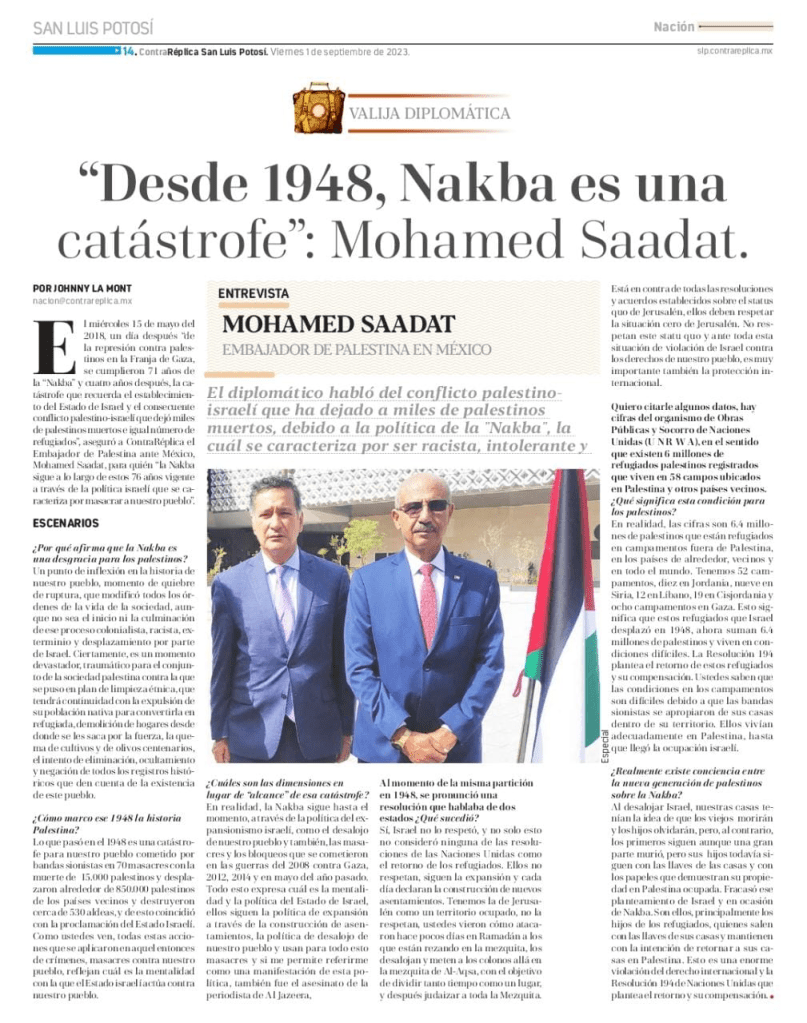




 Mexico Today USA